The Vietnamese Centre
Vietnam is a very long country and its overland transport is really slow. Our second destination after Ho Chi Minh City was the central region and the city of Da Nang. This is an 18 hour journey by bus or 19 hours by train. Neither of these were particularly attractive so we decided to take the 1 hour flight instead, which was in fact cheaper than the train!

We arrived in Da Nang on New Year’s Day to deserted streets but a warm welcome from our very quiet, almost empty hotel, which we had no problem locating due to it being 15 storeys of bright yellow. While the building was a nice sunny colour the flight northward to the central region meant a big change in the weather and a temperature drop of around 10-15 degrees.

Da Nang is famous for its Dragon bridge which breathes fire (and water) at 9pm on weekend evenings. Luckily we arrived at the weekend so after settling into the hotel and getting our bearings we headed down to the bridge to watch the display… along with hundreds of other people who seemed to appear out of nowhere.
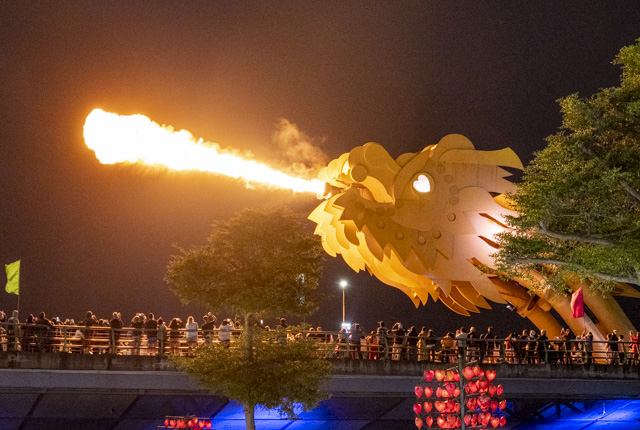
Next to the bridge is a large street food market, so with some time to spare before the show started, we wandered the stalls and tried a few of the local delights. One of our favourites was the snail stall, which had a vast array of molluscs (both marine and land) for us to try.


We walked over to the bridge with the rest of the crowd to watch the show and then back towards the market where there was a performance on a big stage with dancers and a DJ hyping up the crowd.

Although Da Nang isn’t really a big hitting tourist destination we actually really liked the feel of the city and there are a few tours that run from here but unfortunately for us, not during Tet. What it does have is a pretty lovely beach but as you can see from the picture, it wasn’t really beach weather.

After our brief stop in De Nang we headed to the stunningly beautiful and uber touristy town of Hoi An, which is about 30 minutes away by taxi.
Hoi An is an historic port town that dates back to the 2nd century when it was a busy seaport of the Champa kingdom. The town avoided damage during the Vietnam/American war and as a result there are over 800 historic buildings, meaning the town looks much as it has for hundreds of years.
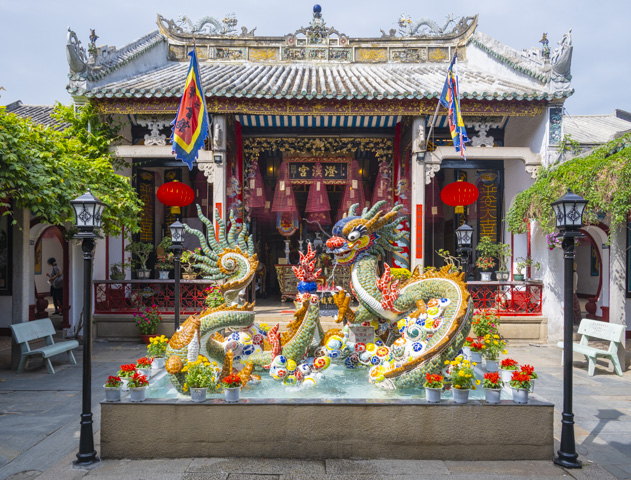
Unfortunately the Japanese covered bridge, which is one of the top attractions, is being refurbished and has been completely deconstructed but there were still plenty of temples and historic buildings to wander around and admire.

Just a few metres from our homestay was a street which became a vibrant night market with lots of vendors selling all sorts of food from frogs on sticks to Vietnamese pizza (which are nothing like pizza but are absolutely delicious).

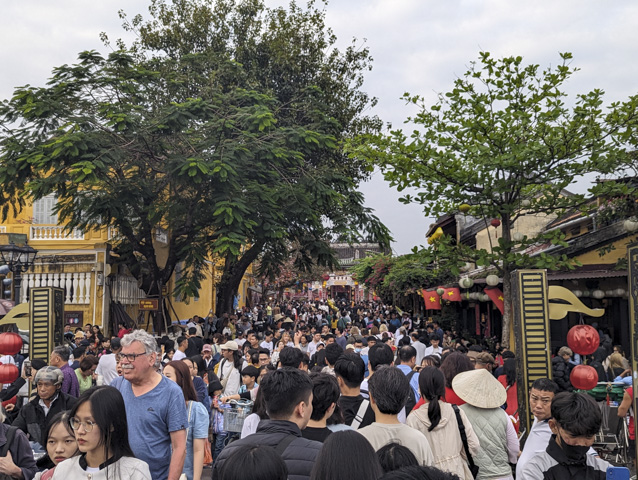
In addition to foreign tourists, the town of Hoi An is really popular with Vietnamese tourists and therefore, we assume because of the Tet National Holiday, the volume of tourists was unbelievable. Think Venice and then double or triple the numbers. Early in the morning it was really pleasant with not many people around but by about 5pm the streets were packed and it was difficult to walk around.
Many of these tourists (when not taking selfies in front of everything and anything) were taking small boats up and down the river, particularly at dusk when they would light small paper lanterns to float them down the river.

Hoi An is about 3km from An Bang beach, and when we woke up one day to a warm sunny day we decided to escape the hustle and bustle of town and head to the beach, only to find that everyone else (well, the Westerners) had the same idea! However, the crowds were clustered around a bunch of bars and restaurants with sun loungers and after a little walk along the beach the crowds fizzled out and we were treated to an empty sandy beach that stretched as far as the eye could see.

From Hoi An we also arranged a car to take us to the My Son ruins. It takes about an hour of driving through the countryside to get there from Hoi An.

My Son, meaning Beautiful Mountain, is the site of Vietnam’s biggest Cham remains. My Son was a religious centre and was occupied between the 4th and 13th centuries. Unfortunately many of the temples were destroyed by American bombing. At one stage the tops of the buildings were covered with a layer of gold but this is all gone now.

Today the Cham people remain a sizeable ethnic minority within Vietnam with around 140,000 people.
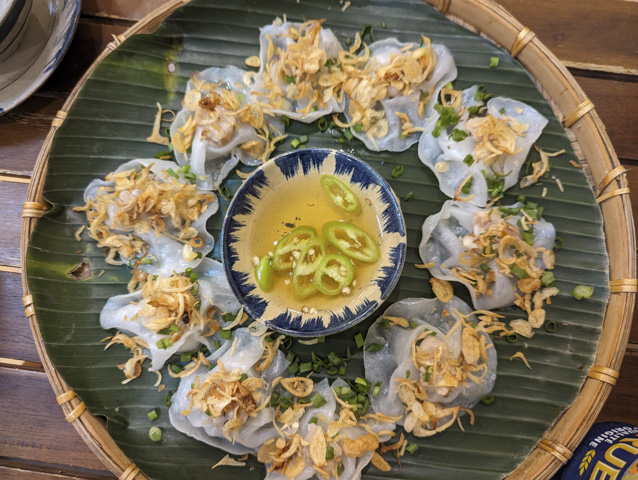
We have been really enjoying the food in Vietnam and each of the regions has its own speciality. In Hoi An there is a dish called White Rose which we absolutely loved. These are dumplings that are only made by one family who were Chinese immigrants and have been making White Rose for 130 years and only in Hoi An. They distribute the dumplings to many restaurants in town.
Our next port of call was to be Hue (pronounced H-way) which is about 120km North of Hoi An. The most interesting route is to drive over the Hai Van pass.

Through the owner of our homestay we arranged to do an easy rider trip (which means being a passenger on the back of a motorbike) across the Hai Van Pass.
We were picked up in the morning and rode back towards Da Nang. The bikes were actually really comfortable and the views were great.

Our first port of call were the marble mountains just outside Da Nang. These are a series of five marble hillocks which are topped by temples. There is an elevator to reach the top but there are still lots of steps when you reach the top to get between different areas. There are also a number of caves around the summits which have been converted into temples.
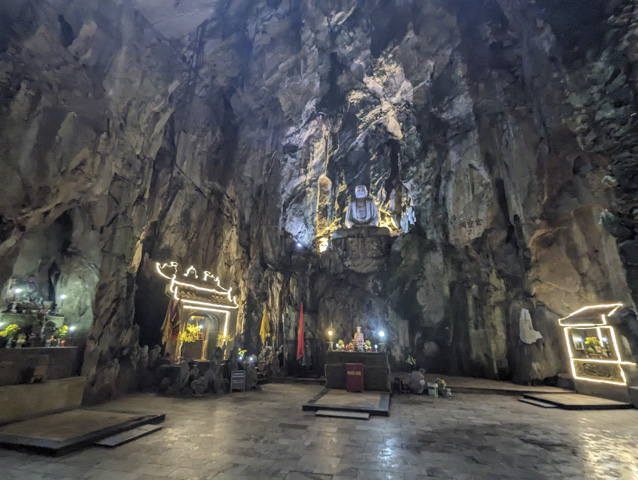
From here we looped through Danang and along the coast until we started climbing up the Hai Van pass. The pass is only 496m high but Hai Van means Sea Cloud which means that it is often buried in dense cloud. And so it proved for us. We stopped at a viewpoint but all we could see was white with the occasional glimpse of the rugged coast beyond.
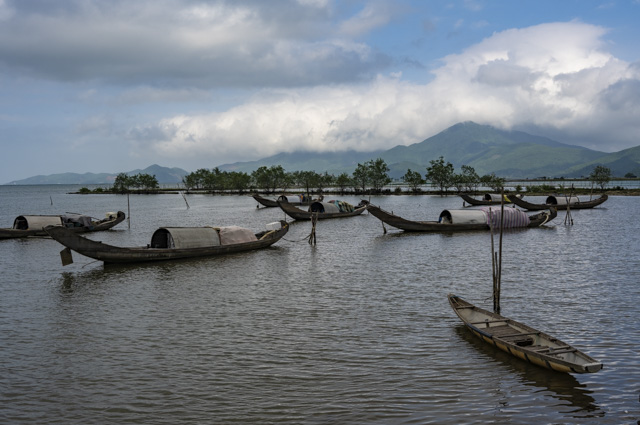
After stopping for lunch at a lovely fish restaurant on the beach we headed along the coast towards Hue. Stopping to learn about the fishermen who live in the Phu Loc Lagoon area.
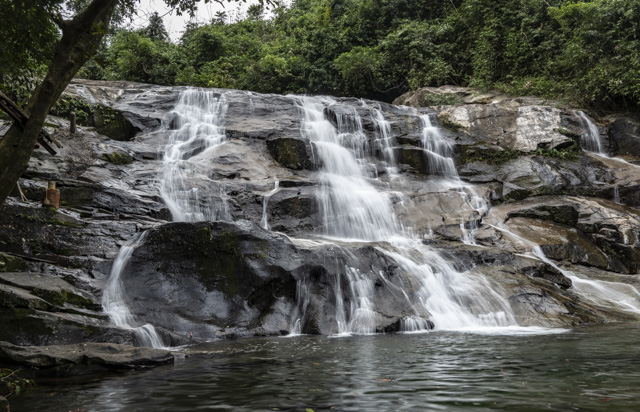
The weather this side of the pass was completely different and much better than it had been in the South so we next visited a waterfall for a refreshing swim.
We were now getting close to Hue and detoured through the rice fields on narrow dirt tracks and paths between the paddies before eventually entering the city and finding our hotel.
It had been a really good day despite the weather so we asked our guides whether we could book them the next day for a tour of the area around Hue, which they were happy to do.
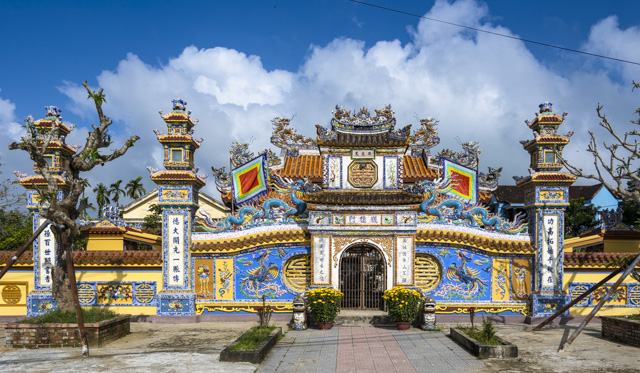
Early the next morning our guides/drivers turned up again and we were off to explore Hue, which is a much bigger city than Hoi An. Hue is sited on the Perfume river and was a centre for trading in the past with access from the sea and from inland. Traders came from all round the world to do business here. It was also the capital of Vietnam between 1802 and 1945 as the home of the Nguyen dynasty emperors.
For the morning we headed out of the city to visit a number of tombs of the emperors of Hue which are in the vicinity of the city.

Before starting with the temples we headed to the Thanh Toan Japanese footbridge (built in 1776) which is in a small village just outside Hue. There was a local market just next to the bridge and we stopped in a little unmarked restaurant for a breakfast of soy eggs in a sizzling skillet which was delicious.
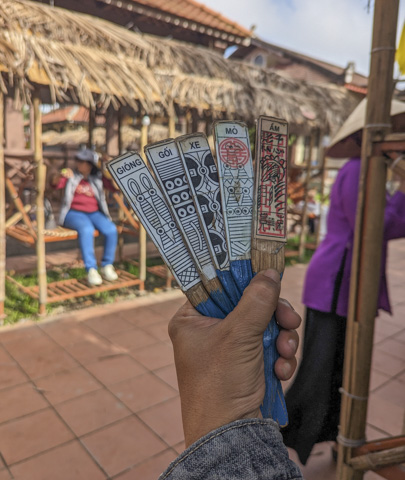
While we were looking at the bridge one of our drivers took part in a gambling game which was taking place near the bridge. It involved wooden battens with different drawings on which needed to be matched. The gamesmaster was a woman who would chant until someone claimed a match. It was all very mystifying.
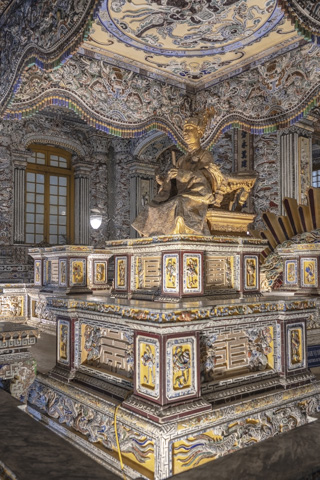
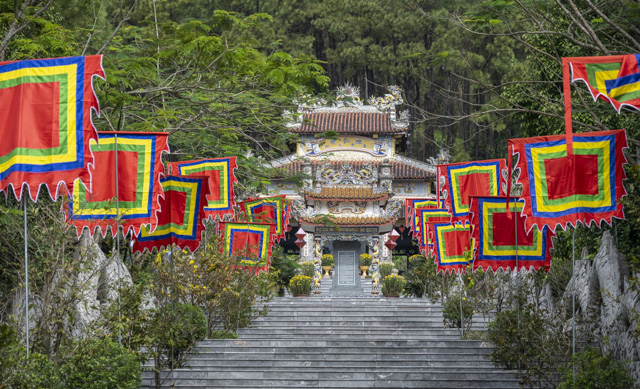
The first tomb we visited was the Tomb of Khai Dinh, built into the hillside and accessed by a grand staircase. Khai Dinh was the penultimate emperor of Vietnam and died in 1925. The interior of the tomb is decorated with a colourful ceramic mosaic.
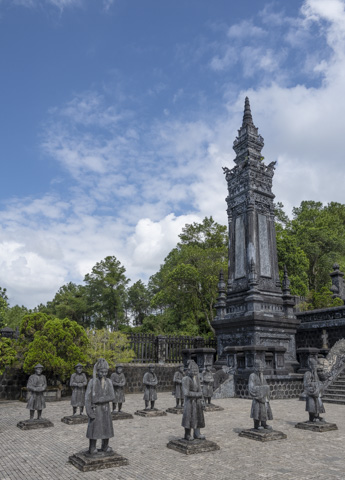
Next was the Tomb of Tu Duc which was completed in 1867. This has a lake just inside the entrance with a small island and a beautiful pagoda overlooking the lake. In the grounds of the complex are a number of tombs.

As we rode between destinations we wound our way through a valley of gravestones. This ‘cemetery’ filled an entire valley and was at least 4kms long. We have never seen anything like it before, it was absolutely filled with small tombs and gravestones and quite a sight.
The next stop was a break from the history of the area as we visited an abandoned water park. This is due for demolition soon and the slides that used to be here have already gone.

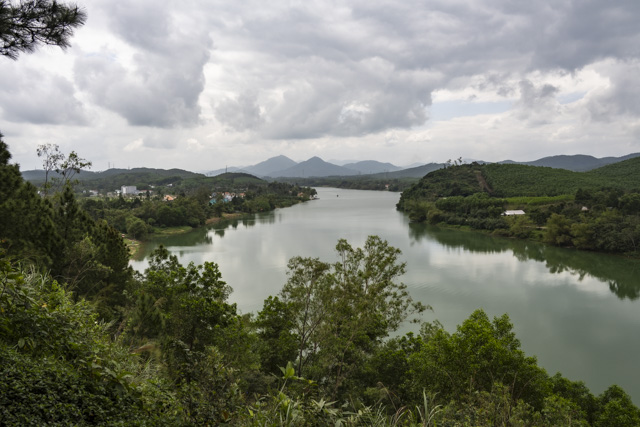
Around lunchtime we rode back towards Hue, via a viewpoint over the perfume river where old American bunkers from the war are gradually crumbling, to a local restaurant down a back street where we were treated to some fantastic local food and were the only westerners in a very busy restaurant.
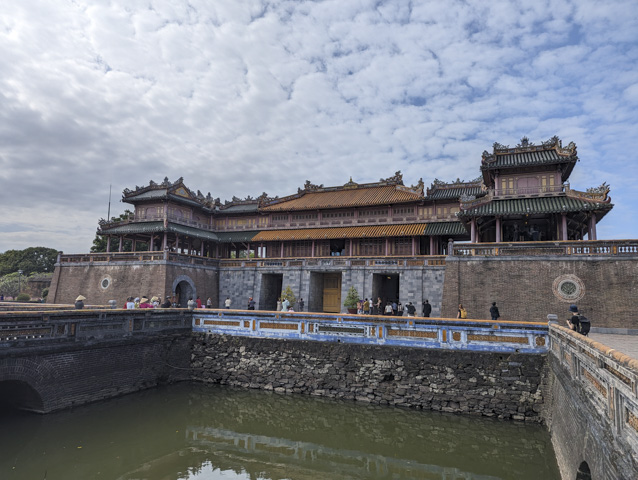
The biggest attraction in Hue is the Imperial Citadel and we had saved this for last, although it is huge. This is a city within a city and was built between 1804 and 1833. The whole citadel is surrounded by thick walls (2m thick and 10km long) and a moat (30m wide) so is well defended.
The centre of the citadel is the Purple Forbidden City which was the reserved solely for the emperor and his concubines. The only servants allowed here were eunuchs who wouldn’t be interested in the concubines !
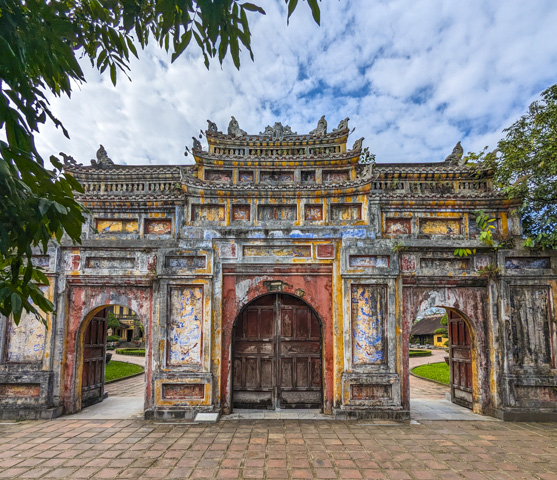
The stunning Kien Trung palace has recently been opened after being fully restored following its destruction in 1947 during the Indochina wars. This was the most recent and ornate of the palaces in the Citadel and was used by the last two emperors of the dynasty.

We managed to see the highlights of the Citadel but its sheer size defeated us and after a long day we were absolutely exhausted by the time we found our way out. We had seen temples, palaces, gardens and even a theatre in this vast site. It would definitely reward multiple visits. But this was the end of the day as we made our way back to our hotel (the themed Scarlet O’Hara hotel!).

We said goodbye to our drivers and guides from the last two days – HueToGoTours– who were absolutely excellent and we would thoroughly recommend.
 FromAtoB