Operation Overlord
After enjoying relaxing by the river for a few days in Pont d’Ouilly, we were persuaded to leave by torrential rain flooding our spot, although driving in it was about as much fun as sitting in it. Thankfully it eased towards late afternoon and having made it to the city of Caen (the capital of the Calvados region of Normandy and a sizeable town of 500,000 people), we parked next to the Caen Memorial and jumped on our bikes to explore the town.
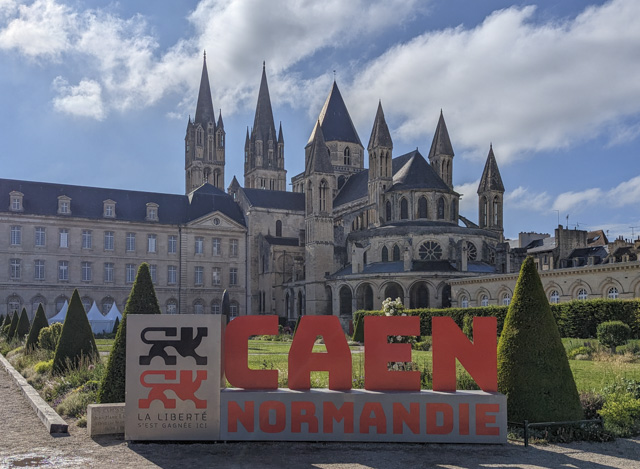
Caen suffered a lot of damage during WWII, 70% of the city was destroyed during its liberation in the Battle of Normandy but the impressive Men’s and Women’s Abbeys survived along with the impressively turreted adjoining church, Eglise St-Etienne. The Men’s Abbey is at least twice the size of the Women’s Abbey and is much grander.
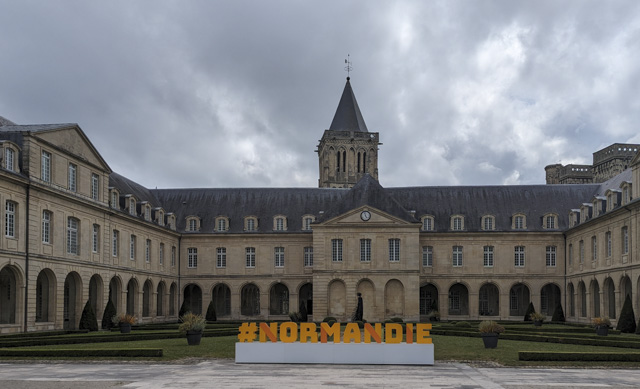
It is possible to visit both abbeys but the only areas that can be visited are the cloisters and some small exhibitions.
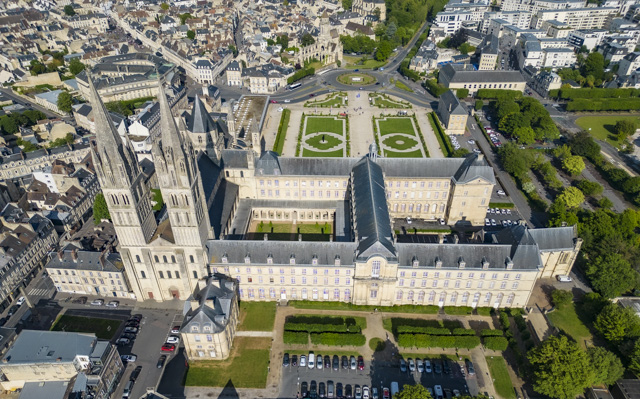
The Eglise St-Etienne is more like a cathedral it is so big and notable for containing the final resting place of William the Conqueror. However, his tomb has been sacked over the years and now all that apparently remains is one femur!
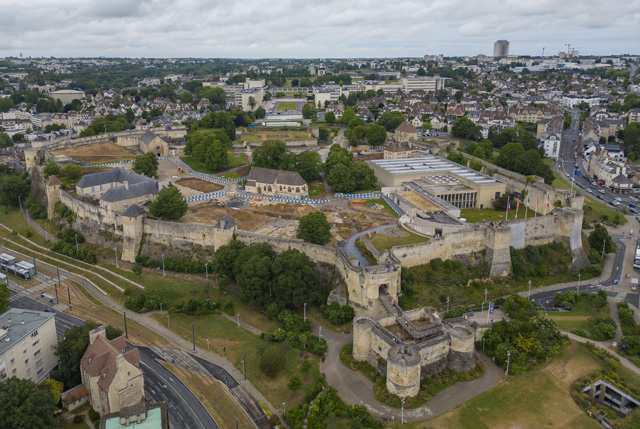
In the centre of Caen we visited the old castle, Chateau de Caen – but only the walls survive to this day.
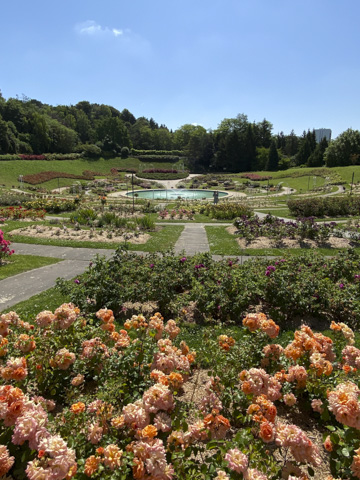
Next to the Caen Memorial is a D-Day museum but it is quite expensive so we elected to skip this one, knowing that we were due to visit more sites and museums in the coming days. Caen also has a beautiful park, the Parc du Colline aux Oiseaux which has a stunning rose garden, lakes and a panoramic view of the city.
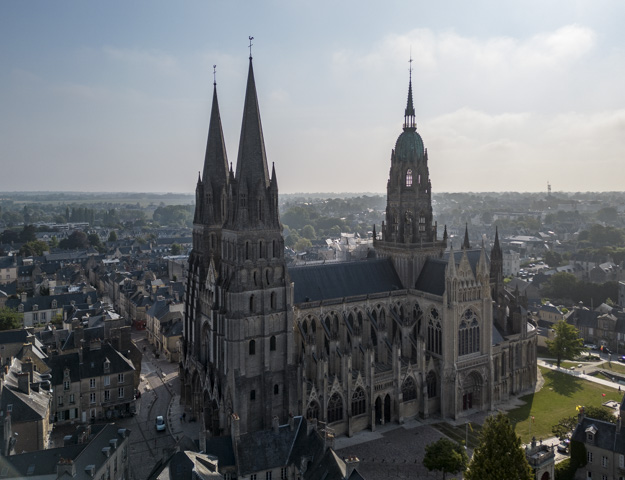
From Caen we moved onto Bayeux which is a lovely medieval town. Of course it is most famous for the tapestry which shares its name. The cathedral here is very grand and the Bishop when it was first built, Bishop Odo, was Willliam the Conqueror’s half-brother and is depicted fighting in the Bayeux tapestry.
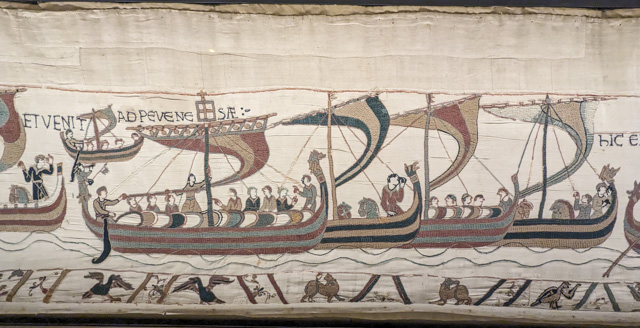
The Bayeux tapestry itself is housed in a former abbey and is displayed in a low-lit room (to best preserve the fabric). As part of the admission price you are given an excellent audio guide which walks you through each scene of the 70m long tapestry. A further two rooms upstairs house a museum and a cinema running a short film at regular intervals about the tapestry and the history at the time.
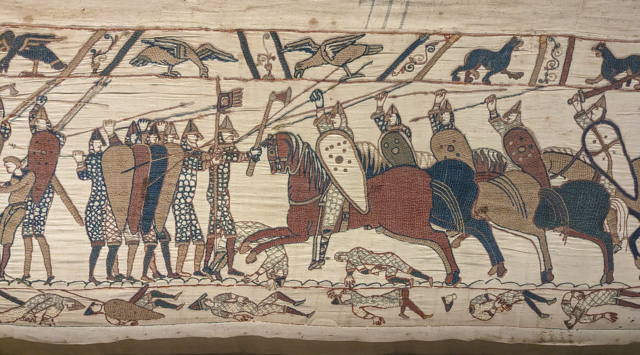
We thought the museum was absolutely excellent and really enjoyed seeing the tapestry which is in amazing condition for being nearly 1000 years old.
As an add-on to the ticket for the Bayeux tapestry an additional 2 Euros gets you admission to the Battle of Normandy Museum as well. We were parked in the Aire attached to this museum so we were well placed to check it out.
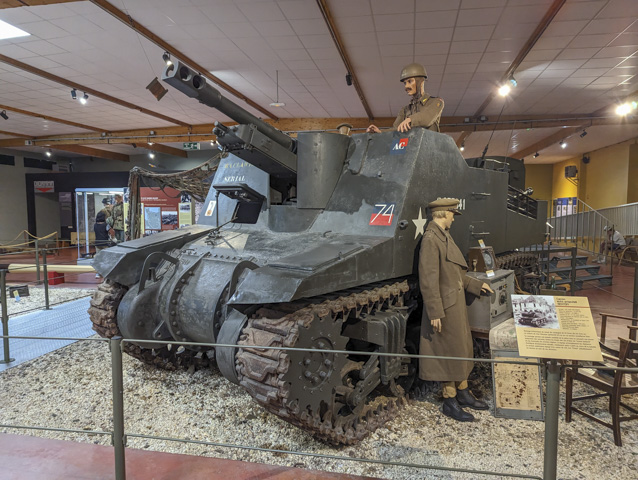
This museum uses a lot of narrative panels, alongside diaramas of soldiers and equipment, to explain D-Day (codenamed Operation Overlord) and the following 100 day war in Normandy. It was definitely worth the visit and we came away with a good overview of the events around the Allied invasion of Europe.
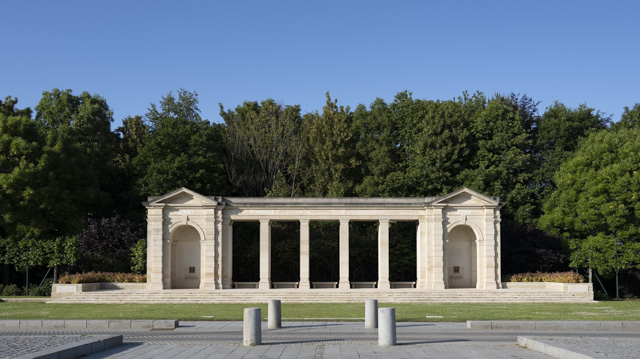
A few minutes walk from the museum is the Bayeux Commonwealth Cemetery. This is the largest of the 27 Commonwealth Cemeteries in Normandy. It contains 4,648 graves as well as a memorial to a further 1,807 soldiers with no known graves.
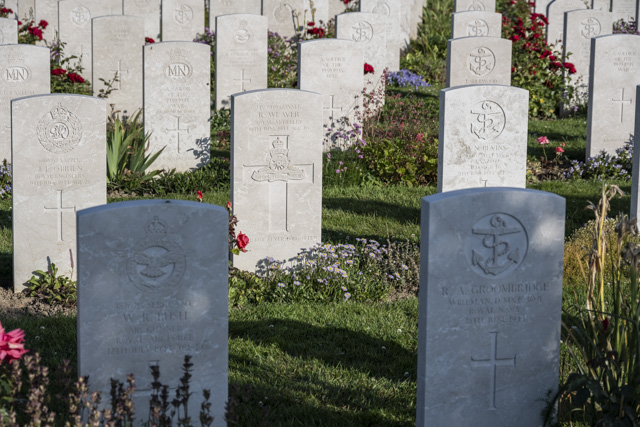
The graves were initially erected with simple crosses but in the 1950’s these were replaced with white headstones with the details of the person and a carving of their divisional emblem. They are beautifully kept with flowers planted around the graves.
It is a very moving and humbling experience walking through the cemetery and contemplating what these soldiers and sailors went through and the horrendous waste of life that war produces. The ages of the soldiers that died looked to range from 17 years to those in their sixties but the majority seemed to be very young.
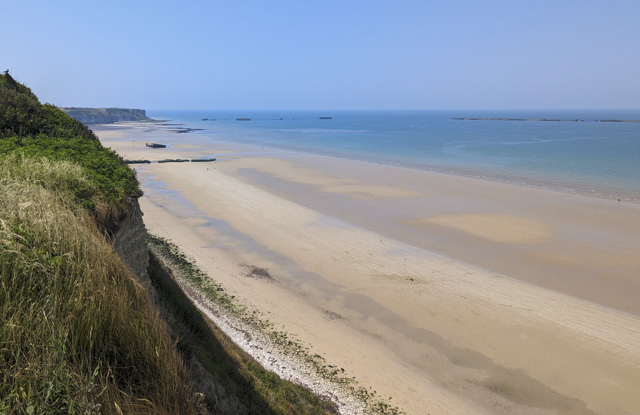
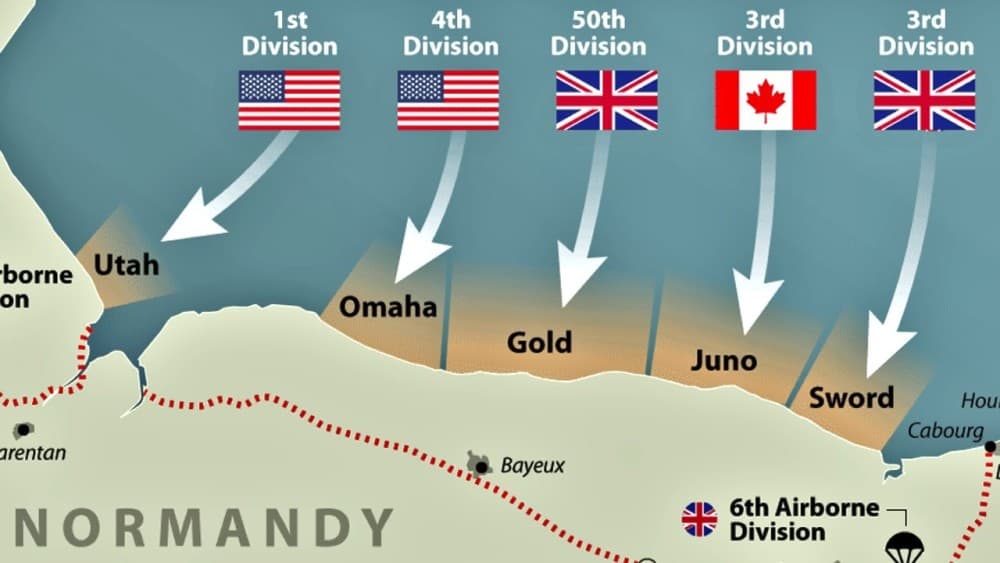
We moved from Bayeux towards the coast and the D-Day beaches. The D-Day landings were split into two halves – with the Americans in the West landing on Utah and Omaha beaches and the British and Canadians in the East on Gold, Sword and Juno beaches.
We stopped first at Gold Beach where you can see the remains of one of the massive Mulberry harbours that the British constructed after the first landings to enable them to bring in vast amounts of men and machinery.
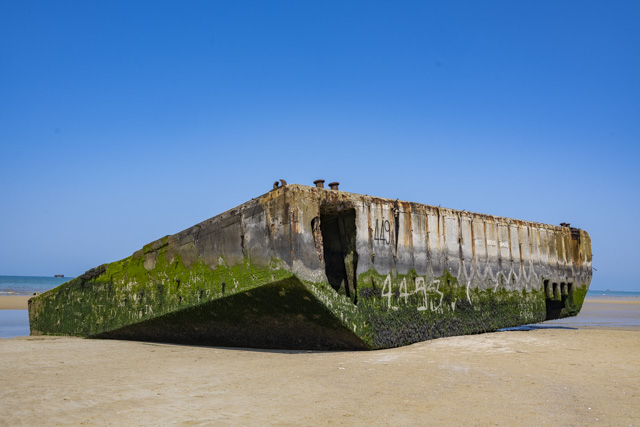
There were initially two of these harbours. The second, in the US sector, was destroyed by a big storm shortly after it was built.
We stayed the night in Arromanches, at the site of Gold Beach, parked on top of the cliffs overlooking the remains of the Mulberry harbour and in the morning moved further down the coast to Omaha Beach.
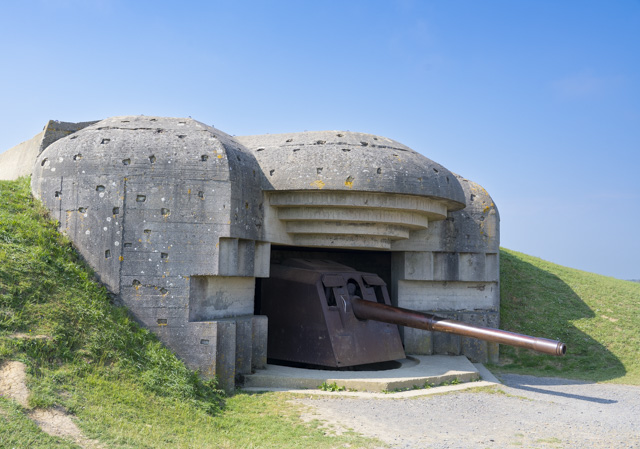
On our way to Omaha Beach we stopped off at Longues-Sur-Mer, the site of four intact German concrete gun encasements, still housing the artillery guns, which formed part of the Nazis’ Atlantic Wall.
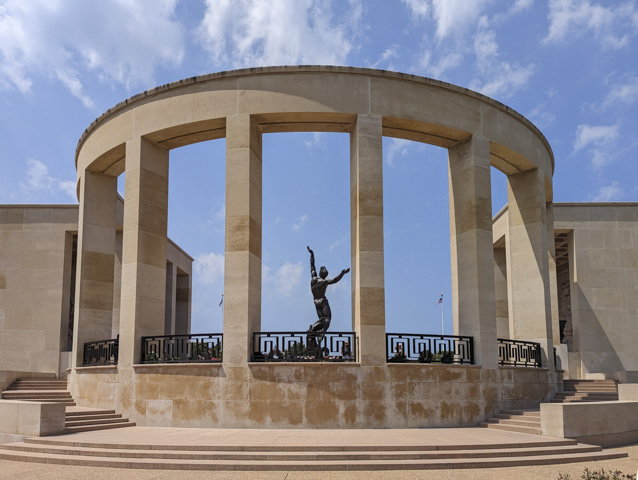
Upon reaching Omaha Beach we find the excellent Overlord Museum and the absolutely enormous American Cemetery where 9,386 headstones, overlooking Omaha Beach, mark the graves for all the US servicemen who lost their lives in the Battle for Normandy.
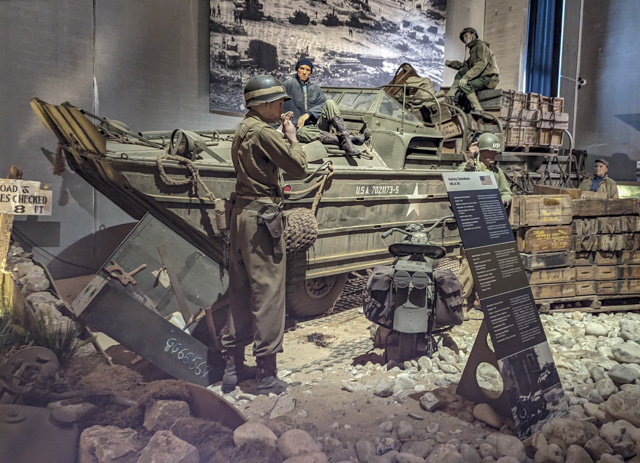
The Overlord museum is another museum dedicated to the D-Day landings which had a lot of military hardware recovered from the period, all set up in dioramas from the Battle for Normandy. However the highlight of the museum was a corridor dedicated to photos and stories of those who fought in the D-Day landings and their recollections. This really brought home the terror, brutality and chaos of the war.

The American cemetery was immaculately kept with fresh cut grass between the gravestones and an army of gardeners working away. The crosses (and stars for the Jewish) of the headstones seem to stretch forever in this massive graveyard.
Our time in this area of France has taught us a lot about the events of D-Day and the horrors associated with it. Seeing the graves of the brave servicemen who were fighting to liberate Europe is something that we feel everyone should try to do once in their lifetime as it is a stark reminder that we must do everything we can to avoid anything like this happening again.
The Big Trip To France
Having secured our six-month Visa for France, albeit a month later than we ideally wanted, we wasted no time in booking a Dover to Calais Ferry with DFDS (refusing to use P&O after their appalling firing and rehiring antics of last year).
We wanted to make the journey to France as frictionless as possible so we decided to book an early crossing (hopefully avoiding any delays) and spend the day beforehand in Canterbury which is then just a short hop to the ferry terminal. Canterbury Council have been quite savvy and have created one of the only motorhome Aires in the UK welcoming income from those travelling in motorhomes rather than spurning them. The Aire is at the Park and Ride just outside town and costs £8 per night. There are toilets and a free shuttle bus which runs regularly into the town centre.
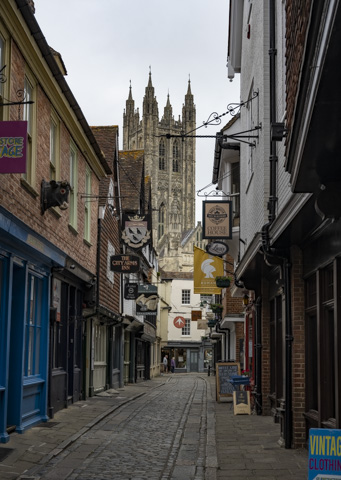
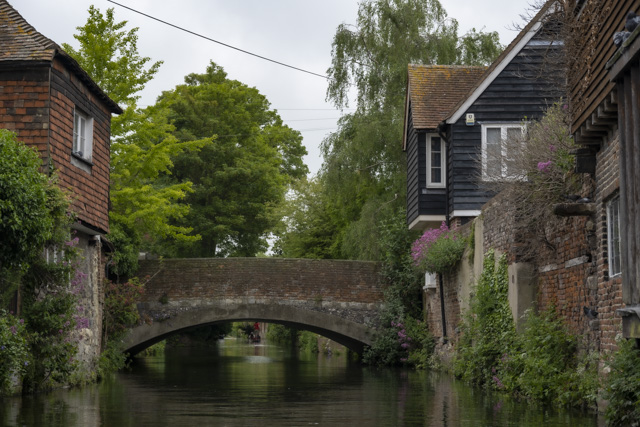
We hadn’t been to Canterbury for over 10 years and it is a beautiful town so were quite happy to spend some time there. It would have been nice to visit the Cathedral but at a cost of £15 per person and having been there before we gave that one a miss and instead spent our money on a boat trip, a Roman museum and dinner.
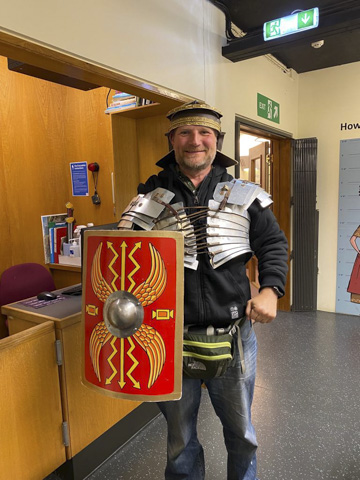
All in all we had a lovely day. The boat trip was fun and we had a good history lesson to boot, while the Roman museum was a little disappointing but then we were comparing it to the sites and museums from our recent trip to Turkey which is difficult to live up to.
The next morning we were up early for our 9am ferry (which we were told needed to be checked in for 2 hours before). The drive from Canterbury to Dover is very straightforward and the sign posting to the ferry is also very good. We flew through customs and arrived early enough to be redirected to the 7.40am ferry which was leaving in half and hour (so much for 2 hour early check-in but good for us as there was obviously much less waiting around).
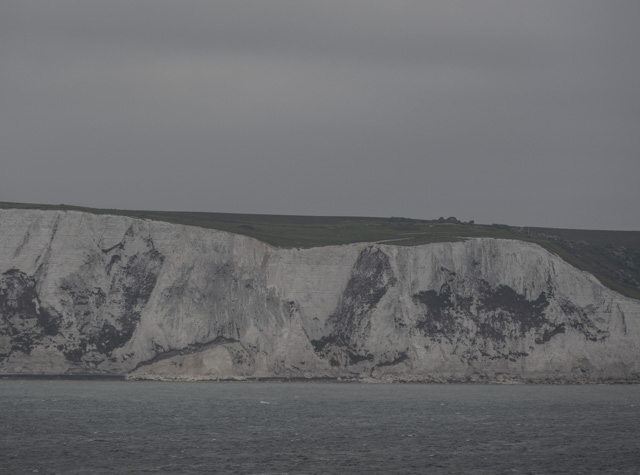
The ferry was pretty quiet and there was plenty of space to relax during the hour and a half crossing. Having always crossed using the Eurotunnel I have to say this was a much more relaxing way to travel, albeit slightly longer.
We drove off the ferry into France with the freedom to explore for the next six months!
The first thing we did was head West to find the campsite that we needed to pre-book for our visa application and to find some sunshine as Calais was as grey and dull as Dover. Fortunately about 100km West we found blue skies and our very nice campsite in Sotteville-Sur-Mer, called Les Pommiers, where we found ourselves a lovely grassy spot.
Having made pretty good time and with the sun shining, we whipped out the bikes and cycled to the beach and the village (where almost everything was shut… argh, we forgot about the French long lunches). However just a few kms further is the beautiful (and bigger) village of Veules des Roses, which, according to the campsite owner, has been awarded the title of prettiest village in France. With a title like that it is of course a little more touristy and therefore most of the shops and bars were open for business. Agreeing that this is, very possibly, the most beautiful village in France we decided to stay in the area a little longer, but for this evening we cycled back to the campsite, set out our chairs and cracked open a very nice bottle of red to accompany the Saucisson we had just bought. We also tried our hand at our own version of Petanque having no idea of the actual rules.
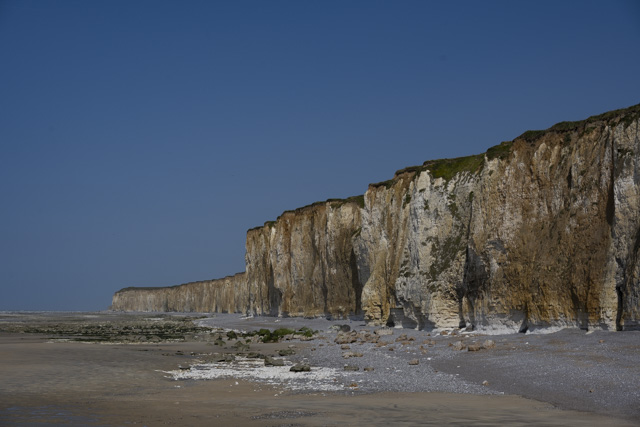
The next morning we moved to the Aire in Veules des Roses which is just above the village and, at €11 a night including the use of toilets, showers and(very nice) swimming pool of the campsite next door, we though this was a bargain compared with UK prices.
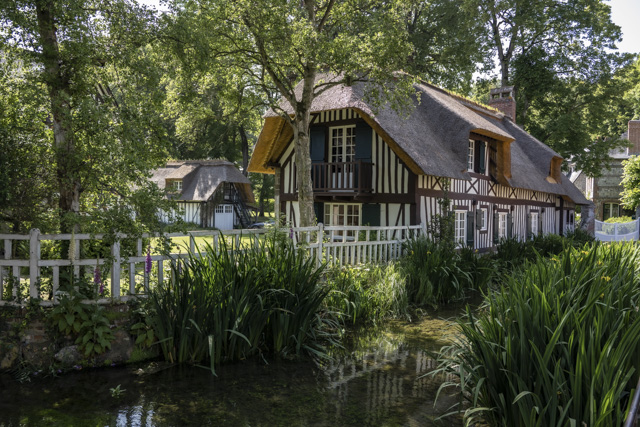
Heading off on our bikes once again we free-wheeled down the hill (not so much fun for me coming back up later on, especially after a few beers, although Sarah found it very amusing as she whizzed past me on her E-bike) before walking the length of the river (at just over 1km it is apparently the shortest river which flows to the sea in France), which starts in watercress fields and as billed ends between big chalky cliffs of the sea.
The coast of this part of Normandy is a lot like Dorset with big white cliffs cut with arches and stacks. The skies have been cloudless and blue but it has also been extremely windy.
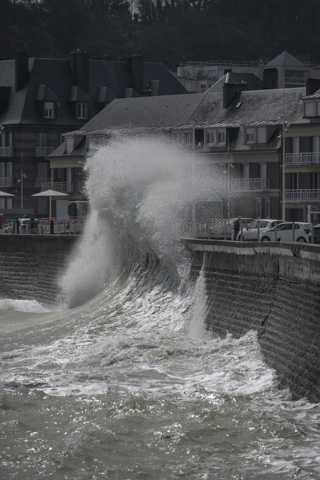
We also visited the town of Valery en Caux by bike, which was about 9km away. This is a town with a big harbour between huge white cliffs where the high winds were whipping the waves up over the seafront.
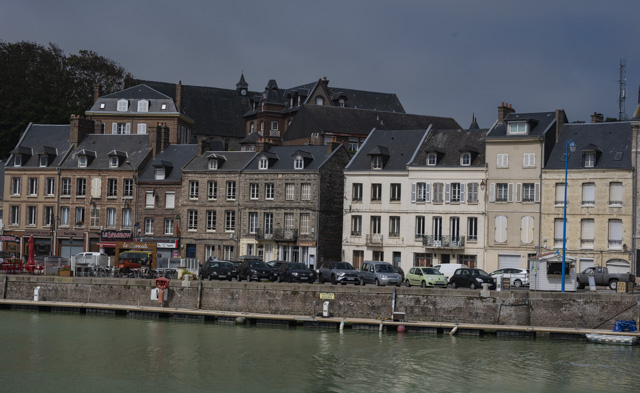
Saying a fond farewell to Veules des Roses the following day we set out for the small seaside town of Etretat about 45km further West where there is an Aire about 800m from the town centre, next door to the municipal campsite. This is a good place to stop as with its tiny streets you wouldn’t want to try and negotiate this town in a bigger vehicle.
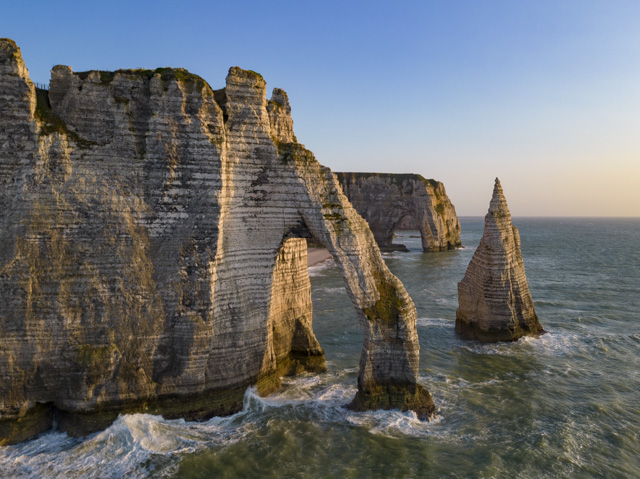
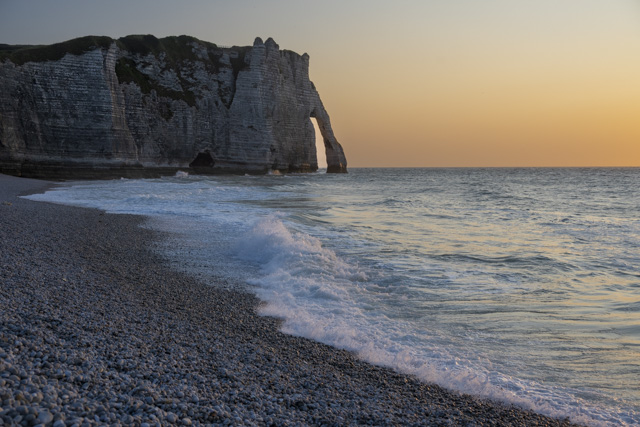
This is a real sea-side resort and hitting it at the weekend was probably a mistake as it was teeming with tourists making it very difficult to cycle around, however there are bicycle racks in the small car park on the seafront so we left our bikes there and explored on foot (even better as this provides a free hand for an ice-cream). The beach here is shingle with an arch at both ends in the white cliffs. The Aire we stayed in was completely full over night with over 30 motorhomes which is making us wonder what July and August will bring!
It seems like bringing bikes was a great idea and means we can nip around towns from where we park very easy without having to move the Beastlet, although it is a touch annoying when Sarah cruises past me on her new folding e-bike, the Pedibal Navigata Cite, which I have to say is very good.
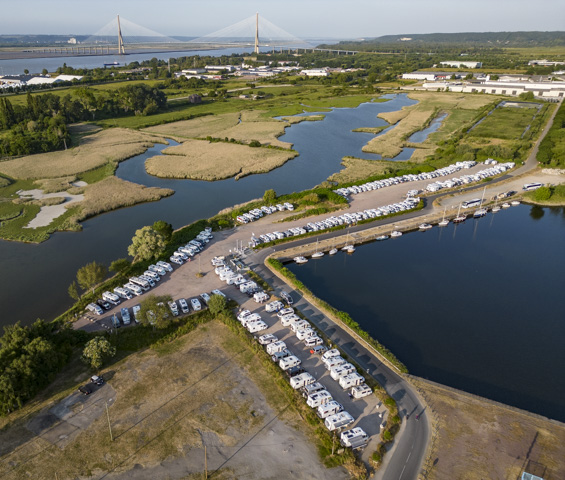
Another 40k along the coast (we really aren’t moving far each day, there is just too much to see) and over the impressive Pont de Normandie bridge is the port town of Honfleur.
This has one of the biggest Aires in France with space for over 150 motorhomes. Despite its size it retains its own charm as it overlooks the waterfront, so if you manage to get a waterfront spot (as we did) its not a bad place to park up for the night. It is only €12 a night with electricity and water and is located about 500m from the town.
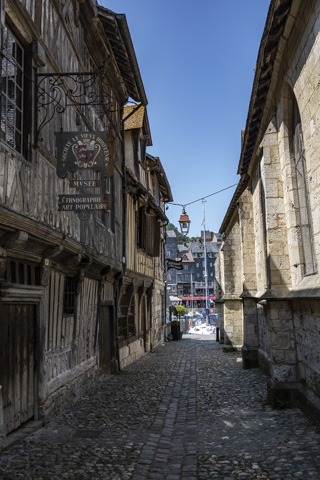
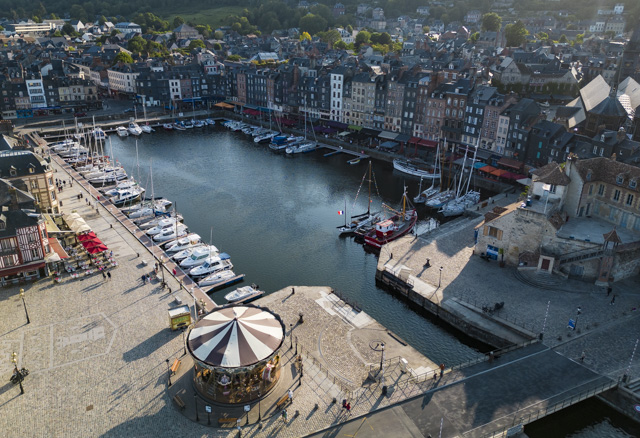
Honfleur is a beautiful medieval town of timber-framed buildings built around the harbour. Its back streets are full of original buildings and narrow cobbled streets. It would be easy to lose yourself for hours wandering the streets and would make a fantastic weekend trip away by ferry to Dieppe, to indulge in its many culinary delights with restaurants and confectionary shops on every corner.
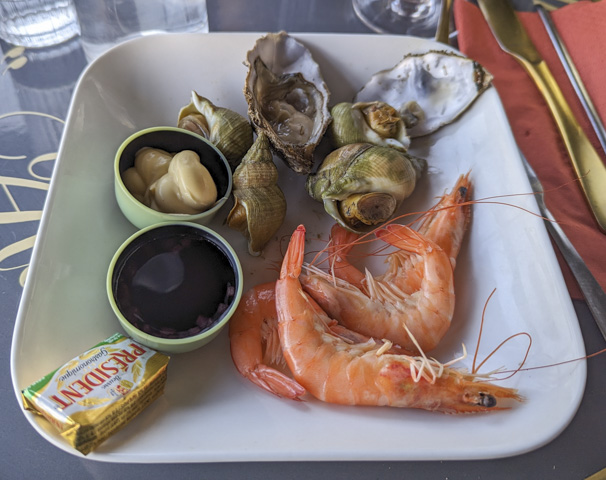
Not wanting to miss out on the culinary delights ourselves, we of course enjoyed an evening meal of freshly caught seafood at a small harbour-side bistro while watching the world go by.
On our wanderings around Honfleur we stumbled across Naturospace which is a hothouse filled with butterflies. We decided to pop in and it was lovely with tropical birds and lots of butterflies in a steamy tropical garden.

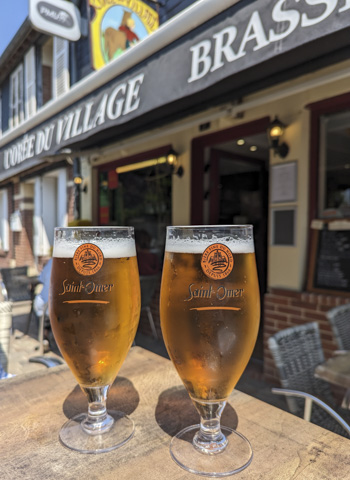
After Etratat and Honfleur we wanted to get off the beaten track a little and away from the crowds so we headed a few km’s inland to the picturesque village of Beuvron de Auge (which could also be the prettiest village in France!). The Aire in this little village has two separate parts, a larger gravel section and a smaller leafy section with parking on grass. Naturally we chose the latter and walked all of 200 metres into the village for a little exploration and few drinks at the local bar in the evening sunshine.
Our first week in France has flown by but we have managed to end the week at our best Aire yet, right on the river front (River Orne), in the little town of Pont d’Ouilly and, at only €9.25 a night with electricity, it is an absolute bargain.
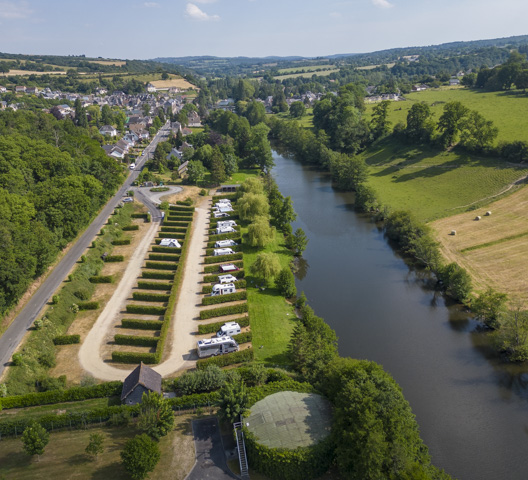
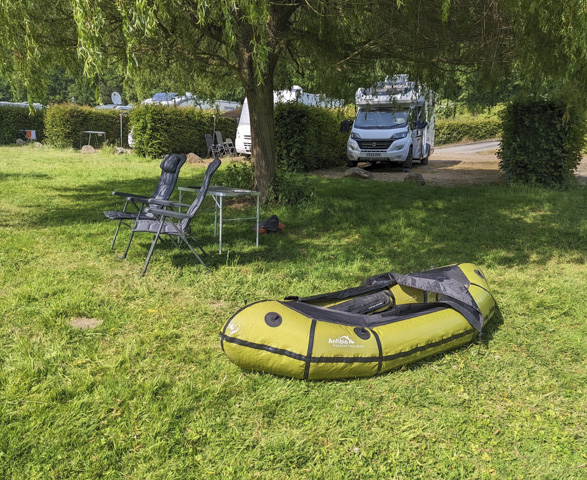
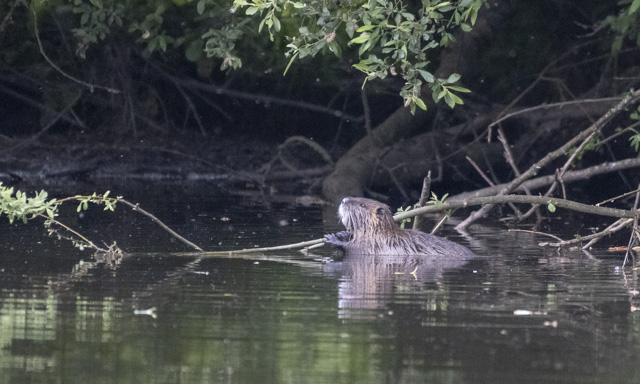
This has been a great place to get away from the hustle and bustle and sit out some really hot weather as the temperature rises, with some swimming and kayaking. The River is teaming with life and we have seen plenty of fish, kingfishers and Coypu (a rodent like a smaller version of a Capybara).
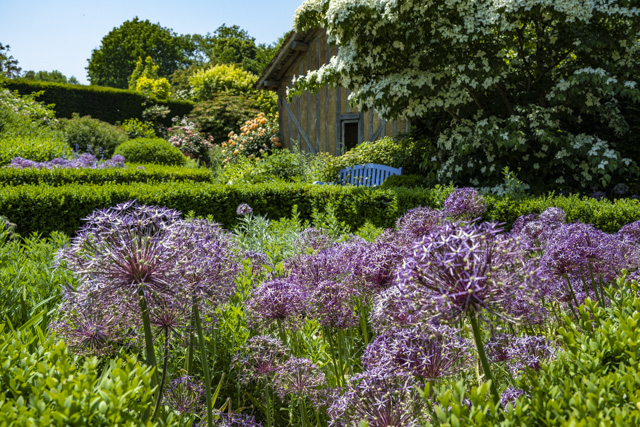
On our way to Pont d’Ouilly we made a couple of stops, firstly at the gorgeous Le Jardins du Pays d’Auge where you can wander around a selection of small gardens each with its own theme. I particularly liked the devil’s garden with its collection of toxic plants and the water gardens with loudly mating bullfrogs but there was much more to explore as well as a Creperie for a break from the heat.
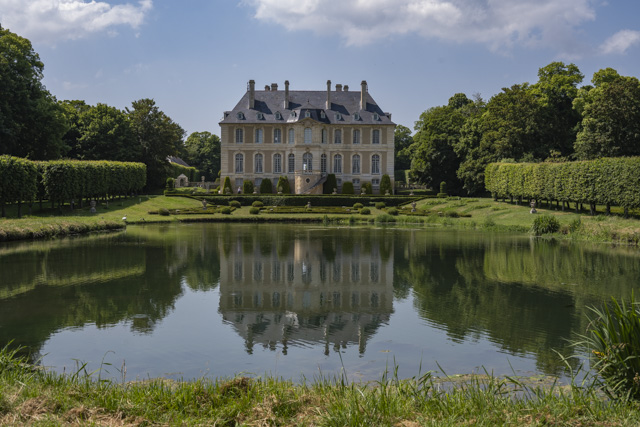
We also visited the restored Chateau de Vendeuvre, which is a stunning country house set in some well-maintained gardens.
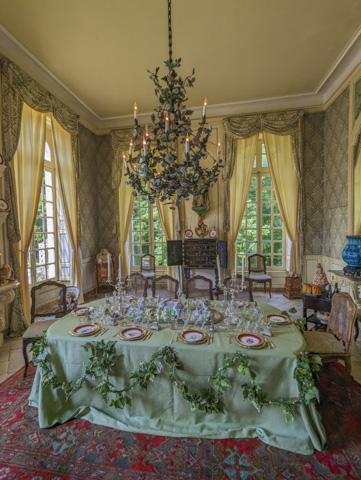
On one side is the garden of surprises where a number of water features are triggered by sensors and the other side is the seashell grotto with a series of small follies.
Motorhome Modifications
When we travelled through the Americas we hadn’t really spent any time in The Beast before shipping it to Canada and then living in it for 2 years. This gave us no time to make any changes to the set up before heading off.
We didn’t want to make the same mistake this time, so before heading to France for 6 months we spent some time in the UK making a few modifications.
The two main things we want when we travel are:
Autonomy: The ability to park up on a remote beach for extended periods without having to worry about any of the consumables e.g. running out of gas/ electricity.
Security: Motorhomes are often targeted by thieves so we wanted to try and make it as secure as possible for our own piece of mind (which also helps to reduce the insurance premiums). Ultimately if a thief really wants to get into your vehicle they will, all we can do is to try and make it a little more difficult for them.
With these things in mind we set out to make some changes.
Autonomy
Power
The Beast was very constrained by its amount of battery power and we could really only last 2 days without running the engine to charge the batteries even with good solar input.
When we bought the Beastlet she had 1 lead acid leisure battery of 100 amps and a solar panel of 150 Watts but with a very basic charger module. There was a charger from the alternator that would work while driving but not very effectively.
We wanted to completely upgrade this system so we went to a company in Somerset called Van Bitz who have a great reputation and had the following installed:
- 2 x 110 Amp Lithium Batteries
- Victron MPPT 75/15 Solar Regulator
- Sterling 70 Amp Battery to Battery Charger
- Victron Smartshunt Battery monitor
- Victron Phoenix Smart 30 A Mains Battery Charger
- Battery Master Charger for Vehicle Battery
This is quite a lot but is a complete game changer on the power front. We should have significant power reserves to last us for a week without any charging. On days with sun, the solar panel can increase our time without charging indefinitely.
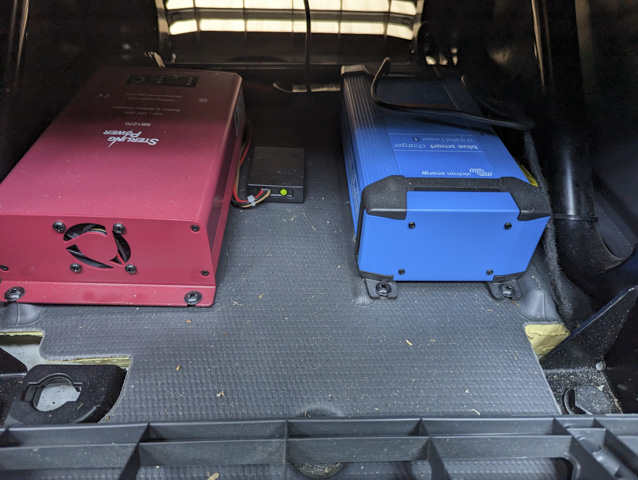
The Battery Master is a useful addition as it ensures that the vehicle battery stays charged by trickle charging from the leisure batteries, so we should never be unable to start because of a flat battery.
All of this equipment can be monitored by a Bluetooth connection and app on your mobile phone.
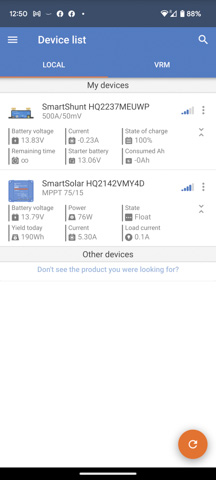
The dual lithium batteries have about 4 times the usable power as the original lead acid battery as they can be used down to 10% of their capacity without causing any damage unlike the lead acid which is 50%.
The original alternator charger was not specifically designed for a smart alternator found in modern vehicles so only charges at a very slow rate. To get around this the better way of charging is to use a battery to battery charger that takes a feed from the vehicle battery which in turn will be charged by the alternator. This means that the charging when the engine is running will be very rapid.
Our experience of this system so far has been that it is working so well we really don’t need to worry about our power requirements. An immediate benefit of this is that if we stay at a campsite we no longer need an electric hook-up which can save quite a bit of money but also increases our flexibility enormously.
Toilet Time
One of the most limiting things in a motorhome is the size of the toilet cassette. To combat this we have purchased a second cassette, which is stored in the garage, to double our capacity. (For those not familiar with motorhomes the cassette sits under the toilet and collects the output. The cassette can then be removed from the motorhome and carried to a “Dump” station and poured away. Not a super pleasant task and it somehow always seems to fall to the man in every motorhoming couple)
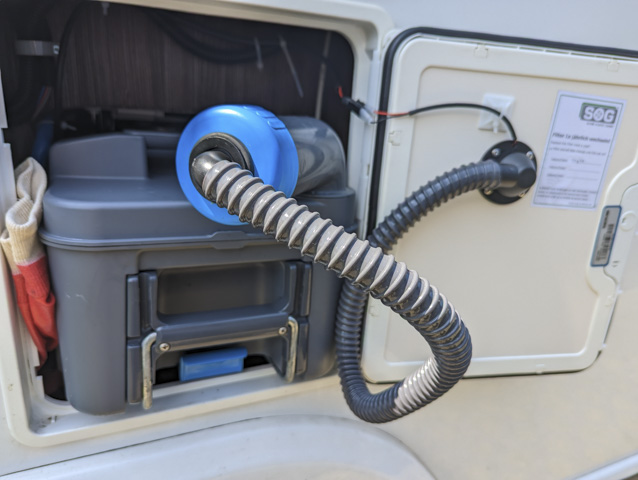
Motorhome toilets usually rely on adding chemicals to the cassette to minimise any odours, however this makes the end product more toxic and is an ongoing cost. The chemicals also prevent you being able to dump the toilet in septic tanks and domestic drains. The solution to this is to install a SOG. This is a small fan that attaches by hose to the toilet cassette and vents the air via a carbon filter to the outside. It is very effective at minimising any untoward smells inside the camper. After studying a few YouTube clips I managed to install this myself (although my heart was in my mouth drilling a hole through the outside of the camper!)
Gas Low
Out of the factory the standard gas system is based on calor gas exchangeable tanks. These are not only expensive but cannot be obtained outside the UK.
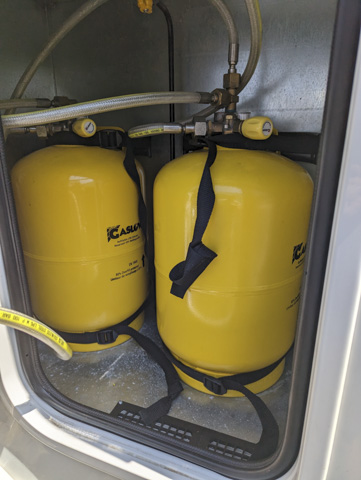
Fortunately, the Motorhome that we bought had already been modified by its previous owners to include Gaslow cylinders. These are removable tanks that can be filled through an outside filler port. Gas refills are available at petrol stations throughout Europe.
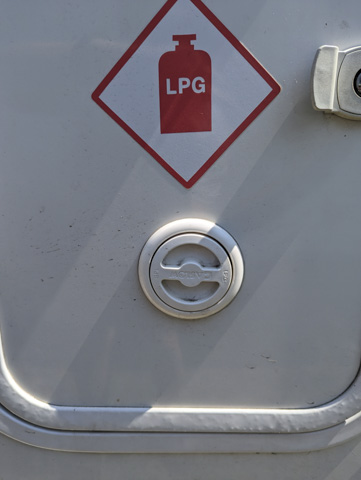
The gas runs the heating, cooking and the fridge when not on an external electric hook-up.
What I have done is add Bluetooth tank sensors which enables us to remotely monitor how full the tanks are.

Security
When you are travelling, there are two ways of securing a motorhome from anyone up to no good. You can add additional locks and you can add electronic security. We decided to do both.
Vanbitz (www.vanbitz.com/) (who were fantastic and we highly recommend), sell and install probably the most well regarded security package available for motorhomes. We had them install their Growler alarm and immobiliser to ensure that if anyone breaks in it’s a really noisy affair and if they do they can’t steal the vehicle itself. The alarm has blue LEDs on each side of the van and signs for the doors and windows to alert the potential miscreant that there is an alarm in operation. Deterrence being the best protection.
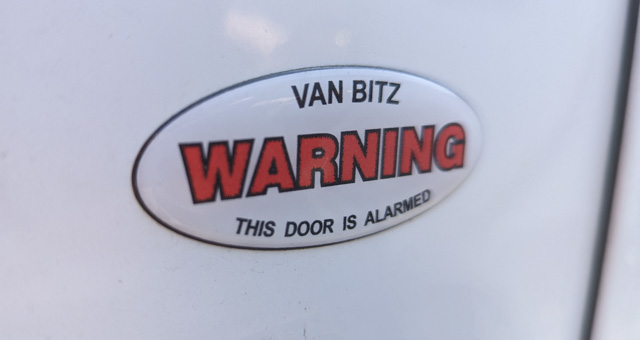
Vanbitz also put us up in their campsite for a couple of nights as part of the works. We would highly recommend getting any work done by them as they were very knowledgeable with a high level of quality.
In addition we have added after market locks on all of the doors and windows to make it just that little bit more difficult to get in with the hope that any thief looks elsewhere.
Internet
Not an essential but pretty important to us is access to the internet.
The last thing that we had done was to have an aerial and mobile router for Internet access installed. The aerial sits on the roof just behind the TV aerial and is higher gain than a mobile phone aerial , but more importantly sits outside the box of the motorhome. The mobile router then gives us a WIFI signal that we can use in the camper.
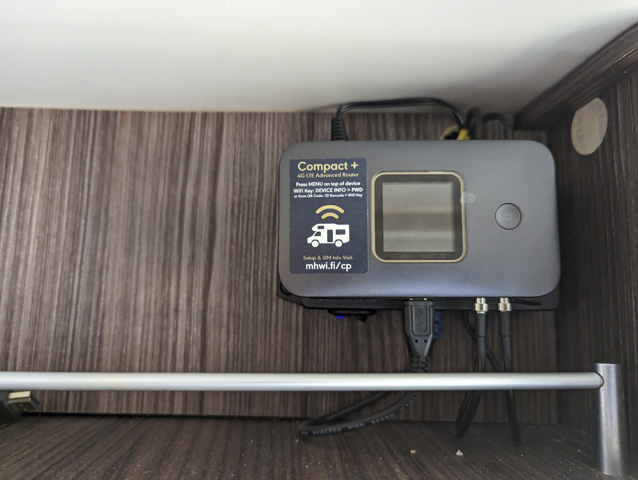
We decided to install a 4G router as 5G is really only available in cities and we don’t intend to be in those much. The price of 5G routers is currently very high but I am sure will come down in time and we can replace it in the future as the aerial is future proofed.
We have paired this with a 200GB Global data plan from RWG Mobile (rwgmobile.wales) which unsurprisingly from the name gives us 200GB of data anywhere in Europe. This is based on the EE network in the UK but roams to the best network in the area you are in when overseas.
Visa For France: Two Fingers to Brexit
Ever since the UK’s withdrawal agreement from the EU came into force at the start of 2021 the rights of UK citizens to travel freely throughout Europe were ended. This meant that instead of being able to tour indefinitely in Europe UK citizens are restricted to the standard Schengen terms of 90 days in any rolling 180 day period.
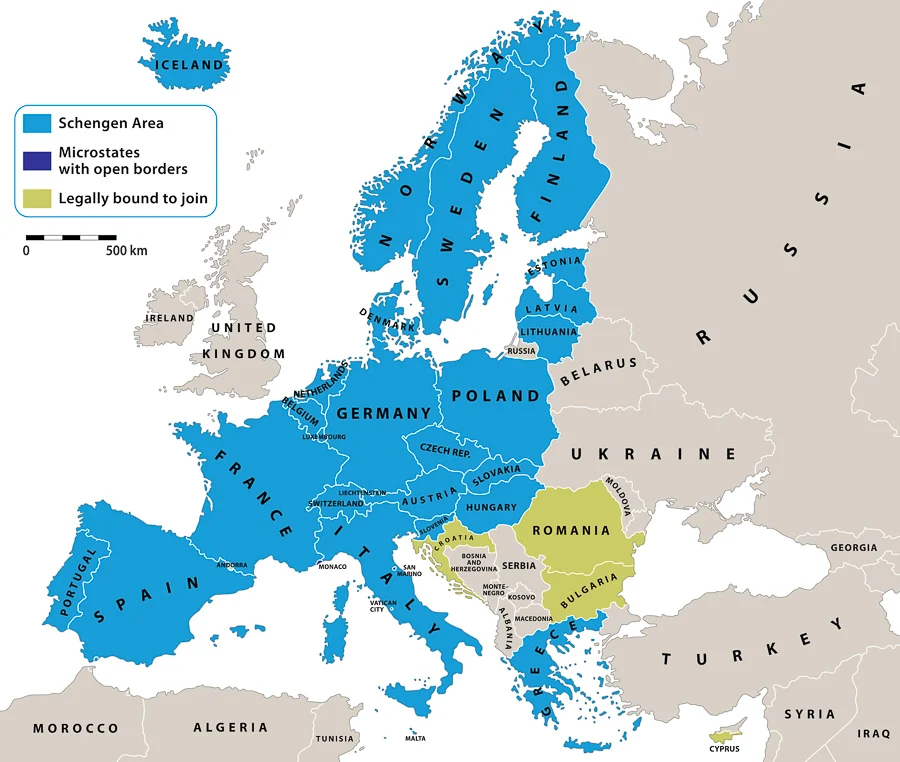
So unless you are married to an EU citizen or can get an European passport the 90 days of Schengen will limit your ability to travel through Europe.
There is one route to spend longer in Europe however as the French offer a specific Long Stay visa for Tourists which allows for access to France outside of the Schengen rules. This is the VLS-T visa (Visa de Long Sejour Temporaire).
This visa allows up to 6 months stay in France.
There is also the VLS-TS visa (Visa de Long Séjour-Titre de Séjour) which allows a stay of up to 12 months. This requires health insurance to be purchased and any stay in France in a calendar year of over 6 months also requires the declaration of worldwide income and potentially paying French tax.

We decided to apply for the VLS-T visa to allow us to travel into France for 6 months. This is a multi-entry visa and health insurance can be evidenced by use of a GHIC card which Is available free from the UK authorities.
The process for applying for the Visa is complex and the online guidance can be confusing so I will run through the process that we followed. However there is a very good resource available at:
https://sites.google.com/view/180-days-in-france
The first step of the process is to go the French government website:
You must register here and each person in your party has to fill out a visa form and get a reference number. But do not submit this form yet.
You have to go the website of a service company in the UK called TLS-Contact:
https://fr.tlscontact.com/gb/splash.php
On this website a form needs to be filled out for each applicant and then an appointment for a face-to-face meeting booked. There only needs to be one appointment made per group as you can do it together.
Only when an appointment has been made with TLS can you go back to the French visa site and submit the application.
During the online application process you also need to make payment for the Visa fee which is £31.
TLS have three UK centres – one in Wandsworth in London, one in Manchester and one in Edinburgh. You have to attend one of these centres. The Wandsworth centre was known to us and actually was walking distance from where we used to live so we chose this one.
The first booking we were able to get was 3 weeks in the future and this took a couple of days to get because the website was suffering reliability problems.
Once the forms are submitted and the appointment is booked you need to spend some time getting a number of documents ready to hand over at the meeting. You will need each document per person and you will also need 2 copies of each one.
Documents for TLS
- Promise Not To Work
A short letter confirming that you do not intend to work. Signed and dated
- Project Plan
A short letter describing the reason for wanting the Visa. This had two sections. The first we titled Purpose and simply stated that we intended to tour France for Touristic purposes. The second section, The Plan, we stated that we intended to tour in our motorhome and gave a very brief overview of start date and return date, and rough plan eg. Start in Normandy, travel through the centre to Alps, on to the south and then back up West coast. This was signed and dated.
We did not list any place we would stay other than the first night campsite booking and to state that we would stay in aires and campsites throughout the country.
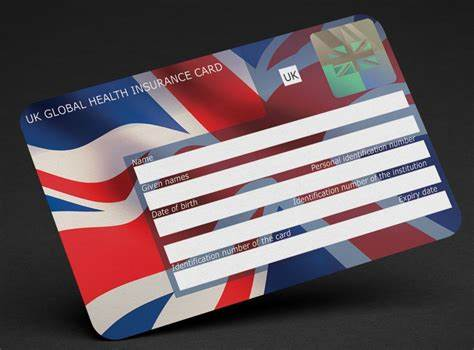
- GHIC
A photocopy of your GHIC card or other alternative health insurance. An old EHIC Card can still be used but do check that it doesn’t expire. These can no longer be applied for.
- Proof of Income
Documentary proof of income or resources to support yourself during the period of the visa.
The requirement for income or resources is £2,000/month for a couple of £1,200 for a single person.
3 months bank statements must be shown.
So we decided to each show a bank account with the required minimum amount (our joint account) and also to document income to exceed the £2,000 per month. This was done with a letter listing the income items and referencing these to the bank statement. We did this to make it very easy for anyone reviewing to see the income receipts in the bank statement and be able to easily go from the summary to the primary documents. We did not show any additional financial details beyond those we thought were necessary to obtain the visa.
- Passport Photos
Two passport photos for each person. We used a photo booth which is in Wandsworth Southside shopping centre (there are two which are just passed the entrance to Waitrose). The format to select is the standard UK passport format. We had no problems with these being accepted although be careful to ensure that your hair does not cover your eyebrows as they were insistent that this was important. There is also a photo machine within the TLS centre but this might have a long queue or be broken when you visit. Leave the photos uncut as the TLS staff have a nifty cutter of precisely the right size for their needs.
- Address in France
The process is designed for people who will be staying at a single place in France for the duration of the visa. As we were intending to tour around by motorhome and had no real set itinerary we booked a campsite for out first night and used this address. This was perfectly acceptable and caused no problems. No other addresses were provided beyond this first night.
The other side of our address though was our motorhome which we had referenced in our Project Plan. We provided the invoice of purchase of the motorhome (our V5 has not arrived yet) and our insurance schedule showing insurance for Europe.
The TLS Visit
We arrived at TLS 5 minutes before are appointment time. We were met at the door by a security guard who asked to see 1 copy of an appointment confirmation. He checked this and let us in through a metal detector.
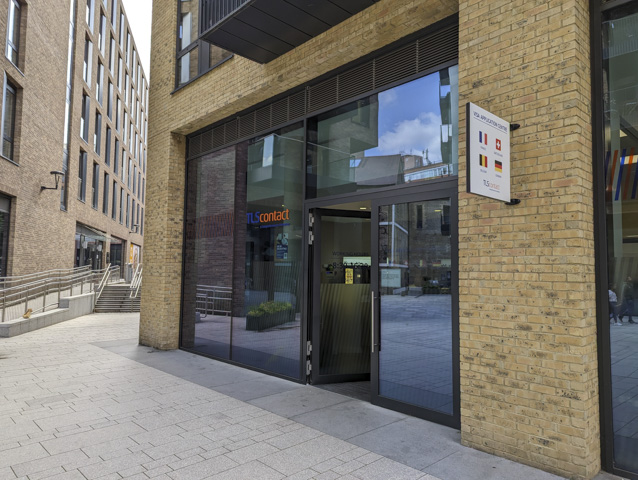
We then had to queue at a reception desk and show our passports and the copy of our TLS form (printed from the website). The person at the desk put these in a plastic folder and told us to move to the next room.
The next room is a waiting room with rows of seats in front of monitor screens which have a list of reference numbers being currently called and the desk to go to. Once your number appears you go to the appropriate desk number.
We waited just over 30 minutes for our number to come up and made our way to the desk where we were greeted by a very friendly and helpful lady.
This lady had to go through each of our documents and place it into each of our plastic folders. Where something on the form needed changing she was happy to make the changes in the system and also photocopied our marriage certificate which she didn’t think our copy of was good enough. We were standing at this desk for almost half an hour to go through all the documents and get them situated in the right order in our folders. This person also takes payment of the processing fee for the Visa which is £87 per person. This is based on a Euro amount so can fluctuate a bit.
Once this was complete we were handed our folders which has been sealed and told to move to the next room.
The next room is another waiting room for the biometrics. We were directed to sit down near the front and after only waiting a couple of minutes were called up to join another queue outside one of the biometrics rooms.
On being called in (individually) you hand over your folder and sit down to have a photo taken and then your finger prints. This only takes a couple of minutes. Your folder is then retained and you are done.
In total it took us 2 hours from arriving at TLS to departing.
When you leave you have handed over your passport and are told that they will let you know when your passport is back. We had our TLS meeting on a Friday and were emailed that our passport was back on the following Wednesday. They don’t tell you whether you have been successful or not at this stage.
TLS can courier your passport back to you for an additional charge but we elected to collect our passports from TLS in Wandsworth.
To collect you need to take photo ID (we used our driving licences) and to have a photocopy of this. We arrived at the collection point – the building opposite where you went for your TLS meeting – showed the security guard our photo id (and copy) and went to the desk at the front where we were given back our passports.
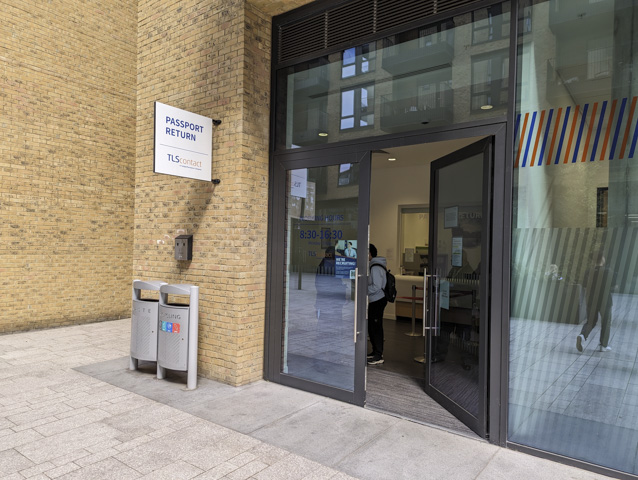
We’d got our visas starting on our requested start date and finishing 6 months later. Hurrah !
Getting to Wandsworth TLS
By Car: The best place to park is in the Waitrose/Southside car park which is off Garret Lane. This is pay parking and you pay when you leave. It is a five minute walk to the TLS centre.
By Public Transport: If you travel by train to Clapham junction then get a bus from the other side of the road from the station to Wandsworth (10 minutes) – use 37,337, 170,156. Both the 170 and 156 drop you directly opposite the Ram Brewery development where TLS is situated.
Alternatively on the tube both East Putney and Southfields are about a 20 minute walk away or Wandsworth town train station (10 minute walk).
Gadding About
After moving into our new motorhome we’ve been spending our time between campsites close to London to see family and friends, doing adaptations to the camper, a bunch of boring chores and heading off for mini-breaks further away to figure out what works for us and what needs changing before heading further afield.
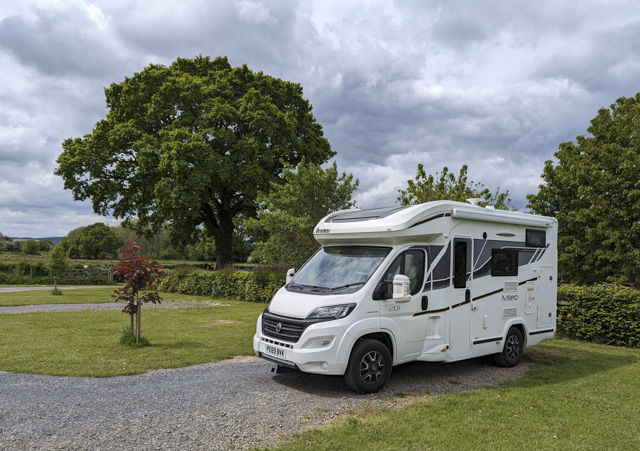
The UK is not the easiest country to travel around in motorhomes. With its parking restrictions and height barriers, it makes it difficult to park to visit local attractions or stay anywhere other than dedicated campsites – although some savvy pub landlords are starting to see the value in opening up their carparks to campers, the quid pro quo being that you buy a drink or meal whilst there.
As a result, we have been staying in campsites in the UK which can be quite expensive, although the price varies significantly depending on location and the facilities available – which range from massive sites with marked up pitches and all the mod cons to very undeveloped sites which are basically just a field.
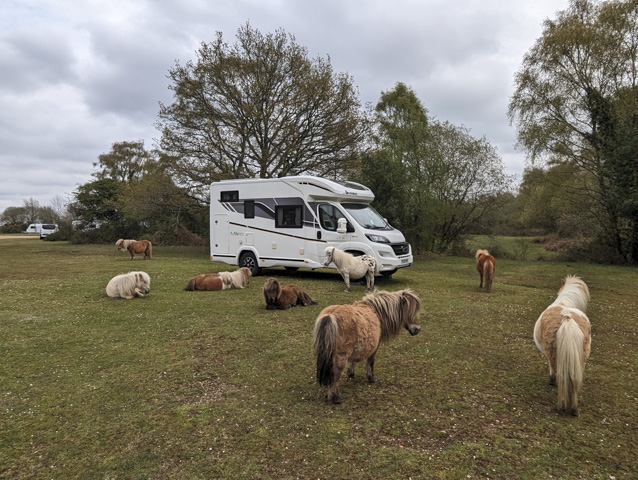
We have spent some time in the New Forest and have really enjoyed a basic campsite run by Forestry England called Ocknell. There are no specific pitches and you can setup wherever you like as long as you are 6m from other campers. We found a large clearing which was fairly flat. The great thing about this campsite is the sheer volume of wildlife that comes through.
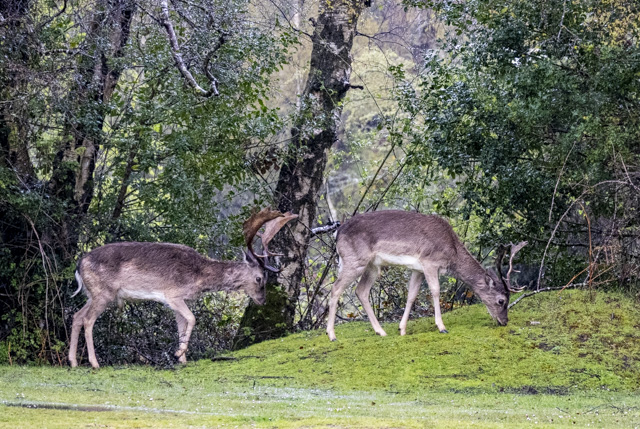
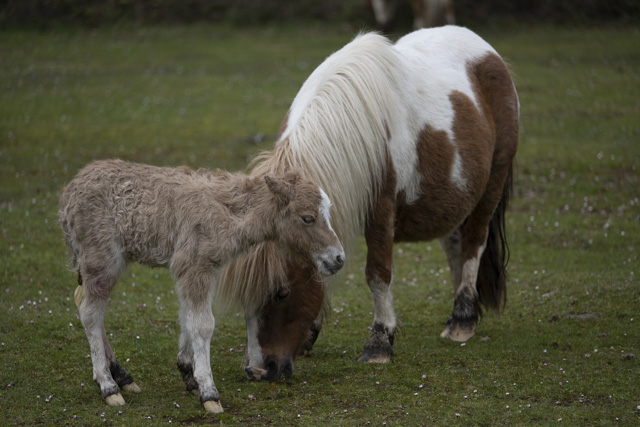
We had deer, Shetland ponies, new forest ponies and donkeys eating the grass around our camper. At one stage we were surrounded by tiny ponies including a mother with a new born foal which we think we saw suckle for the first time – it took a while before it worked out how to do it, but it was great to see it grow in strength and become more steady on its feet as the day went on.
We also saw New Forest pigs foraging by the roads and plenty of free roaming cows.

Believe it or not we also saw the Northern lights while we were in the New Forest – albeit only as a purple glow in the sky.
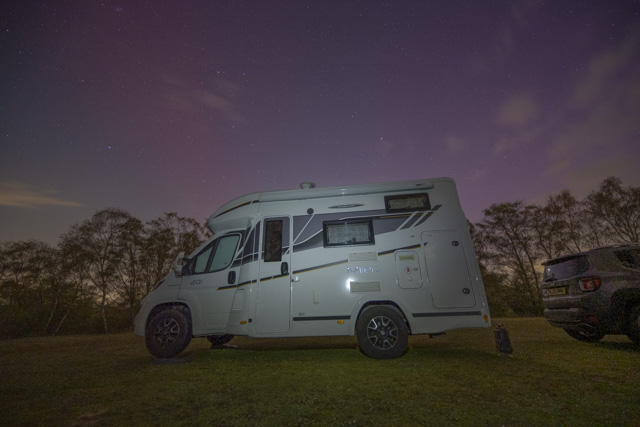
We have also had a couple of trips to Wales and the West of England, staying near Monmouth, Hereford and the Forest of Dean.
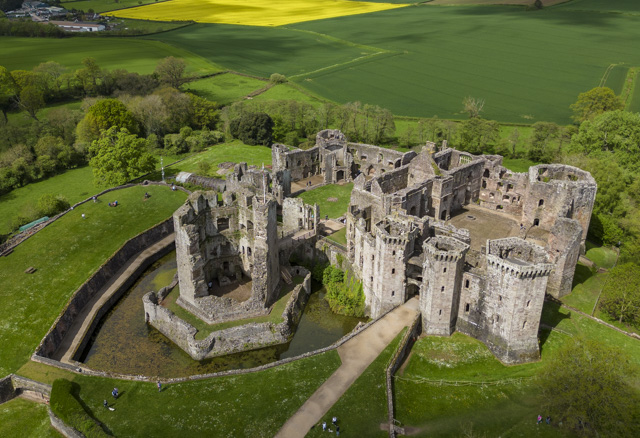
Whilst in Monmouth we did a tour of nearby castles including Raglan Castle, White Castle, Grosmont Castle and Monmouth Castle. Raglan castle is definitely the pick of the bunch and is quite impressive while Monmouth castle only has a couple of walls still standing.
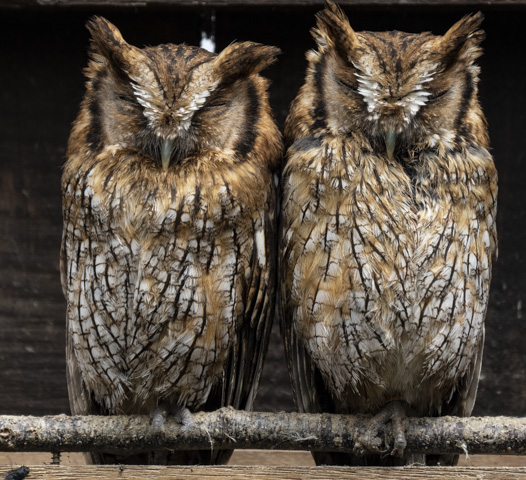
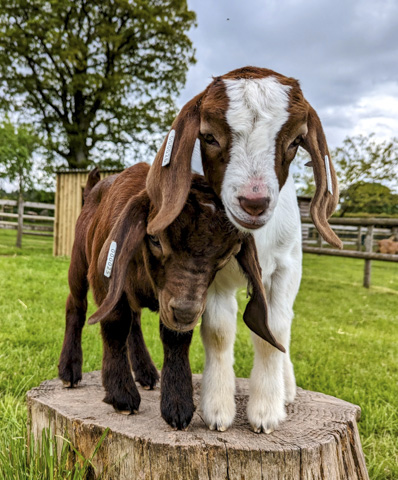
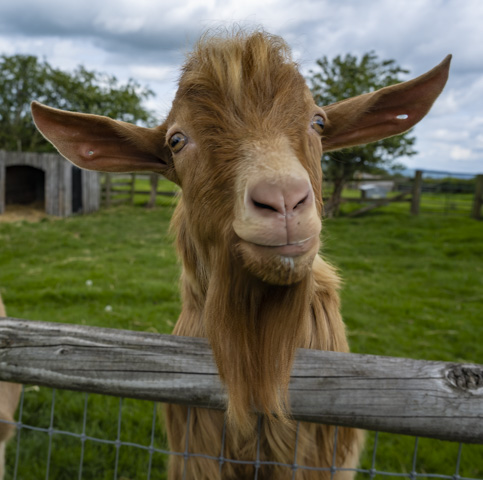
When staying at a farm near Hereford we enjoyed the first proper sunshine of the year and visited an owl centre with over 30 different species of owl and also a small breeds farm attached where you can feed the sheep and goats – which were really cute.
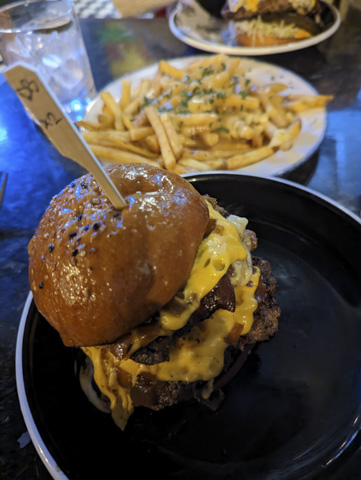
In Hereford we also visited Beefy Boys – one of the best burger restaurants we’ve visited. Every time we go to the Hereford area it’s a must stop off for us. Their burgers are amazing.
Forestry England have campsites all over. Having loved the one in the New Forest we decided to visit another in the Forest of Dean, called Bracelands. This is in a big clearing in the woods but is more expensive than the New Forest (to be fair it has full facilities) but the grass, no electric pitches are not very flat. We would visit again (during the week as the weekends were very busy) but would stump up the cash to stay on a hard standing pitch as these were in the prime positions with great views.
After our trips around the south and south west, we have got used to living in the Beastlet and prepared as best we can for our trip to Europe. Having applied for and now received our 6 month visa for France, we are leaving shortly and hope we haven’t forgotten anything that we’ll need!
The Beastlet: Benimar Mileo 201
When we came back from our trip to the Americas we both agreed that we would definitely tour in a camper again. Its taken 10 years but when we were back in the UK in December we went to see a few motorhomes and found one that suited our needs. Having put down a deposit, Marquis (the dealers) agreed to hold onto it until the start of April when we would be back from skiing.
So at the start of April we moved into our new home – all 6 metres of her.

We had a good idea of what we wanted in our new camper from our time living in the Beast and from the camper we hired in Andalucia a few years ago:
- Max 6m length: short enough to manoeuvre through medieval towns without getting into too much trouble at tight corners.
- Fixed Bed: Making up a bed every day begins to really grate after a few nights and, when travelling for long periods invariably one of you will be ill at some point.
- Two Lounging Areas: When you are together 24/7, it helps to be able to get a bit of distance from each other (even if it is only 2 metres), especially on those rainy days
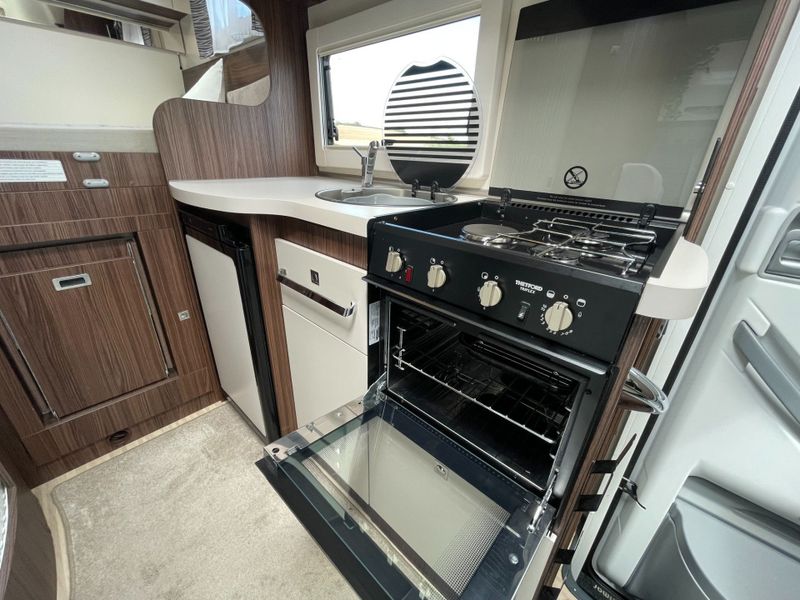
- Decent Kitchen: we like to cook so some kitchen workspace is an absolute must
- Bathroom: with a shower and most importantly a toilet.
- Garage: Storage space for all the toys!
- Payload: Enough payload to ensure we can carry all the stuff we need
- Under 3.5 tonnes: Faster speed limits, cheaper tolls and less restrictions on roads.
When we started looking at campers we initially thought that we would be getting a new one but after making a few enquiries we realised that the supply chain for vans has been so disrupted by Brexit, Covid and the war in Ukraine, that we were unlikely to be able to take delivery before 2024. This meant that we had to look at the used market.
The impact of Covid on the used market has been significant. The supply of used vans in the UK has reduced as lots of people were forced to holiday at home. Reduced supply has increased prices and this coupled with inflation has meant that used vans are selling for more than new ones from only a couple of years ago.
We were therefore a little bit concerned that we would struggle to find what we wanted but after some online searches we picked out a number of dealers to view a few potentials.
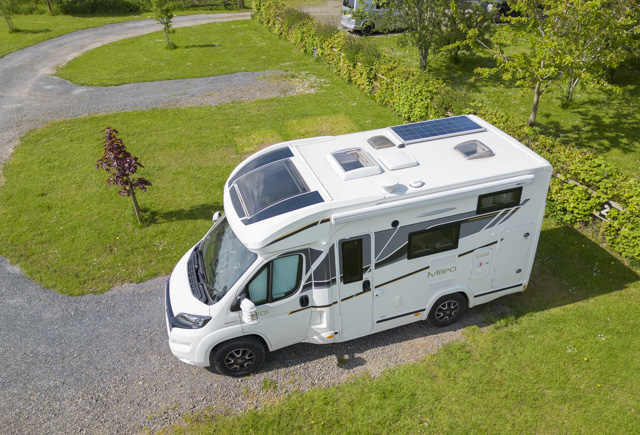
The model we went with is a 2019 Benimar Mileo 201. This is a Spanish built motorhome. Benimar are part of the Trigano group which is one of the biggest motorhome manufacturing companies in the world, including brands such as Auto-Trail, Adria and Chausson.

It is based on a Fiat Ducato van and has a fixed rear transverse bed over a large garage (back locker). At 3 years old it has done just over 10,000 miles so was only lightly used and the interior was in great condition, the previous owners looked after it well.

We are delighted with our purchase and have been getting used to living in her while making some modifications to enhance our ability to travel off-grid (which I will post about at a later date) before heading off to Europe.
Skiing Wrap Up: All good things must come to an end
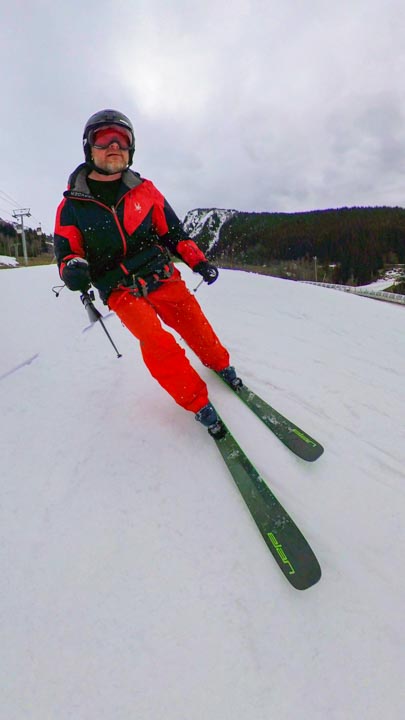
As the proverb goes, all good things must come to an end and our time in the Alps has drawn to a close. After being starved of snow throughout February, March has brought better conditions with some good dumps of snow but rising temperatures mean that many of the low lying areas have melted back quickly. We’ve been seeing temperatures as high as 20C in the valley and 13/14c on the slopes. There have been some overcast days in March but the majority have been beautiful blue skies. Alpe d’Huez boasts 300 days of sunshine per year and this has certainly been borne out while we have been here.
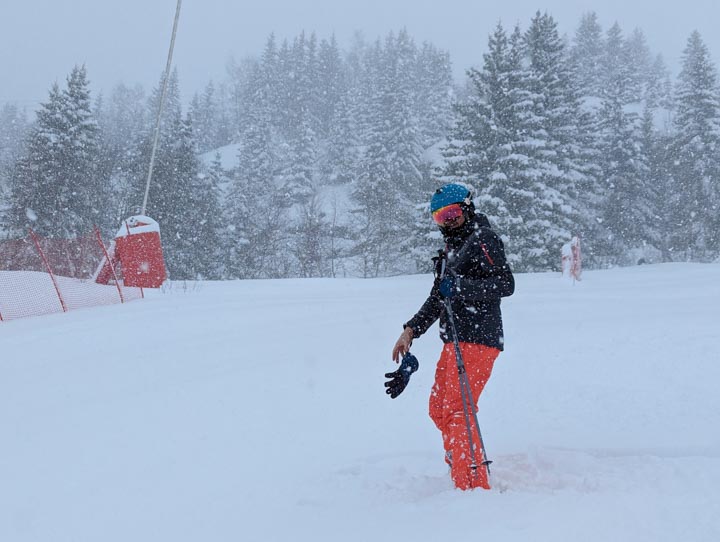
The slopes at the top of the mountain remain in fantastic shape with the runs down from Pic Blanc covered in powder and in great condition. The low lying resort of Auris de Oisans though is really struggling and the slopes down to Maronne have been closed for some time.
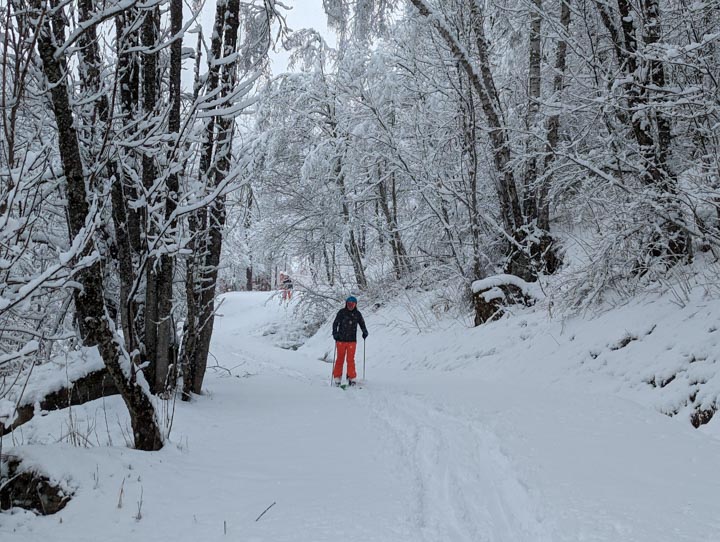
There are slopes in the resort that have not been open throughout both February and March because there just hasn’t been enough snow to keep them open. Although after the large dumps in March some of them have been skiable for a few days even though not officially open.
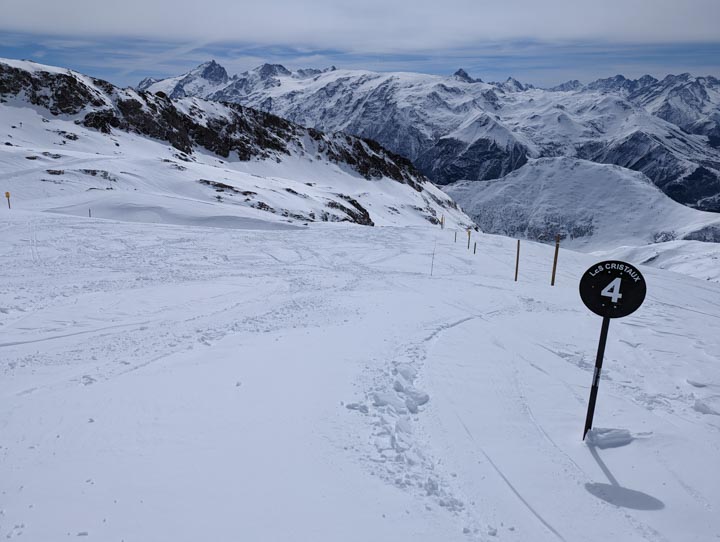
In 2 months of skiing I have skied 965 km’s with a vertical drop of 190 km’s. I’ve skied just about every run in the resort (there are some green runs I haven’t tried) and taken every lift.
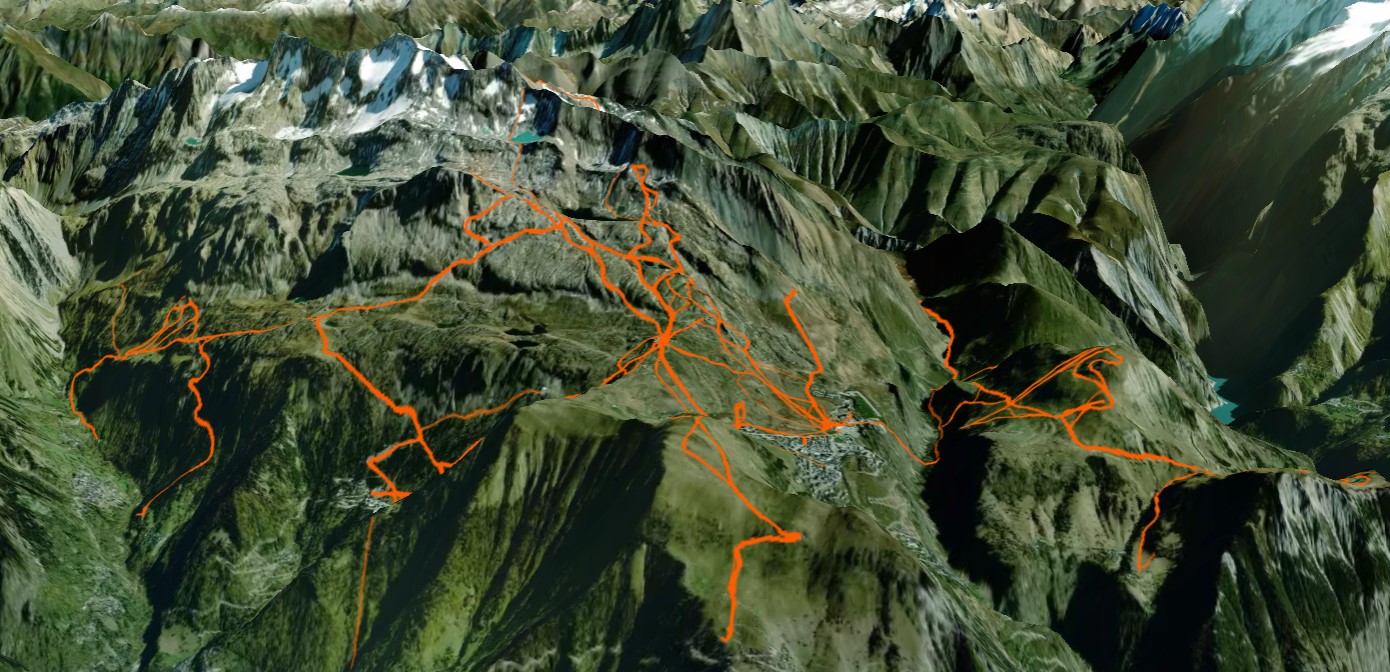
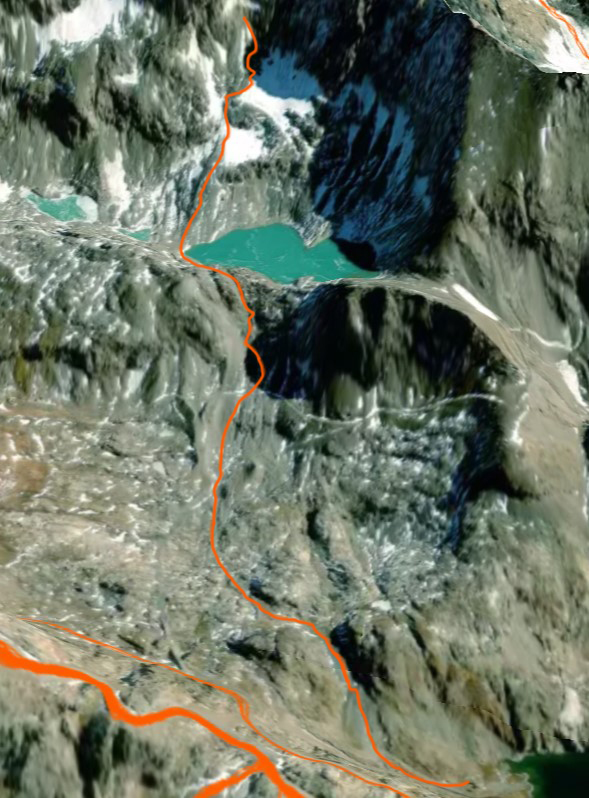
Below you can see a heatmap from Strava of the skiing that I have done and this looks a lot like the resort ski map.
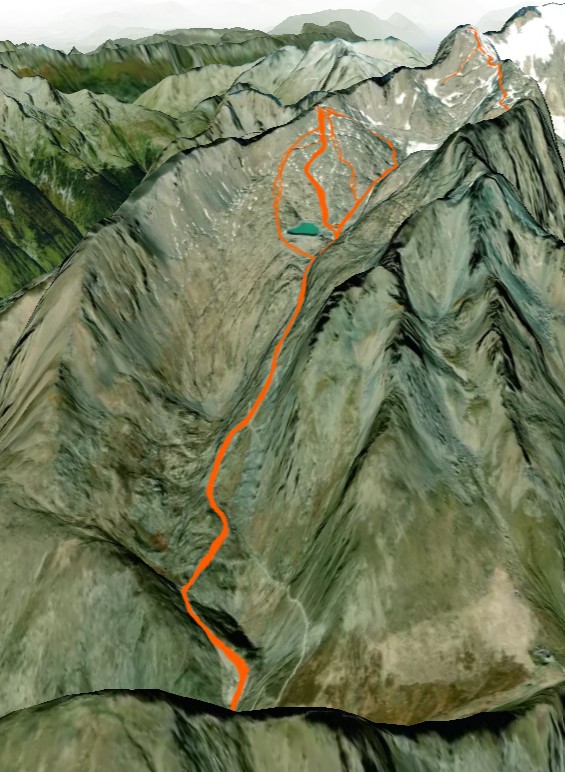
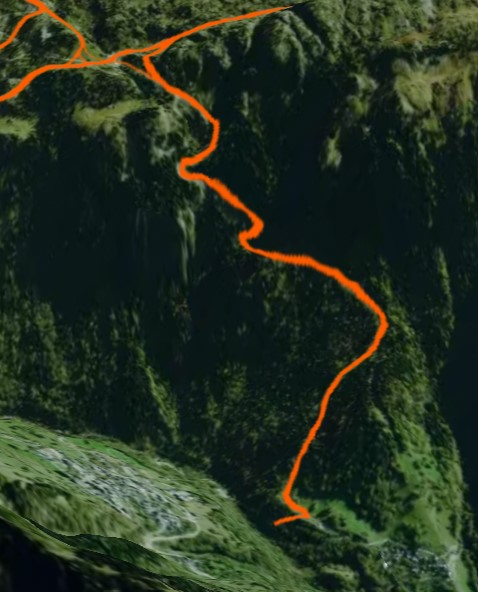
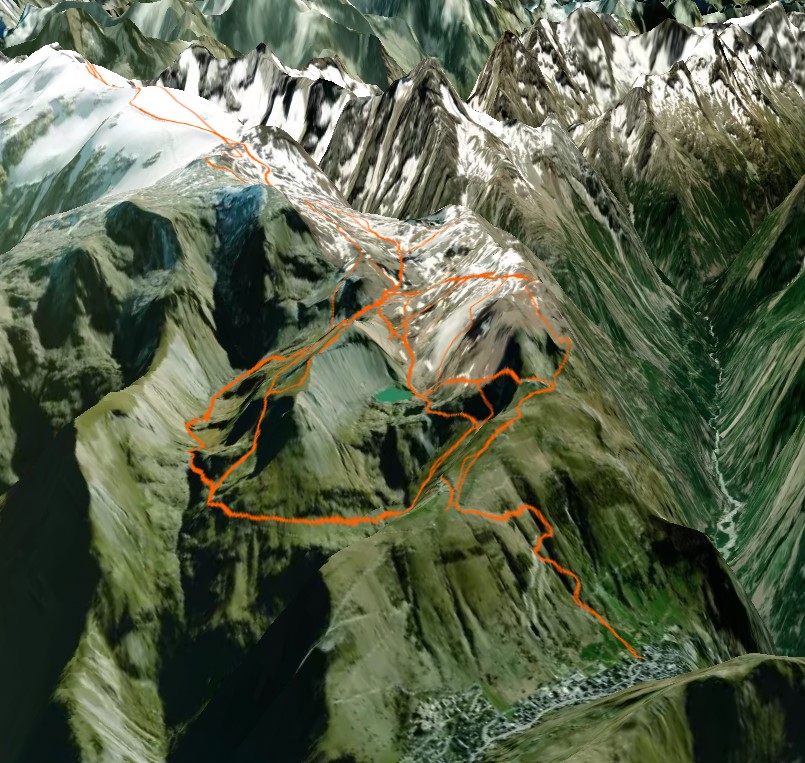
and the heatmap showing the runs in the Sarenne Valley:
So for us we are heading back to the UK for some downtime, before starting the next chapter in our adventures!
The undoubted highlights of the resort for me are:
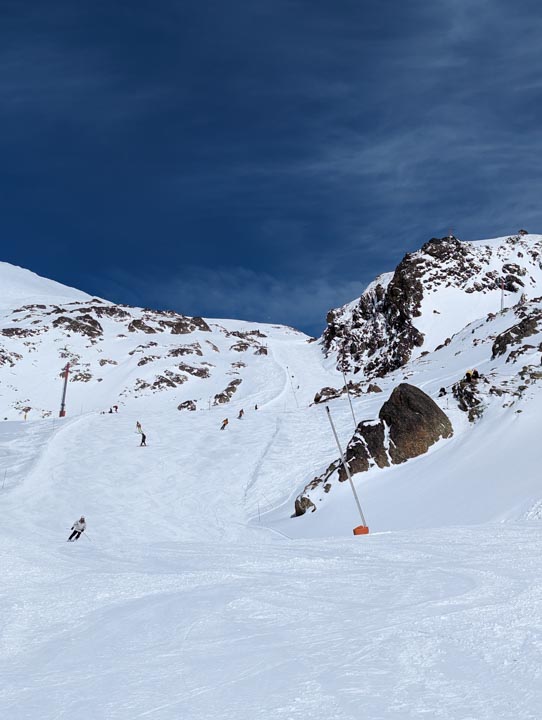
Sarenne: From the very top of Pic Blanc (3,330m) this black slope falls 1,820m, through 9km into a deserted valley below Alpe d’Huez, the Sarenne Gorge. Once you start there is a bail out after the first 25% but then you are committed to the whole thing but the first section is probably the most difficult. In good snow, freshly groomed it is a standard red run but in the late afternoon with spring conditions it can become quite moguled in certain places making it live up to its black designation.
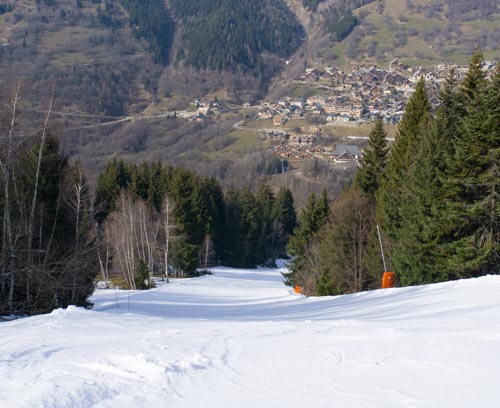
La Fare: This run is so good they built a gondola purely to service it as it drops down well below the town of Vaujany. If you ski from the top of the Alpette lift it is a 8km drop of around 1600m vertical. But the highlight is when you turn onto the narrow La Fare run dropping through the trees. It is never busy and is one of the few runs through the trees in the whole domain. I have skied it in powder, when icy, pisted and non-pisted and each is a different experience but all have been fantastic. It is quite shaded which means even though it drops down so low the snow has stayed in great condition throughout the time we’ve been here.
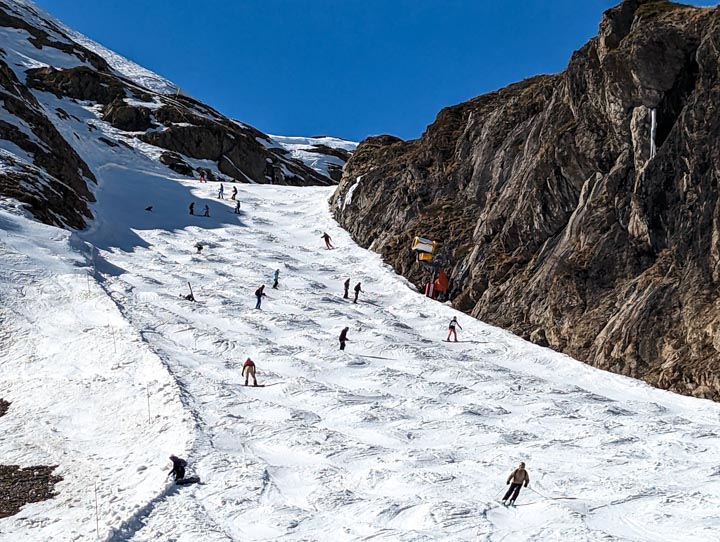
Tunnel: Often making the list of top 5 hardest runs in Europe. Tunnel starts from the highest point in the resort at 3330m, Pic Blanc. From here you have to ski down a steep moguled run called Glacier, to the entry point to the tunnel. This 200m long tunnel, built in 1964, takes you under the glacier and through the ridge back into the main valley of the Alpe d’Huez resort.
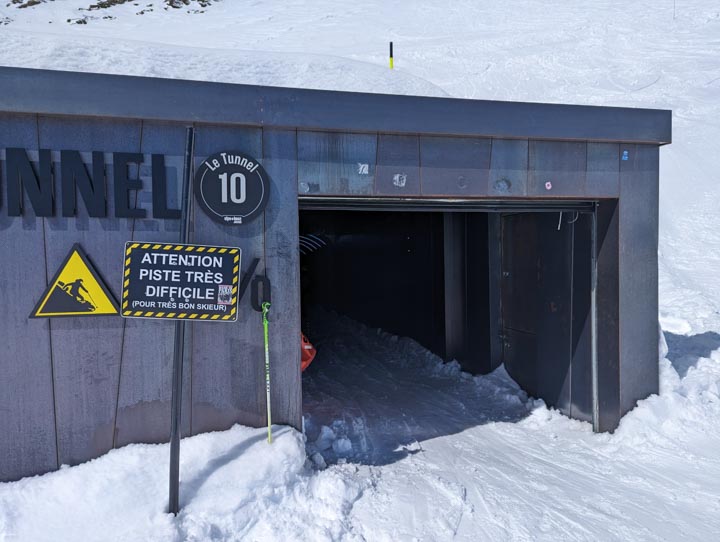
At the end of the tunnel a very narrow, steep and moguled funnel is the start of the much wider, but no less moguled or steep slope. The slope is 70% or 35 degrees making it the steepest moguled slope in France.
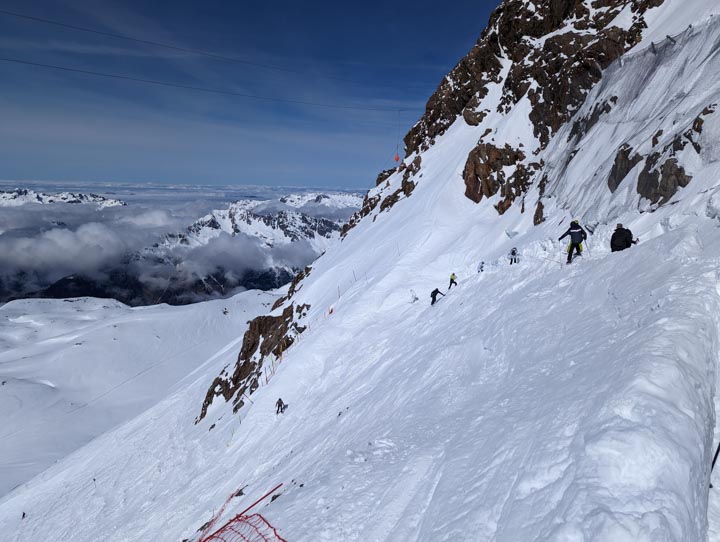
Just don’t fall on this one as getting skis back on is fiendishly difficult. The run finishes at its own lift to connect back to the Alpe d’Huez side of the resort or can be skied out to just below the Dome de Rousses.
Les Deux Alpes
Ski passes at the larger French resorts are very expensive. It costs €56 per day to ski in Alpe D’Huez but fortunately if you are in resort for more than a week there is a season pass available which is much cheaper. We bought our season passes for €745 including medical insurance for the equivalent of 13 days skiing.
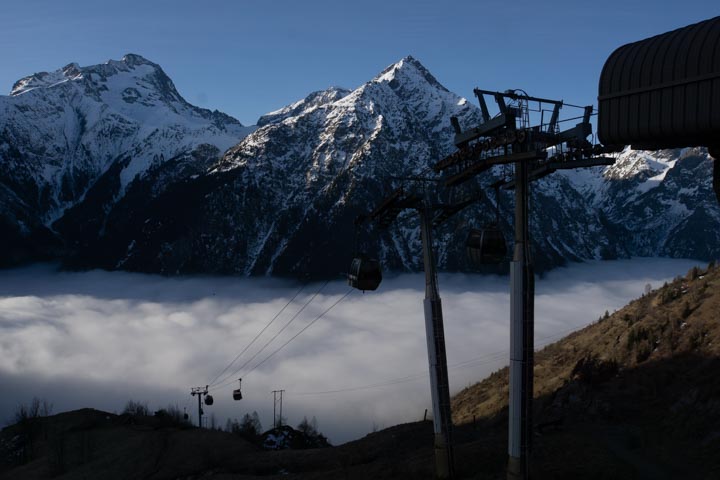
The bonus of buying any pass that is one week or longer in Alpe D’Huez is that you also get a number of days in other ski areas included in the cost. One of these is the nearby report of Les Deux Alpes, which can be seen from some of the Alpe D’Huez slopes.
The town of Les Deux Alpes is sprawling and busy and it is difficult to park so I wasn’t keen on trying to drive up there. However, just like Alpe D’Huez, there are lifts in the valley which directly access the resort. At the bottom end of the village of Venosc is a lift called simply Telecabine de Venosc, with a car park alongside it. The slight disadvantage with this lift is that it arrives in the bottom end of town and the connecting ski lifts are a few hundred metres walk away.
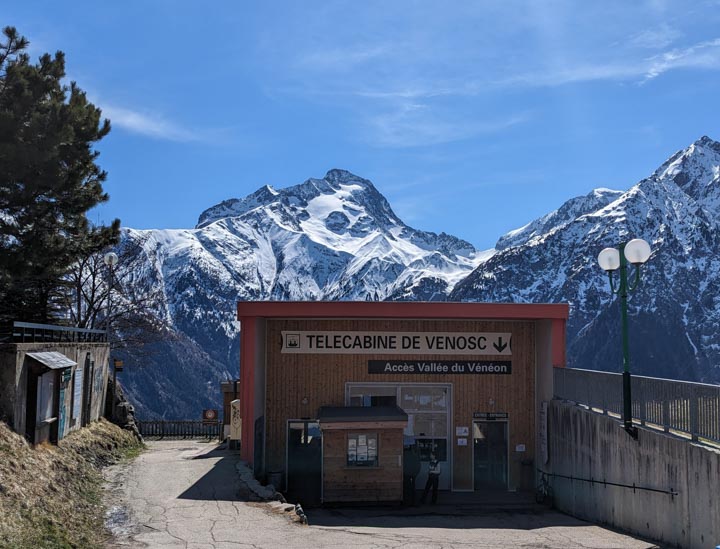
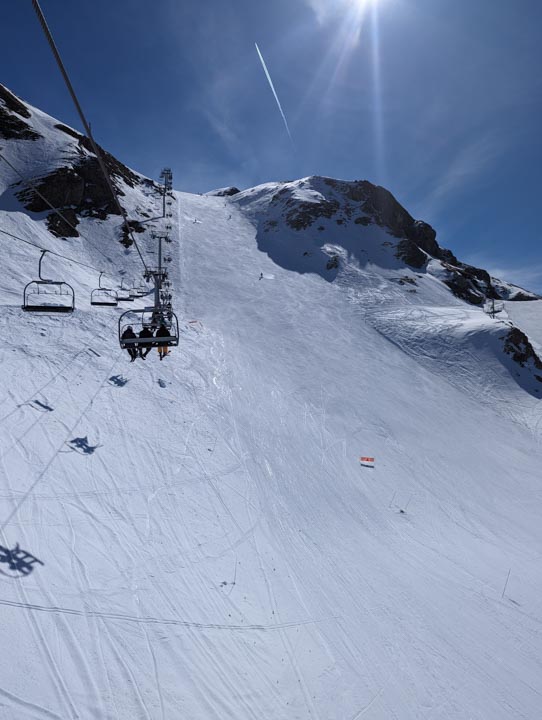
However, once you reach the lifts (the closest being the new Diable lift), it is a very quick ride up the mountain. This is a high resort with the top at 3600m and the town at 1650m. Les Deux Alpes is an unusual resort in that the very top of the mountain, the glacier, has pretty gentle slopes which make up a great beginner area. The more intermediate and advanced skiing is in the middle and then the way back to town is either a wide sweeping blue run or a gnarly steep black run. There are 15 greens, 41 blues, 13 reds and 9 black runs over 119km of slopes. So overall it is a smaller resort than Alpe D’Huez and more geared to the early, intermediate skier.
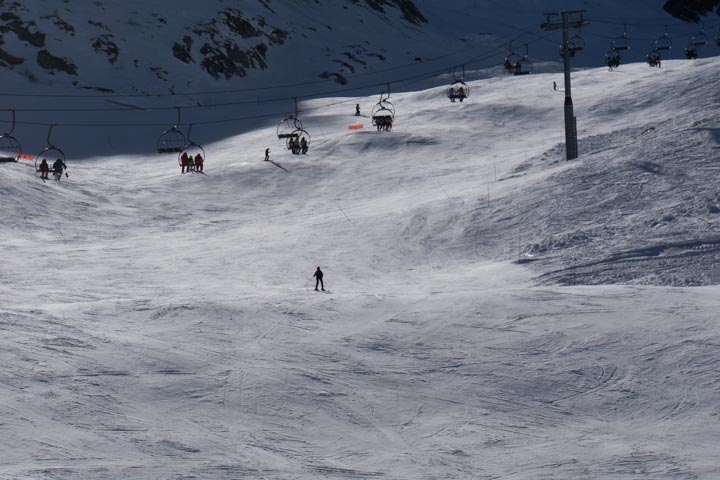
The lift system in Les Deux Alpes seem to be more modern with fast chairlifts in more places and the lifts seem less prone to queues than in Alpe d’Huez. The ski runs also tend to be much wider than in Alpe d’Huez and there are lots of really cruisy runs making it really suitable for those intermediate skiers.
The mountain itself is made up of different sectors which are either linked by lift or by fairly level ski runs so it takes a bit of time to learn your way around. It is possible to ski all the way from the top at 3600m down to the town without using a lift and the run is just over 12km long with almost 2000m of vertical drop.
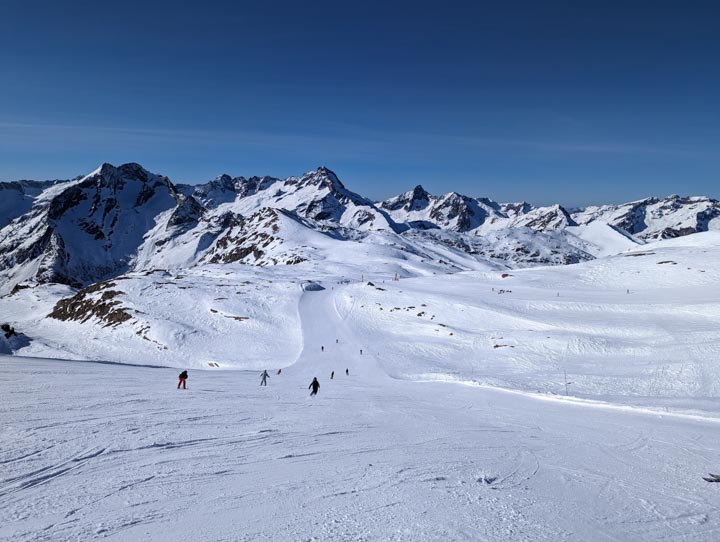
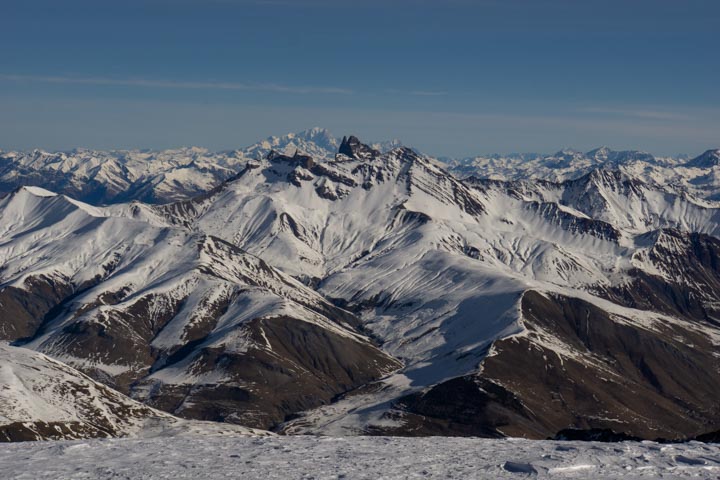
The views from Les Deux Alpes are spectacular and from the top it’s possible to see all the way to Mont Blanc and over back towards Alpe d’Huez. Going right to the top of the resort is a bit of a chore though with the final T-Bar lift only accessible after a bit of a trek over flat ground and the same on the way back. This is hard work at over 3000m.
There has been talk for a number of years of a lift linking Alpe d’Huez and Les Deux Alpes but the construction was delayed by Covid and there is no go live date currently fixed.
Alpe d’Huez Town
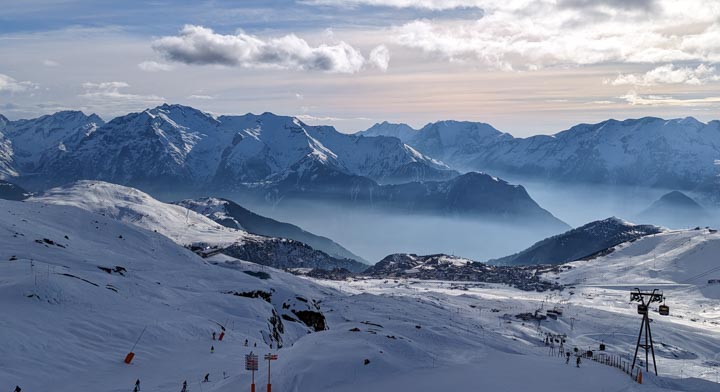
In order to keep our costs down we had booked most of our accommodation for our trip to the Alps in the town of Allemond in the valley below Alpe d’Huez. But for the middle two weeks we had decided to treat ourselves to an apartment in the resort itself. We figured that 2 months in the thick of a ski resort would probably be too much but it would be nice to have a short ‘holiday’ in the town where we would probably eat and drink too much and be grateful to get back to the peace and quiet of Allemond.
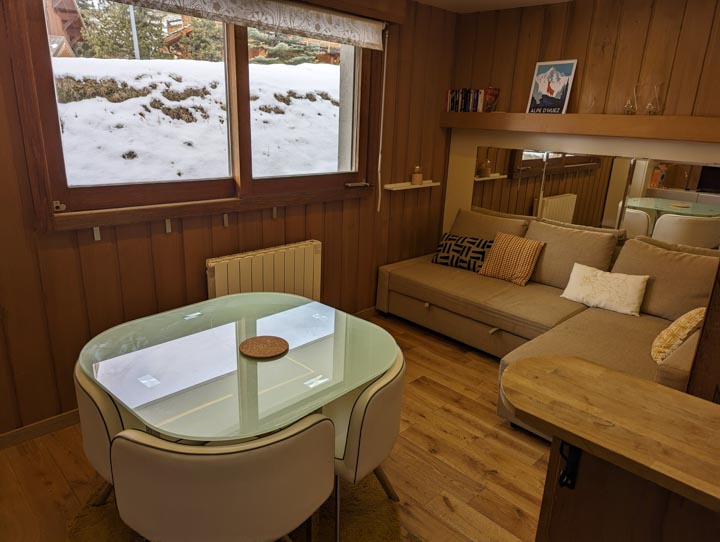
Alpe D’Huez town is divided into a number of quartiers, each with their own small centre of shops, bars and restaurants. Some of these quartiers are nearer the slopes than others with Cognet, Jeux and Bergers being closest to the slopes. For the other quartiers of Vieil Alpe, Passeuax, Eclose, Outaris and Huez Village there are both lifts and a free shuttle bus to make getting to the slopes easier. Fortunately, more through luck than anything else, we had booked accommodation in Jeux which was only 100m away from the nearest piste.
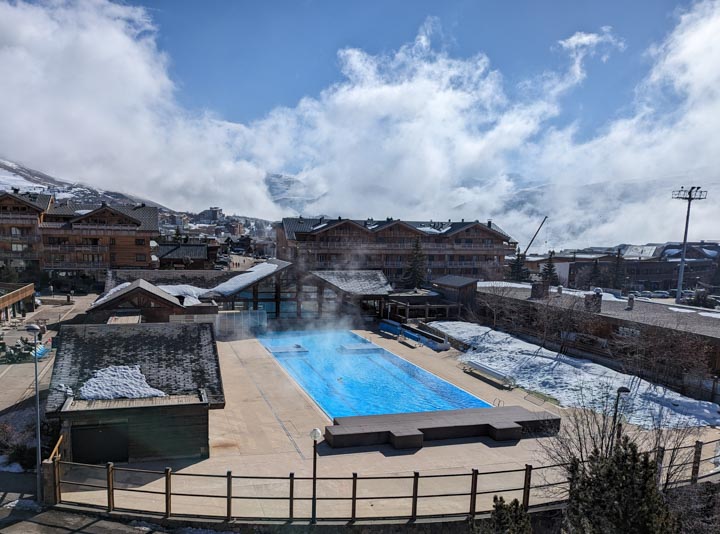
In hindsight, and fortunately, it looks like Jeux is one of the better places to be based with a lovely outdoor pool (heated of course), the ice-rink and a short walk to the luge, along with a good selection of bars and restaurants.
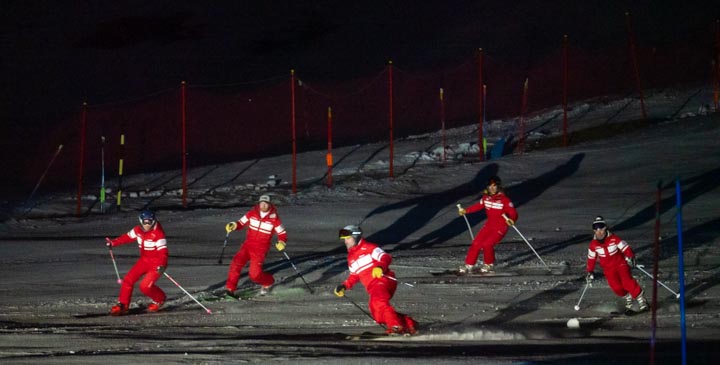
One of the disadvantages of ski resorts is that once the lifts shut, at around 5pm, you need to be back in your home town as by road the various settlements can be a long way from each other and potentially a very expensive taxi ride. So it was very fortuitous for us, that while we were staying in Alpe d’Huez town itself and not Allemond, the ESF (French Ski School) put on a fantastic evening show on one of the slopes straight above town.
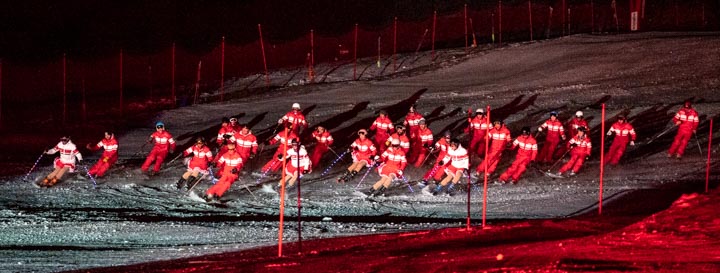
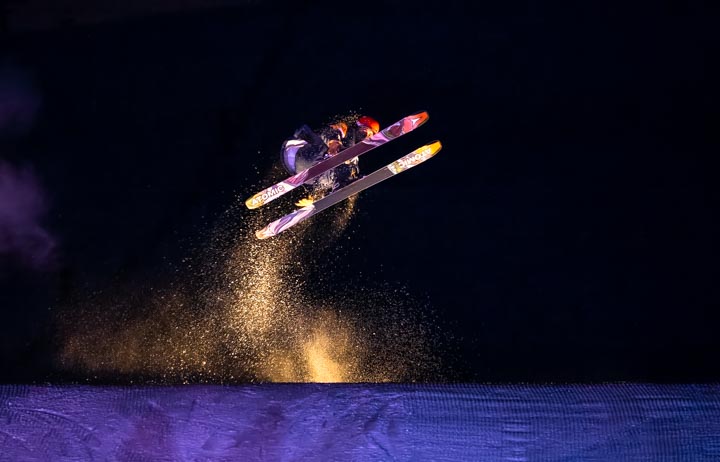
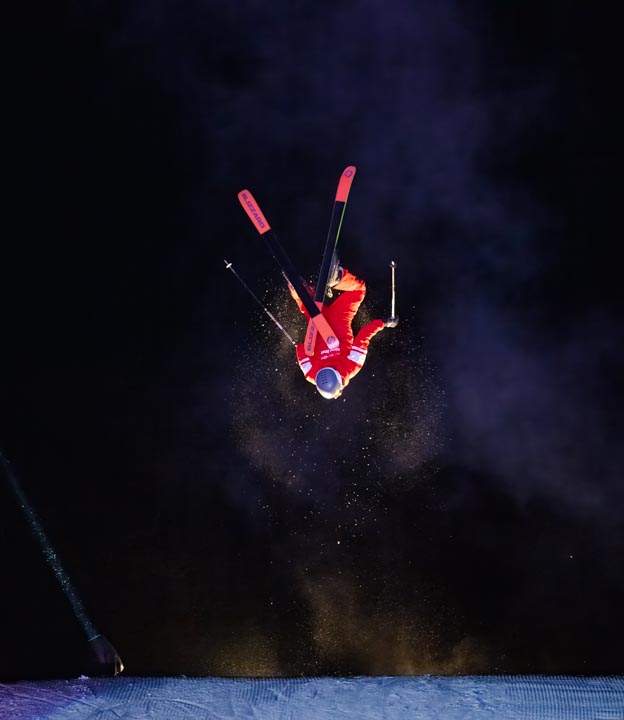
The event show-cased all the different styles of skiing such as telemark, snowboarding, skiing, slalom, biathlon, monoskis and parapenting. This was interspersed by freestyle skiing and snowboarding over a jump.
The whole event ended with a spectacular torchlight procession down the mountain and a fireworks display.
Global Warming
One of the reasons we chose Alpe D’Huez for skiing was its high altitude, with slopes as high as 3300m. We wanted a snow sure resort that would guarantee snow for our whole trip.
This turned out to be a good decision as February has been one of the worst winter months for snowfall in history. Only 5cms of snow fell on the slopes throughout the whole of February. The normal expectation for this part of the Alps is around 62cms, so we are way off the average.
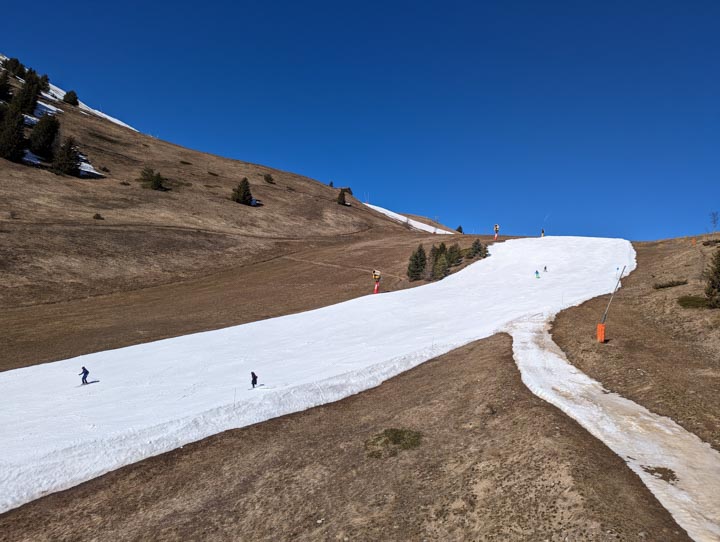
Not only has there been a lack of snow but almost every day since we arrived has been a blue-sky day. Curiously the ski areas and the immediately surrounding valleys have been clear of clouds but the valleys moving away from the Alps have been filled with thick cloud nearly every day. Some days we’ve seen a real cloud inversion in the surrounding valleys, which tends to clear by lunchtime.
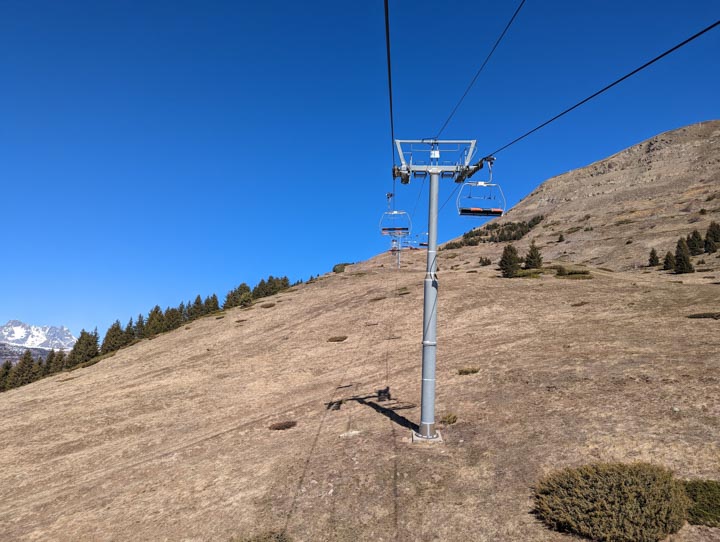
The impact of this weather, with highs of 14C (the highest temperature I have seen while skiing in February), means that a lot of the snow cover from earlier in the season is melting. The pisteurs have been doing an amazing job at keeping the pistes in good shape but despite this, some of the lower slopes are now closed, several of them are surrounded by exposed grass and those that are open are becoming narrower by the day. Having said that, it is still possible to ski down to the lower lying towns of the ski area, it’s just that the ski conditions are what you might expect towards the end of the season, not at its peak.
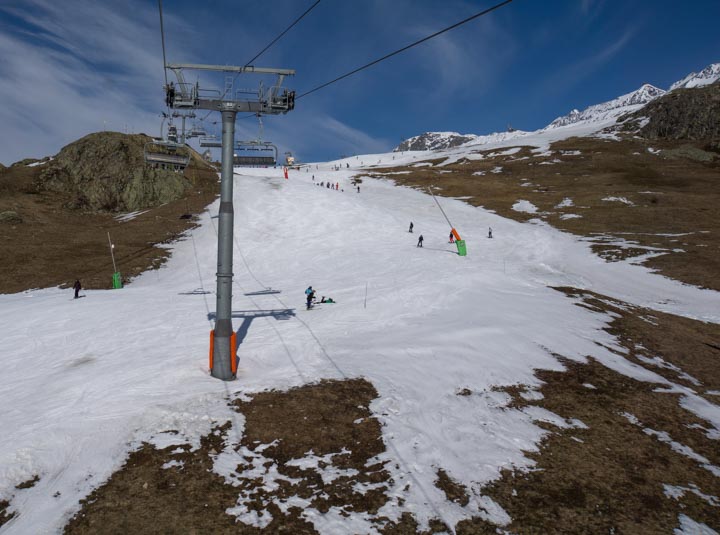
There is no doubt that this hasn’t (so far – I’m still hoping!) been a great season for skiing in the Alps and while this may be a freaky one-off warm snap, I worry that this is a sign of things to come. For now I am just grateful to have had the opportunity to spend time on the snow.
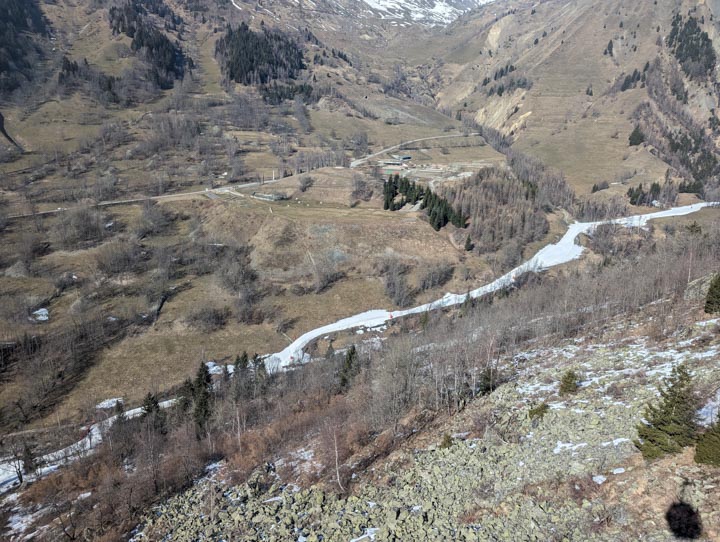
It is not all doom and gloom though and the top of the resort, over around 2500m, is still in good condition with cold temperatures and full snow cover. The pistes are icy in the morning but soften as the day progresses, this softening does hasten the formation of moguls but these are kept under control by the pisteurs overnight, apart from on a small number of unpisted runs which are kept that way.
 FromAtoB