Portugal

Our plan for Portugal was to make our way down the coast until we reached the most Southerly point, drive East across the Algarve to Algeciras in Spain where we would then board the ferry to Morocco. But first, as neither of us had visited Portugal before, we wanted to spend some time hitting the coastal highlights on the way down. Due to the wintry conditions, we’d have to leave the inland areas for another time.
Our first stop in Portugal was the pretty town of Viana do Castelo where we found a nice free aire near a beach on the other side of the river from the town. We had read that a small boat operates to ferry people across the river but there was no sign of it, so we could only assume it doesn’t run in the winter months. With that, we drove back around the estuary and parked in town.
We headed for the funicular that goes up the hill behind the town to the Sanctuary of the Sacred Heart of Jesus, from which there are great views across the estuary and the town.

The town itself has a nice old town where the Christmas decorations were still up. However the highlight for us was visiting the Gil Eannes ship which is docked on the river. This was the flagship of the Portuguese White Fleet, their cod fishing fleet, and was both an administrative hub and a hospital ship. Boats in the fleet would go out for 6 months at a time and at its peak there were almost 5 thousand sailors in the fleet.

The ship was built in 1955 and was in operation until 1984. It carried a full team of doctors and nurses and included an operating theatre, pharmacy, isolation wards and dentists. The engine room was also really cool and we were able to walk all through it. I have to admit we were sceptical when we went aboard but it is definitely worth a visit.

From Viana do Castelo we headed inland to the town of Braga. Braga is the oldest city in Portugal and dates back more than 2,000 years. The city itself has some beautiful architecture and makes an enjoyable place for a wander around.

Above the city of Braga is a monumental staircase that starts off winding its way up towards the Bom Jesus do Monte Church and then about half way turns into a straight stairway leading right up to the church. There is a water powered funicular to go up to the church but the walk is much more impressive.

At intervals as you climb the pilgrims stairs there are small buildings with dioramas of religious scenes.

Continuing on our way, Guimaraes is a medieval town with a small centre that is really lovely. We managed to park up for the night in a parking area next to the very small aire that was only a five minute walk from the centre, so we decided to walk into town for a night out.

Walking through the deserted streets we arrived at a small tapas restaurant with no one in it. We had read some great google reviews so decided to go in anyway. We were greeted warmly by the proprietor who sat us down and got us drinks – some very nice local wine. He then asked us whether we ate meat and fish and explained to us that he’d cook us some tapas.

He started cooking behind the bar and only a few minutes later brought out a few dishes of food which he said was traditional Portuguese tapas. He did explain what each dish was but to be honest all I can remember is how tasty it was.
The next day we explored the town and cycled up to the medieval castle just outside town. It is a lovely place and I imagine in the summer it is very busy with tourists but in January it was very quiet, unlike our next stop, Porto, which is a major tourist destination throughout the year.

Porto is a big city with a population of 1.8 million. It is also very hilly so getting around can be hard work.
We parked up at a stop on the tram network, called Fanzares, which had a large free car park right by the tram stop. Once we worked out which ticket we needed, it was an easy 20 minute ride into the city centre and we avoided driving through all of the narrow, busy urban streets.

We arrived in the centre of Porto at the main railway station, which quite helpfully was one of the spots we had marked to visit. The main hall of the station is tiled with some beautiful Portuguese tiling and quite impressive.

From here we walked up hill to the cathedral.

We generally have a policy of not paying to go into cathedrals as we have seen so many but here we did as it is a joint ticket for the cathedral and the Episcopal Palace next door.

The cathedral itself is not particularly notable with the highlight being the gothic cloisters which have some impressive tiled murals. However the Episcopal Palace which is next door is much more impressive. The entrance leads to a grand staircase with a beautifully painted ceiling.

It was originally built in the 12th century as the residence of the Bishops of Porto and the first floor has lovely views over the Duoro river and Port district of Porto.

After visiting this area we walked down the steep streets of the old town to find a restaurant near the river. Both of us tried the local speciality the Franceshina. This looks terrible when you get it – its basically a meat sandwich with an egg on top drowned in gravy – but boy does it taste good. The portions were huge and we were absolutely stuffed.

After lunch we walked along the river side and then made our way back up through the town to the city hall and then across the to the magnificently tiled Chapel of Souls.

Porto is definitely a city that rewards walking around its steep streets and we were pretty tired when we got the tram back to the camper.

Our next stop was further down the coast at Coimbra. We stopped here, staying in a fairly scruffy car park the other side of the river from the old town. Coimbra is famous for its University which was established in 1290 making it one of the oldest continuously operating universities in the world. We cycled into the old town not realising that the university was at the top of a steep cobbled hill which meant that we had to push our bikes up to it.

The central buildings are spectacular but it is the library that we had come to see. The ticket to see the library is quite expensive and you can only visit on a guided tour of up to 40 people. We were really lucky that there was only us and 1 other person on our tour which was late in the day.
The Joanina library is a medieval library with books from the 16th to 18th centuries but was opened to receive books in 1750. Its main room is stunning and at night the tables are covered with leather covers to protect them from the faeces of the bats that are allowed to nest there to control any insects that might damage the books.

Besides the library the ticket also entitles you to visit the Great Hall and St Michael’s Chapel, both of which are well worth taking the time to see.

Unfortunately our visit to Coimbra coincided with some heavy rain and we got absolutely drenched on our cycle back from the old town!
Not too far from the city of Coimbra are the Conimbriga Roman ruins. These are notable for the excellent floor murals that have survived. The site itself is poorly signposted but the murals make it well worth the visit.

The Romans arrived in this area around 139BC. At the time there was already a settlement here but the Romans took it over and formalised it. By around 70AD it was a city of around 10,000 people.

The city was eventually destroyed in 465AD in an invasion by the Germanic Sueves (enslaving much of the population).

As we continued heading South we passed by the city of Batalha where the massive Batalha Monastery is visible from the road. We were intrigued so we jumped off the main road and parked up in Batalha for the night.

The monastery has at its heart an enormous and not completely finished cathedral, which is in the gothic style and was built over 200 years ago to commemorate the victory of the Portuguese in the battle of Ajubarrota against the Castillians in 1385.

There is a lot to explore in the monastery from the Founder’s chapel with royal tombs including Henry the Navigator, to the big cloisters and the unfinished chapels which are still open to the elements.

In a room off one of the cloisters is the eternal flame and the tomb of the unknown soldier from the first world war which has a military honour guard. We actually arrived as the guard was changing and got told to stand in a corner while the soldiers marched around.

Our tour of the cathedral ended with the unfinished chapels where a large gothic area has been built but a roof was never put on. Now it’s a very grand home to pigeons!
Despite travelling down the coast we hadn’t actually hit any beaches since our first stop at Viana do Castelo, so we were looking forward to visiting Nazare. This is the site of the biggest wave surfing records and it is renowned for having massive waves at this time of year. Just our luck, we arrived in bright sunshine and calmish seas sandwiched between periods of bad weather on either side with big waves.

It didn’t stop us however, visiting the peninsula where the big waves are surfed and we saw a couple of jet skis and surfers hanging around in the water, but there obviously wasn’t anything they wanted to surf. Even on a clam day though the waves are quite impressive.
After hanging around in the old town at the top of the hill we drove down into the town of Nazare itself, which is the other side of the peninsula from the big waves. There is a large parking area for motorhomes within walking distance of pretty much everything and so we wandered along the beach and seafront enjoying the rare sunshine and taking in the fish drying racks.

We couldn’t resist stopping at a seafront bar for a drink to watch the sun go down, although we retreated pretty quickly once the sun was below the horizon as the temperature plummeted – it is still January after all.

Driving South For The Winter

After a lovely Christmas break with the family, before the mince pies had even run out, we jumped back in the camper and headed to Calais, determined to find some warmer and dryer weather.

When you head south it gets colder before it gets warmer as France has much harsher winters than southeast England. Our first night in France was down to -4c, so we didn’t hang about in the morning, getting the Beastlet going and the heater on as quickly as we could.

On the plus side there was no snow at this time on the west coast of France. We had our sights set on St Jean de Luz, a beautiful town near the Spanish border in the far southwest corner of France. Our weather app was showing us that this was a relatively warm 12c with clear skies.

However, we began to lose faith in the weather app when we were just 20kms away from St Jean de Luz and the thermometer was still reading 0c outside. To our surprise though, in the space of 20km the temperature gradually started to rise and as we drove into the town the thermometer hit 12c. The sun was shining and it felt like a different country!
Our plan was to drive across the North of Spain and down through Portugal, hugging the coastline to benefit from the milder climate, before getting a ferry across to Morocco for a couple of months.

We enjoyed a day walking around St Jean de Luz, a favourite town of ours that we have visited before, although this time it was much busier with the French out in force enjoying the holidays.
Shortly after leaving St. Jean de Luz, we crossed over into Spain and started driving along the North coast. We decided to avoid the big towns that dominate the Northeast of Spain and so our first stop was in the small town of Lekeito which has a free Aire within walking distance of the centre.

It didn’t take us long to find a bar for our first Pinxtos of the trip and a refreshing Spanish beer. This is one of our favourite things about travelling through Spain and so dry January was definitely not part of our agenda!
The town didn’t feel very touristy, at least not in early January, and in fact was pretty deserted until after 5pm when it seemed to come alive.

Our next stop was 200km down the coast in San Vincente de Barquera. This is a coastal town from which you can see the snow capped peaks of the Picos de Europa. We’d love to explore the Picos but at this time of year it is just too cold for us to go into the mountains in the camper.

We explored the old town which is at the top of a hill overlooking the harbour and then went down into the harbour area where we enjoyed a tapas lunch – the hero of this was definitely a platter of garlicky squid which was delicious.
Llanes was the next town we visited on our brief traverse across the north coast of Spain. This is a fairly nice town but it was mostly shut up for winter while we were there, although we did manage to visit the beach and have a walk around the harbour area.

Probably the highlight for us on the North coast of Spain was the village of Cudillero. This colourful little village is built up the cliff face around a small harbour and feels like it hasn’t changed in a 100 years. We walked through the town, climbed up through the steep streets to a traverse across the top of the town and back down the other side of the harbour. The main square must be wonderful in the summer with lots of bars and restaurants – not so much in the winter when everything was shut up.

Next up for us was Ribadeo, which we visited because of it proximity to Playa de las Catedrales, but actually it’s a nice town in its own right. We arrived in a storm and quickly abandoned our proposed parking place down by the seafront as it was much too exposed. We eventually found a supermarket car park inland of the town to bed down for the night.
In the morning the weather was much improved so we drove back into town and went for a wander, stopping for the almost obligatory hot chocolate – well they are when you are out with Sarah!

After the town we drove down the road to Playa de las Catedrales, a beautiful beach with a number of rock arches. We explored the beach and managed to reach the double arch despite the incoming tide, and get back out without getting wet.

This was our last stop on the North coast as we cut back inland to head to the regional capital of Santiago de Compostela. This is the pilgrimage town that is at the end of the Camino de Santiago. This famous walking route is actually a number of different routes that vary from 87km long to the mighty Northern route which is 820km.

The impressive cathedral, which is a mixture of Romanesque, Baroque and Gothic styles, was built between 1075 and 1211.

The cathedral is at the centre of the Unesco World Heritage old town where you can get lost in the beautiful back streets. It’s a gorgeous town and easily lives up to its reputation of one of Spain’s most beautiful cities.

After just six days in Spain we were closing in on our destination of Portugal, but we had one more stop we wanted to make on the way, which was the town of Pontevedra. In the 16th century Pontevedra was the biggest city in Galicia but now it is a pleasant medium sized city of 80,000 people that houses a lot of the administrative services for the region, including a very good (and free) museum which is definitely worth a visit. Its old town stands out as particularly beautiful.

Leaving Scotland

While on my final hike in Harris I reached into my pocket to check something on my phone and to my horror the screen was black and wouldn’t work at all. After some trouble shooting it stayed black and I could only conclude that the screen had failed and the phone had become completely unusable.
I just didn’t realise how reliant I was on my phone, but these days you use it for everything, especially while travelling. So we needed to get it fixed as a priority. After a bit of research we worked out that; a) it was still under warranty so I could get it fixed for free and b) the only place in Scotland that would do warranty repairs on a walk in basis was in Edinburgh. So we changed our plans and headed straight across country and down to Edinburgh.
We took the ferry back to Skye the next day, albeit a slightly longer crossing than normal as it diverted to pick up some livestock. The crossing was calm and we arrived back in Skye in time to find a park-up just before nightfall, tucked away off the road.

The next day we started our drive across country to get to Edinburgh. As we were driving along we were completely surprised to pass a large dam with a huge amount of water being released. It was such a cool sight we had to stop to take a look. We learnt that this was Laggan Dam, a hydro-electric structure built in 1934, which releases water via six pipes into the River Spean to manage water levels.
We stopped only once more on the drive to have a nose around the House of Bruar. This is a high end shopping complex of Scottish products and as Christmas was fast approaching Sarah couldn’t resist picking up a few gifts. We also wandered around the food hall looking longingly at all the amazing food but managed to resist. You could spend a fortune there if you weren’t careful.

We reached Edinburgh and parked up in one of the park and rides (Newcraighall), taking the train the next morning directly into town. The mobile phone shop was easy to find in a shopping mall in the centre of the city. However it was going to take a week to fix as they needed to order parts, which meant hanging around near Edinburgh for a week.

Edinburgh is an amazing city and we hadn’t been here together since 2004, so we had a fun touristy day, taking in some of the sights again.

It was a wet, cold day which limited the number of tourists around but that also meant we practically had a private tour of Gladstone’s Land, a National Trust property, which is one of the oldest buildings on the Royal Mile.

Each floor depicts a different era and function of its life span, from a boarding house to a wealthy merchants home and there are some impressive painted ceilings which have been preserved from the 1600’s. What we thought was going to be a fairly uneventful way to get out of the rain for a while actually turned into one of the highlights of the day, which was completely down to the fantastic knowledge of the guides.

So with a week in the Edinburgh area and our National Trust membership, we decided to visit as many of the attractions in the area as we could.
First up was Preston Mill which was the region’s last working watermill and was actually still in commercial operation until 1959. The mill produced oatmeal and there has been a mill on this site since the 16th century. It was the centre of the community and all the local farmers would have there oats milled here.

The tour of the mill by the guardian of the site was very interesting. He had a huge amount of knowledge about the process of milling and the history of the site which really brought it all to life for us.
From here we drove to Falkirk to see the famous Falkirk Wheel, the only rotating boat lift in the world. It was built in 2002 to connect the Forth and Clyde Canal with the Union Canal, 35 metres above, replacing a series of 11 locks in the process. It is now of course a major tourist attraction and for £18 motorhomers can spend the night there.

Just down the road from the Falkirk Wheel are the Kelpies, massive sculptures of horses heads. It’s a diverting 10 minute stop but not much more.

We also visited the Bannockburn Visitor Centre which is on the site of the battle of Bannockburn. There is not much to see outside but in the centre a 30 minute long presentation by a guide gives a good overview of the battle and the tactical failings of the English army.

We found a good free place to stay at Loch Leven where there is a lovely walk through the woods around the Loch.

This allowed us to visit a couple of National trust properties in the area.

First up was Kellie Castle, which is really a big house rather than a castle. Kellie Castle was originally built in the 14th century but it was in the 19th century when it was overhauled by the Lorimers, a family of artists, when it took on its current character.

The castle was sold to the National trust in 1970 and the rooms remain largely as they were then.

Up next was Falkland Palace. Unfortunately this was partially destroyed by fire in 1654 but some of it still remains including a stunning chapel and one of the first Real or Royal Tennis courts in Scotland, built for King James V.

The palace was used by the Kings and Queens of Scotland and was actually one of Mary Queen of Scots favourite places.
The Real Tennis court is actually the oldest in the world that is still in use today.

The chapel, which unusually for Scotland, is Catholic, is still in use today for Sunday Mass. It was originally built in the 16th century and refurbished in 1896 by the 3rd Marquess of Bute. King James V (Mary Queen of Scots father), died at Falkland Palace and his body was laid in state here for a month.
It wasn’t just National Trust castles we went to see, we also headed to the village of Dunkeld where the National Trust has restored 20 houses some of which date back to the 17th century. Dunkeld has a been the site of Christian worship since the 6th century and has a large 13th century cathedral out of all proportion to the size of the town.

Right next to the village is a lovely walk called The Hermitage, which follows a river through a wood of giant Douglas Firs, among the tallest in Britain, to a lovely waterfall overlooked by Ossian’s Hall, a folly built in 1757.

All of this enabled us to kill a week in the Edinburgh area and with some really cold weather coming in we checked into a campsite just outside Perth so that we could run our electric heater. The campsite was at Scone Palace near Perth, but unfortunately because of the time of year the palace was shut. When one night hit -7c our pipes froze even with the heater on and we decided it really was time to head back down south!

From Perth, I took the train into Edinburgh to pick up my fixed phone. It was a crisp blue sky day so the tourists were out in force and bagpipers had appeared on what seemed like every street corner. I took the opportunity to walk around much of central Edinburgh before getting the train back to Perth.

It was now late November, the weather was cold and a succession of winter storms were starting, so our time in Scotland was almost at an end but not before we visited the small settlement of St Abbs.
It was however blowing a gale the day we were there. We had hoped to walk out towards St Abbs Heads but when we turned the corner, as the high wall fell away and the path hit the coast, we were almost blown away. So we took this as our cue to turn around but on the plus side, we did see some seals.

We made a few more stops on our way south including a brief stop to see the Angel of the North having never visited Newcastle before, but by far the stand out was a visit to Donna Nook in Lincolnshire, thanks to a recommendation from our friends Donna and Jon @theroverlanders.

Being nature lovers I can’t believe we hadn’t heard about this place, it must be Britain’s best kept secret. Donna Nook is a nature reserve with a huge colony of grey seals with over 2000 pups born each year. There are volunteers there to answer any questions you might have and we got some great close up views of the seals and their pups. This marked a fab end to our Scotland trip.


From Skye to the Outer Hebrides

Skye is the largest island of the Inner Hebrides and the most heavily populated, and touristed. It is actually connected to the mainland by a bridge and I think it is this convenience, along with the scenery of course, that makes it the second most visited place in Scotland after Edinburgh.
The views as you drive towards Skye are pretty special and just before reaching the bridge it’s worth stopping if only to take a photo of the famous island castle, Eilean Donan. The entrance fee, which felt a little high, gives you access to the island and entrance into the castle itself but the best views of the castle are actually from outside the pay area.

The castle is a 20th century reconstruction of the original which was destroyed in 1719 by the Royal Navy as part of putting down the Jacobite rebellions. The fortress was originally the stronghold of Clan Mackenzie and was originally built in the 13th century. For film fans it has featured in many films including Highlander and Braveheart.

Leaving Eilean Donan behind we drove across the bridge, which is relatively new having only been finished in 1995, to the Isle of Skye.
On arrival we had some fairly bad weather with very strong winds, so we sought somewhere to stay with good shelter. The place we found was in the South of Skye on the shores of Loch Slapin. This was way off the tourist trail in Torrin and the site of a good hike up to Bla Bheinn, a Munro. I hiked part of the way up to some waterfalls but the weather was very changeable so I decided against doing the full hike.

The next day we drove to the Fairy Pools, which are very much back on the tourist trail. This involves an uphill walk next to a river with a number of waterfalls along the way. It is a pretty hike, and I am sure in better weather it looks amazing but unfortunately we had a lot of low cloud and got thoroughly drenched in a heavy down pour not long after setting out.

Heading to this part of Skye however did give us the opportunity to visit the Cuil Café, which we highly recommend. This is an exceptionally popular café that serves Scottish cuisine and was originally based in London before moving to Skye. I had the beef brisket Rarebit which was really good.

Having dried off and refueled, feeling much better we moved onto the North of Skye, stopping off for a night in Portree, the Capital of Skye, on our way up to the infamous Old Man of Storr.


Getting close up to the Old Man itself is a short uphill hike from the (incredibly busy) car park. Motorhomes aren’t actually allowed in the car park so you have to find space alongside the road which fortunately we managed to do but I imagine this would be a nightmare in high season. As it was, the hike was very busy with lots of Japanese and French tourists.

Along the East side of Skye are some lovely waterfalls that are worth stopping to see and are accessible via very short walks.

My favourite was the Kilt Rock Waterfall which cascades over the cliff face into the sea, although Lealt falls which has a number of different waterfalls is also nice.

On the North of the island one of the most famous hikes is the Quiraing, which is a hike around a rock landform with some steep cliffs stretching down into a hollow. We started it from a small car park on the coast which makes the hike a bit longer.

The first half of the hike is pretty with some jagged rock forms, however upon reaching one end of the Quiraing you have to climb up to the top of the landform to move back along it. This started off with a great path but then became a slog up a boggy slope where each step left me sinking into the waterlogged peat – unpleasant. On reaching the top it was incredibly windy but fortunately the wind was blowing me back onto the cliffs otherwise it would have been quite dangerous. Definitely a recommended hike for the views but perhaps when its not quite so wet and windy !

From the Quiraing, a narrow single track road runs across a pass in the mountainous central part of Skye over to the West Coast. This is a lovely drive and well worth doing but despite this we encountered very little traffic.
We were travelling to the West side of the island in order to take the ferry from Uig to the Outer Hebrides, but before crossing we stopped for a lovely walk at the Fairy Glen, which is nearby. This is an aptly named other-worldly landscape of dips, rock formations and cone-shaped mounds, and perhaps the fairies had sprinkled a little of their fairy dust because the clouds parted and we enjoyed a rare glimpse of blue sky and sunshine which made it all the more endearing.

The ferry crossing from Uig was our longest yet at two hours. Fortunately it was nice and calm which was a pleasant surprise. Unfortunately the brief spell of fine weather proved to be very brief indeed.

North Uist, situated in the middle of the Outer Hebrides island chain, was our landing point. It is a very flat island with no mountains and consequently when it is windy it is very difficult to find anywhere sheltered to park – and when we were there it was very windy.

From North Uist we initially travelled South to visit South Uist, Benbecula and the Island of Eriskay, which is connected to South Uist by a causeway. This is a beautiful area but you need to get away from the main road to see it at its best. There are a couple of attractive RSPB reserves and while we didn’t catch a glimpse of any birds of prey we did see the very cute wild ponies.
On yet another very wet and windy day we elected to do an indoor activity, not easy at this time of year when many of the museums are closed for the season, but there is a new distillery on Benbecula, aptly named the Benbecula Distillery, so we decided to take a tour. The ‘private’ tour (as there was no-one else around) of the distillery, explanation of the distillation process followed by a tasting was a fun diversion on a fairly miserable day.

Our final day on the Uists saw a slight improvement in the weather so we decided to check out the beaches on North Uist, which were big, beautiful and sandy. If they were somewhere with better weather they would probably be world famous but in the North of Scotland, not so much.

From North Uist we caught the ferry to the Isle of Lewis and Harris, whose route weaves its way cautiously through a shallow rocky channel.
Lewis and Harris (the North and South of the same island) feels very different from the Uists as it’s very mountainous in the centre and has some beautiful beaches on the Atlantic side. In fact having spent the summer months travelling through Norway, the East side of Harris has a real Norwegian feel.
Lewis and Harris is the most populated of the Scottish islands with 20,000 people but it is also the biggest one and 30% bigger than Skye. Half of the population live in the capital of the island – Stornoway, and it certainly doesn’t feel over crowded.

We started by visiting the beaches on the West coast but it was really windy and not really beach weather to say the least so we looped round to the other side of the island.

This really does feels like Iceland or Norway and is a rocky alien landscape that is really beautiful. We found ourselves a lovely park-up for the night, which was high on an outcrop but somehow sheltered from the wind.

Most of the roads in the Outer Hebrides and in fact on most of the islands we’ve visited, are single track roads with passing spaces. These are actually great to drive as you don’t have trucks whizzing past inches away from you as you do on the narrow two lane roads. Instead, everyone has to be considerate and look ahead to gauge the best passing space to use whenever you meet another vehicle. This is really easy and I don’t think we had to reverse once.

After driving up the east coast and stopping for an excellent hot chocolate and cake at a small café /art gallery that was only open on Thursdays (and felt like being in someone’s living room), we headed North up into Lewis. There really isn’t any obvious distinction as to the split between Lewis and Harris, other than a sign but we drove past this marker and headed North to the Callanish Standing Stones.

This is one of the best sets of standing stones in Scotland. They were erected around 5,000 years ago making them older than both the Pyramids and Stonehenge. They are in a cruciform arrangement with a central stone circle and placed at the top of a hill.

There are actually a number of stone circles in the area and although the Callanish Stones can get quite busy the others are generally deserted. We visited another set and only had some cute hairy coos for company.

From Callanish we drove down to Bosta Beach where we spent the night and had a lovely walk around the beach and a reconstructed iron age hut.


A few Km’s down the coast from Bosta is a beautiful set of Sea Stacks called Mangersta Stacks. There is no parking and no tourist infrastructure at all other than a hand written sign at the side of the road with an arrow pointing across a field to the stacks which are invisible from the road. If this was on the mainland it would be one of the most famous tourist sites in Scotland !

Along this coast almost every beach is beautiful and worth stopping off at for a walk and we visited a few as we made out way towards the Northern tip of Lewis.
We also stopped for a beautiful sunset at Dan Carloway Broch which is a clan tower from the 1st Century AD. It is mostly collapsed now but there are still some stairs that you can climb which give an insight into what it would have looked like when intact.

Our final stop for the night was at Shawbost beach where we were treated to an amazing sunset. The weather in Scotland at this time of year doesn’t often oblige with a sunset but when it does they are generally pretty good !

We carried on heading north in the morning, after a quick trip across the island to the capital, Stornaway for some provisions, and a trip to Garry beach on the East Coast, where we had another beautiful walk.
We also visited the Clach An Truishal standing stone which is the largest in Scotland. It’s quite weird because it’s just next to someone’s house. They must get quite annoyed with tourists walking up past their house all the time.

One of the things we loved about the Outer Hebrides were the Honesty Boxes outside people’s houses with a variety of items for sale from smoked salmon to baked goodies. I think we discovered the best in the North of Lewis, Niseach Bakes, which had some fantastic brownies, brookies and more. We ended up buying quite a few!

We stayed the night, all alone, with a fantastic beach and sea view at Port Stoth beach where we were a few hundred metres from the Butt of Lewis lighthouse on the most Northerly point.


We had really enjoyed our time in the Outer Hebrides but sadly we were due to get the ferry back to the mainland in the morning, so we drove back South to Harris and spent our last night on the coast a short walk from a Golden Eagle observatory. We did see golden eagles flying high above our heads but nothing from the actual hide ! This seems to be about standard for our visits to hides.
Our ferry was from Tarbert (on Harris) to Uig on Skye but instead of going direct it was rerouted to carry livestock and sailed to North Uist first and then across to Skye so our two hour crossing turned into four hours. It was a calm crossing though, so we sat back, relaxed and settled down with a good book.
Heading for the Inner Hebrides

As we headed north after leaving Arran our next stop was Oban, where we’d heard about an amazing seafood shack in the harbour selling fresh seafood.

It is said that while Brad Pitt and Angelina Jolie were filming in Edinburgh they actually sent a helicopter to pick up seafood from the shack, whether that’s true or not I don’t know but its reputation is warranted.

We bought their seafood platter which consisted of a whole lobster, crab claws, a huge chunk of hot smoked salmon, herring, prawns, mussels, calamari and clams, as well as a few dipping sauces all for only £48, which is incredibly good value. Everything was so fresh – it was absolutely fantastic. If you are in Oban and like seafood definitely give the Green Shack a try, you won’t be disappointed.

As we left Oban the weather was worsening. Storm Amy was on the way and we were directly in her path. It was predicted to be a massive storm with incredibly strong winds so we knew we had to find somewhere sheltered for a couple of days to hunker down.

Fortunately the camping and caravanning club have a lovely campsite just North of Oban which is set within a walled garden. We really lucked out and couldn’t have found a better place to hole up in a storm, protected behind the high walls. We did however lose electricity, hot water in the showers and the cell tower went down so we had no phone reception but the staff at the campsite were great and coped with it all very well. After surviving the storm walking in the woods surrounding the campsite showed how much storm damage there was with trees and branches down everywhere.

When we left the campsite and continued our drive North the road was like an obstacle course with lots of trees down across it. We were very lucky to have found somewhere so well protected during the storm but even so, we had some scary moments in the night when it felt like a giant hand was shaking us.
After leaving our refuge we drove up to Glencoe but after visiting the visitor centre and their recreated turf dwelling we decided that the weather was just too bad for any hiking (think low cloud and pouring rain) and so we carried on up to Fort William.

Fort William is the biggest town in the North West of Scotland and we were destined to be back and forward through here a few times as they have plenty of shops and a good motorhome service area here.

We decided we’d wait for a weather window and come back to Glencoe so in the meantime we headed to the West coast to visit the remotest pub in Britain. This is the Old Forge in Inverie and there are only two ways to get there, either on foot via a 24km hike from Kinloch Hourn, which is itself a 22 mile drive down a single track road or via boat. We opted to take the easier route and took the 30 minute ferry across from Mallaig.

The ferry journey was very calm which was good and we even saw dolphins on the way over to Inverie. There isn’t much in the village other than the pub, a café, a small shop and a hostel but there is plenty of walking to work up an appetite or thirst before hitting the pub or café, just make sure you don’t miss the last boat back!

On the way back from Mallaig we parked up at a small car park by a very swollen river which was just a few Km’s away from the Glenfinnan viaduct. I decided to walk to the viaduct, which is very popular as it was featured in Harry Potter. This was a mistake as the path was flooded and I had to jump and climb onto a bridge which was cut off by flood water. Needless to say I returned to the camper with two very soggy feet.

The viaduct is quite impressive though. We also had our closet encounter so far with Red Deer who we’d heard rutting most evenings at our park-ups but rarely spotted them, however this time they were grazing right by our camper. The downside of the spot though was that we were woken at 5am because someone had parked their camper blocking the road and the forestry trucks couldn’t get through. Their reaction, understandably, was to blast their horns until he moved.

At this point we were expecting to head down to Mull but we discovered that the Mull car rally was going on so the ferries were fully booked and the island would be very busy. So, with a weather window opening, we decided to head back to Glencoe.

We drove back through Fort William and down to Glencoe where we spent a few nights wild camping in the park. I think the parking here would be horrendous in the summer but in the off season we managed to park up at all the trail heads and always managed to find somewhere for the night without a problem.
The views that I got on the Buachaille Etive Beag hike were amazing I just wish I could have seen them all. It was really a story of two halves as one of the peaks was completely covered in cloud when I got to the top while the second was completely clear, almost like two different days.

The next day I hiked up to the Secret Valley which is a hanging valley between two peaks where the local clan used to keep cows to be safe from the English. How they got them up here I don’t know though as the route up was pretty steep and a bit of a clamber in some places.

As well as the hiking we drove through the Glencoe valley and stopped off for the classic waterfall picture of Buchaille Etive Mor.

The thing that surprised us most was that whatever the weather there seemed to be couples dressed in their wedding gear having their photos taken with the mountains as a backdrop. From what I saw the poor women looked freezing in their wedding dresses.
After enjoying a few days in this area we left Glencoe and drove back past Fort William (where we purchased some much needed wellies!) heading for Lochaline, the shortest ferry crossing to Mull. On the way we stopped off to investigate the ruins of a castle on an island – accessed via a sand bar at low tide. Castle Tioram was built in the 12th century and controlled access to Loch Shiel from the sea. It was the traditional seat of the Clan Ruaidhri.


We were definitely taking the road less travelled. I suspect that most visitors take the ferry from Oban across to Mull but the drive down to Lochaline is beautiful and a road trip in itself with some lovely loch-side park-ups for the night. There are one or two tight turns and approximately half way down it becomes a single track road but there are plenty of passing spaces which are clearly signposted.
Now that the rally was safely over and most people had left we finally made across to the beautiful Isle of Mull, the 2nd largest of the Inner Hebrides at 875 km2. This is twice the size of Arran but with fewer people living there.

Our first port of call on the island was Duart Castle, which is a single tower on a headland, the seat of the MacDonald Clan. If you are not a MacDonald it’s a castle that you can easily skip as there is not too much to see inside. However on the estate of the castle we did see our first Highland Cows or Hairy Coos as the Scots call them and we did fall in love with these beautiful beasts.

After a night in the mountains in the interior of Mull we headed to the Southwest corner of the island where the well known Fidden Farm Campsite has a great winter setup with a beach-side Aire for only £10/ night. We had visions of getting our kayak out here and maybe even going for a swim but it wasn’t quite warm enough for us Southern Softies so instead we opted for walking the beautiful shoreline.

We used this campsite as our base for visiting the Island of Iona and to take a boat trip to Staffa Island.

Iona is referred to as the “Cradle of Christianity” in Scotland as in the year 563, St Columba came from Ireland and established a monastery here. The graveyard in the grounds of the Abbey allegedly has 48 early kings of Scotland buried there.

It is possible to visit the Abbey and attached Nunnery that are on the site of the original monastery and the audio guide is actually very good.

The island of Iona has a very laidback feel, partly because vehicles are banned but also perhaps because of the time of year we were there. As well as being educational, it really does make a lovely day trip as there are some pretty walks and gorgeous beaches to visit. We took our bikes across on the ferry and had a great day leisurely cycling and walking around. There are also some small shops and cafes for much needed baked goods and refreshments.

The next day we headed out to visit the nature reserve, Staffa Island. In the summer it is home to Puffins but we were there well after Puffin season. However we did get to see plenty of very cute seals basking on the rocks.

Perhaps the biggest draw of the island however is Fingal’s Cave. The cave is actually named after the hero of an 18th century poem in which the cave is one end of a bridge that an Irish giant built so he could cross over the water and fight his Scottish rival. Back in reality the cave is reminiscent of the Giant’s Causeway in Ireland as it is formed by the same hexagonal basalt columns. It was a good trip, the only downside was that we didn’t really have long enough on the island to have a good walk around and visit the cave, it all felt a bit rushed.

After leaving this corner of Mull we drove up the West coast and spent a rainy day at Eas Fors waterfall. A beautiful multi-tiered waterfall that eventually cascades down the cliffs into the sea.


In the North of the island I went on a hike to Langamull Beach. The hike to the beach went very well but in trying to loop back I decided to take what I thought would be a shortcut but ended up having to hack through forestry to get round a high deer fence – eventually finding a lower bit that I could climb over. Unfortunately I then had to climb down a cliff into a bog and hack through the bog to re-find the path. This was one of my famous shortcuts that made life so much harder than it should have been. I got back to the camper with my legs and arms cut to shreds by brambles and exhausted from spending a good 45 minutes fighting with the bog.

In the North of the island is the capital of Mull, Tobermory. This is a colourful town with the islands main supermarket and what seemed like a lot of bakeries which of course we couldn’t resist as well as some delicious fish and chips – we definitely need to diet after this trip !

Just next to the town is Aros Park which has some nice riverside walks with a number of smallish waterfalls and we managed to find a spot to spend the night nearby. We absolutely loved Mull, it has such a laid back vibe with stunning scenery much like our experience in Arran, but it was time to move on again, so the following day we headed back to Fishnish and boarded the ferry to Lochaline to do that stunning drive once again in reverse.

We drove back to Fort William – it seems all roads in this part of Scotland really do lead there – and then headed North for our visit to the infamous Isle of Skye.
Scotland – Touring the Highlands and Islands

After returning from our Norway and Baltics trip we found ourselves in a bit of a bind having used all of our Schengen time, which meant that we were limited to either the UK or Ireland if we wanted to stay in the camper. So, having seen very little of Scotland, we decided to stay in the UK and head North for a three month trip around Scotland’s West Coast and Islands.
The trip North started well with a stopover to visit friends Donna and Jon (@theroverlanders) in Yorkshire who are busy remodelling their Land Rover Defender ambulance conversion, before heading West (stopping at the lovely Tan Hill Inn – the highest pub in Britain, for refreshments along the way), across to Cumbria and into Scotland.
We were looking forward to seeing the stunning scenery that Scotland is renowned for but we also had some question marks around travelling Scotland in a camper – would it be easy to find park-ups and motorhome services, would we be eaten alive by midges and what would the Autumn weather hold for us.
We started our trip at the beginning of September in good weather with no signs of any midges. So far so good!

Knowing we were going to be in the UK for a while we decided to buy joint membership to the National Trust of Scotland, cheaper than National Trust England membership but with full reciprocal rights. Determined to get the best value out of our membership our first stop in Scotland was at a National Trust garden (Threave Gardens) and then shortly after we visited Hill House, built in the Art Nouveau style from the early 1900’s. Besides its Art Nouveau style, this house is also interesting because the walls have become waterlogged so the house is in danger of collapse. To help it dry out a temporary roof has been built over the top and the sides are now protected by a massive chain mail tent to aid air flow. This structure affords you the opportunity to walk the scaffolding which gives you an interesting new perspective that is not usually possible.

We spent our first week exploring the South West corner of Scotland (Dumfries and Galloway), learning the ropes of travelling in a motorhome in Scotland. In fact we found it fairly easy to find wild camping spots in Scotland (of course it might not be as easy in the summer months) and we spent most of our nights off grid, which started by design but turned into necessity from mid October when most of the campsites closed for the season straight after the October half term (note the Scottish half-term is earlier than the English half-term).

One of our favourite stops around Dumfries and Galloway was the Big Water of Fleet Viaduct. This would be a lovely park-up in good weather but as you can see from the sky, we were forecast some heavy rain and the area is prone to flooding so we decided to move on to Wigtown, Scotland’s national book town and then onto the Torhouse Stone Circles. Scotland is not short of viaducts and stone circles so these would be the first of many! Not all stone circles are as good as this one though – sometimes it’s difficult to see the circle at all.

We travelled all the way down to the Mull of Galloway which is the Southernmost point of Scotland and the site of a Robert Stevenson built lighthouse from 1828.

Dumfries and Galloway was a relaxed way of introducing ourselves to motor-homing in Scotland but the lack of other motorhomes and tourists pointed to the fact that the big hitting grandeur lay elsewhere.
We headed North towards Argyll where the Highlands and Islands region of Scotland really starts and along the way stopped off at the very impressive Culzean Castle, getting more value from our National Trust membership.

Culzean Castle was built in the 1780’s by the 10th Earl of Cassillis. It is perhaps most famous however for having been on the RBS £5 note between 1972 and 2015. It’s a big impressive castle with amazing sea views as it’s perched atop the Ayrshire cliffs and sits in a large 260 hectare estate.

On our way Northwards we took a detour inland to visit Loch Lomond and hike Ben Lomond – the most southerly of the Munros. Munros are Scottish mountains that are over 914m (that’s 3000ft so there is some sense to the figure) and there are 282 of them.

My hike up Ben Lomond had some lovely views over the Loch but unfortunately I didn’t get to the top – a thick layer of cloud blanketed the final ascent and I didn’t see the point in pushing on with zero visibility.

After Loch Lomond we carried on with a loop to take us up and around the end of the Loch before heading down towards the Isle of Bute. We stopped off at a Forestry Scotland scenic drive called the Three Lochs Drive, where we had booked a spot for the night – just a roadside bay on the unpaved road around the drive but with a lovely lake view.

We drove around the top of Loch Fyne where we stopped at the famous Loch Fyne Oyster Bar and Restaurant to celebrate my birthday. This original restaurant spun off into a chain across the UK, which is now defunct, but this is the original and much better than the franchised chain. We had a lovely seafood meal with all the ingredients having being sourced locally.

We found the roads around the Lochs quite narrow and busy with forestry lorries so after our wing mirror clash in Poland we took it quite cautiously but even so, there were some squeaky bum moments as the lorries came hurtling towards us.
Leaving the Lochs temporarily we ventured across to the first of the islands that we visited on this trip, Bute. This tiny beautiful island is only 15 miles long and the ferry crossing that we took was only 300m – practically spitting distance.

We spent our first night on the island parked alongside a beach and were treated to an amazing sunset.
I suspect that the biggest tourist attraction on Bute is the large stately home, Mount Stuart and that is exactly where we headed the following day.

Mount Stuart was built by the 3rd Marquess of Bute in the late 1870’s and was designed by the same architect as Cardiff Castle which was also owned by the Marquess. John Patrick Crichton-Stuart was the 3rd Marquess of Bute and when he inherited his title he was reputed to be the richest man in the world. He also owned Chiswick House in London and the Falkland Palace in Fife. Unfortunately this is not part of the National Trust of Scotland but it well worth spending the money to visit.

The highlight of the house is definitely the enormous marble hall/ atrium with its vaulted ceiling themed by the four seasons and studded with crystals mapping the zodiac constellations. The whole atrium is flooded with multicoloured light through stained glass windows.

Our second night on Bute we parked up in a viewpoint overlooking a bay with a rocky beach that gave us our first sighting of seals. Walking on the beach they were very curious, swimming backwards and forwards keeping their eyes on us.

We only spent a couple of nights on Bute as it is really quite small but we thought it was a very pretty and laidback island. Leaving Bute we looped around Loch Fyne again to drive down the Western side and head down towards the Isle of Arran. Although you can see Arran from Bute the drive around is just under 100 miles if you don’t take any of the ferries. It is a beautiful drive though.

We had decided to take the short crossing from Claonaig to Lochranza on Arran because the more popular crossing that would have been much quicker to Brodick was booked solid and was disrupted by mechanical problems with the ferry. The plus side of this was a very quick ferry journey over to the island.

Arran is about 4 times the size of Bute – around 20 miles long and 9 miles wide but with a smaller population. Arran is often referred to as a scaled down version of Scotland as it is mountainous in the North and much flatter in the South.

We spent a week on Arran and absolutely loved it. We found the scenery beautiful, the locals very welcoming and good motorhome service areas that ask for a small donation. We had a real mixture of weather from blue skies and sunshine to pouring rain. But Arran delivers in all weathers as long as you are willing to get outside.

There is lots of hiking to be done on the island. The hike up Goatfell which is the largest mountain on the island has absolutely amazing views of mountain ridges from the top and is probably the most popular hike on the island.

The west of the island is largely uninhabited and has a number of lovely beach parkups that are perfect for wild camping.

There are also some good hikes to stone circles and to King’s Cave, which is said to be the cave where Robert the Bruce was inspired by watching a spider trying to build its web.

As you drive round the southern end of the island and start up the east coast there are a number of small villages and then you reach Brodick, the capital of the island. It’s a very small town stretched along the seafront. The main shop there is a Co-Op supermarket which serves as the only proper grocery store on the island.

One of our favourite finds on the island was a little beach bar that sits right on the beach, Arran Botanical Drinks. If you didn’t know better you’d think you were in the Caribbean, well… with a little imagination and some warm clothing, but we loved it.

Just North of Brodick is Brodick Castle which was the historic seat of the Dukes of Hamilton. There has been a fortress on this site since the fifth century but the current castle was built in 1844. This castle has featured on the Royal Bank of Scotland £20 note since 1972.

In the gardens which stretch from the house down to the sea shore there is a hide setup for red squirrels and we were lucky enough to see some of these timid creatures that had so far eluded us on this trip.

On the Eastern coast of Brodick there is a curiosity. It is known as the Doctor’s Bath, a man-made basin that was carved out of the sandstone rock on the sea shore. At high tide it fills with water and provides a safe bathing environment on the rocky coast. It was cut in 1835 for use by a Dr McCredy who provided saltwater therapy to his patients.

Just before we left Arran, we stopped off to see the ruins of Lochranza Castle and were treated to some lovely light – just before it started to pour with rain. That pretty much sums up Scottish weather – anything can happen.

We absolutely loved Arran and could have spent longer than a week there as there was plenty of hiking that we left undone but it was time to move on and we took the ferry back to the mainland (but not before bagging a delicious bacon butty from The Sandwich Shop next to the ferry terminal, yum).
Next up – heading north to Oban and beyond.

The Last Days of Summer

Our entry into Poland wasn’t quite as straight forward as expected. Following google (often a mistake) we headed towards the border, down a minor road that became unpaved as we approached the border itself.
We suddenly passed a sign saying “Poland” and we were in but then we came across a military roadblock and got pulled over. So much for the EU’s open borders ! Fortunately after a quick passport check and look inside we were waved through and were on our way again.
Our first port of call was a campsite in the Northern lake district of Poland. Nestled on a lakeside, we arrived on a holiday weekend to an absolutely packed campsite. After a good walk around we managed to find a quiet corner and enjoyed visiting the onsite bar for a couple of sundowner beers.
However we did have a small hiccup on the narrow road leading to the campsite when we clipped wing mirrors with a passing van. There was damage to both vehicles but thankfully the cover on our mirror seemed to take the brunt of the impact and as a result the damage was minimal. There were a tense few minutes while we were trying to work out what to do, they didn’t speak English and our Polish is non-existent, but eventually we agreed to meet them at the campsite just 100 metres further up the road as we were both blocking the road. However they didn’t turn up so I guess that was the end of that.

I managed to patch up our wingmirror, gluing the protector back together and all it needed was a new bulb in the indicator to be roadworthy which we managed to source easily enough from an autoparts store.

After a day relaxing in the campsite we headed off to the nearby Wolf’s Lair. Wolf’s Lair was Hitler’s main HQ during WWII and the location of the failed assassination attempt on 20 July 1944.

During the war this was one location where Hitler spent most of his time, around 800 days. At the end of the war the Wolf’s Lair was captured by the Red Army who used huge amounts of explosives to destroy the bunkers. The bunkers were such massive constructions however, that despite being cracked open, they are still standing today.

Wandering through the forest from bunker to bunker was a fascinating insight into the operation of the Nazi leaders during the war and the audio guide was very good. The only downside… having to fend off dense clouds of mosquitos. If you plan to visit in a motorhome, get there as early as possible as the car park was full by 10am.
Knowing we had limited time left, we were on something of a schedule and we drove south from the lake district to the city of Lodz. Not normally on the tourist trail we were visiting our friends Adrian and Magda who we had last seen in Cape Town earlier in the year.

We had a great day catching up and eating an absolute feast at a fantastic Polish restaurant near the Manufaktura shopping an entertainment complex.


Unfortunately it was just a flying visit and the next day we set out for Krakow. After finding parking near the centre we set out to explore Krakow on our bikes. We soon learnt that Krakow in the summer is a massive tourist destination and the centre of the city was absolutely rammed.

It is a lovely city though and despite not being able to get tickets for any of the attractions that we wanted to see (because they were all sold out so book in advance if you are visiting in the summer months) we still had a nice day wandering around.

After lunch, where we indulged in a few local beers, we headed back to sightseeing.

We did manage to visit part of the big central Wawel Royal Castle with tickets near the end of the day.

And, we found a great parking spot for the night overlooking the Zamek Tencyzn Castle.

Our next stop in Poland was at Wroclaw. This is a beautiful medieval city, very similar to Krakow, but nowhere near as busy and consequently it had a much more relaxed vibe.

Wroclaw is famous for its tiny Gnome figures dotted around the city, which began as a peaceful resistance movement against the communist regime in the 1980’s. Reports on the number of gnomes in the city vary but there may be as many as 800 scattered throughout.


Our last stop in Poland was in the town of Klodzko where there is a huge fortress. We didn’t visit the fortress itself but we walked around the medieval town which is interesting with some really old buildings.

We drove from here into the Czech Republic as we wanted to visit Prague – another really busy tourist city. Unfortunately we arrived in Prague under cloudy skies but we managed to find parking fairly centrally – at a football stadium.

It was an easy cycle into the central old town – although downhill all the way so the journey back was a lot harder work !

We arrived at the old town via the Charles Bridge which was the only bridge across the Vltava river until 1814 and it was built in the 1300’s. Once across the bridge you are into the medieval centre of the city and it is only a short distance to the Old Town Square which houses the famous Prague Astronomical Clock (or Prazsky orloj). The clock is famous for its hourly show where the twelve apostles appear in small doors a the top of the clock.

We managed to see the hourly show very early and the crowds were not too big but later in the day its was difficult to get anywhere near it.

After exploring the old town we made our way back across the river and headed up the hill to Prague Castle which is a sprawling complex looking out over the city. The castle was built in the 9th century and is considered the largest ancient castle in the world.

Despite the crowds we enjoyed our day out in Prague, it’s an incredibly beautiful city but next time we visit it will definitely be out of season.

Prague was our last major destination of the trip but we did stop off at Pilzen as we headed towards Germany. Pilzen is famous as the birthplace of the Pilsener beer and of course we made sure that we tasted some while we were there.

We learnt that under Pilzen there is a network of tunnels which link most of the buildings in the city. They ae up to 3 stories deep and provide access to wells which were used to provide water for brewing of the famous beer. We managed to book on a tour of the tunnels and accessed 800m of them which was really interesting and the best bit was that it included a voucher for a beer afterwards !

It was almost time for our ferry back to the UK but we had to hot foot it across Germany first, which we did in a couple of days before arriving back in France. We spent the night before our ferry at the lovely town of Esquelbecq.

The ferry home was the end of our whirlwind trip to Scandinavia and the Baltics but we weren’t resting on our laurels because we were heading straight up to Scotland for the autumn.
The Baltics

After enjoying a few days in the big smoke exploring Helsinki and then Tallinn, we were glad to get out into the countryside again.
We found a flooded quarry not too far from Tallinn which was a great location for a swim and a quiet spot to spend the night. The sky was overcast but it was a lovely warm day.

We decided to head West to Estonia’s largest island, Saarema. Estonia actually has more than 2,000 islands but Saarema is the biggest at 2,673km2 and it is only a 30 minute ferry journey over to the island.
On our arrival in Saarema we headed to a campsite that had good reviews on Park4Night but when we got there it was deserted, teeming with mosquitos and had a real cabin in the woods horror movie vibe, not to mention the long drop toilet which was a horror show of its own, so we decided to beat a hasty retreat. Instead we headed over to the North coast of the island where there are a series of RMK sites.

RMK’s are rural camping areas which are free to use and which usually provide a long drop toilet and free firewood.

The one that we used on Saarema was a strip of woodland along the coast with a series of unmarked bays for camping. We managed to park up with our door facing out right onto our own little beach among the fir trees. We enjoyed a couple of days chilling here with a campfire in the evenings, watching the beautiful sunsets. This peaceful little spot was as close to perfection as Vanlife gets !

After dragging ourselves away from our beautiful little campsite we headed to the only town on Saarema to visit Kuressaare Castle.

The castle has a central tower that contains a very good museum and you can climb right up to the top and look out at the area from the battlements. The castle is old and the first reference to its existence is in 1381 but the current form of the castle wasn’t built until the 17th century.

After leaving Kuressaare Castle we drove back to the ferry terminal and caught an afternoon ferry back to the mainland. We found another RMK site not too far from the ferry to spend the night. It was really busy when we arrived with a children’s birthday party but they soon left and we enjoyed a really quiet night.
The next day we drove towards Tartu, the second biggest city in Estonia (with a population of just under 100k), stopping along the way in the small town of Viljandi. This is a pretty town with a small Old town. It is perhaps best known for its 30m high red brick water tower which has been converted into an observation tower.

The town is also known for its ruined castle in a park just next to the old town . At one time it was the largest castle in Livonia (the territory of the Livonian Brothers of the Sword who ruled what is now Estonia and Latvia from the 13th century until the 16th century), but it was damaged in the early 1600s in the Polish-Swedish war.

We made it to Tartu and found a great place to park for the night at a cycle track just at the edge of town, from where we cycled into the centre. It is a very pleasant town with no particular big hitting tourist attractions, although most people will visit the ‘kissing students’ fountain, the unusual statues dotted around and the large ruined Cathedral. Tartu is the site of one of the oldest universities in Europe (founded in 1632) and 1 in 5 of the people in Tartu is a student.

We enjoyed our afternoon in Tartu and rounded off the day at a pavement bar with a beer and, what was becoming a fast favourite of ours, some garlic bread.
Mindful that we needed to keep moving, our next stop was in the town of Cesis, in Latvia. Cesis is a small medieval town known for its castle, which was built in 1209 by the Livonian Knights.

In 1577 during the Livonian war, which reduced the territory of the Livonians drastically, the Russians captured the castle and over 300 people committed suicide by blowing themselves up with gunpowder.

Visiting Cesis Castle is actually a 2 for 1 treat as following the war, the medieval castle fell into disrepair and in the 1800’s a new modern castle was built alongside it. The new castle is more like a stately home and is now an art and history museum.

In the old castle, part of the visit involves being given a lantern with a candle inside to light your way through some of the passages. It was definitely a fun touch and added to the atmosphere but it gave out so little light that in the end we did cheat and resort to using our phone torches once the novelty had worn off.
Our next stop in Latvia was Sigulda, which is another town with two castles built together. Again the medieval castle in the town is in ruins and it has been superseded by a more modern castle which is more like a stately home.

The old castle was built by the Livonians in 1207 and was later abandoned after the Swedish-Polish wars. The family who owned it decided to build a new castle in the 19th century to live in, which was then destroyed in WW1. However it has since been rebuilt.

In addition, just outside the town is yet another medieval castle, just the other side of the valley. The Turaida Castle was again built by the Livonians, this time a little later in 1214, and was abandoned after a fire in 1776. The castle has now been refurbished and you can climb the tower for views of the surrounding countryside.

On the way to Turaida Castle from Sigulda we made a brief stop at the famous Gutman’s Cave, a shallow cave in a hillside which has had thousands of engravings carved into it.

The oldest is from 1654 but most date from the 19th and 20th centuries. There is a local legend believed to be based on a true story, that a beautiful girl known as the Rose of Turaida, who was lured to the cave, tricked her kidnapper into killing her rather than betray her true love.

As a bonus the weather seemed to be warming up and as we hadn’t seen much sun this summer, when it did suddenly make an appearance we made a snap decision to make the most of it and headed to Pludmale Beach for the day. The beach is an easy day trip from Riga.

Pludmale Beach is a lovely long sandy beach with small dunes at the back and we had a relaxing time soaking in the sunshine. The only downside was that the water was a really brown tannin colour and was too shallow for a good swim – you needed to head out for around 100 metres just to get to waist deep water.

The best bit of our beach visit was that you could spend the night there, so after our day on the beach we headed to the beach bar where we settled down for some refreshingly cool beers, calamari and, of course, some more garlic bread!

Of course you cannot go Latvia and not visit Riga, so after our lovely beach day we headed into the city and parked at Riga Waterfront, which is right on the cycle path into the town centre.
Riga feels like a much bigger city than Tallinn and the medieval centre is more spread out and interspersed with modern buildings.

One of the first places that we came across was the House of the Blackheads which is a gothic structure originally built in 1334. It wasn’t until we did the tour that we found out the original building was destroyed in WW2 and that this replica is relatively new, having been rebuilt in the 1990’s. Nowadays it houses an interesting museum on the history of the guild as the headquarters of unmarried male merchants and ship owners.

We also found the oldest houses in Riga which are called the three brothers and used to be the houses of craftsman. Legend has it that they were built by three brothers however the oldest was built in 1490, the middle one in 1646 and the third in the second half of the 17th century so this story seems unlikely
Just outside the centre of town are 5 massive old German Zeppelin Hangers which now house the Riga Central Market which was fun to walk around. The area was really bustling and the markets get between 80- 100,000 visitors every day.

Just the other side of the market is the towering Stalinist Latvian Academy of Sciences. This has a 17th floor observation deck which we visited, fortunately by lift, which gives panoramic views across the city.

Near to the freedom monument which is guarded by Latvian soldiers we found a pop up street market with bands playing. There were two rows of tents competing with each other to produce the most delicious smelling street food. We decided to have lunch here and each had a burger from a different tent – Sarah won !

In the evening we had arranged to meet our friend Jolanta, who we met in Kenya earlier this year, for dinner. She took us to a well known Latvian restaurant and we had a lovely evening together catching up. She introduced us to Kvass which is a fermented drink made from rye bread and malt. It is only lightly alcoholic and has an oddly sweet taste.

After a good nights sleep we headed off the next morning for our last Latvian stop, Rundale Palace. This is a huge stately home with formal French style gardens.

The palace was built in the 1730’s and 1760’s for the Dukes of Courland. However the Duchy of Courland was absorbed into the Russian Empire in 1795 and, after the palace was gifted by Catherine the Great to Count Zubov – youngest brother of her lover, it eventually ended up in the hands of the Shuvalov family where it remained until WWI.

The Palace was damaged in the war of Latvian independence and again in WW2 but it was fully restored by the soviets in the 1960’s and completed in 2015. It is certainly a spectacular building and definitely worth visiting.

It is probably one of the most impressive palaces that we have been too.

Sadly we had to leave Latvia and keep moving as our Schengen days were fast running out, so we crossed the border into Lithuania, with our first stop being the Hill of Crosses.

This is a small hillock that was a symbol of Lithuanian resistance to the Soviet invaders. Locals would plant crosses on the hill under cover of darkness and the Soviets would rip them down and punish any transgressors that they found. This did not deter the Lithuanians and today the hill is covered in crosses with so many that they are draped over each other and have started spreading away from the hill.

We found a spot by a lake for our first night in Lithuania and the next day headed to the town of Kaunas. This is the second biggest city in Lithuania but only has a population of around 300,000.

We only spent an hour or so wandering the streets of Kaunas but we did visit the Ninth Fort of Kaunas just outside the town. This is the site of one of a network of forts ringing the town for its protection.

However in WW2 it became a concentration camp and the site of the massacre of 30,000 jews who had lived in Kaunas. Today it is a very moving and well put together museum as well as a memorial to those who were killed here.

The next stop on our whirlwind tour of the Baltics was the Lithuanian capital, Vilnius.
Vilnius was another city that we decided to explore on our bikes as it was easier for us to park up a few kilometres outside of the centre. It is a pleasant medieval city with a big complex in the centre made up of the Catherdral and the Palace of the Grand Dukes of Lithuania.

This Palace is quite complicated to visit as it is split into a number of different sections each with its own ticket. We picked one which was to see the apartments of the Dukes but it was a bit disappointing as they were not fully furnished.

Next to the palace is the cathedral which we also visited and walked around and then we headed up the road to find a restaurant for lunch.

We had a lovely meal of dumplings and Sarah decided to try a bread drink having been inspired by Jolanta in Riga. However this was called Gira and was slightly different from the one we had tried before and not it a good way. I very much enjoyed my beer though !

We didn’t have anywhere to stay in Vilnius so we drove down the road to a great parkup overlooking Trakai castle.

Trakai is a lovely town on a lake and the castle itself is on an island in the lake. In the morning we got up and headed to the castle for opening time. We thought we would beat the crowds and how wrong we were. It was absolutely packed which coach loads of tourists. To be honest the location is gorgeous and it looks amazing from the outside but there wasn’t much to see inside.

We didn’t really enjoy the castle because of the crowds but we did enjoy walking around the lake and hopping across the bridges linking the islands on the lake.

Trakai Castle was our last stop on our flying visit to Lithuania. Next stop Poland !
A Nordic hop, skip and jump across to Tallinn

With Norway in our rear view mirror we were driving across Sweden heading for the Abisko National Park. We had been here before on a northern lights winter trip and it didn’t disappoint.

We stopped for a hike at Abisko and walked down to the lake shore (that we had walked across frozen in the winter) and then up the river. A beautiful place in all seasons.

We couldn’t stop for long though as our plan was to make it through the Nordics quickly so we could spend a bit more time in the Baltics.
As we headed south across Sweden we stopped for lunch at a really lovely beach on a lake. There were picnic tables and even free wood available for fires. Unfortunately the day we were there was not so sunny so we moved on and didn’t stay to enjoy the beach.
Just South of here we hit the Arctic Circle and stopped for the obligatory photo of the sign which we had missed on the way north in Norway because we were on the tiny coastal road.

Although we were heading through Sweden rather quickly we did make a detour to visit the Gammelstad church town. This is a Unesco site and is the best preserved example of a “church” town. These weren’t proper towns but instead were effectively towns of holiday homes clustered around a central church. People would trek from their actual homes to stay in their church town house at the weekend and for holidays. These towns are unique to Northern Scandinavia and exist because of the large parish sizes, inclement weather and laws requiring church attendance.

The town was still in use until the 1950’s and although some of the houses are still used for major religious holidays most are not. The houses did not have plumbing and each block has a central toilet for communal use.

After this interesting stop off we carried on driving and soon found ourselves in Finland.
The good weather had returned and our first Finnish stop was in a small regional park where we went for a walk through some woods – which were plagued by swarms of mosquitos – and had a lovely swim in a river which was fairly warm unlike the arctic swimming opportunities !

Finland is the land of lakes and forests and we found a couple of great places to stop for the night or longer if we weren’t beelining Helsinki and our ferry across to Latvia.
On arriving in Helsinki we found a car park just outside the centre and jumped on our bikes to explore as neither of us had been here before.

Helsinki is a fairly modern clean city which was really easy to cycle around. We made our way down to the harbour area and explored the little market there.

At one of the many food stalls we tried Vendace which are a lake fish that is similar to whitebait and is served lightly battered with lemon. Being seafood lovers this was right up our street and we weren’t disappointed.

We took a ferry from the bustling harbour to Suomenlinna Fortress. This is a sea fortress built over 6 islands and 200 hectares by the Swedish in the 18th century, the primary purpose of which was to defend against the Russian Empire.

The fortress is vast and you can wander around the various islands for hours, accessing some of the buildings, seeing the big dry dock and the miles of walls.

Once we had our fill of the fortress we headed back to the ferry and across to Helsinki to pick up our bikes and carry on cycling around the city.

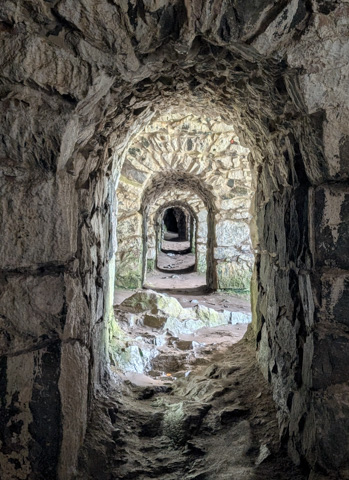
We stayed the night in the same car park that we had parked in all day because the next morning we had to be at the ferry terminal first thing for our crossing to Tallinn.

The ferry itself was massive and we were surprised at how busy it was, every single seat on board was taken. There was a long line of people outside the duty free shop, the corridors were packed and others just sat on the floor wherever they could find a space. We’ve never seen a ferry like it. It felt more like a party boat, with children’s entertainers, DJ’s and bingo!

The ferry takes around 2 hours and we soon arrived in Tallinn as the ferry terminal is really close to the old town. Conveniently there is a car park for motorhomes right next to the old town so we had no problems finding somewhere to park for our stopover.

The old town of Tallin is fairly compact and a great size for a weekend sightseeing trip.

The old town is a walled and cobbled medieval town with a big square in the middle. We stopped off for lunch at one of the restaurants near the central square and had our first taste of the famous black Baltic garlic bread, which is common to all of the Baltic countries. It is made with black rye bread and absolutely drenched in garlic butter. If you like garlic you will love this and we were to have it many times throughout our trip in this region.

During our stay in Tallin we also made time for two other stops. The first was the Seaplane harbour or Lennusadam which is a maritime museum. Here, in the massive hangars that used to house Seaplanes, is a fascinating museum, the highlight of which is a British built submarine called Lembit that you can explore inside.

Outside the hangar there are also a number of ships on the dock and in the water that you can explore including a 100 year old icebreaker with massive engines. You can go on board and walk around. The engines stretch most of the length of the ship and are three stories high.

The second place that we visited was Kadriog park which is centred around the Kadriog Palace, now an art museum. The park was built under the instruction of Peter the Great in 1718.

This was a great introduction for us to the Baltics. We loved Tallinn, there is plenty to do and see without feeling overwhelmed, which is sometimes the case with larger cities, great food and friendly people. You might want to leave the bikes at home though as the many cobbled streets make cycling around quite uncomfortable !
The North of Norway

After wending our way down and then back up the Lofoten Islands we eventually made our way onto the Vesteralen archipelago and the island of Langoya, the third biggest island in Norway.

We headed straight to the North of the island and down a pretty good unpaved road to the tiny town of Nyksund. This small fishing village was abandoned in the 1970’s but since 2003 it has seen a revival as a tourist destination, with a thriving restaurant scene (well 2 restaurants!) and around 30 inhabitants (in the summer).

The town has two rows of buildings separated by a waterway and a small protected harbour and we enjoyed mooching around the old derelict buildings from its old industrious days.

After visiting Nyksund we made our way back down the unpaved road and up to the Northern tip of Langoya and the town of Sto.

We’d come all the way to Sto for a whale watching trip that we had booked for the next day. Fortunately there was an abandoned campsite on one side of the Sto harbour which allowed us to spend the night within walking distance of the departure point for the boat tour.

The next morning at the harbour a lot of people appeared out of nowhere and in total about 60 people were loaded onto the whale watching boat. There was plenty of room in the boat’s cabin downstairs with airline style seating but as soon as we got going it became quite unpleasant as there was little air and some persistent swell so everyone relocated outside.

Up on deck there was seating for about 40 people and although Sarah was lucky enough to score a seat I was relegated to sitting in the elements on the bow of the boat which was the bounciest place.

We set off from Sto and headed Northwards towards the Bleik Canyon which is a feeding ground for sperm whales. Unfortunatley we weren’t lucky enough to see a sperm whale however it wasn’t too long after setting off that we saw some minke whales. These are sneaky whales, they only came to the surface briefly before diving back down so you had to be quick to see them.

It took us around 3 hours to reach the canyon and once here we spotted a big pod of pilot whales. We managed to have very good sightings of these small whales over the course of about an hour.

The swell calmed down in the afternoon and the water was much flatter than on the way out so the journey back in the sunshine was very pleasant. We also saw a Basking shark on the way back which is apparently a very rare sighting.

On the way back they served up an amazing fish soup made with locally caught fish. It was so delicious that we both had seconds.

The trip involves visiting the island of Anda which is close to Sto. We saw razorbills and puffins here but the highlight was a fairly large number of Sea Eagles which were both perched on the island and flying around.

It was a long day at sea, about 8 hours in total and we were surprisingly tired by the time we got back to shore so we decided to stay in Sto and have a down day, which was a good opportunity to get our laundry done – a service that was provided at the local café.

When we eventually left Sto we headed to the next door island, Andoya and drove to the Northern tip of this island where there is a ferry across to the island of Senja. We arrived at the ferry queue 2 hours before the departure time and were parked in lane 3 of 4 lanes. When the ferry was loaded only those in lanes 1 and 2 got on and the next ferry wasn’t until 9am, the next morning. We decided to move into lane 1 and spend the night in the queue as did many others, with those in cars heading off into town to find accommodation, leaving their cars in the queue. By 7pm that night lanes 1-3 were all full. This was the busiest ferry crossing that we had seen which wasn’t helped by the fact that it was also one of the smallest ferries.

Resigned to spending the night here we went into town to look around – although there wasn’t much to see. We did find a wine bar and sat down for a drink. This was the first time that we’d actually been to a bar in Norway and our concerns about the cost of the drinks was realised as a bottle of beer and a small glass of wine came to €20! Needless to say we did not stay for a second round.
In the morning we were pleased that we managed to get loaded onto the first ferry and watched from the back deck as a lot of the queuing vehicles failed to board. It is clear that this is a real bottleneck and if you decide to travel this way you need to leave plenty of time.
I can understand why lots of people want to go to Senja though. The drive across the island was absolutely spectacular as we drove around the fjords that split the island.

We stopped for the night in a beautiful valley, ooposite a highland valley with a waterfall cascading down from it.

The following day we started our drive across the island and stopped off at a small parking area next to the coast.

This was the the start of a short walk down a rocky coastline to some pools with amazing reflections of mountains across the bay. It was fun to clamber around the rocks to get the best angles.

The best know hike on Senja is the Heston hike where you get views of the foreboding Segla peak. This is a climb straight up from fjord side to a ridge with great views across to a jagged pyramidal mountain that towers over the fjord with a sheer drop.

Once you reach the top there are incredible 360 views of fjords and mountains. It’s a pretty easy hike and the payoff on reaching the top is amazing.

After the Heston hike we drove to the ferry to leave the island. Fortunately the queue for this was nothing like the queue to get onto the island and we easily made the first ferry. This carried us across to the mainland, near the city of Tromso.

Before hitting Tromso we stopped in at the island archipelago of Sommaroy, which in the sunshine looked more like it was in the Pacific than the Arctic. It was only a quick stopover as we couldn’t find anywhere to park for long. While here, we took the opportunity to stretch our legs on the beach but unwittingly disturbed a nesting bird. Sarah wisely backed away at its cries but I was a little slower to react and as a result was dive bombed repeatedly before it very accurately shat on my head, much to Sarah’s delight!

We arrived in the pretty town of Tromso on a lovely sunny day. It is definitely worth a visit although we were there only briefly. We managed to park in the downtown area and walked along the waterfront ticking off the main tourist sights.

The highlight of visiting Tromso for us were the botanical gardens. These are the largest Arctic Botanical gardens in the world and have arctic plants from around the globe. It was clearly a great time to go and many of the plants were in bloom.

After leaving Tromso we stopped briefly at the Arctic Cathedral which is a modern building. We didn’t want to pay to go inside so we only admired the architecture from the outside.

Tromso was the furthest North we were going on this trip and from here we started to head back south. We stopped off for a very windy night on the pretty Storfjord before getting up early the next day and heading to the trail head for the hike to the Steindalsbreen Glacier.

It was a grey overcast day when we arrived but the forecast was for gradual improvement so I set out on the hike to the glacier. This a fairly straightforward 7km hike, which takes you through forest alongside a river before climbing up and over the first moraine of the glacier. You then trek through a big glacial valley before climbing over another moraine and descending down to a glacial lake with a huge glacier tumbling into it.

There is only around 600m of climbing to get to the glacier but because it is pretty remote there aren’t many people on the hike. I hadn’t had any views of the glacier on the hike up because of the low cloud but as I arrived the clouds began to clear and I was rewarded with some great views.

This was a great hike to sign off our time in Norway but we had one more destination before driving inland and into Sweden and that was the town of Narvik.

Narvik is a modern town with not a lot to excite tourists. It does have a few museums and we choose (perhaps wrongly) to go to the car museum. This is not something I would recommend if you happen to visit the town. We did however enjoy a very good lunch at a fish restaurant (Fiskehallen), which was also fairly reasonably priced. The arctic char in particular was excellent.

From Narvik we started to drive East and after stopping for a night next to a beautiful mountain lake we entered Sweden and said goodbye to Norway after a fantastic couple of months (although the second half with sunshine was definitely better!).
