North Macedonia – Part 1
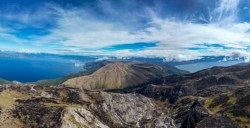
We didn’t have to travel far to cross from Lin on Lake Ohrid into North Macedonia. It was an easy crossing with the ability to buy insurance at the border. The town of Struga (also on Lake Ohrid), is just a short distance away where you can easily park up on a quiet side street and walk into the centre to pick up some local currency, sim cards and anything else you may need.
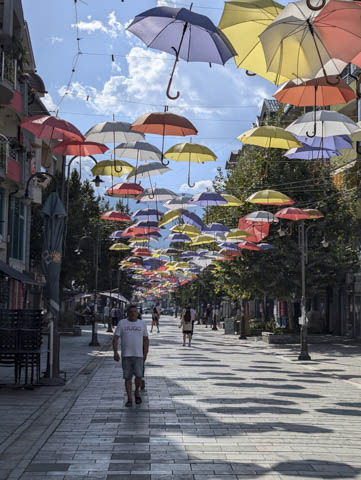
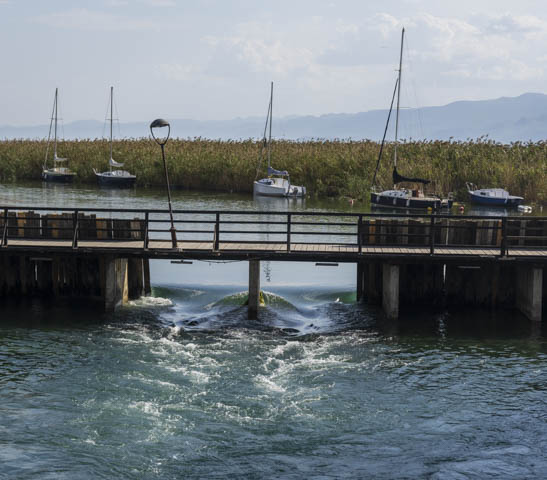
Struga has the feel of a holiday destination with hotels on the lake shore lined with sun loungers and plenty of bars and restaurants to choose from. The Black Drin river runs from the lake and is a good place to go for a stroll or a swim to cool off from the heat of the day.
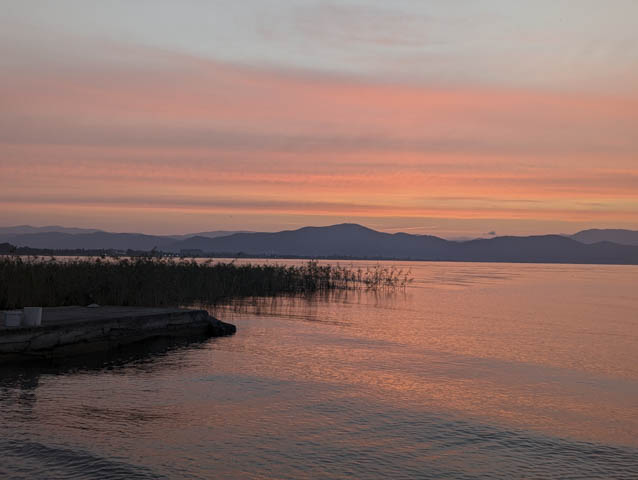
From here we chose one of the many campsites that line the shore before jumping on our bikes and heading off to explore the area.
A short cycle from the campsite is Kalista Monastery. The monastery’s church has a great position overlooking Lake Ohrid and unusually, we were able to access the upper floor of the church which provided a great viewing platform. While we were visiting, a boat arrived with a bride and groom and their wedding party. Not a bad wedding venue!
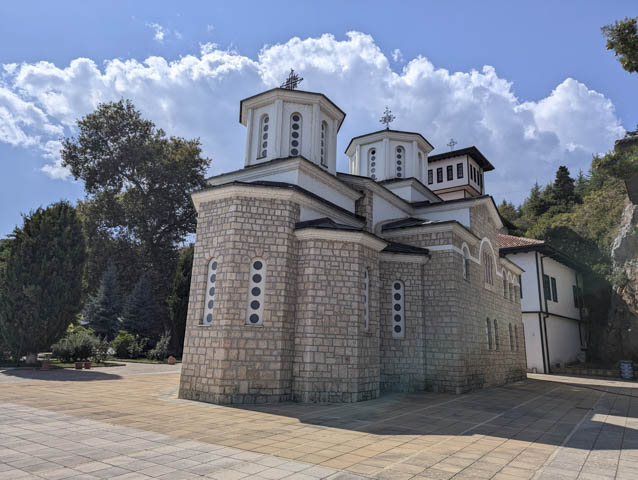
The real reason for visiting this monastery complex however is not the beautiful lakeside location, attractive monastery church, or the smaller Church of St. Peter and Paul, it is the connected 14th century cave church. There is a small fee for entering the cave church but as there wasn’t anyone on the desk when we arrived we entered without charge, although the lights were off and we had to sneakily locate the key to turn them back on!
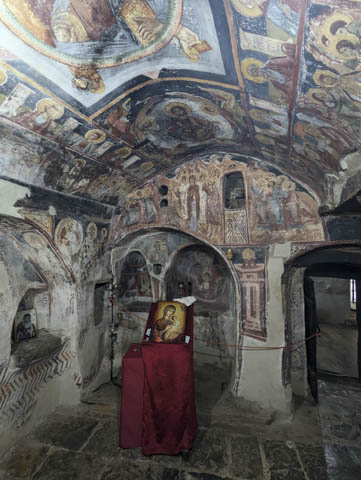
About 500 meters further along the coast, past a hotel and leisure complex, is another one of these very cool cave churches, the 14th century cave church of St. Athanasija. Based on the style of the frescoes it is thought that they were painted in 1360’s. We thought that it may be locked but upon climbing the metal staircase we found it open and unattended.
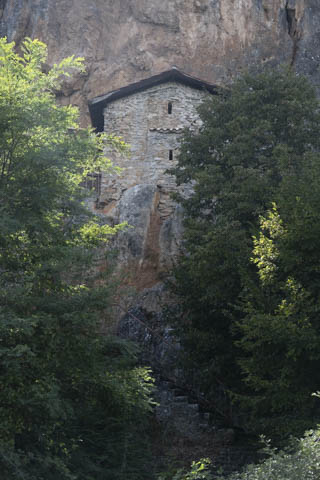
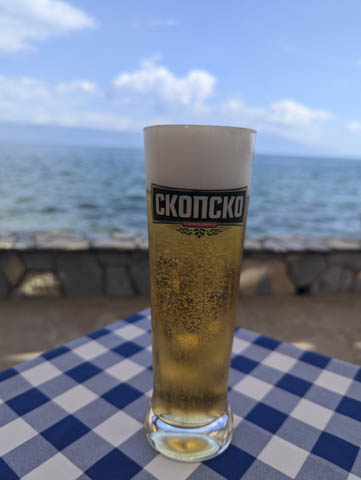
Having come to the end of the path, we walked back to retrieve our bikes and headed to a lakeside bar to quench our thirst.
The following day we drove further along the shore of the lake to the attractive but bustling town of Ohrid. As it happened, we turned up in Ohrid on Independence Day, so the place was pretty busy with locals enjoying a long weekend. There is a lot to explore here and enough cafes, bars and restaurants to cater for everyone.
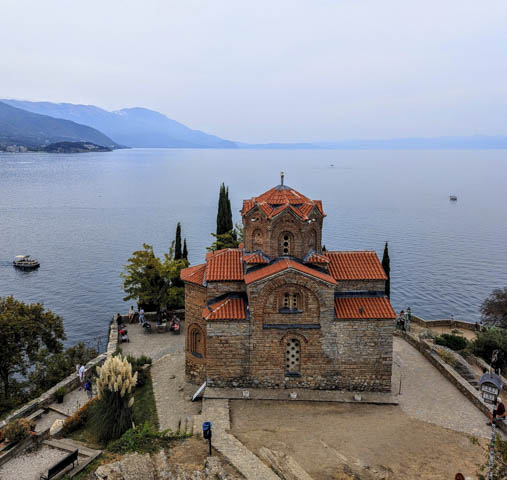
The walking tour takes you down narrow cobbled streets, past numerous churches, along a cliff-side boardwalk, past beautiful waterfront restaurants where we decided to stop for a leisurely lunch and a glass or two of wine, before climbing up to the picturesque Church of Sveti Jovan overlooking the lake.
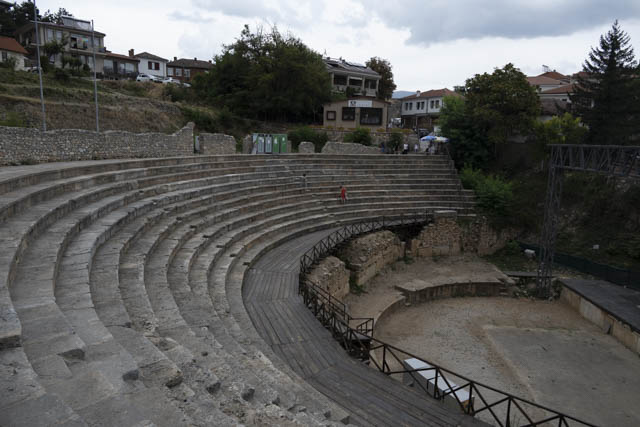
Next up was the Hellenistic Amphitheatre that dates back to 200 BC. Later, during Roman times, as well as plays and performances, it was also used for gladiator fights and executions. The latter is believed to have made it unpopular with locals and so, with the downfall of the Roman Empire, the theatre was buried and consequently well preserved. It wasn’t until the 1980’s that it was accidently discovered during building works in the area.
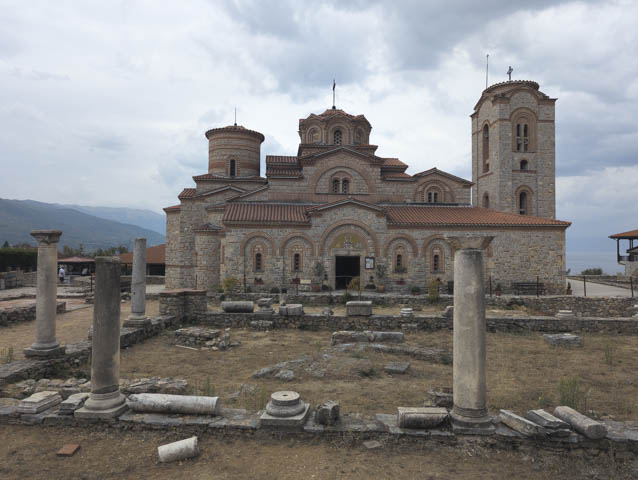
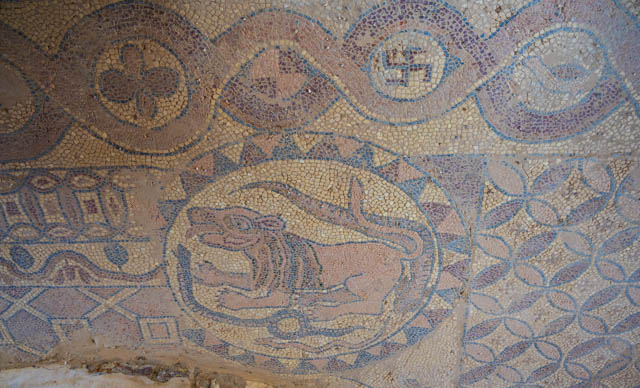
From here we walked to the archaeological site of Plaosnik – which contains the church of St. Clement from 893, the ruins of a 5th century basilica and some impressive floor mosaics.
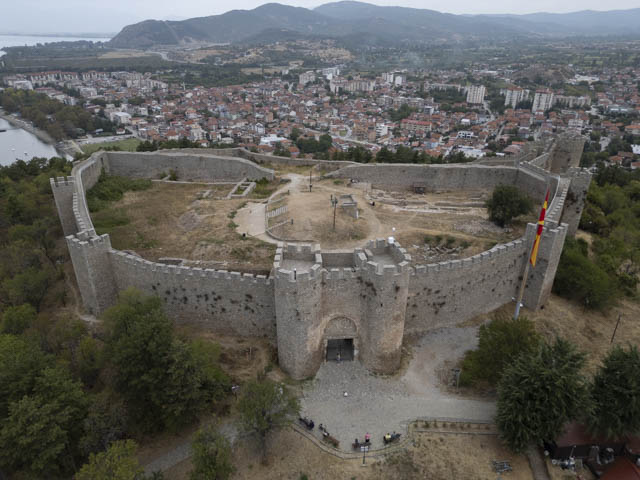
And, last but not least, we completed the walk to the very top of the hill to the gates of Samuel’s Fortress – one of Macedonia’s largest medieval fortifications dating back to 209 BC. Unfortunately for us, having made it all the way to the top, we found that it is closed on Mondays.
Ohrid is sometimes referred to as the Jerusalem of the Balkans (because it once had 365 churches), but there is a fee to enter many of the remaining churches and as photography is also forbidden we decided to give them a miss.
With a full day of sightseeing behind us and a couple of lunchtime drinks, we decided to stay put for the night in the lakeside car park where we had parked to visit the town. As a general rule, we prefer not to stay in town car parks if at all possible as they tend to be the meeting place for groups of teens and couples until the early hours of the morning, however thanks to an evening of torrential rain we spent a very peaceful night here!
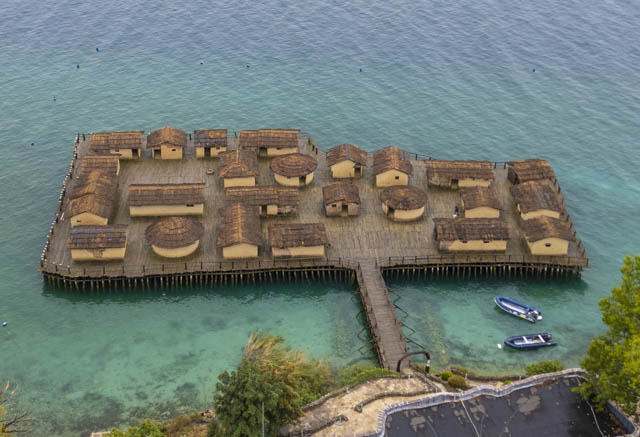
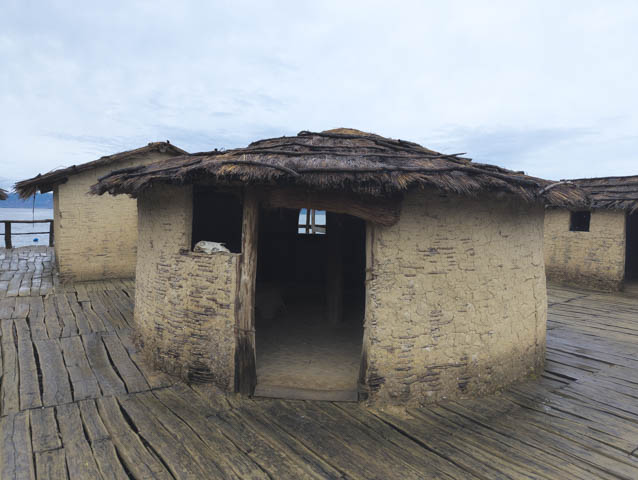
The next day we drove to the eerily named, Bay of Bones, museum on water. This is a reconstruction of a prehistoric settlement on Lake Ohrid, dating back to between 1200 and 700 BC, where, rather than live on the shore, the villagers drove up to 10,000 wooden piles into the lakebed and built their modest homes over the water. Historians have dated the settlement to the end of the Bronze Age and beginning of the Iron Age and, given its fascinating history, this should be a really interesting attraction. However, there is minimal information at the site to bring this attraction alive and it really feels like with a little effort they could make the experience far more interesting.
Further still along the shore is the Sveti Naum Monastery. This was unlike any other monastery we had seen so far on this trip, in that it seemed more like a monastery theme park. There is a boating lake with boat trips to the Springs, roaming peacocks, restaurants, a hotel and souvenir shops lining the promenade up to the monastery. The place is a money-making machine with coachloads of people being bussed in, including from over the border in Albania. The original church on this site was built in 900 but this was destroyed by The Ottomans in the 15th century and the current Church of Sveti Naum was rebuilt in the 16th and 17th centuries.
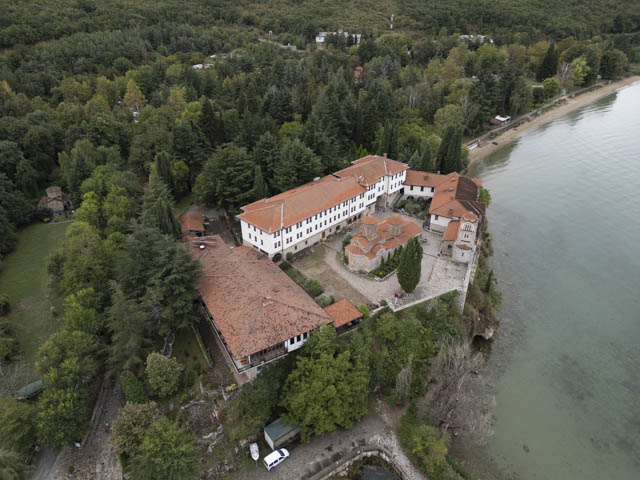
After the recent hustle and bustle we decided to head into the mountains for a little peace and quiet to Galicica National Park which provides fantastic views of both Lake Ohrid and Lake Prespa. This is a pricey park to spend the night though with an entrance fee the equivalent of €13 (600 dinar for the vehicle and additional 100 dinar per person)! Having spoken to fellow travellers who visited the park recently and were only charged for the vehicle, it is possible the additional 200 dinar was a nice little tip for the ranger!
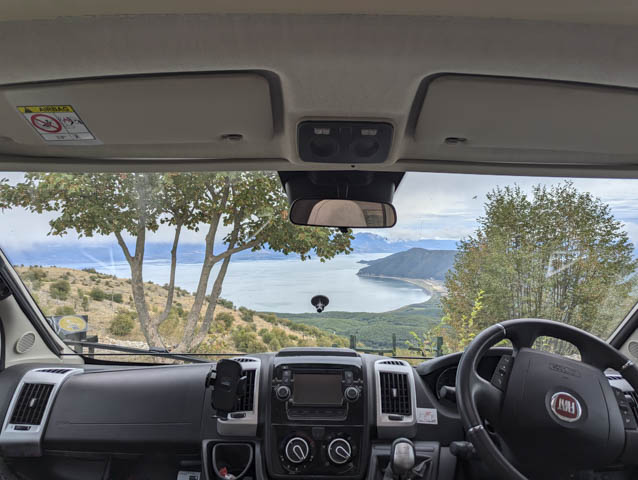
There is a very nice park-up along a narrow spur road with a beautiful view of Lake Prespa, which had barely any passing traffic, so we were a little surprised when three 4×4 vehicles on a tour parked up around us and took their groups to the view point where they gave them some local information about the area. However, the good thing about being this high is that it is pretty cold out of the sun, so it wasn’t long before we had the place to ourselves again.
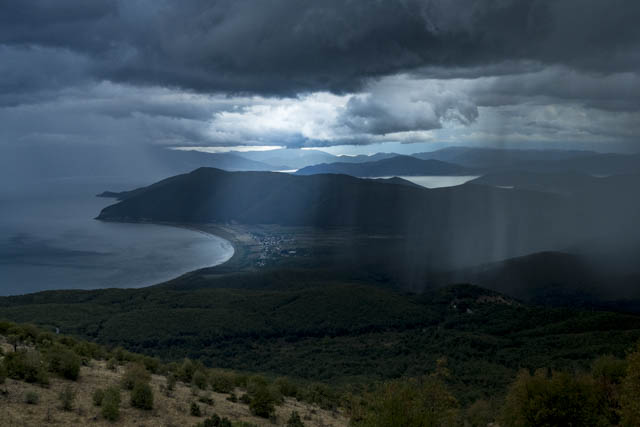
There are lots of hikes in the park and the next morning I set off on the hike to Magaro Peak. The first section is a steep hike up through forest and into a gully but eventually you reach a crossroads at a saddle. There is a choice of two directions but both go to the same place. I chose the steeper of the two and after another 30 minutes or so of climbing along a ridge and around a cirque there was a traverse across to the peak. The views from the peak aren’t actually as good as the views from the route up, where you can see both Lake Ohrid and Lake Prespa at the same time.
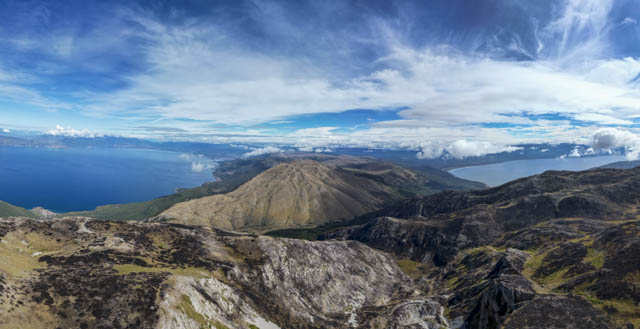
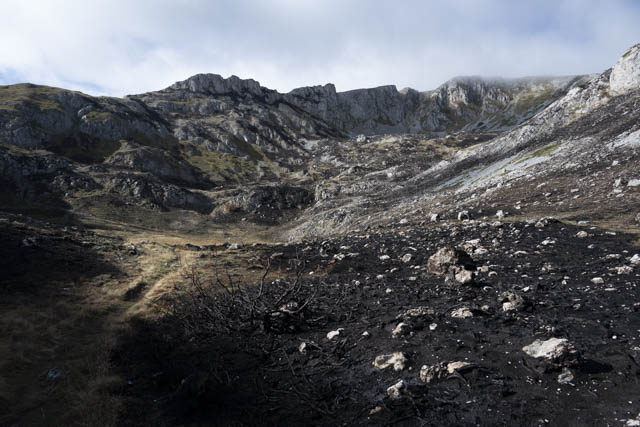
For the route down I looped around the other way which Is a bit longer and the views definitely weren’t as good. There had also been a forest fire come through this area recently and there were still lots of patches of slightly smoking ground !
Having hung around the South Western corner of the country for a while it was time to start heading north and the next stop on our clockwise circuit around the country was Mavrova National Park and the Monastery of Sveti Jovan Bigorski. Unlike Galicica, there was no fee for entering this park. It is a beautiful drive following a winding river through a narrow gorge and is home to the country’s biggest ski resort in Mavrova town.
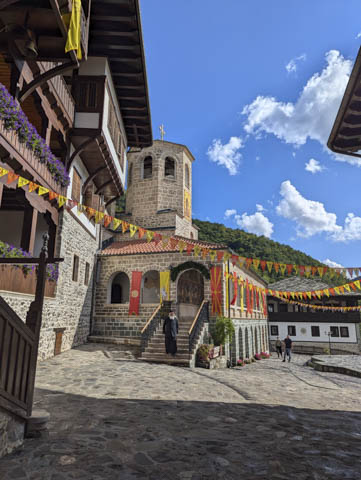
The monastery of Sveti Jovan Bigorski (St. John the Baptist), is a Byzantine monastery from 1020 which has been painstakingly restored and, from its hillside perch, has stunning views of the surrounding mountains. While the monastery itself was quite busy with visitors, there were very few people elsewhere in the park and we spent a quiet night on a grassy picnic area next to a river with only a couple of cute stray dogs for company.
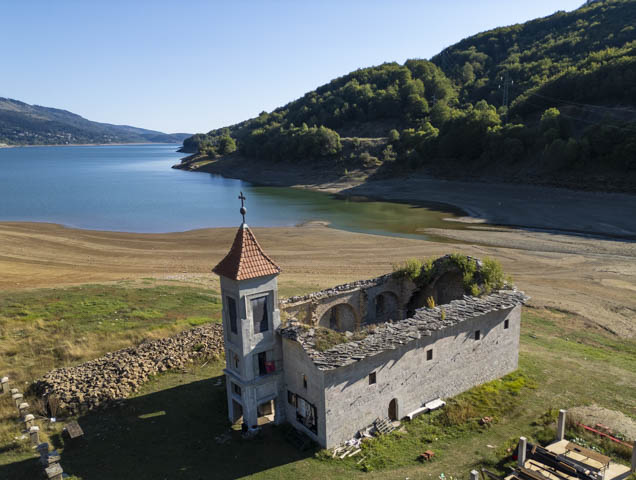
We ventured into Mavrova ‘town’ the next day which is no more than a village really but it is in a lovely setting overlooking Mavrova lake where we visited the abandoned roofless church of St. Nicholas with its impressive tiled floor. What’s even more impressive is that since 1953 the church has been submerged on and off through the seasons by the lake depending on the water content and yet it’s still standing. There are even objects in the church which suggest that it is still in use despite the new church in town.
 FromAtoB