Magical Damaraland
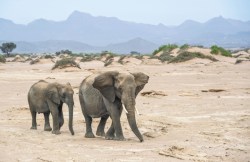
It was going to take a lot to live up to our experience in Etosha and we weren’t quite sure what to expect as we headed towards Damaraland but we were feeling pretty positive as Namibia hadn’t disappointed us so far.
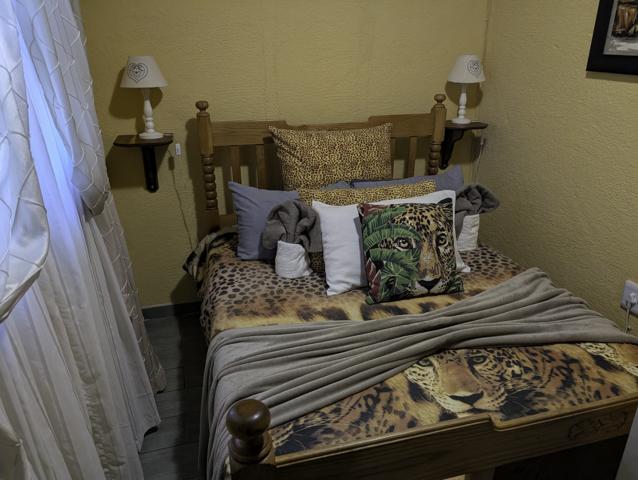
We stayed the night in a fairly eclectic guest house in a small town called Kamanjab, where there was very little to do other than to visit an ancient rock engraving site.
The engravings (called Peet Alberts), which are the second largest concentration of rock engravings in Namibia, are on private land, so in order to visit them you have to get a key to the gate from Oppi-Koppi Rest Camp and then drive 5km out of town to the site.
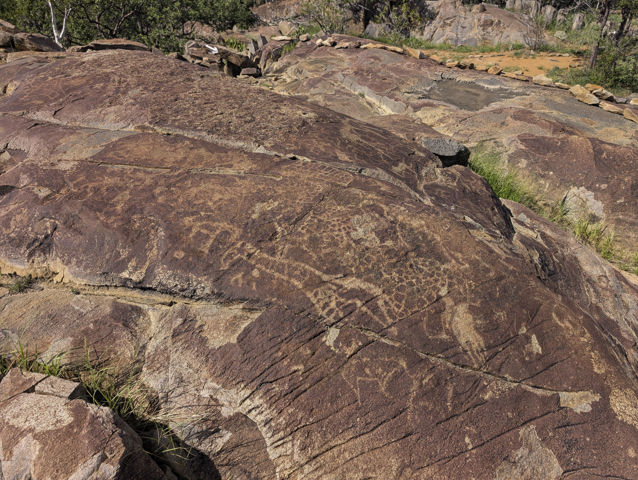
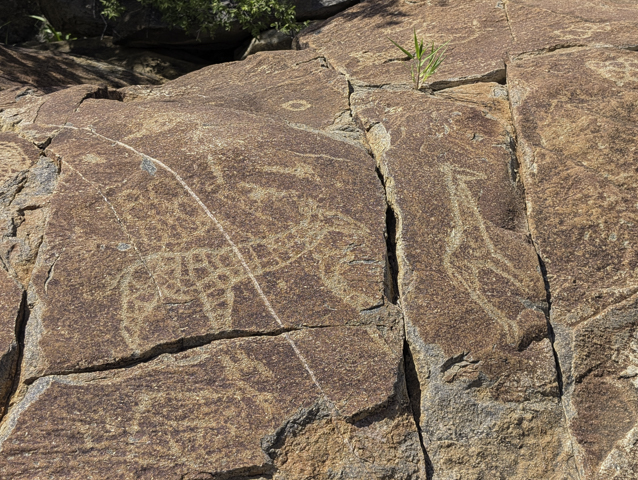
There is a short walk up a small hill of tumbled rocks to the top where a series of painted white arrows direct you around the animal and abstract rock engravings, of which there are said to be between 1,200-1,500. The engravings were created by two distinct ethnic groups, the San/ Bushman are responsible for the animal engravings which could be up to 25,000 years old and the more recent geometric abstract designs are those of the Khoekoen people, which are dated between 400-2,500 years old.
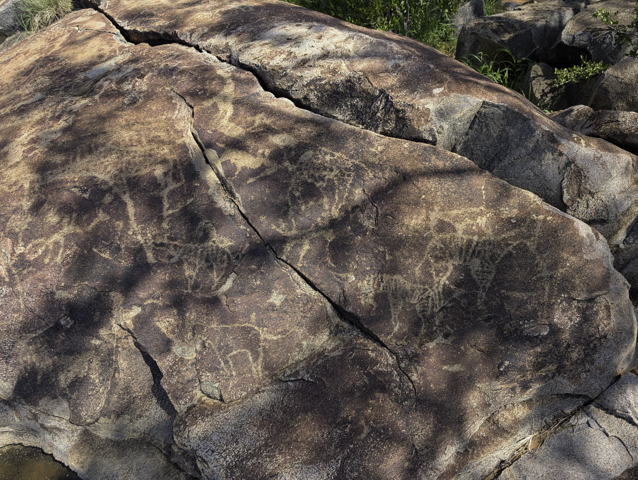
The engravings mostly feature animals, in particular giraffes as the larger the animal the more supernatural potency they were considered to have as, for the Bushman, the art is part of their Shamanism religion and this site may have been considered a gateway to the spiritual world. Other images that can be found here are zebra, elephants, oryx, human figures, animal prints and a human footprint amongst other things.
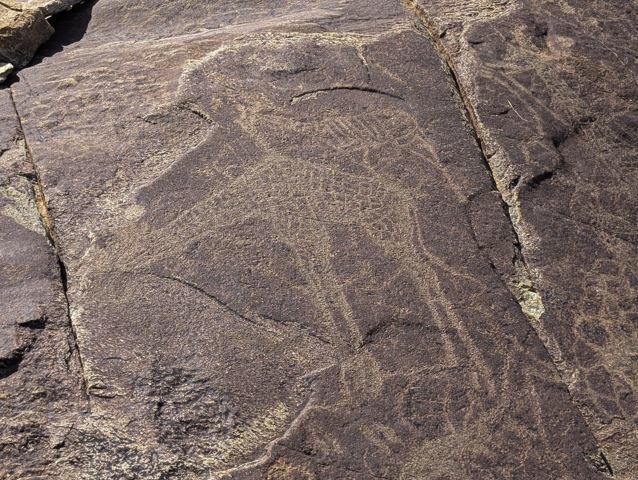
It was amazing being able to wander around the rocks at our own pace, discovering the engravings with no one else there and not something you would be able to do in many places around the world.
After this brief excursion we returned the key and left Kamanjab heading South on a gravel road towards Twyfelfontein, stopping on the way to visit the Petrified Forest.
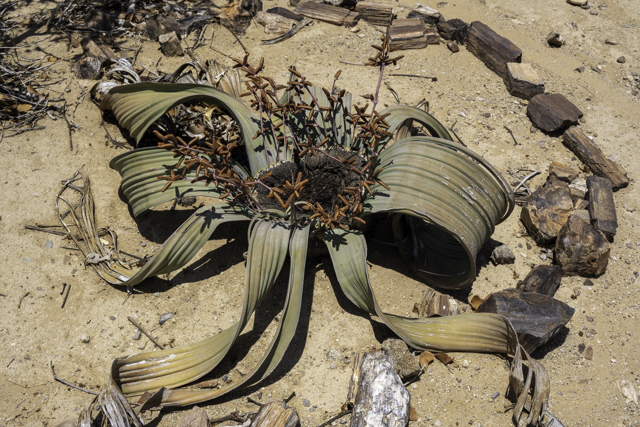
This tour requires a guide to walk you around the site where we were first shown the famous Welwitschia plants. These are amazing plants that have adapted to desert-like conditions and very low rainfall (they have had no rainfall in this area for 2 years to date). The plants have only two very broad rubbery leaves which become split over the years by the action of the wind. These plants can live to over 1,500 years old and are the longest lived plant in the world.
A few of the petrified trees have been exposed by erosion in this area. It is believed that they were actually deposited here millions of years ago when Africa was still part of Gondwanaland, having been moved hundreds of miles from what is now central Africa by floodwaters.
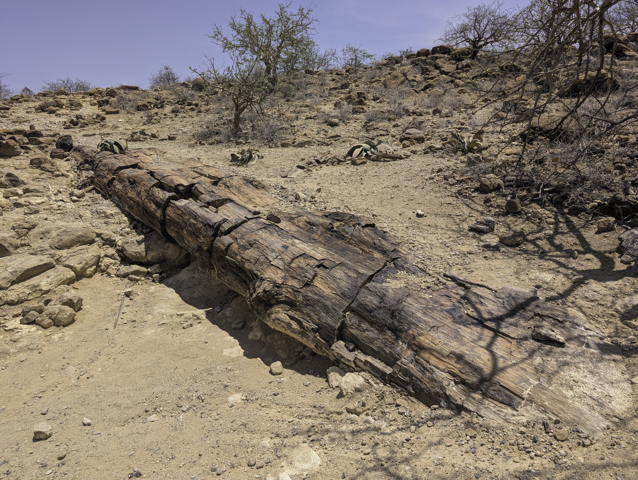
The trees were buried and under extreme pressure minerals were pushed into their structure gradually turning them to stone but keeping the form of the trees, including the rings and form of the bark. They have taken on different colours depending on the minerals that they absorbed. This was an interesting stopover but walking around in the searing mid afternoon sun wasn’t the best and we were grateful to get back to the air-conditioning of the cab and continue on our way to Twyfelfontein.
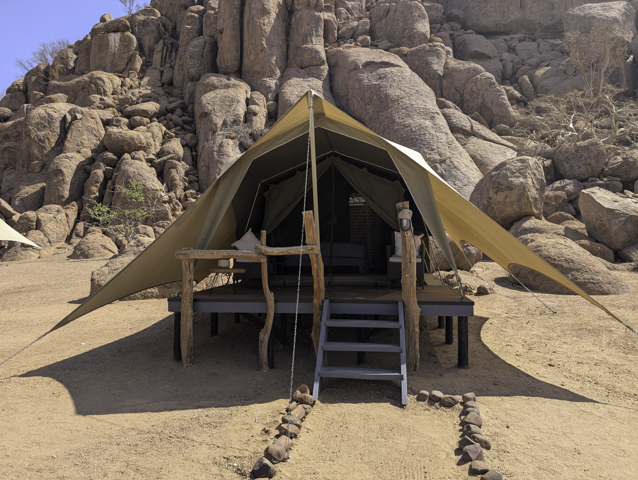
In Twyfelfontein there is a real lack of accommodation choices so we booked a tent at Twyfelfontein Adventure Camp which was way over our normal budget. This was not your normal tent though – think luxury glamping, it even had a bathroom. In fact the whole place was amazing, a real treat for us after some of the dubious backpacking hostels we have stayed in on this trip.
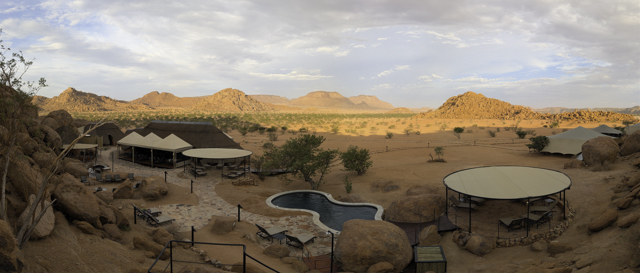
This part of the world is very hot so early morning and late afternoon are the best times to move around – we were lucky to be staying somewhere with a swimming pool (in fact it had 2) to allow you to cool off in the baking afternoon.
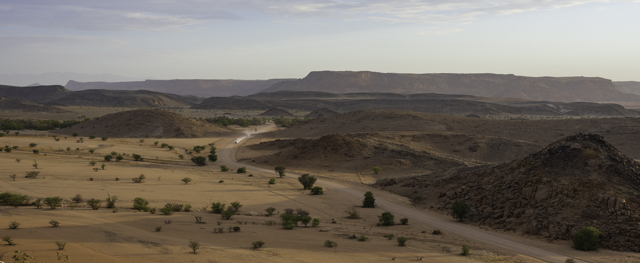
The tented camp was at the foot of a rocky hill on which live a troop of baboons and in the afternoon they would come down from the hillside to drink from the small artificial waterhole in front of the camp. In the night you could hear their cries from the rocks behind the tents.
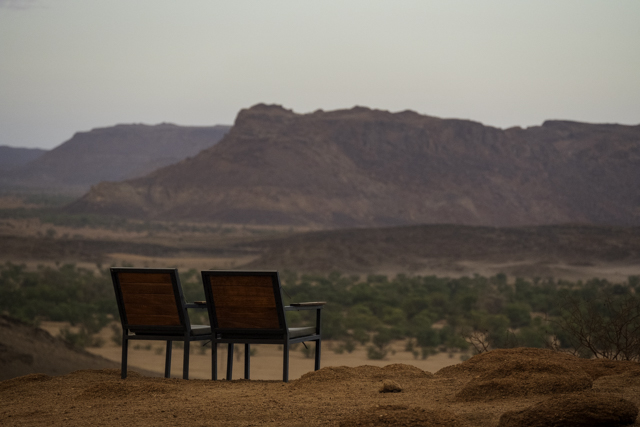
One of the best things about the camp was that they had built a staircase and path up the rocky hill to the top where they have set up a small bar. This made it the perfect place for a sundowner as the views from the top were beautiful in the setting sun.
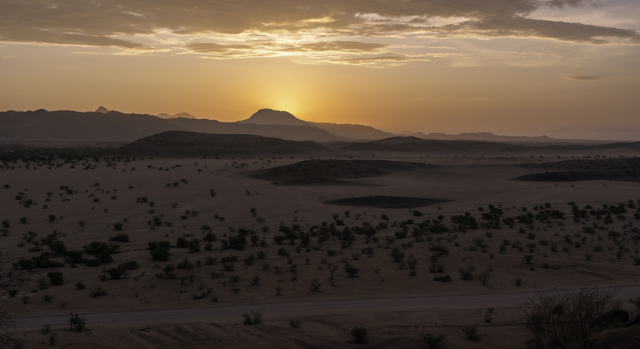
The camp was also half board and the food was excellent, each evening they served up a great Braai for dinner.
There were two reasons we had come to Twyfelfontein: the first is that it is a world heritage site for its bushman rock art and the second is that it is possible to do a game drive to see desert adapted animals.
We booked a game drive through the lodge and it started immediately after an early breakfast when we were loaded into the back of an open seated Landcruiser (unfortunately in the bumpy back seats). Almost immediately we turned off the gravel road onto a track and then dropped into a dry sandy riverbed. This was going to be a bumpy trip!
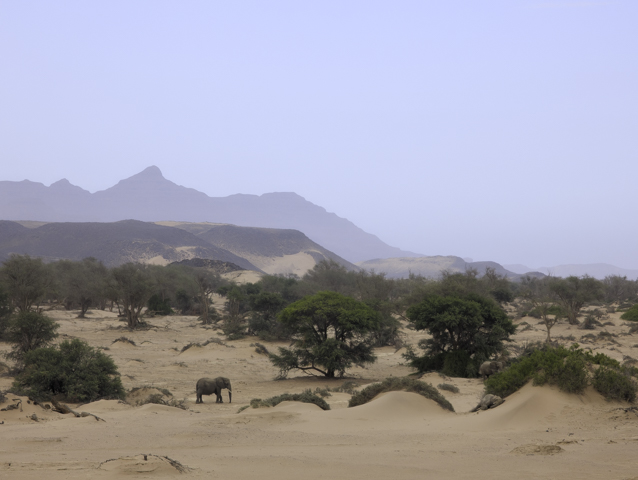
As there hasn’t been any rain in this area for 2 years all the rivers are dry and the concern from the locals about the effect of global warming is palpable, however there is still some underground water so there are plenty of green trees lining the river beds and it is these which provide food for the majority of the animals to be found in this area.
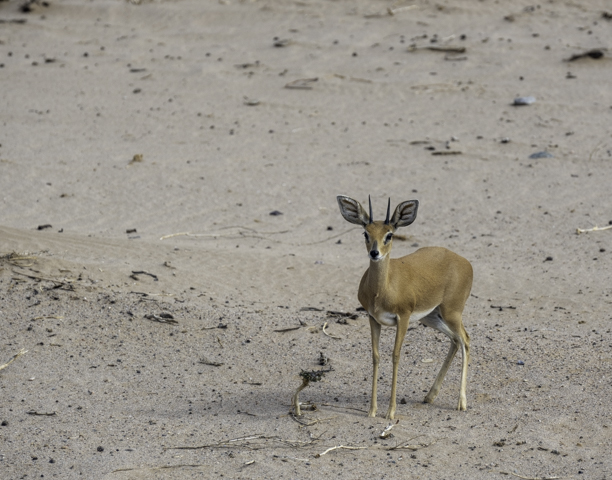
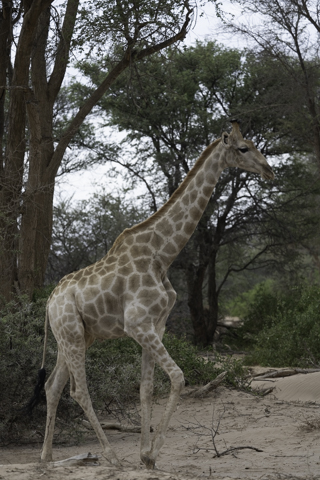
Our first spot was a small deer and then we came across some giraffes and a sizeable herd of ostrich but we weren’t here to see those.
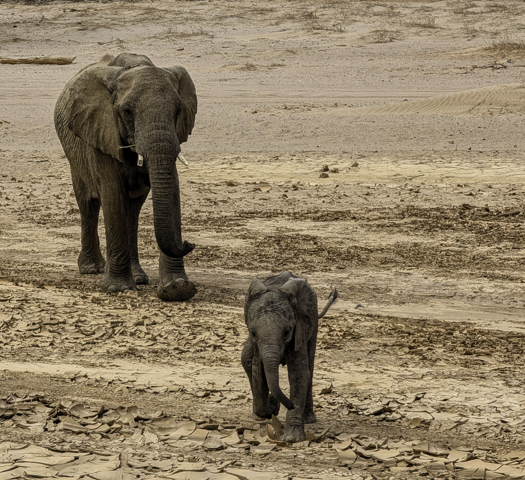
We had come to see the desert-adapted elephants and it wasn’t long before we found two bull elephants grazing on a fallen tree. They are not a distinct sub-species but they have longer trunks (for digging for water), bigger feet (for walking on sand) and they only need water every 4 days. They are also more aggressive than normal elephants – I suppose only drinking every 4 days makes them tetchy.
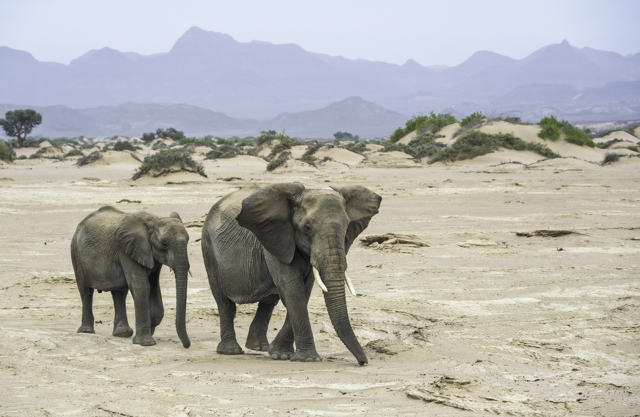
Our guide was an amazing tracker and he was able to follow the elephant footprints in the sand – distinguishing the age of the prints from how faded they were by the wind.
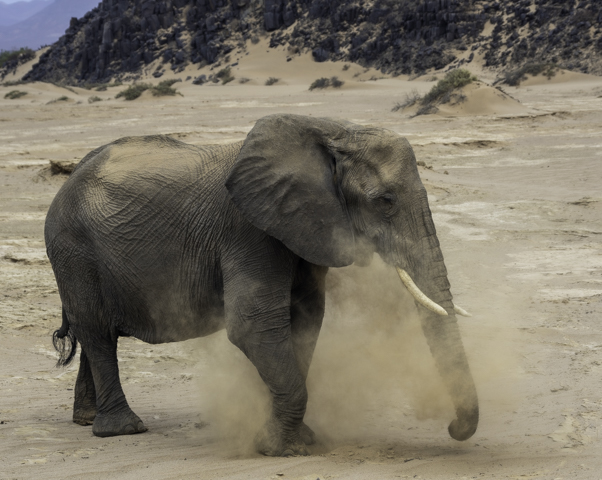
We spent a couple of hours tracking down a couple of groups of elephants with babies in tow and had some really good encounters with them.
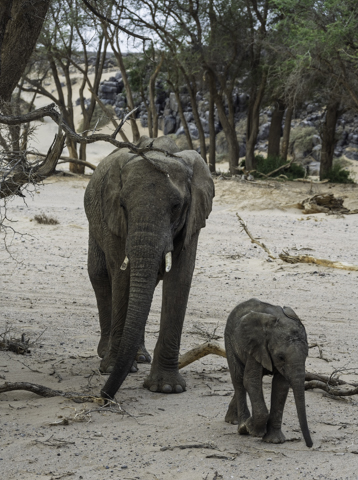
It was a great trip and highly recommended even though by the end of it we were feeling pretty beaten up as the back of the Landcruiser was like a rollercoaster.
The Unesco rock art site was only a short distance from the camp and we decided to visit first thing the following morning when it was bit cooler. A good decision as there was no shade anywhere on the walk through the engravings.
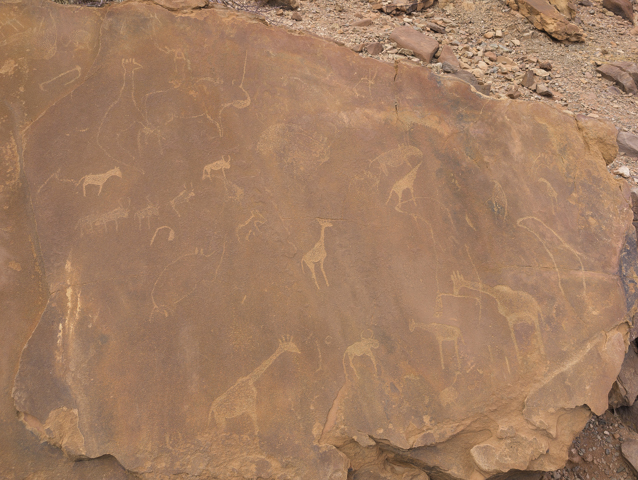
This site requires you to have a guided tour but you have your own private guide. The engravings here are younger than those at Kamanjab, only between 3 and 5 thousand years old! However this meant that they were a bit more complex and better preserved.
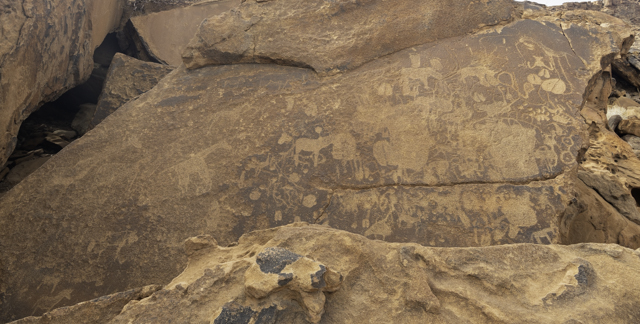
Researchers think that some of the engravings served as a map to the nomadic San people. They would indicate sources of water and the presence of game and dangerous animals to help other groups of people who moved through the area.
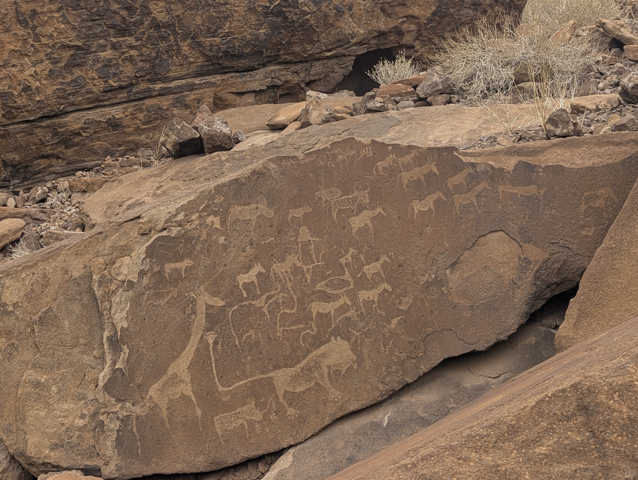
The most famous of the engravings here shows a lion with a strange tail which represents a shaman.
After our luxurious break at Twyfelfontein we continued to move South through the beautiful landscape to the town of Aus near the Brandberg mountains. The gravel roads up until this point had been in good shape but this one was definitely hard going with some deep sand, potholes and corrugations.
Aus is a mining town and doesn’t have a whole lot to recommend it but it is close to a short hike to some paintings in the Brandberg mountains that we wanted to see.
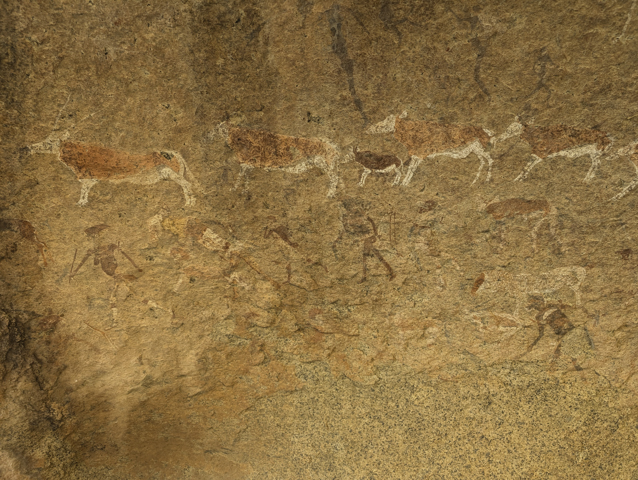
This is more Bushman art, but younger still, at between 2 and 3 thousand years old and these are actually paintings rather than engravings.
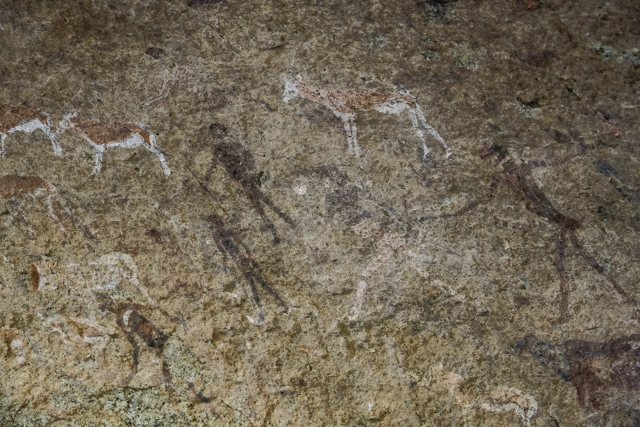
The site of the paintings is actually a 2.5km hike up through a dry river valley and you have to have a guide to take you there.
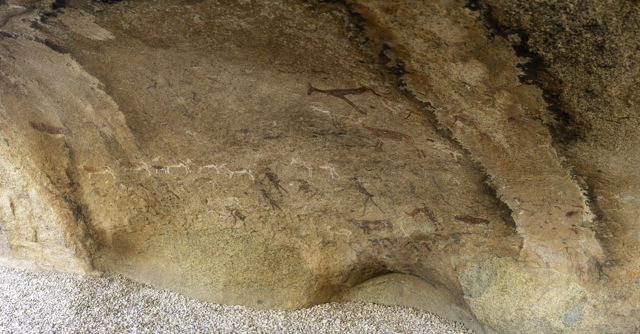
The paintings themselves are in a small cave formed by an overhang. The famous white lady is in fact neither white nor a lady and is said to be the representation of a shaman. It is now very faded, a process which has been accelerated by water being poured over the paintings for many years in the past to ‘bring out the colours’ for visitors. Our guide believes that within10 years the image may have completely gone. I hope he is wrong and on the plus side while we were there it was good to see a team assessing the site for UNESCO heritage status.
We managed to get back to the car before the temperature became too unbearable and we left Damaraland to head back to the much cooler coast.
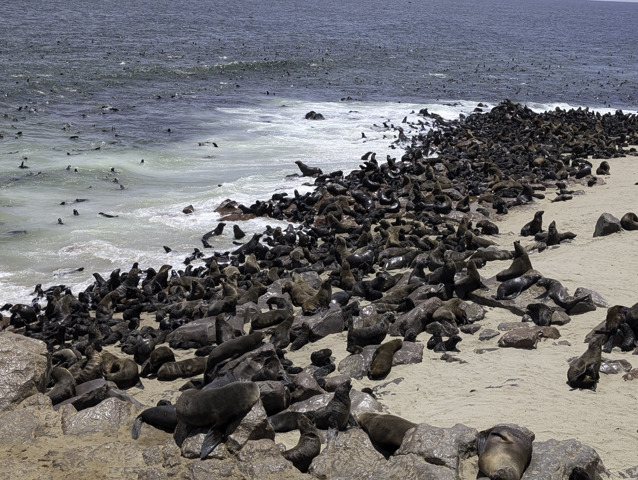
After an easy drive along a rare tarmac road towards the coast and then a very good salt road (which are great until it rains), we reached Cape Cross. Cape Cross is the largest seal colony in Africa with as many as 250,000 seals.
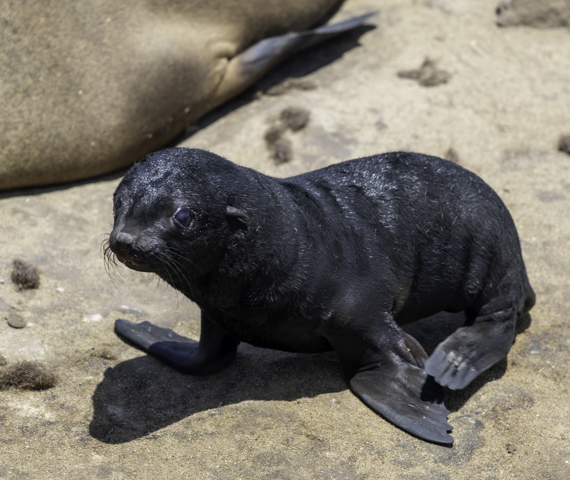
When you arrive here and open the car door the first thing that hits you is the over-powering stench of the seals. It’s so bad it feels like a physical blow. I don’t think that I’ve ever actually smelt something so bad.
The smell was actually so bad that the day after it still permeated our clothes and we had to wash everything.
At Cape Cross there is a boardwalk to view the seals and they are everywhere, under the boardwalk, next to it and lining the rocky beach. It’s a noisy place to be as all those seals make a real cacophony.
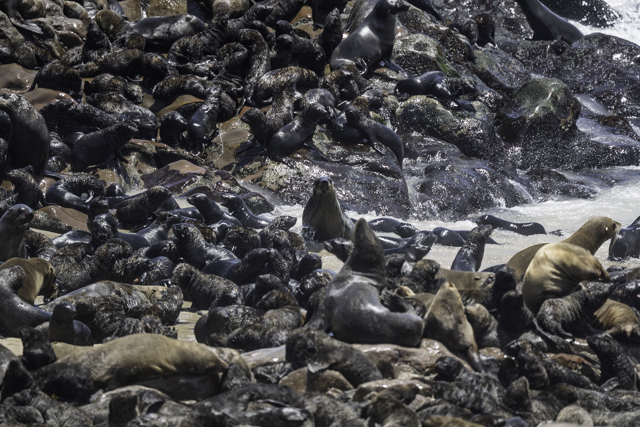
By the water there were hundreds of baby seals, with only a relatively few adults as most of the adults would be at sea fishing for food.
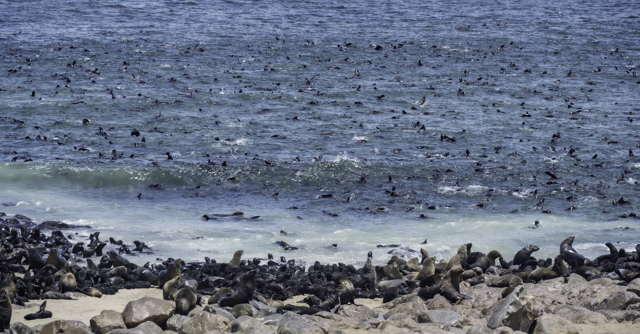
We could only stay here for around 30 minutes as eventually the stench overpowered us and we retreated to the car, which also stank for days afterwards, continuing our drive along the coast to Walvis Bay which was a convenient stop on the way to our next destination.
 FromAtoB