Christmas in Ancud
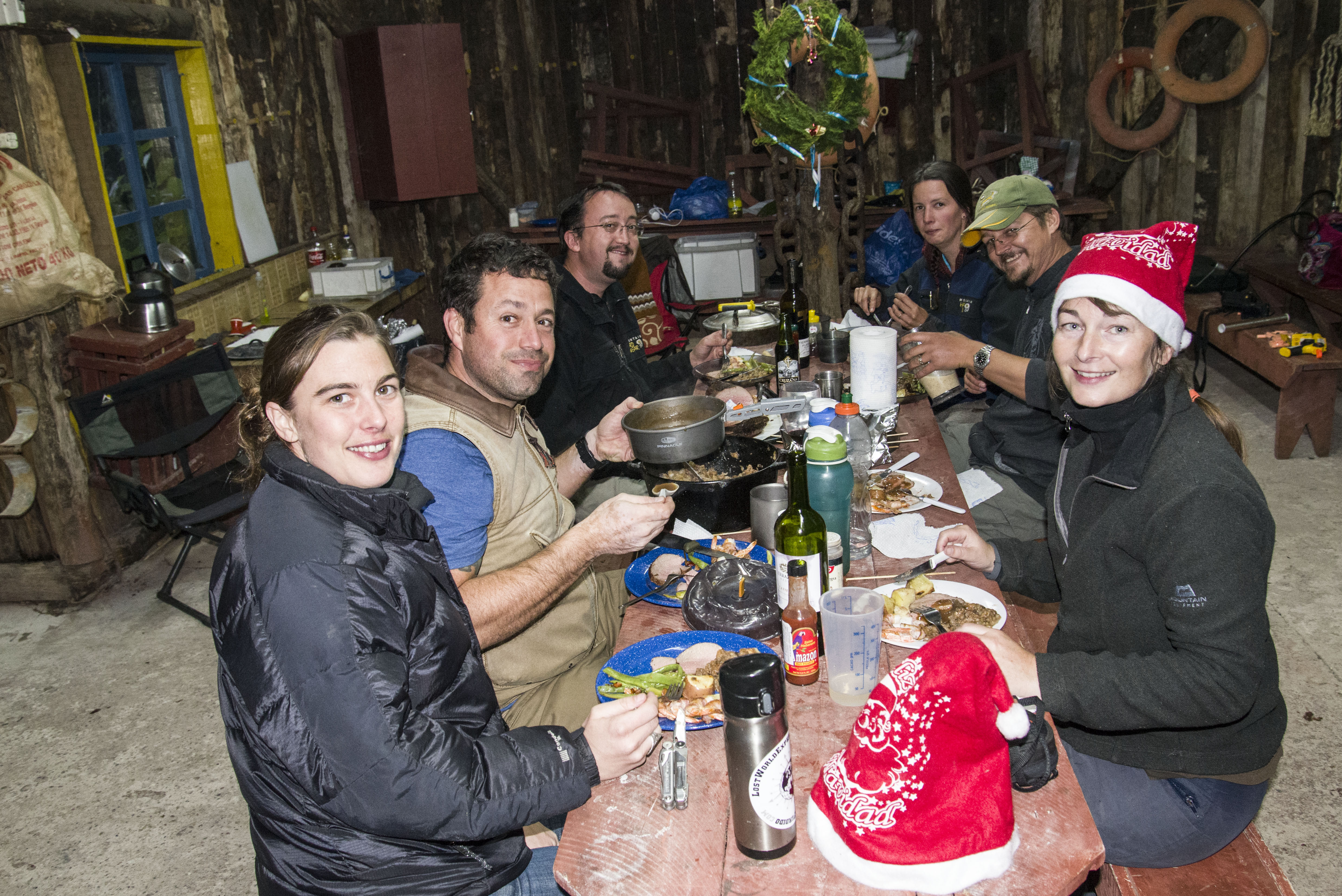
We had arranged with our friends from www.liferemotely.com to meet up in a campsite in Ancud so that we could spend Christmas together.

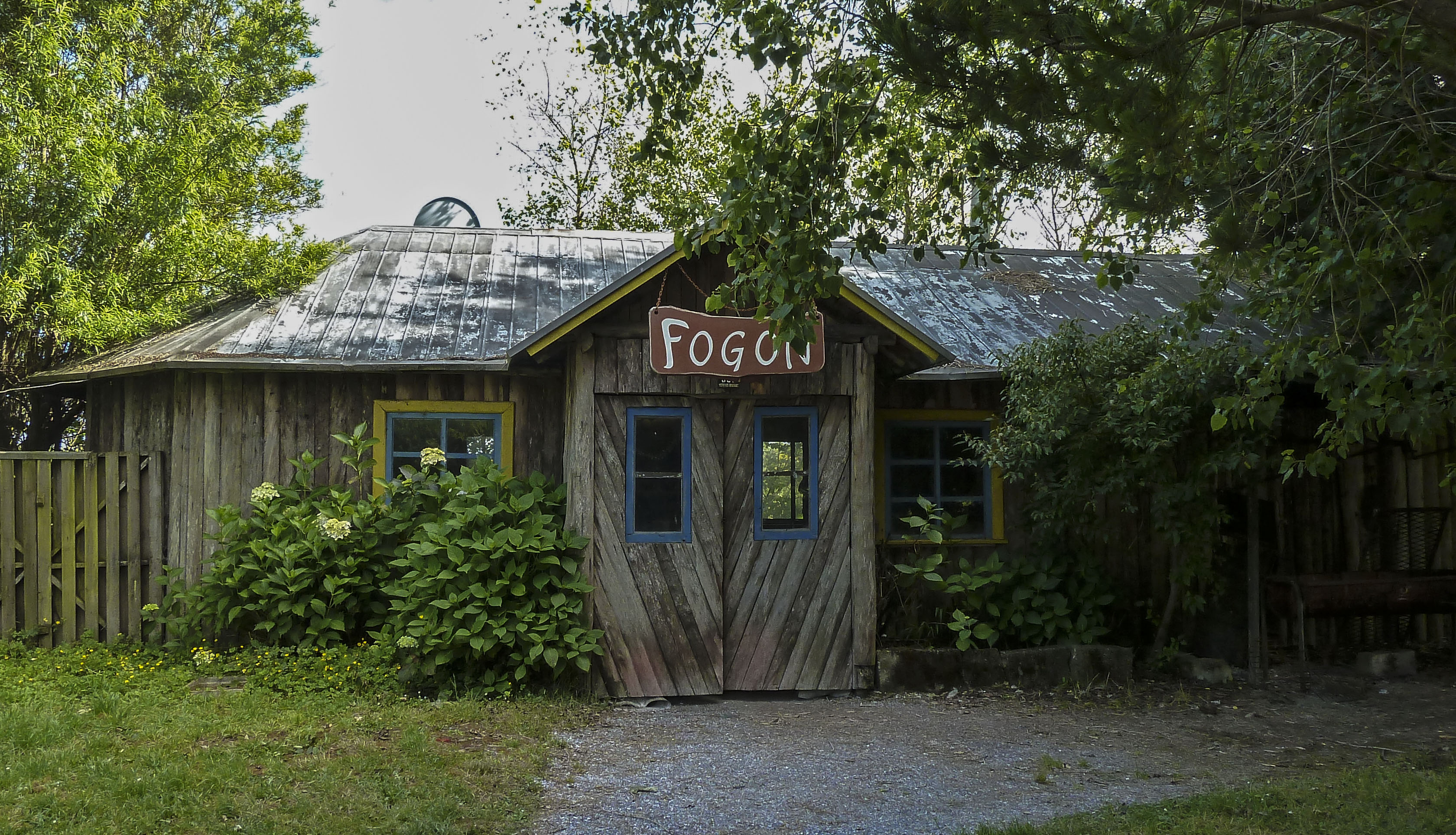
We arrived in Chiloe a day before them so we scoped out the campsites in around Ancud and decided on Playa Gaviotas which was actually a few Km’s outside town. Its major selling points were wind protection in the campsites and a big shed called a Fogon with a huge iron fireplace, a grill and tables and chairs. These were major considerations given the wind and rain that was forecast. A nice beach was also a plus but not so relevant given the weather.
When Kobus, Jessica and Jared arrived they told us that we could expect Luis and Lacey from Lostworldexpedition.com to join us so Christmas was going to be a proper party.

As we’ve come to expect when we get together with the Remotelys Christmas was a real feast. It started on Christmas Eve with a massive salmon roasted on the grill. The rain was coming down incessantly and it was really cold so we moved festivities into the Fogon and lit a huge fire to warm the room.
The real feast was to come on Christmas day. The previous day Jared had used our small walmart BBQ to smoke some Salmon and this was to be the centrepiece of some amazing wontons for lunch. Luis cooked up some South American pancakes called Arrepas and I made some pigs in blankets.

After lunch I did some needed maintenance on the truck – namely fixing a light at the back which had a loose connection (with some great help from Kobus).
This worked up an appetite for dinner which was a joint of beef that Jared expertly roasted on the BBQ and made some incredible stuffing. This capped of a lovely Christmas day with some great people.
So a big thank to Kobus, Jared, Jessica, Lacey and Luis for helping to make a great Christmas on the road.
The Chilean Lake District
Maybe it’s the name but the Lake District in the UK is known for its perpetually wet weather and we found similar conditions in the Lake District in Chile. The lakes here are surrounded by beautiful snow-capped volcanoes but we were only teased with occasional glimpses of the snowline.
However the Lake District is very beautiful even in the rain and we managed to enjoy ourselves regardless.

Our first stop was 17km up a narrow dirt road from Conaripe at what are considered to be the nicest Thermals in the area, Termas Geometrica, and we were definitely impressed. Unfortunately they wouldn’t let us camp in the car park but we managed to have two good soaking sessions. The pools are on either side of a narrow valley with a waterfall at its head. There are 17 pools in total all bounded by the sheer cliff walls of the valley, slate floors and red wooden walkways giving the place a real Asian flavour.

After we’d finished soaking which was heaven sent in the cold rainy conditions we drove back down the dirt road to Conaripe where we found a place to camp right on the shore of Lago Calafquen.

With no change in the weather the next day we decided to head South looking for improvement and drove to Entre Lagos which is on the banks of Lago Puyehue. On the way we visited Panguipulli to see its unusual church.

The weather in Entre Lagos was still bad though so we again found a lake side camping spot and spent the night.

Continuing to push south on scenic gravel roads, well they would be if the cloud level wasn’t about 100m, we arrived at Puerto Octay, a pretty village (apparently surrounded by 3 volcanos of which we saw none) founded by Germans in the mid 1800’s and situated on the banks of Lago Llanquihue.
After a few nights free camping we decided we wanted a touch of luxury and checked into a really lovely campground where we could park on a concrete pad (necessary with the pouring rain) right on the lake.
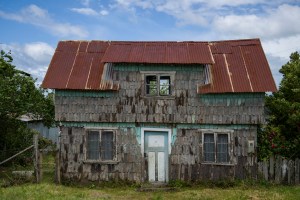
The rain continued to pound down but interspersed with short sunny breaks in which we managed to explore the town.
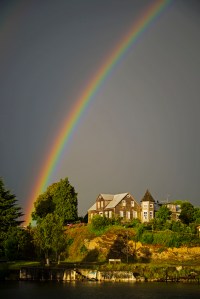
Still no improvement in the on/off rain so we again drove South around the eastern side of Llanguihue Lake to Ensenada. The road was entirely paved, a nice surprise as our 2012 map had it as mostly gravel, so we made good time.

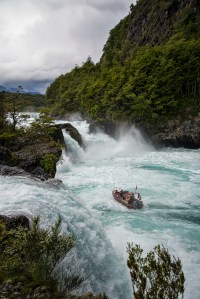
We first visited the Saltos de Petrohue which are some short but immensely powerful waterfalls on the massive fast-flowing river between Lagos Todos Los Santos and Lago Llanquihue.
We then drove 5kms further on a badly pot-holed gravel road to the shores of Lago Todos Los Santos (All Saints Lake), considered to be one of the most beautiful lakes in the District.

The campground where we stayed in Ensenada had two sites right on beach, down a 4×4 track that we just managed to fit down having to squeeze between some trees, but it was definitely worth it.

The place was so gorgeous, despite the weather, that we decided to stay two nights and enjoy the location. The campsite is right in the shadow of a snow-capped Volcano but unfortunately we never saw it !

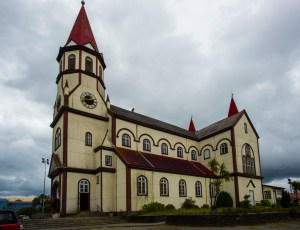
Our last stop in the Lake District was at Puerto Varas which is the biggest town in the area. However it was very busy and difficult to find parking. We did manage to wander round for an hour or two but didn’t see anything that would make us want to stay so decided to continue on our way. There is a very unusual church however !
Northwest Argentina Camping
Roadside Quarry, Salinas Grande (S23 26.243 W66 09.117, 3510m)
A turnoff from the main road goes through an area with large piles of scree about 200m from the road. There is a large flat area in front of one of the piles where it is possible to get out of the wind. Free. No Facilities.
Camping Municipal Xamena, Salta (S24 48.735 W65 25.150, 1166m)
Very large campsite with a massive swimming pool (only filled in the summer) – empty in November. Toilets and hot showers – being refurbished while we were here. Electricity (most sockets don’t work) and water. Cost is ARS 25 per night for an RV and 6 per person per night (total AR$37 per night). Buses into town are 7D and 3B (Return on Ituzaingo – stop opposite VEA supermarket). Try not to stay on a Saturday night unless you like to party until the early hours or have a good set of ear plugs as there is a nearby nightclub which plays music until 6am! WIFI is available at the small coffee shop just outside the gates or at the COPEC petrol station on the main road about 400m away.
Camping Municipal, Cachi (S25 07.327 W66 10.002, 2352m)
Camping at Southern end of town. Three areas – lowest layer under trees between cabins, middle layer – car camping with power, water, grills etc, third layer on grass with trees – electricity by very long cable from bathroom block if in top level. Toilets and hot showers. Large indoor pool (not filled while we were there). Cost 30AR$ per night.
Luz y Fuerza, Cafayate (S26 04.840 W65 58.629, 1555m)
Cost per camper AR/20 + AR/10 per person. Hot showers + toilets. Water + Electricity. Most sites are unshaded but there are 2 or 3 shaded sides on dirt as you come into the campground on the left. 5 minute walk from town. WIFI near the reception block. There is also a big swimming pool around the back.
Outside Quilmes Ruins (S26 28.032 W66 01.964, 1788m)
No Facilities. Free. Dirt area just before entrance to Quilmes. We asked to camp at Quilmes and were told to go here. Quite windy but died down at night. There are toilets in the ruins.
Camping El Molino, Londres (S27 41.959 W67 09.996, 1308m)
Very pretty shaded campground. AR/5 per person at weekend. Free during week. Electricity, picnic tables, grills, water + Swimming pool. Toilets and showers very average – no hot water. Small shop at weekends. Irrigation channels run around campground which are excellent for drowning out noise of grilling families !
Talambaya National Park Visitor Centre (S29 47.086 W67 59.639, 1241m)
Visitor centre. Camping on sand. Parking in cark park. Grills. Sun Shelters. Hot Showers (timed availability) and toilets. Cafe in visitor centre. Cost AR$40
Parque Ischigualasto (S30 09.845 W67 50.563, 1363m)
Small campsite next to Visitor centre. No access for big truck. We camped in car park behind dirt mound for wind shelter. In the campsite there is power and shelters but they are not adequate wind protection. WIFI. Hot Showers and Toilets. Cost AR$30
Parque Suizo, Mendoza (S32 51.270 W68 53.797, 926m)
Quiet camping area. Lots of shade from trees. Palapas with power and lights. Water is available. Toilets and hot showers. Very slow WIFI accessible throughout campsite.AR$100 per night.
Las Montanas, Porterillos (S32 58.317 W69 14.026, 1513m)
Camping on Grass. Lovely large plot down by the river. Hot Showers. Power. Water (with long hose). Grills and picnic tables.. Sheltered from wind. Very tranquil. Cost AR$50 per night.
Los Puquios Ski Resort (S32 49.483 W69 53.551, 2702m)
Free camping outside the ski season. We parked in the car park but tents and cars can go in the wind break behind the buildings. There is a toilet in the building with curved roof (hangar like). No other services. Free.
Pucon
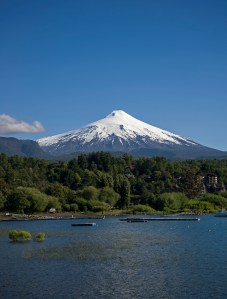
Pucon is often referred to as the Queenstown (NZ) of South America. This is pretty close to the mark and there are lots of adventure companies, cafes and restaurants. If the weather is good this is the kind of place that will suck you in.
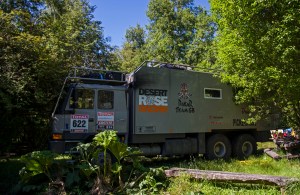
A few minutes walk from town is a very nice campground where we and a couple of other overlanders took over a large grassy clearing to make our own. When we arrived we were excited to see that the Pickering family (Jago, Lucy, Jed, Tate and Teaghan) were already here. They have a big Tatra truck that was built in the same workshop as The Beast and last time we saw the truck it was only half built.
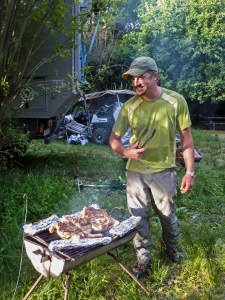
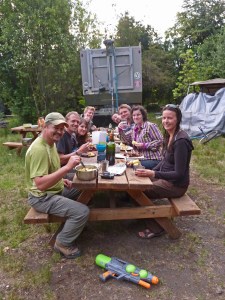
We spent a couple of days just hanging out in Pucon, our friends liferemotely.com also arrived here so we had a big meal one night with Lucy and Jago, The Remotely’s and an English/SA couple who were backpacking at the campsite. It was a complete feast with 2 types of ribs, chicken, beef and all the trimmings. The cooking involved no less than 5 grills and the night was finished off with tequila shots. Nobody can quite remember whose idea that was but needless to say the following day was a rest day!
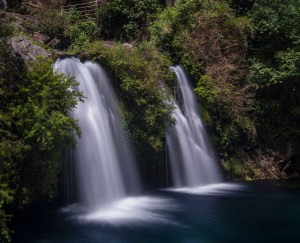
A few km’s up the road from Pucon are the Ojos del Caburgua which are a series of spring fed waterfalls. There are also a couple of km’s of very nice walking trails here which we enjoyed.
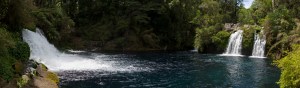
Continuing up the same road we drove up to the Huequehue National Park. The dirt road up to the park was in very good condition although the last 6 or 7km’s were very narrow. When we reached the park however, we were blocked by a low entrance gate but the Ranger very kindly moved his truck so we were able to squeeze into a layby just outside. This left us with a limited number of trails to do so we headed on up a short (5km) but very steep trail to get some volcano views.
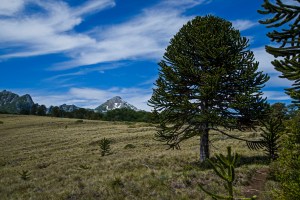
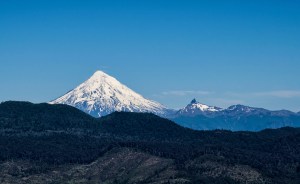
As we neared the top we moved out of dense forest into a more open forest dominated by endangered araucaria trees (Monkey Puzzle Trees). Eventually we cleared the forest completely into an upland plateau with beautifully clear views of four snow-capped volcanoes.
Siete Tazas and Salto del Laja
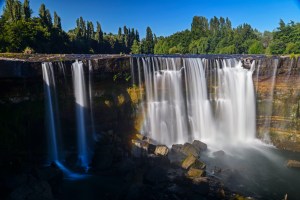
Heading South from Santiago and it isn’t long before the landscape starts to become more lush and the climate more temperate. We were finally putting the deserts of central South America behind us.
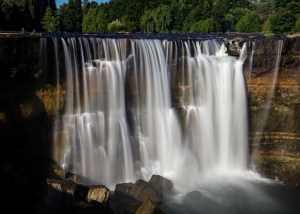
We had decided to visit a National park called Radal Seite Tazas as our first stop on the route South The road into the park was paved until the last 30km and then turned into a decent gravel road. The last 12km or so actually in the park was a less good gravel road but still absolutely no problem – in the dry.
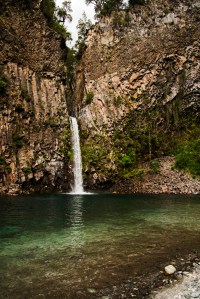
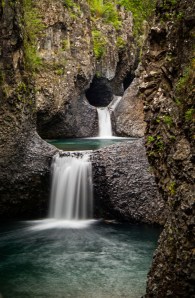
Seite Tazas park is famous for a series of seven waterfalls in a canyon into small pools. Unfortunately you can only see the last 3 of these and there is no path to the others. However there are a couple of really large other waterfalls in the park as well.
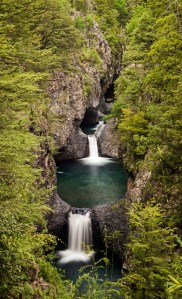
We arrived in the late afternoon and spent a very enjoyable few hours viewing the waterfalls and hiking down to the base of one of them. The long evenings in Chile are really great for travelling as you can get your miles in and then still have time for some fun !
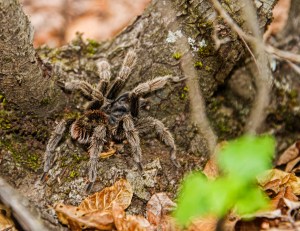
We were a bit disturbed though to see quite a large number of tarantulas. I almost kneeled on one when I was taking a picture.
We decided to spend the night in the National Park at a deserted campsite and were very pleased when it turned out to be free as we were out of season.
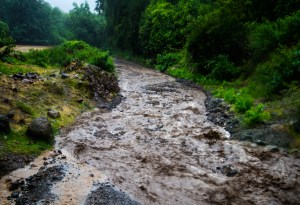
However in the morning the skies opened and it started to rain – hard. By the time we got on the road it had been raining for over an hour and the road had seriously started to disintegrate. On the way in we had commented how the book requiring 4×4 was ridiculous – well on the way out we were very glad of 4×4.
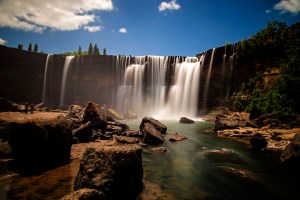
Further South along the Pan American there is a set of very large falls, Salto de Laja. These have been compared to Igazcu falls in Northern Argentina although that is pretty ridiculous. The falls are very pretty though – and there is good swimming at the base.
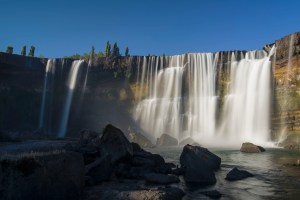
In the area around the falls there are at least 10 campsites and we choose one for a very relaxing day.
Happy Christmas From Fromatob.org
Easter Island – Part 2
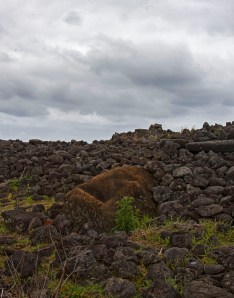
On our 3rd day in Easter Island we awoke to pouring rain. This certainly put a damper on our desire to explore the island. It basically rained all day. We decided to spend the day chilling out and had a long lazy lunch.
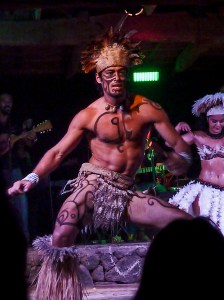
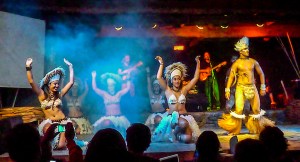
One of the things on the island that is a must do is to go and see some traditional island dancing. This is usually really expensive but we were lucky that we were on the island during the Chile wide Teleton event. This meant that we could get tickets to a charity event with two dance troupes and two bands for only $10 (about ¼ of the normal price). So we braved the pouring rain to get down to the hall where the event was taking place.
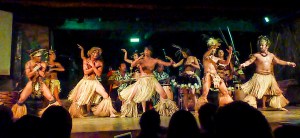
The traditional island dancing was really good and we would thoroughly recommend not to miss this part of Island culture.
The bad weather carried on into our fourth day but we decided not to let this stop us enjoying the island as there was still plenty more to see, so we decided to hire a jeep to explore the rest of the island. We hired a tiny 4 wheel drive Suzuki Jimny. Driving a Jimny is a bit like driving a toy car, they are definitely not built for people 6ft tall. As I slid the seat as far back as it would go, I could still steer using my knees, it was pretty uncomfortable, but thankfully we didn’t have far to go.
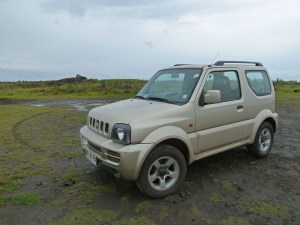
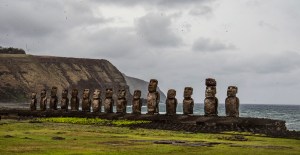
The first thing we did with our Jimny was head up the coast to the row of 15 Moai that we had seen on the tour. While doing this we stopped off at a few sites that we had seen from the bus but hadn’t stopped at.
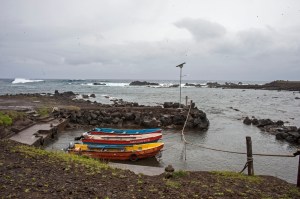
On our drive we passed a small fishing harbour. Surprisingly Easter Island has no proper harbour with the exception of one or two small harbours for fishing boats, which may explain why everything on the island is so expensive.
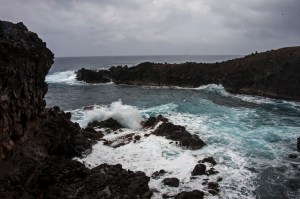
Most of the coastline of the island is very inhospitable.
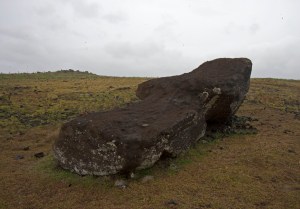
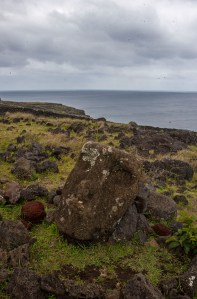
We visited a huge Moai that had been left lying face down in the dirt, abandoned before ever arriving at it’s Ahu by the very family who commissioned it, for reasons that are still unclear. Such was the desiccation of the islanders and their way of life that few people survived to pass down the history of this incredible culture so researchers don’t really know how the Moai were transported. There are however a number of different theories. The most plausible is that they were moved using tree trunks as rollers. The most unlikely (in my mind anyway) was that they were moved in an upright position with ropes moving one side forward at a time in a shuffling motion (a bit like walking). No-one knows for sure but it’s probable that a number of methods were used dependant on the terrain and distance involved.
Due to a combination of heavy rain and mud roads the Jimny rental guy had told us not to take the dirt road up to Orongo but as the following day was to be our last on the island and after all it is 4×4, we graciously ignored his concerns and headed up the slippery slope to the highest point on the island, Orongo, where the famous Birdman Ceremony was carried out.
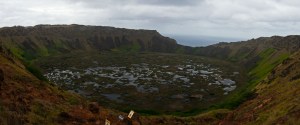
When times became tough on Easter Island as more and more resources were used up the islanders began to believe that their ancestors had deserted them. The belief in ancestor worship began to wane in the 16th century and the birdman cult, based on the worship of Make-Make, started to hold sway.
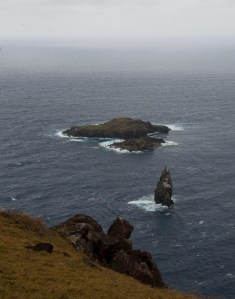
The ritual of Tangata-Manu was performed every year when competitors from each tribe climbed down the cliffs (not for the faint-hearted)and swam to the island Motu Nui to collect the first egg of the Sooty Tern. They might have to wait days or weeks on the tiny island before finding the first egg. On returning to Orongo with the egg the winner was crowned Birdman (or the chief he represented) and was considered sacred for one year living in ceremonial seclusion. However the members of his tribe were given special privileges during this time. While waiting the chiefs from each tribe lived in special houses in the Orongo village.
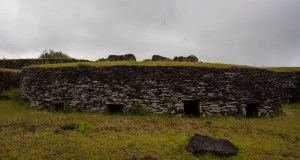
After visiting Orongo we headed up to the Northwest corner of the island where the only inland Moai are found. These are unusual not only because they are not positioned on the coast but also because they were erected facing out towards the sea.
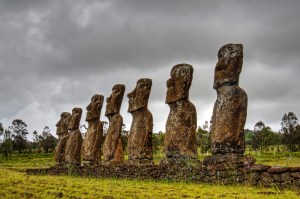
From here a 4×4 track leads to a number of interesting places including the largest canoe house on the island at 60m long near an ahu with many toppled moai.
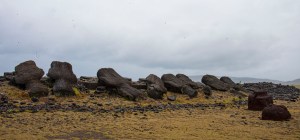
We stopped at a dwelling site where a partially collapsed lava tube provided a room for a garden, worship space and also living space.
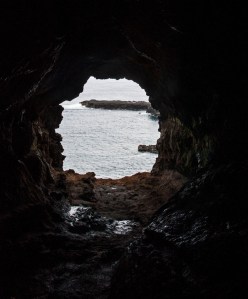
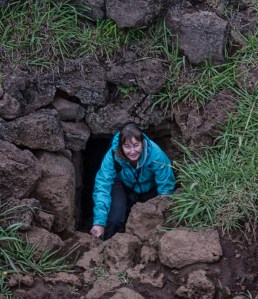
Our final stop was at a cave (Dos Ventanas) accessed by a narrow crawl through which ended in two large windows in the sea cliff with a long drop to the crashing waves below.
We returned the Jimny the following afternoon and packed our bags for our early evening flight. The only downside to our trip was that our flight was delayed from 6pm until 5am the next morning so we spent a very long time waiting in a cold airport on uncomfortable plastic chairs in the middle of the night. We finally arrived at our hotel in Santiago at around 9pm after a very, very long day!
Easter Island – Part 1
We didn’t actually book our trip to Easter Island until we were in Mendoza in Argentina – only a couple of weeks before our departure date. This meant that the cheapest flights by far were via Lima, turning a 5 hour flight into a 10 hour one. A good deal while you can get it though I’m not sure this pricing will remain. The flights are currently discounted because the route is relatively new.
On arrival in Easter Island, early in the morning, we were greeted by blue skies and sunshine. While queuing to pass through immigration, the line for which moved very slowly, we stopped off at the National Park booth on the left which sells discounted tickets (a saving of US10 each ticket) for the National Park (discounted price is US50 per ticket).
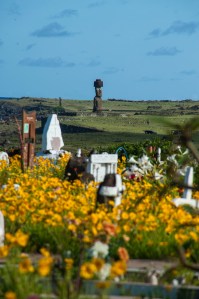
We were met at the airport by a guy from our hotel for the short, about 2 minutes, transfer to our hotel. All accommodation on the island is fairly basic but expensive and we had to pay upwards of US100 per night for a hotel very reminiscent of a shabby US motel.
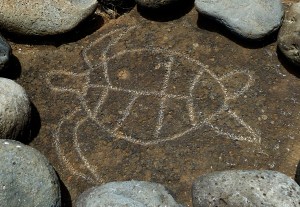
Unable to check into our room until midday, we dropped our bags and headed out to explore the town. The town, Hanga Roa is quite small and most of the restaurants, shops and grocery stores are located along the main drag. There isn’t much to explore in town at 8.30am so we walked to the end of town down to the Harbour where we came across our first Moai.
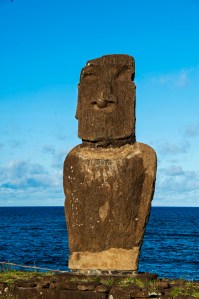
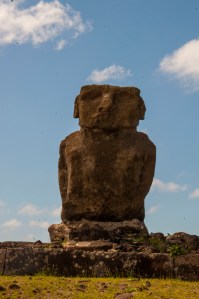
The Moai are what makes the Island famous – the statues of Easter Island. Raised by family groups as part of their ancestor worship it was believed that when the white coral eyes were fixed in the sockets of the statues they were imbued with the spirit of a specific ancestor who would look over the family and protect them. The statue building period began around 1000 AD and continued into the 1700’s. Sadly by the early 1800’s every single Moai on the island had been toppled due to conflict or loss of faith. All the Moai that are currently standing have only been re-erected in the last 56 years.
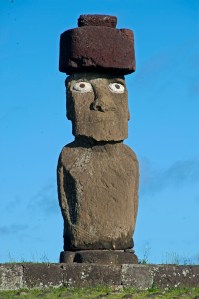
We continued our walk along the coast, where there are some restored Moai on an Ahu. There are around 350 Ahu’s around the island – platforms of loose stones held together by retaining walls which were the platforms on which the Moai were placed. There was also the only Moai with restored eyes at this location.
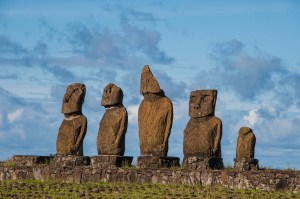
On our second day we arranged for a day tour of the island with tour company Aku Aku, in order to understand the history and culture of the island better. Our English-speaking guide was excellent and although the tour was expensive we felt that it was money well spent.
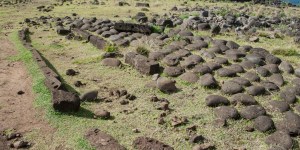
At only 25km long and around 10km wide Easter Island is fairly small, so we spent very little time on the bus. Our first stop brought us to a row of fallen Moai (Ahu Akahanga) and the remaining foundations of a number of canoe houses.
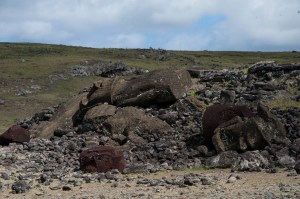
Canoe houses were the first type of home that settlers built on the island and as the name implies, looked like upturned canoes with no windows and only a small, low doorway. Blocks of volcanic rock were used to build the foundations in the shape of a canoe and a wooden frame was placed over the top. There was also a patio of rounded rocks outside the door for cooking.
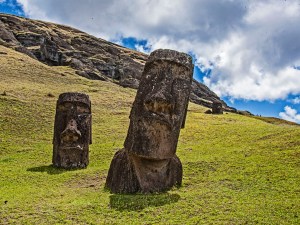
Next stop, the quarry – Rano Raraku, where all the Moai were made. This is the only place on the island where you can find the grey volcanic rock used to sculpt the Moai. They were carved directly from the rock and, once finished, were slid down the hillside on their backs into pre-dug holes where they were left to be collected and transported by the families who commissioned them. The quarry is an amazing sight with Moai of various shapes and sizes scattered all around the hillside.
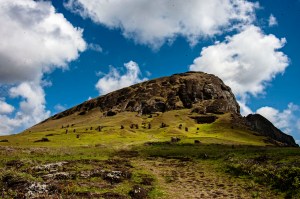
There are two exceptional Moai’s here – one is kneeling and has a goatee and Caucasian features, while the other is the largest Moai ever carved at 21m, but it’s unfinished. This Moai is so big that researchers doubt that it would have been possible to move.
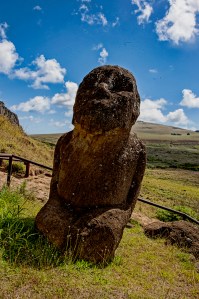
In all, there are around 320 Moai uncompleted or awaiting collection in and around the quarry. This is more than those which were actually finished and placed on Ahu’s (300).
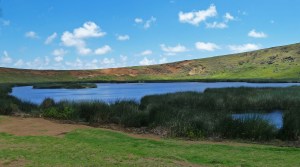
Behind the main wall of the quarry is the freshwater crater lake of the volcano. There are Moai that have been carved inside the crater and these would have been a serious proposition to move up and over the rim before starting their journey back down the hillside and onto their families’ Ahu! The Moai were transported overland for several kilometres and erected on their platforms using only manpower as there were no horses, mules or cattle on the island at that time.
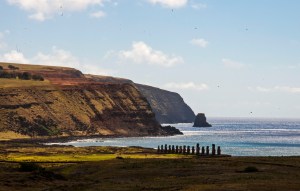
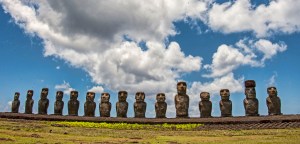
After the quarry we visited the most spectacular and most famous Ahu on the island – Ahu Tongariki. A row of 15 massive Moai all lined up. They were re-erected by a Japanese team after the fallen Moai were scattered by a 1960 tsunami. It took five years to repair and erect them and it was only finished in 1995.
On the other side of the island from the quarry is the largest Moai that was ever actually raised onto an Ahu. This is called Ahu Te Pito Kura where Paro, a 9.8m Moai once stood. Now it lies face down in the spot where it was toppled over a century ago and like many others, has not been restored.
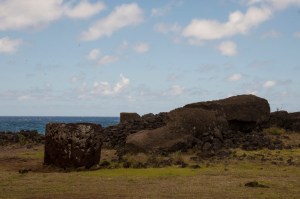
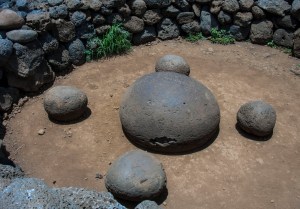
Just below the Ahu is a magnetic stone which is claimed to be a source of good mana and is the only attraction that we are allowed and encouraged to touch (the stone is called Te Pito Kura and the Ahu is named after it).
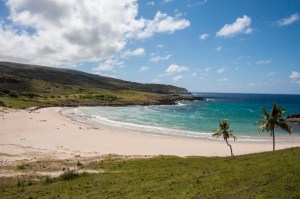
Our final stop of the tour was a beautiful white sandy beach (one of only two on the island) called Anakena Beach where we relaxed for a couple of hours and viewed another row of standing Moai, re-erected in 1979, set slightly back from the beach.
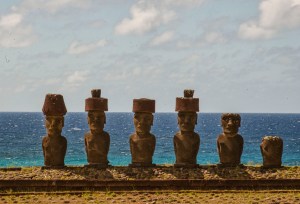
Off to one side is Ahu Ature Huki with a single standing Moai (the first to be re-erected on the island), raised over 18 days by a group of 12 men under the direction of Thor Heyerdahl (the man of Kontiki fame), using only wooden poles, ropes and rocks, to prove that these giant statues could be moved by man and to disprove the crazy alien theories !
Santiago
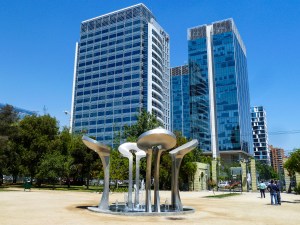
Santiago is the capital of Chile and the population centre for the whole country. Over 55% of the people in the whole country live in the vicinity of Santiago. It is a big modern city, very reminiscent of a European city.
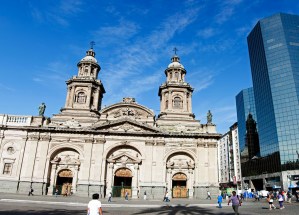
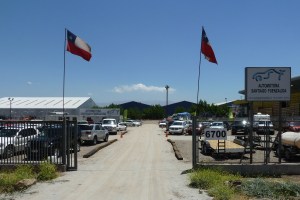
However not many overlander’s seem to go to Santiago, I’m not sure why. This meant that we didn’t have a place to stay sorted out. We got some co-ordinates from an overlander we’d met on the internet for a place just outside Santiago so thought we’d give thjs a try. On arriving we discovered it was a used car sales lot and the guy who owned it had clearly never had an overlander park there ! After a bit of chat he agreed that we could park in the back of his secure lot for US$10 per day. We left after giving him strict instructions not to sell our truck !
The trip into Santiago was easy and we took a collective taxi to the nearest metro station. The Metro in Santiago is modern, clean and very frequent. There is even WIFI on the platforms and mobiles work in the tunnel. Basically its way better than London… with the exception that is, of pick pockets. As a Londoner (me) and an honorary Londoner (Sarah) we are pretty savvy when it comes to crowded Tube trains and managed to thwart the attempts of a cheeky Santiago pick pocket but not before he’d succeeded in unzipping one of Sarah’s trouser pockets. Do use the Metro it’s the best way to get around the City but be aware of these issues.

We loved Santiago as a modern, young, vibrant city but if it’s tourist attractions you are after this probably isn’t the place for you. However just strolling round the city centre is enjoyable in itself and there are plenty of upmarket shops, cafés and restaurants to lure you in and take a break from the heat.

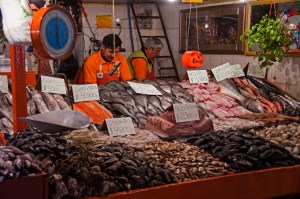
The fish market is also pretty cool !
One interesting phenomena we noticed, definitely one for the boys, is that there are coffee shops where the staff are all young attractive women wearing skin tight lycra mini dresses. Think Starbucks crossed with Hooters.
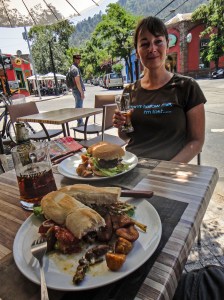
Our hotel (Mito Casa) was just across the river from the Bellavista area which is an arty/student area with a whole bunch of funky restaurants and bars. We highly recommend ‘Ciudad Vieja’ which is actually a sandwich restaurant but the sandwiches are awesome, filling a whole plate and coming with a side of roast potatoes.
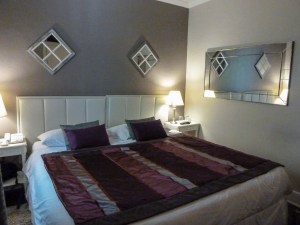
Hotel accommodation in Santiago is very expensive but we managed to find a more moderately priced Boutique hotel called Mito Casa, which was really nice and also very central. The staff here were very friendly, helpful and had excellent English.
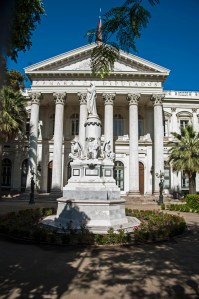
We actually stayed in Santiago twice, on either side of our trip to Isla de Pascua, otherwise known as Rapa Nui or to you and me, Easter Island!
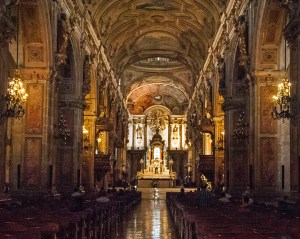
Border – Los Libertadores (Argentina – Chile)
This is the first time that we’ve come across a border that is all in one place. Both The Argentinian and Chilean border controls are in the same building which is on the Chilean side of the border. If you are going the other way into Argentina both sets of border controls are on the Argentinian side of the border.
The actual border is in the middle of a long tunnel through the mountain but the border controls are a couple of km’s after the end of the tunnel.
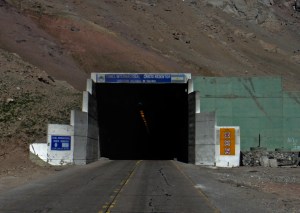
As we approached the border there were two queues one for cars and one for trucks. There were also some people handing out forms for the border crossing – so we asked these guys which queue we should be in and they told us to get in the auto queue. They also handed us some forms to fill in. The forms they handed out were a personal migration form, a car import form and a SAG import form. We later found out that the car import form was the wrong one and there is a different one for cars which aren’t Argentinian or Chilean.
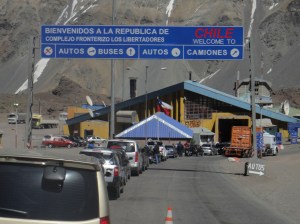
Trucks don’t actually do the border crossing paperwork here it is done near Uspallata and they just have their SAG check here.
After waiting in line for around 20 minutes a policeman came and told us that we wouldn’t fit inside the building so to go and park in the truck area. This was great because we skipped around 30 minutes of the queue. When we got to the truck area we did have a bit of difficultly parking as one policeman was gesticulating us forward and another was telling us to stop. The one who wanted us to stop started shouting at us and blowing his whistle and the other was waving more and more frantically. Eventually we made the whistling one aware of the other one and we managed to park.

Once parked we went into the building where the process is quite straightforward. Then once you have managed to work out what the hell is going on. It basically follows a number system; for overlanders the Migracion windows (1& 2) are around the back (as the 1&2 in the front room are for bus passengers).
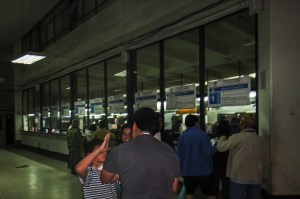
1 – Argentina Migracion
2 – Chilean Migracion
3 – Argentinian Aduana
4 – Chilean Aduana
5 – Get your SAG Check.
We ended up having to go to 1 and 2 twice because the vehicle import form we had been given was the wrong one. Of course the wrong form had been presented and stamped at both windows but nobody told us it was the wrong form until we got to window 3! We would recommend going to Chilean Aduana (window 4) first to get the right form before doing all the other steps.
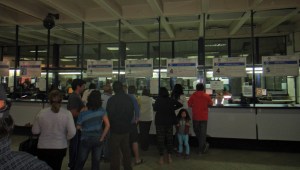
We went back out to the truck and spoke to the officials outside to arrange our SAG check. This was the most thorough search we have had on this trip with 2 officials and a dog. They looked in every cupboard inside and every locker outside. This is the first check where anyone has looked in our outside lockers. The dog even checked out the cab. We had a few veggies taken but we’d eaten all our meat (other than cooked chicken which is ok).
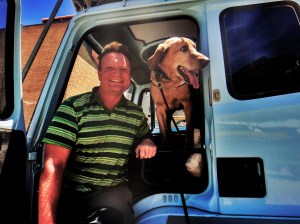
Once this was done we got another stamp on our paperwork and we were free to go to the exit gate where our paperwork was checked and we were free to enter Chile.
 FromAtoB