Tatio Geysers
There are two major problems with San Pedro de Atacama. Firstly there is no supermarket which overlanders need after crossing into Chile and SAG liberating the bulk of your fresh food. Secondly the fuel is very expensive.

Fortunately around 100km from San Pedro is a large town with a big mall, several supermarkets and cheaper fuel. After stocking up with a fridge full of food, and going a bit overboard we were ready to get off the beaten track and head into the mountains to the Tatio Geysers.
The road to the geysers leads past one of the world’s largest open cast mines, creating dust clouds on the horizon and evidenced by the number of truly enormous tyres at the side of the road.
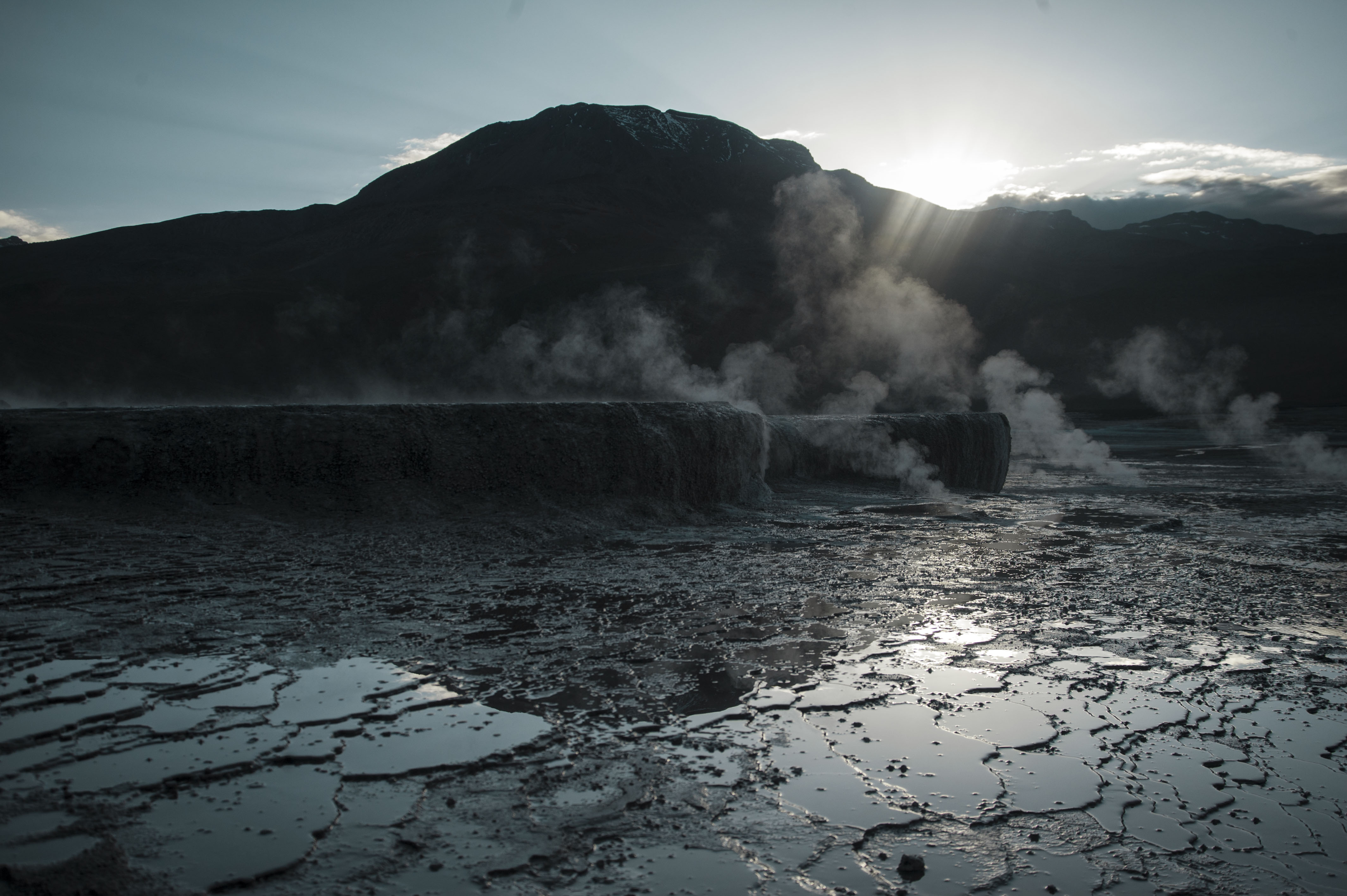
Once past the mine the smooth dirt road rises up into the hills and into the Chilean Altiplano. Our quick progress ground down when we turned onto the road leading the Geysers. It was heavily washboarded and any speed over 20km/hr made us feel as though we were going to be rattled apart. Fortunately there was only 15km of this and we pulled into the car park at the Geysers just as night was falling.
The management allow camping in the car park as long as you buy a ticket for the next day. So we settled in for what proved to be a pretty cold night at 4310m. The geyser field is the highest in the world.
Even before first light in the morning the first minibuses of tourists arrived and as soon as it was light they headed down to the geysers themselves. The geysers are most active first thing in the morning.
We decided to walk down from the office to the main geyser field – around 1km – instead of driving and this meant that we were well away from the tourists. However when we got to the geysers there were quite a lot of people around – mostly in groups.
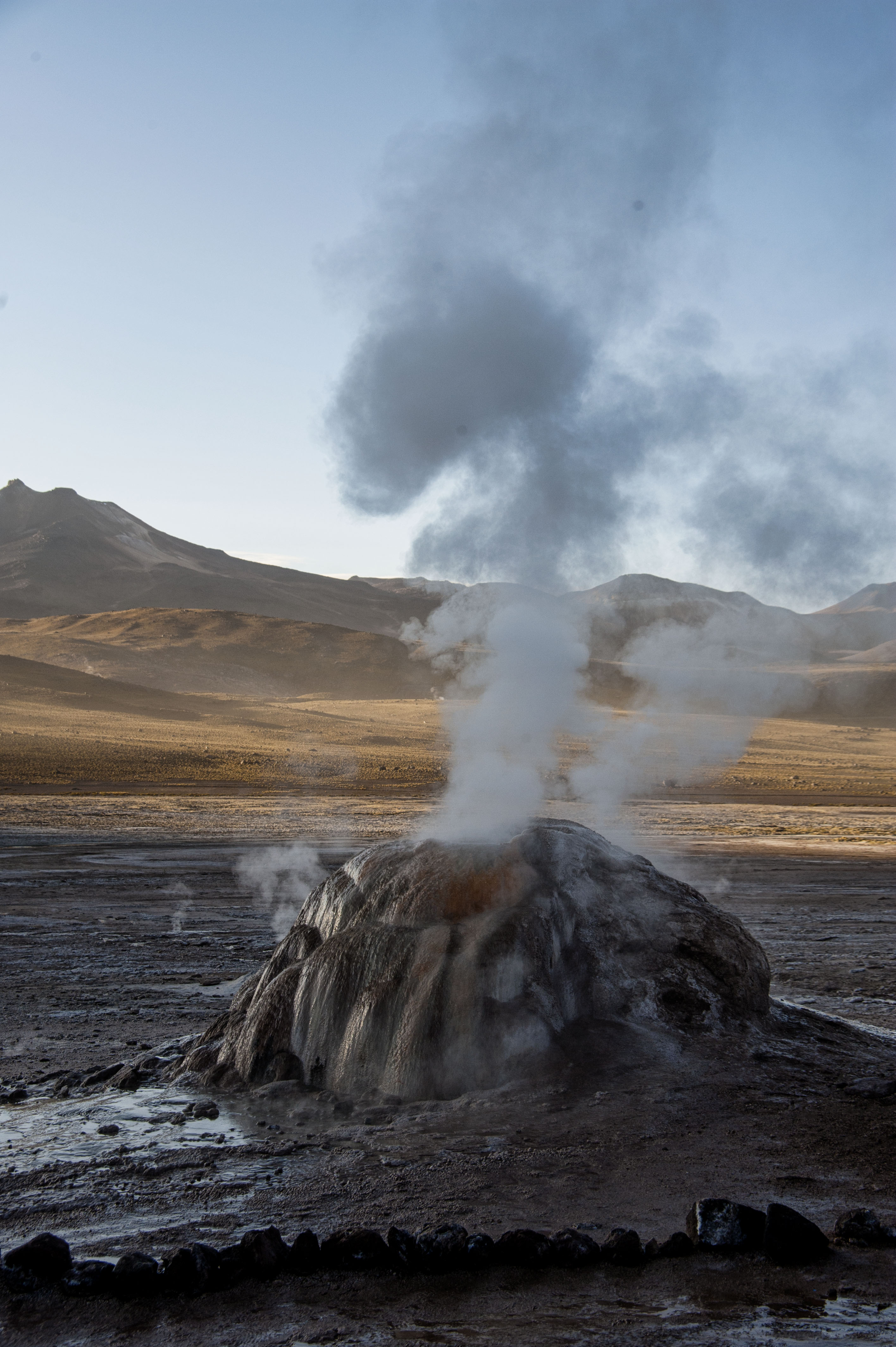
The geysers were enjoyable although not up to Yellowstone in the US and we spent around 2 hours wandering around before returning to the Beast to have some breakfast. By the time we had finished breakfast the geyser activity had really settled down.
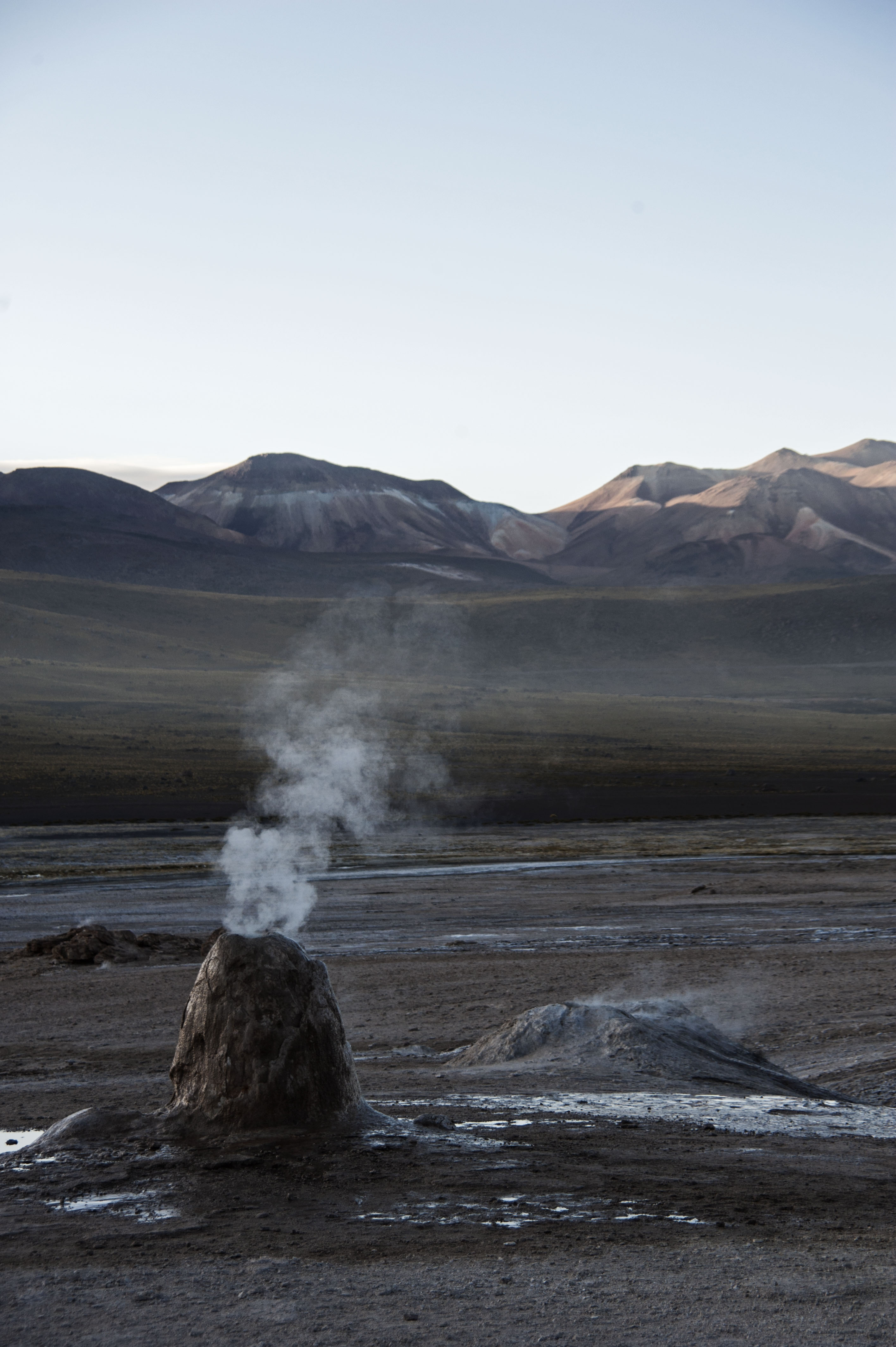
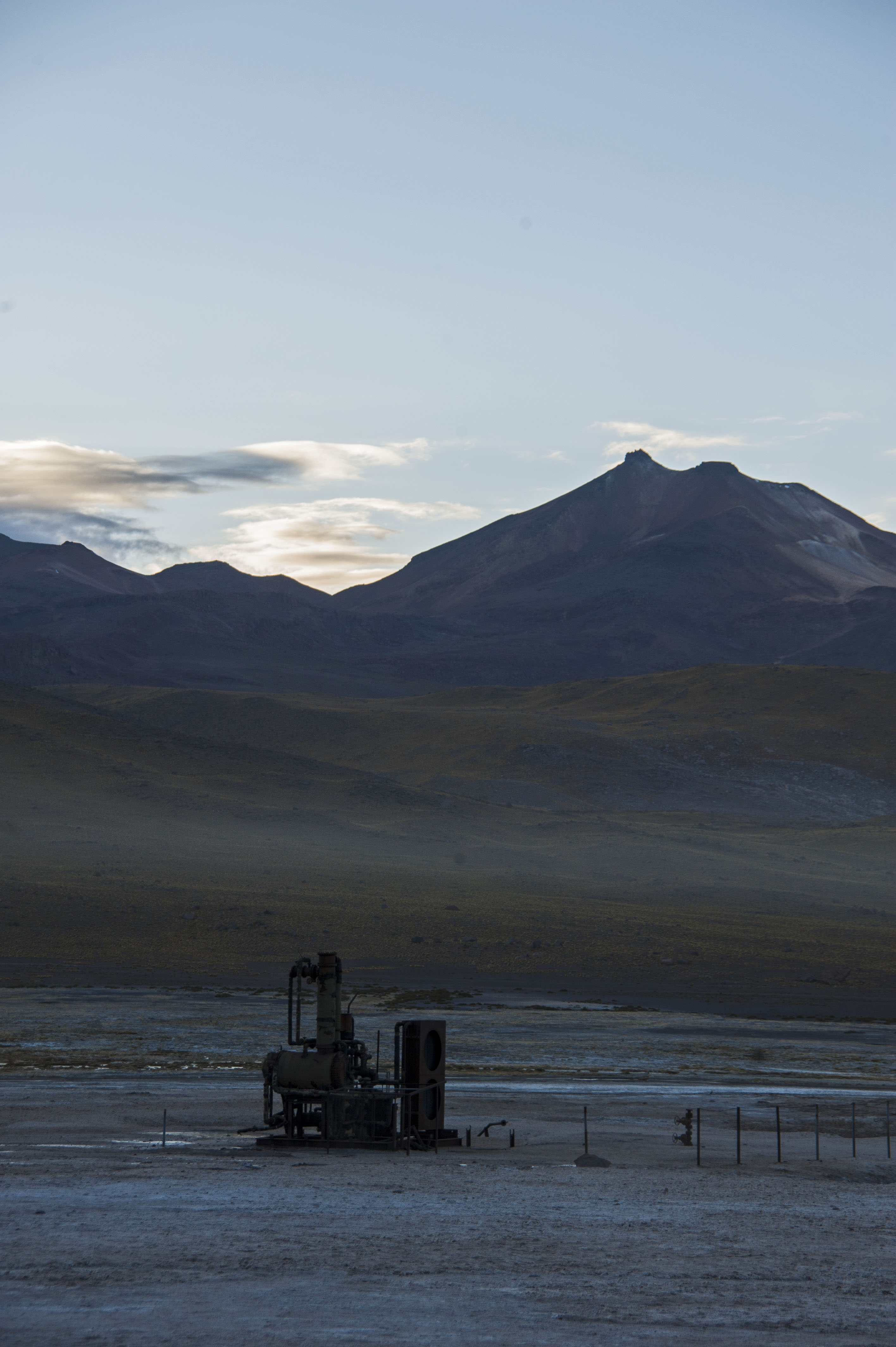
The journey back to San Pedro was slow but uneventful with some beautiful mountain scenery.
San Pedro de Atacama
The drop down from Bolivia at over 4300m into San Pedro de Atacama, only 2400m, is steep and straight – we sat in 2nd gear using the engine to brake to the max as we crawled down at under 20kph. The only other vehicles on the road were car transporters taking new cars from Chilean ports to Paraguay.
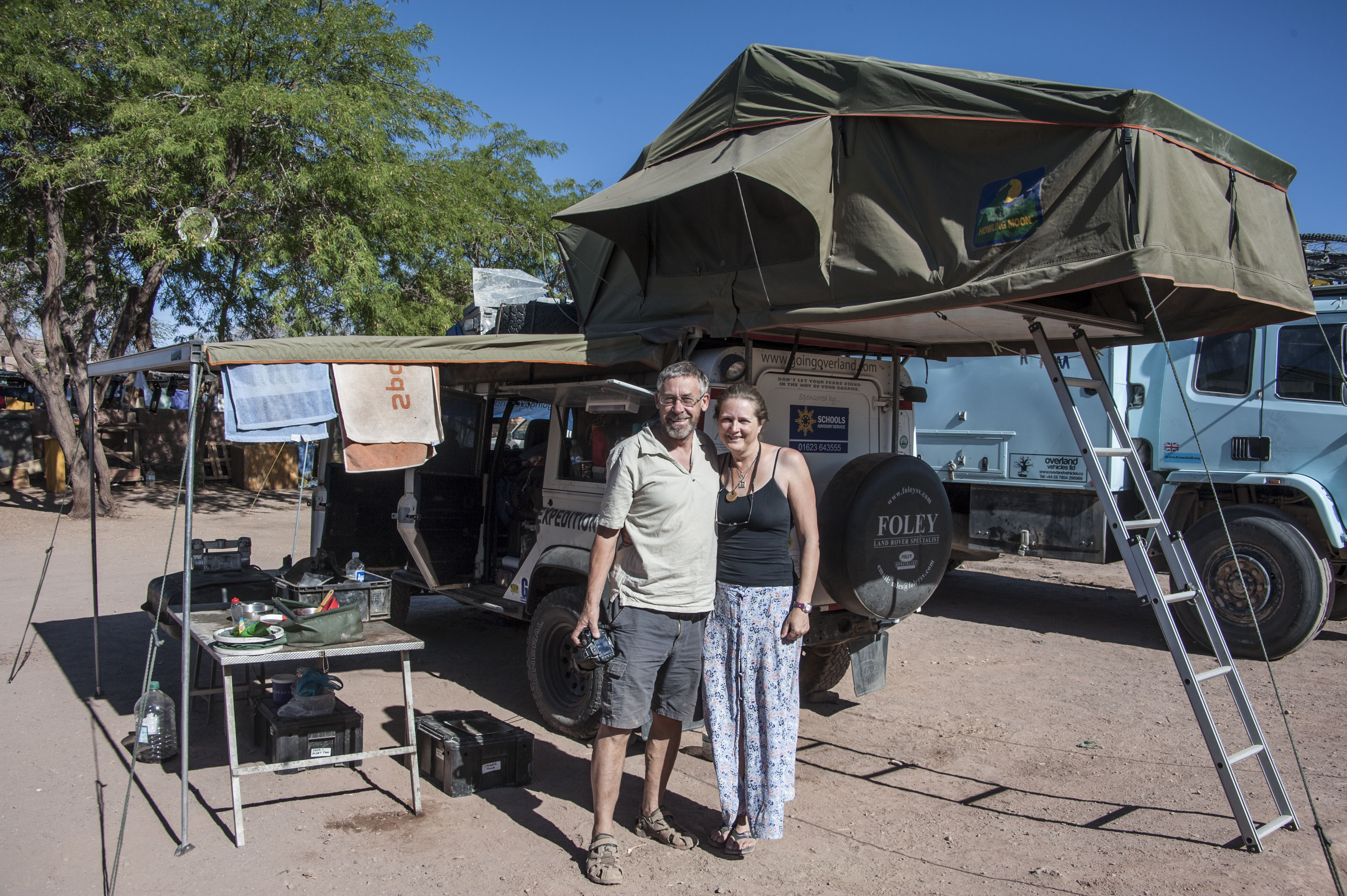
When we finally reached San Pedro it was to mixed feelings . “Is that it ?” was our initial thought followed quickly by “At least its civilization !”. We found the los Perales campground, after a few abortive turns, and were immediately welcomed by Helen & Paul, www.goingoverland.com , the first British couple we’ve met on the road. They were temporarily stopped in San Pedro with mechanical problems but were hoping to be on the way shortly to continue their world circumnavigation.
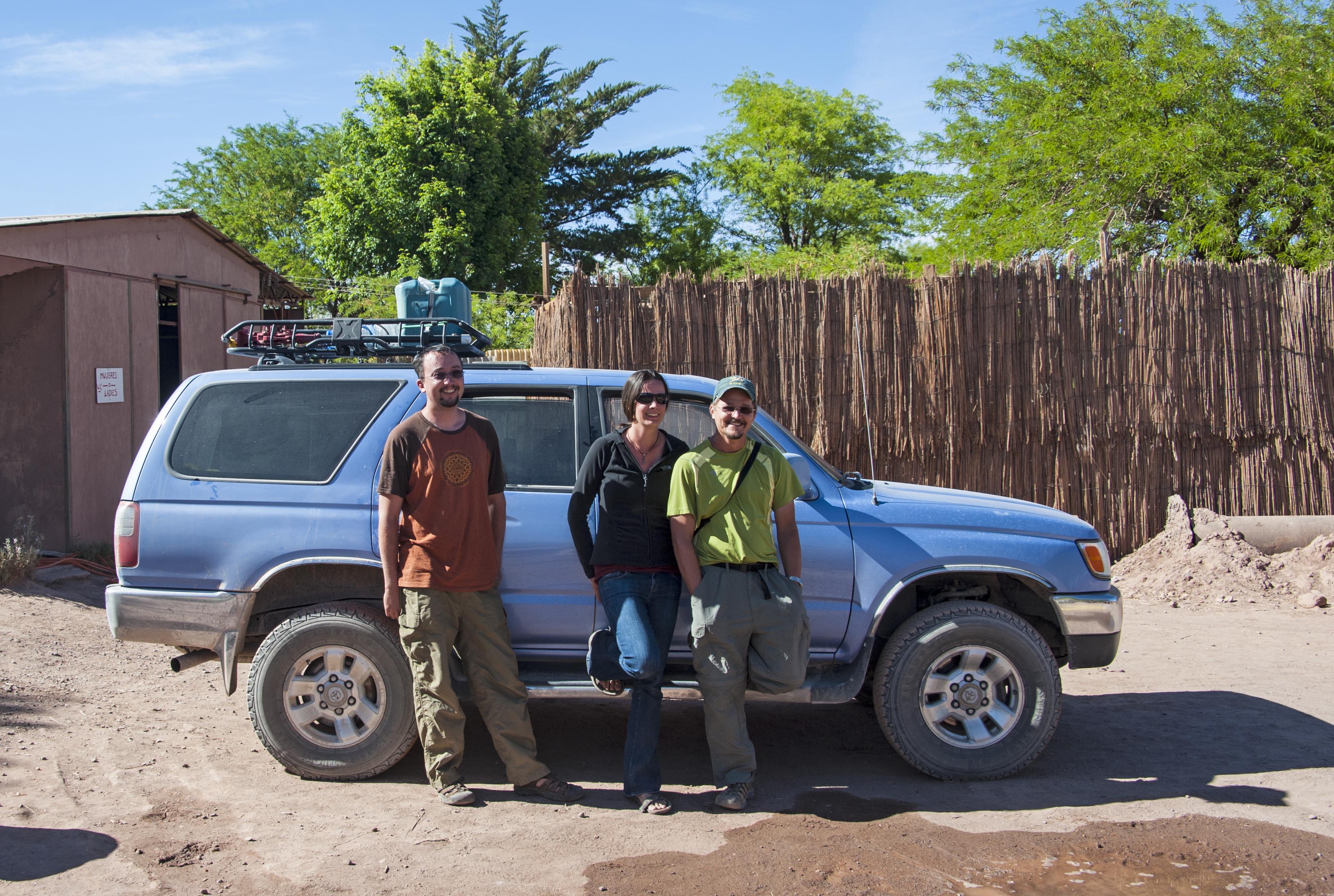
We also finally met www.liferemotely.com, a US/South African combo who have caught us up after following in our tracks for almost a year ! They are Jared, Jessica and Kobus.
After a lovely hot shower we were ready to hit the delights of San Pedro – ten minutes later we’d hit the highpoints of the town and were in shock at the prices of anything. We’ve been assured that San Pedro is the most expensive town in Chile but even so US$20 for 4 drinks (2 of them non-alcoholic) was a shock to the system and of course the wallet.
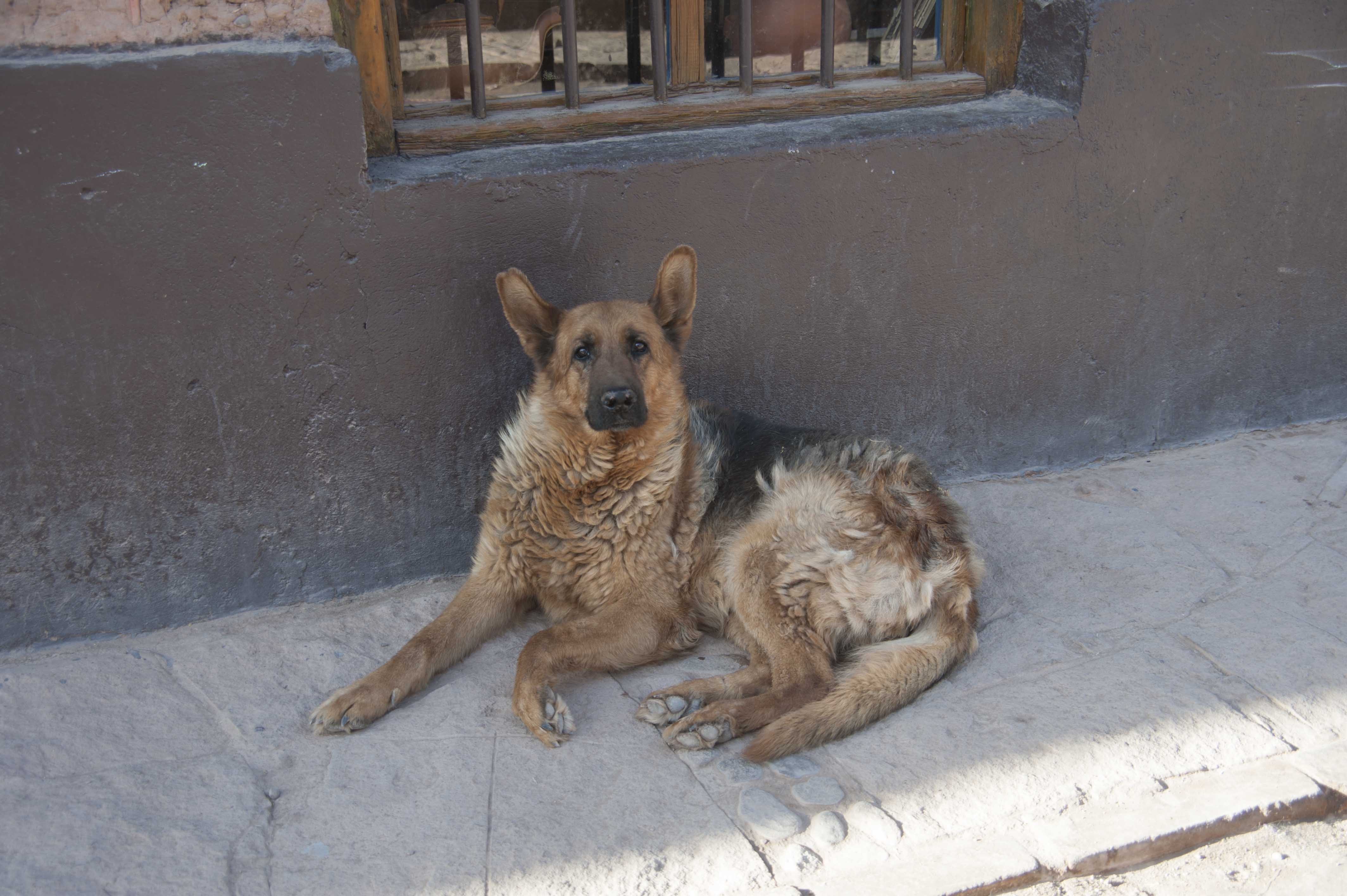
One thing about San Pedro is that wherever you go there are giant dogs. These were honestly the biggest dogs we’ve seen all trip.
Still after the Bolivian Southwest Circuit we were ready for a couple of days of R&R and chilled out in the scorching sunny days – which coupled with cool nights was just what the doctor ordered.
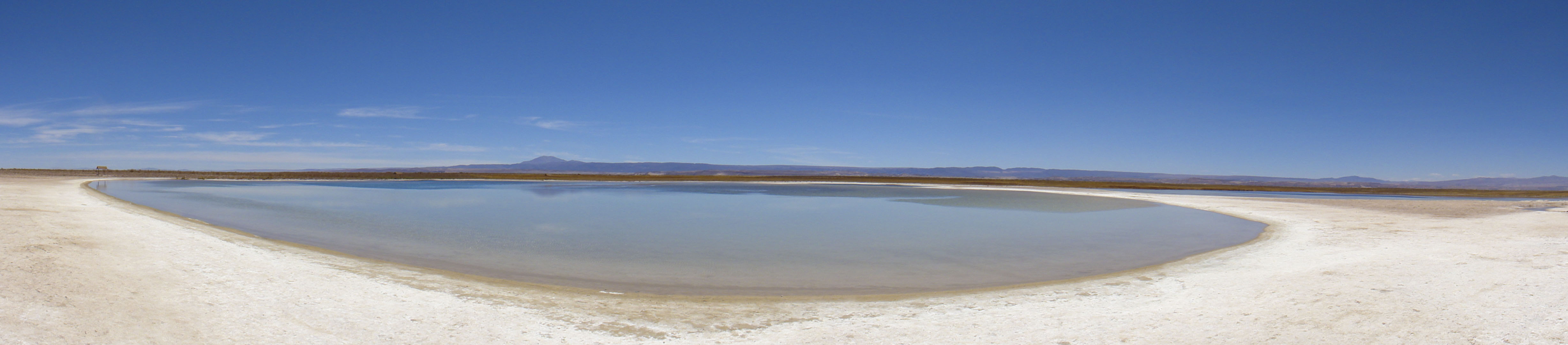
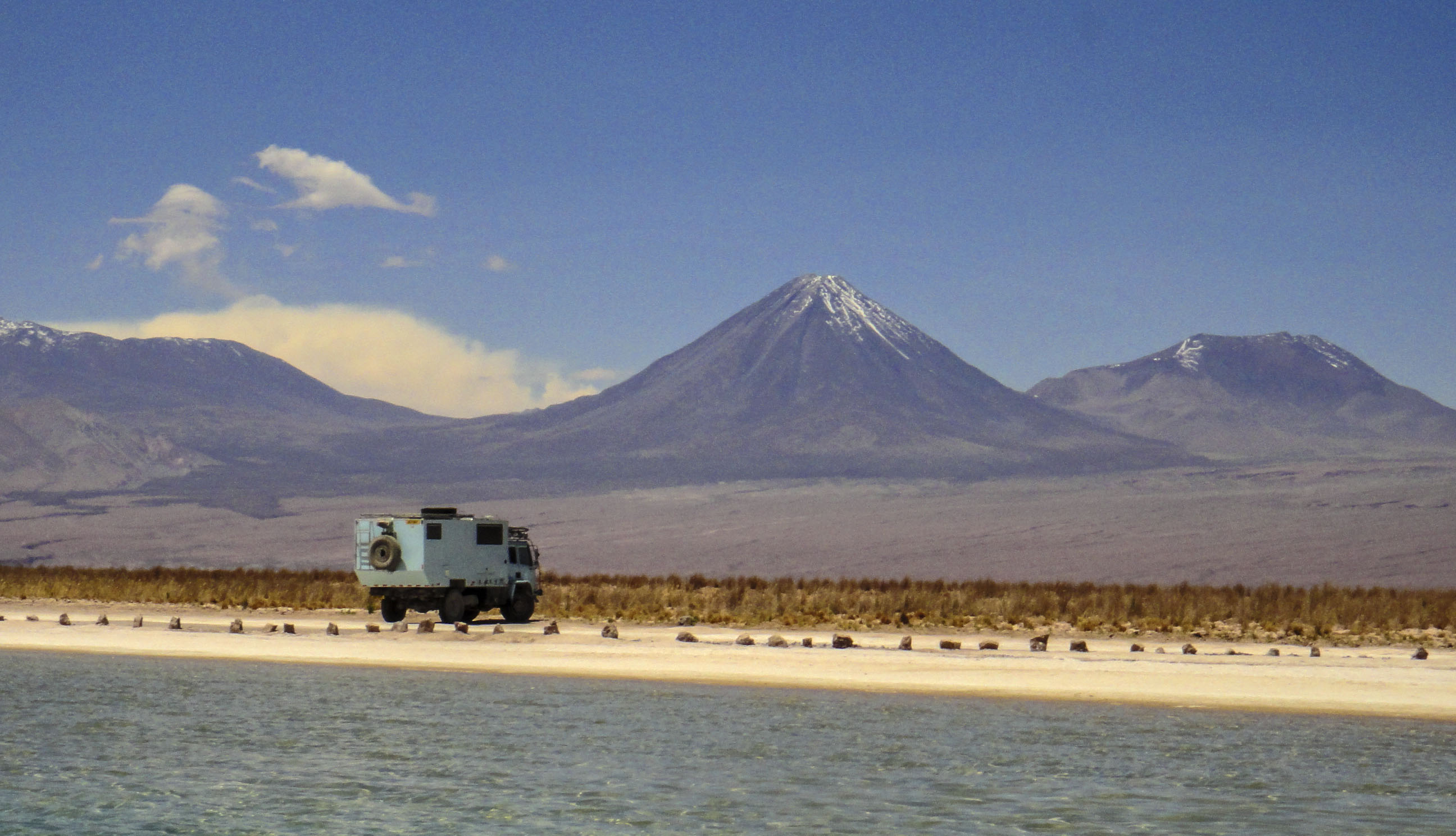
We’re not ones to sit around too long though so we headed off on an excursion to a lake in the desert that we had heard about. Laguna Cejar is not too far from San Pedro and a plus point is that the road is pretty good. Its actually one of 3 lakes but the other two are reserved for Flamingos. The attraction is that the lake is very salty, like the dead sea, so floating on the surface is a piece of cake.
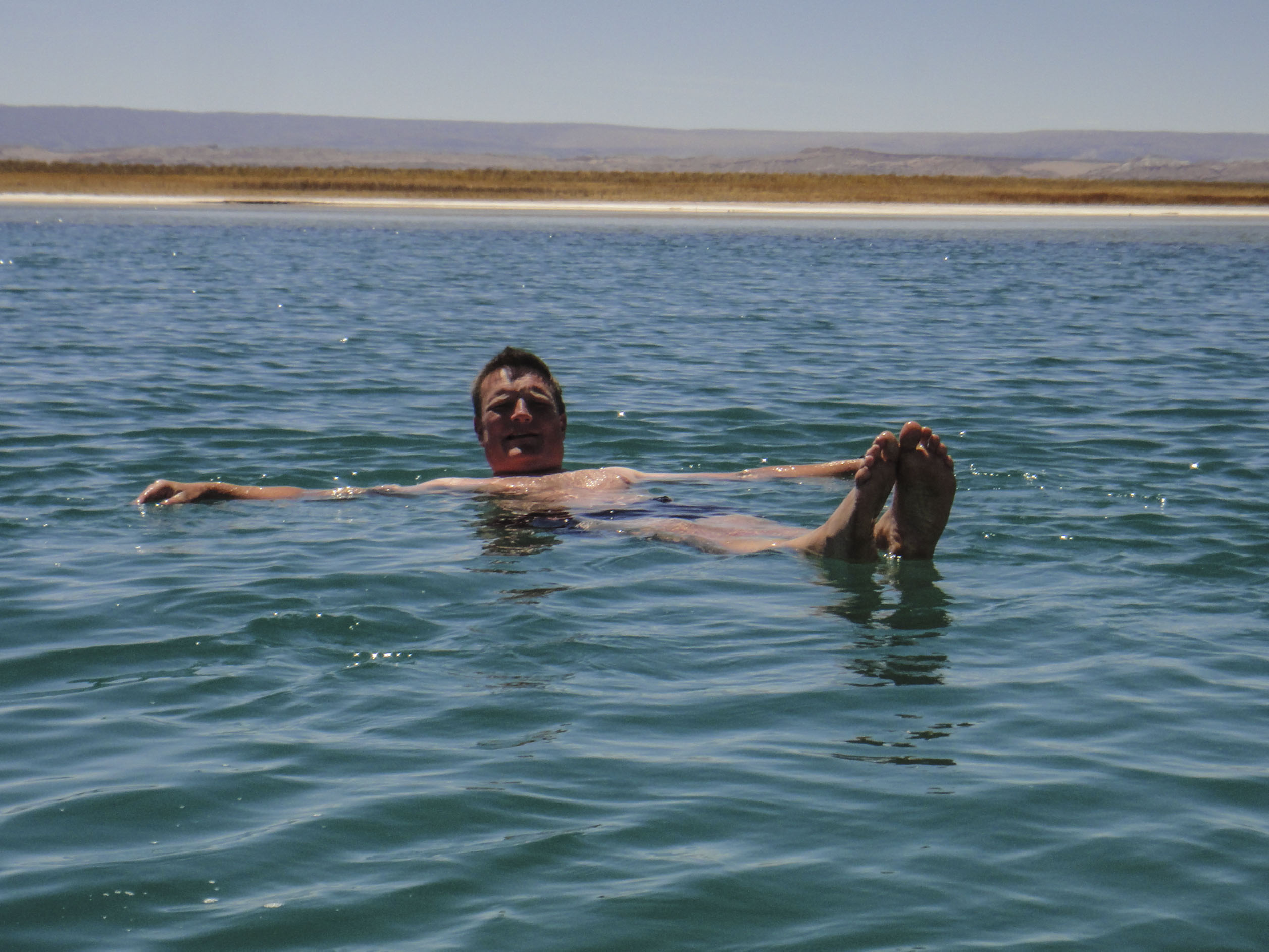
The down side though was that the water was really cold – all that is apart from a couple of inches on the surface – incentive indeed to float!
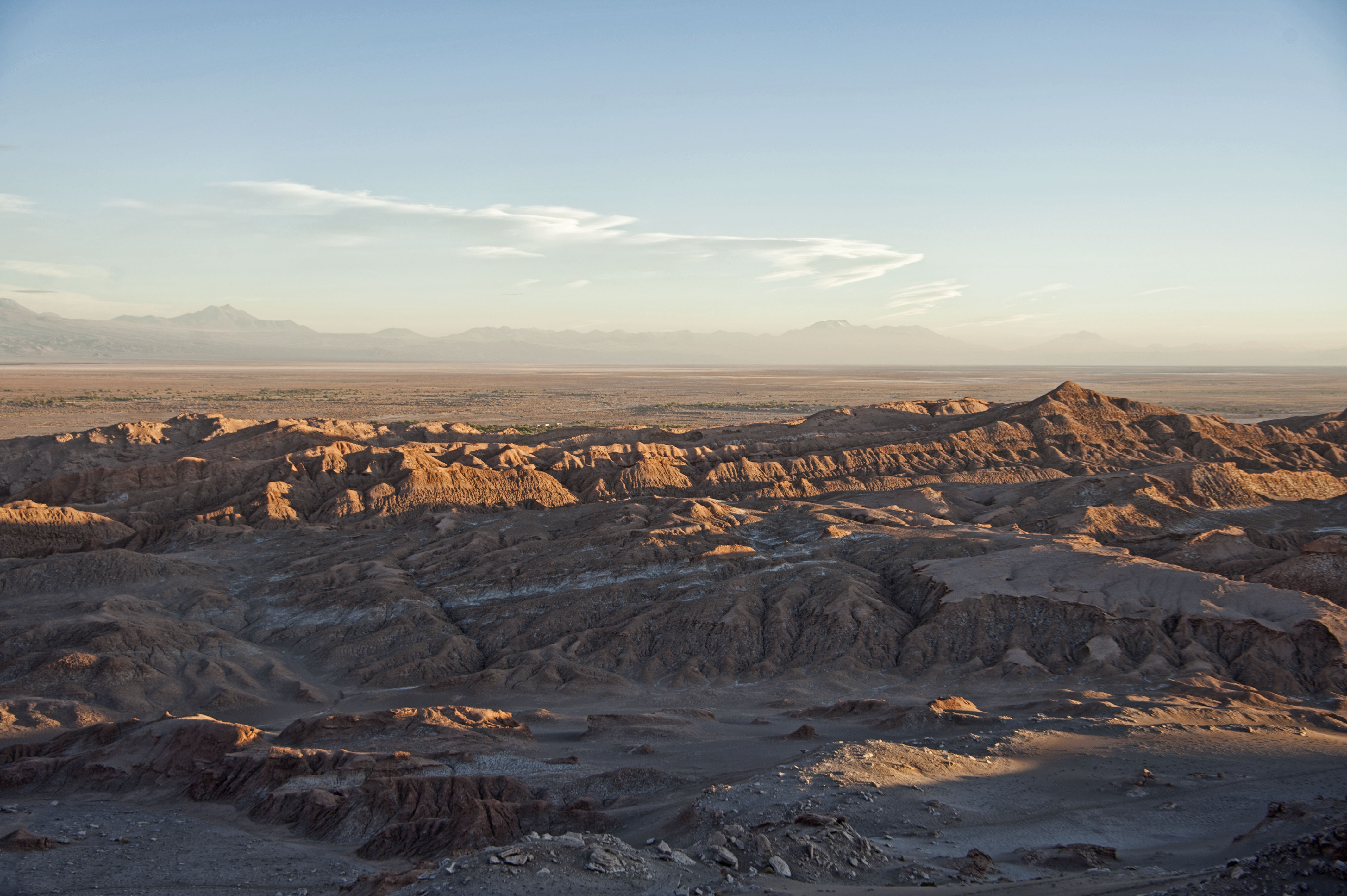
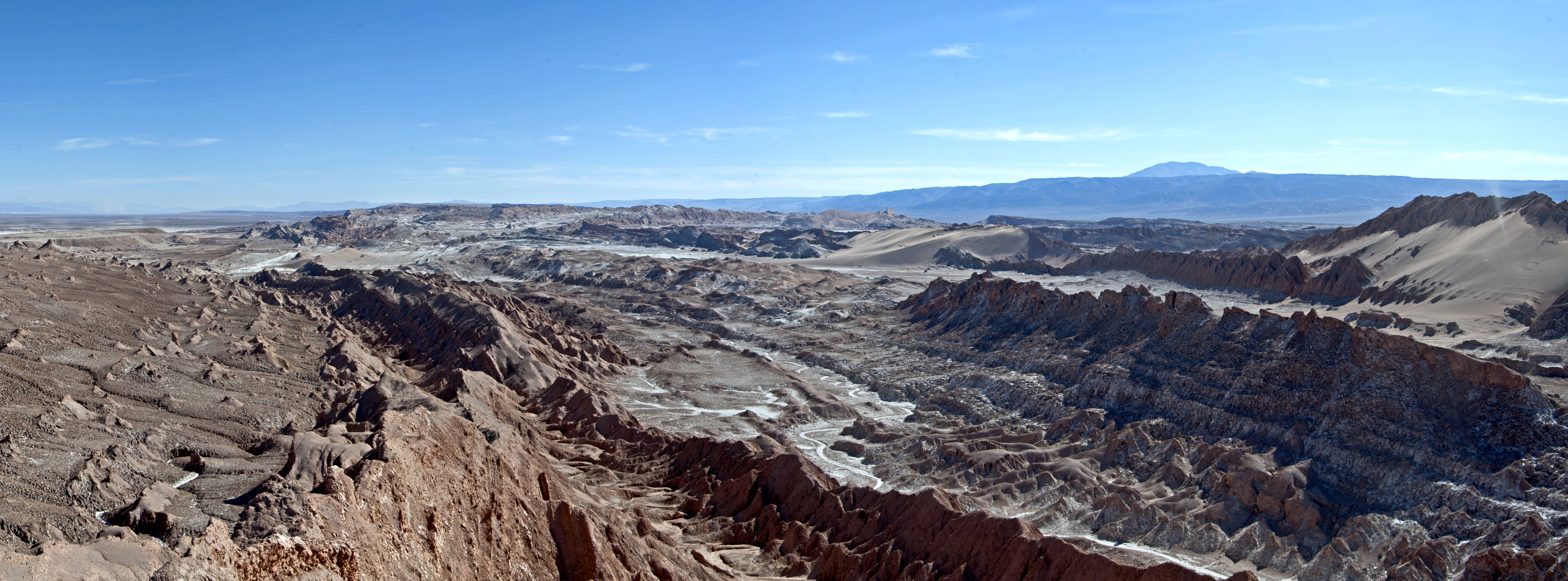
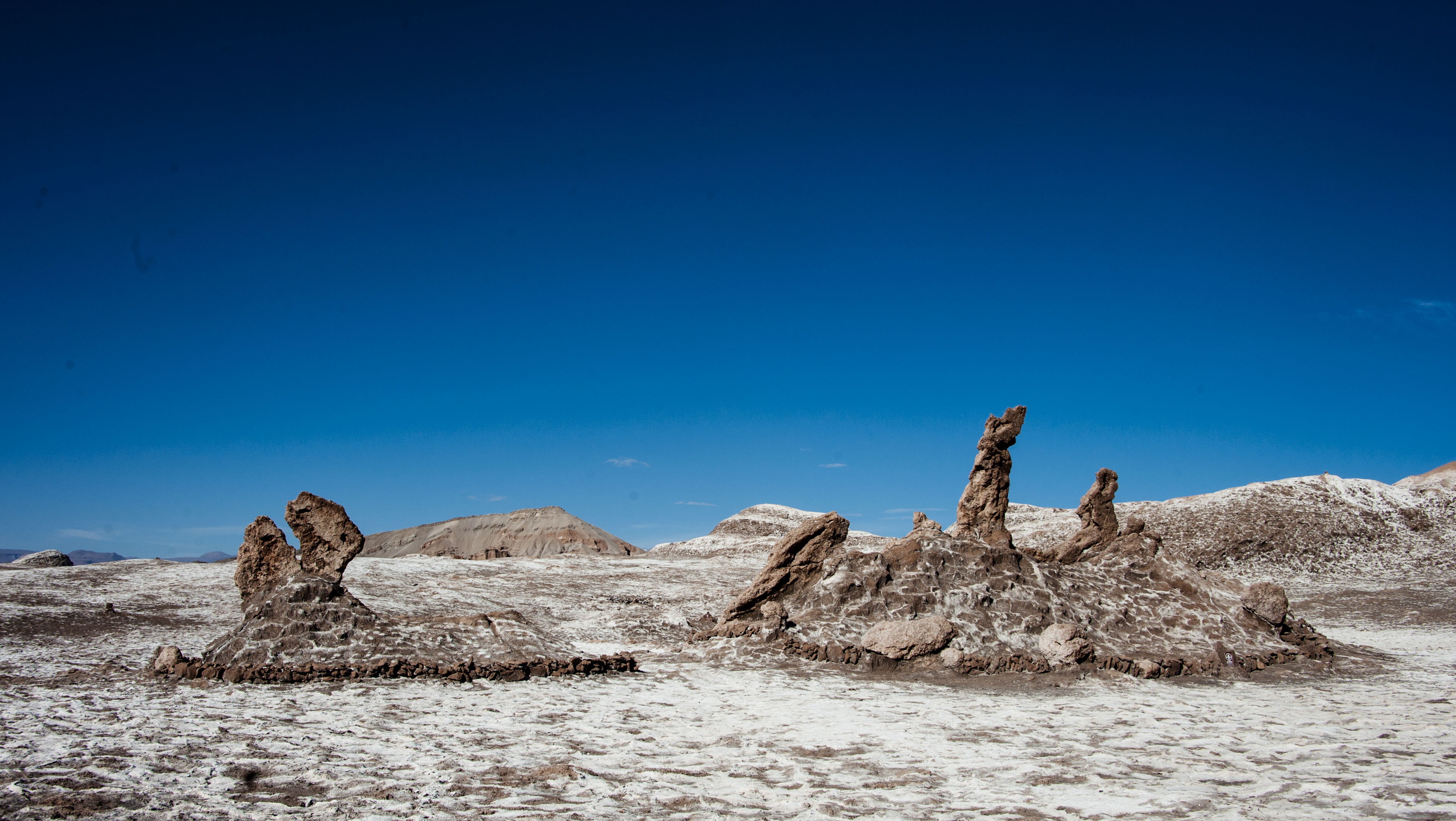
After hitting the lake we drove up to Valle de Luna – one of about a million of these worldwide. It was an otherworldly landscape which looked fantastic in the late afternoon sunshine.
Camping In Bolivia
Bolivia Campsites
Copacabana Beach (S16 10.409 W69 05.651, 3819m)
On Lake Titicaca Beach further along from the trout restaurants. There is a good space just before the Hostel which appears to have no name. This was very quiet overnight with no traffic. Come to an arrangement with the owner of the hostel (who sells some pretty inventive jewellery made out of old cutlery) for toilets. There are also public toilets at the other end of the beach. FREE.
Ridgeline Camp on the Road to Sorata (S15 46.716 W68 40.187, 3033m)
On the road on the way to Sorata. This spot has a great view of two valleys. No facilities. FREE.
Altai Oasis, Sorata (S15 46.175 W68 39.295)
This is a lovely little campground. Access is however very difficult and absolutely not recommended in a larger vehicle. Even in smaller vehicles you must back down into the car park area as the turn into the drive is not possible. However this is a beautiful place to spend some time. We couldn’t stay because it was fully booked by competitors in a bicycle race – and we would have struggled to get in anyway !
Hotel Oberland, La Paz (S16 34.086 W68 05.343, 3314m)
This is one of the key overlander meeting spots as everyone seems to come here. The Hotel Oberland is a Swiss-owned hotel in the Mallasa district of La Paz. Mallasa is around a 20-30 minute collectivo ride from the centre (costs B2.20 per person). The Hotel can be reached by crossing the Valle de la Luna from El Alto thereby avoiding having to drop down into the rabbit warren of the main city. Spotless toilets and hot showers, a pool, Jacuzzi, good restaurant and cafe, laundry service and a very warm welcome from the staff make this a lovely place to spend some time away from the hustle and bustle of La Paz. There are also power sockets and an external tap. B100 per night.
Thermal Baths, Sajama NP (S18 05.592 W68 58.737, 4293m)
No facilities. Sandy car park of the Thermal baths. Cold and quiet overnight. Spectacular views of surrounding mountains. Free. (Thermal Baths are S30 each and consist of natural pool in the altiplano).
Lake by Road to Potosi (S18 49.872 W66 43.852, 3774m)
Reservoir by the road just after the town of Challapata. Most of the access roads to the shore have been blocked but you can negotiate one. No facilities. Free.
Parking Lot in Potosi (S19 34.735 W65 45.342, 3936m)
We were too tall for Hotel Tarija (S19 35.069 W65 45.347) which is the usual overlander’s place to stay. This secure parking lot was very cheap and a 15 minute walk from the centre. No Facilities. B25 per night.
Hotel Austria, Sucre (S19 02.313 W65 14.776, 2867m)
Next to bus terminal. Secure parking lot behind hotel. Toilets and Showers available (hot if you use the ones inside the hotel). External water tap but no power. They wanted B120 to sleep in the truck or B100 to take a room. We took a room and slept in the truck anyway as it is a lot nicer than their rooms! WIFI in the hotel. Collectivo into centre from here is 10 minutes. (3 or A). They have 3 dogs on the grounds, be very wary of the little black one which took a chunk out of Sarah’s leg and tried to do the same to me!
Ojo del Inca, Nr.Potosi (S19 28.027 W65 47.684, 3412m)
This is an awesome place to stay. Short dirt track from the main road to reach the massive (100m across) circular hot pool. You can park right on the edge of the lake. Basic toilet block available. It was busy when we arrived but everyone left by dark. In the morning there was no one there and we had a beautiful solo soak. B70 per night.
Hostal Marith, Uyuni (S20 27.944 W66 49.598, 3722m)
Hostal in Uyuni with narrow parking yard. Room for 2 overland vehicles max. However they stack the vehicles in and if one needs to leave you may be asked to move to let them through. Power and water available. Hot showers and toilets. B60 per night.
Isla Incahausi, Salar De Uyuni (S20 14.450 W67 37.673, 3665m)
On the Salar next to the island. Toilets, water and a restaurant are available on the island. Picnic tables also. Very very quiet after sunset but during the day lots of Landcruisers. Camping here is FREE. Entry to Island walk is B30 per person and you need to show the ticket to use the toilets.
Outside Tonito Hotel, Uyuni (S20 27.912 W66 49.493, 3645m)
In the street slightly up from Tonito hotel. Tonito hotel has Minuteman Pizza which serves very nice Pizza. This is in front of army base guard post so very secure. No Facilities. FREE.
Laguna Honda (S21 37.367, W68 03.669, 4128m)
No Facilities. FREE. On shore of Lake. Bitterly cold at night – but fairly sheltered from the wind.
Laguna Colorado (S22 12.775 W67 47.951, 4312m)
No Facilities. FREE. On slight ridge above lake, in parking area. Landcruisers during the day but deserted at night. Brilliant views.
Laguna Blanca (S22 46.745 W67 48.215, 4354m)
No Facilities. FREE. On Flat exposed ground next to lake. Bitterly cold and very windy during the night.
Border Crossing Bolivia to Chile (Hito Cajon – San Pedro de Atacama)
This was one of the easiest crossings we have done to date. However there are a couple of things to be aware of that can really sting you.
Hito Cajon – Aduana
The first thing to realise is that Bolivian Aduana is around 80km from the actual border right in the middle of the nowhere. Its actually sited at over 5000m so will be many peoples highest driven point in their South American travels. Its also hidden away behind a guarded barrier in a processing plant.
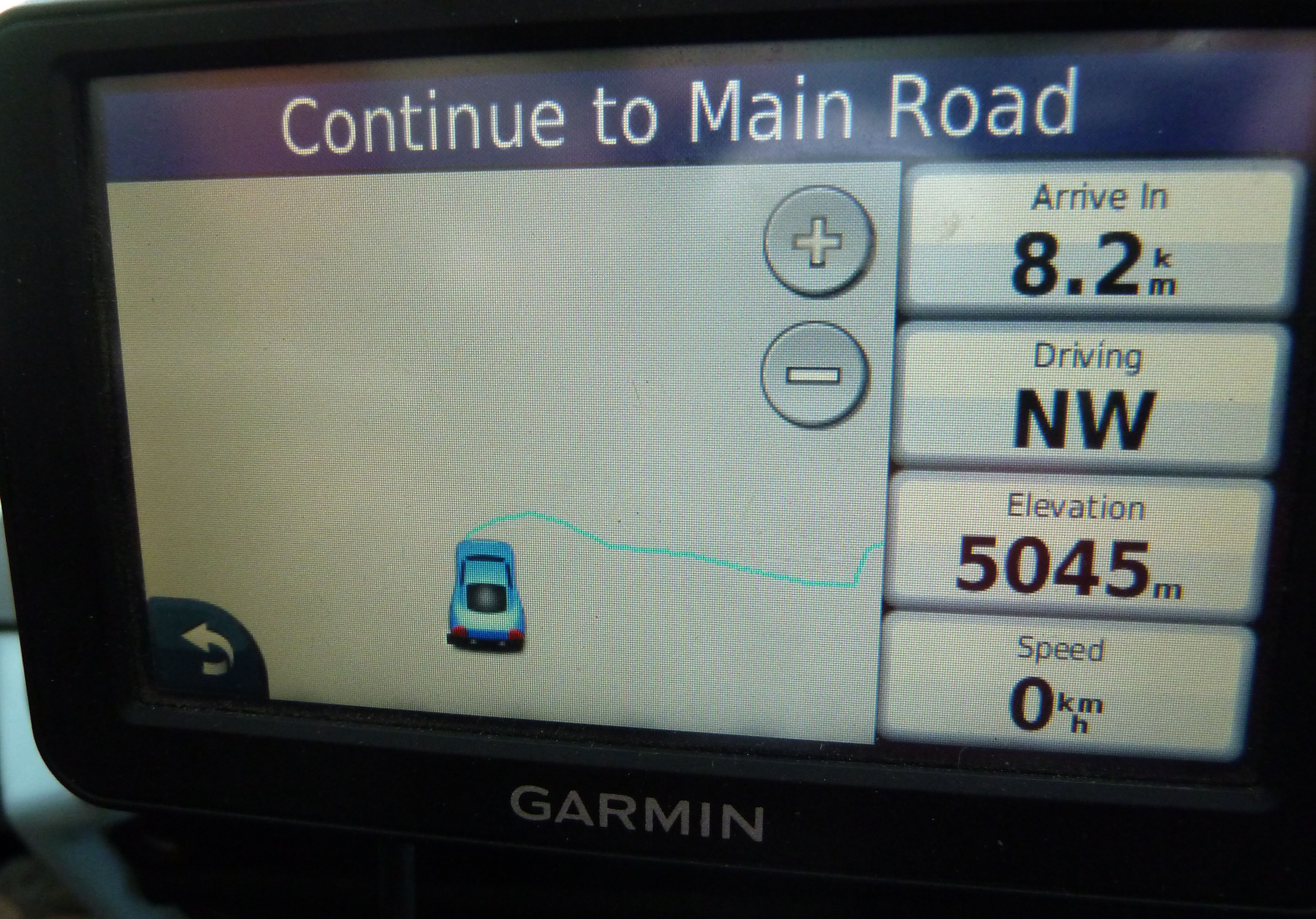
The guy at the guide quickly lets you in once you tell him that you want Aduana.. You can pull up right by the door – probably in a howling gale.
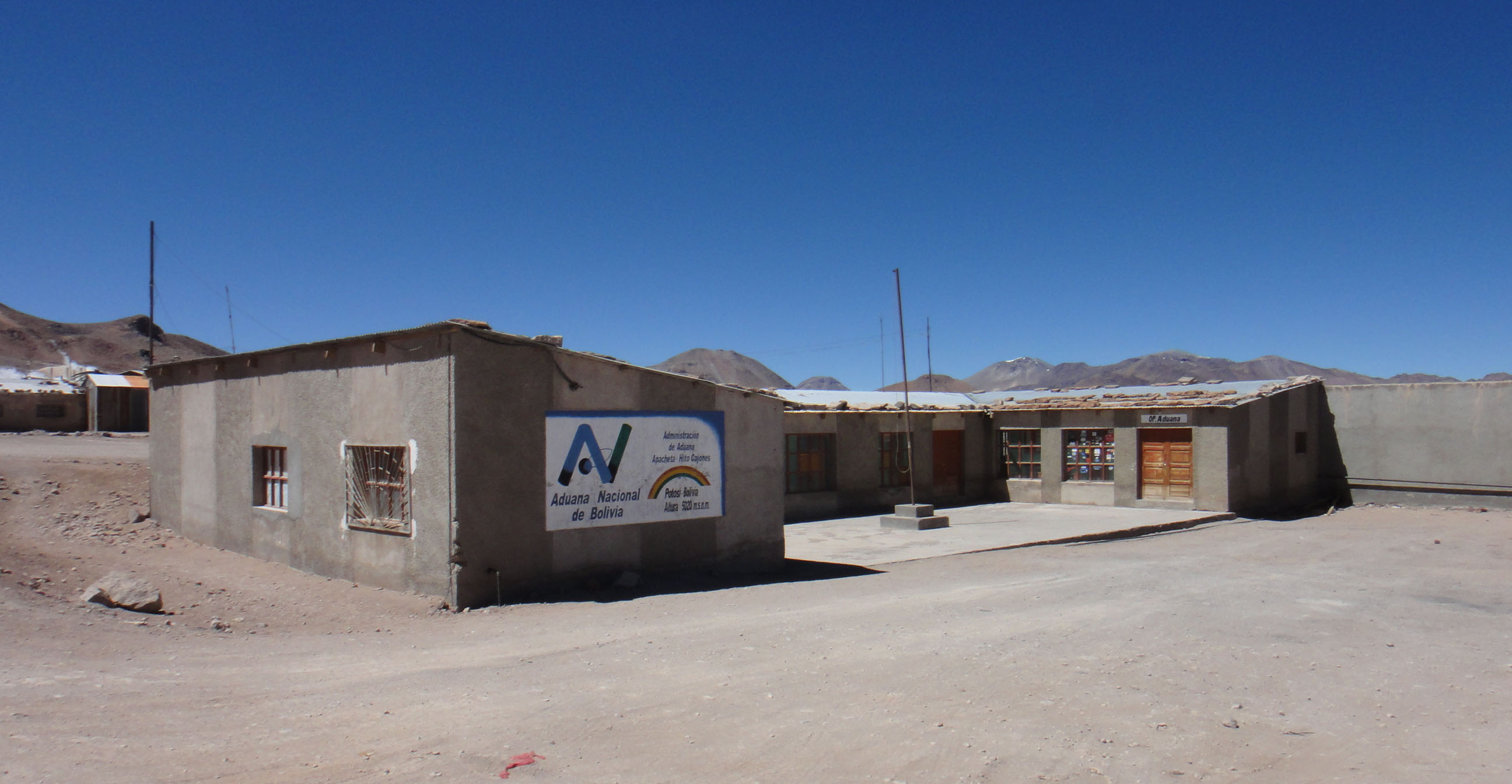
It may take a bit of knocking on the door (which will be locked) to get someone to come open up – but keep trying.
Once You are in it’s a very quick process. You had over your Temporary Import Permit and the customs guy checks it to his computer. He then prints out a couple of forms stamps them and you sign and then you get one copy and you’re free to go.
It doesn’t matter if you spend a couple of days getting to the actual border.
Bolivian Migracion
Shortly after leaving the Eduardo Avaroa park you come to a barrier across the road which is the actual Bolivian border post.
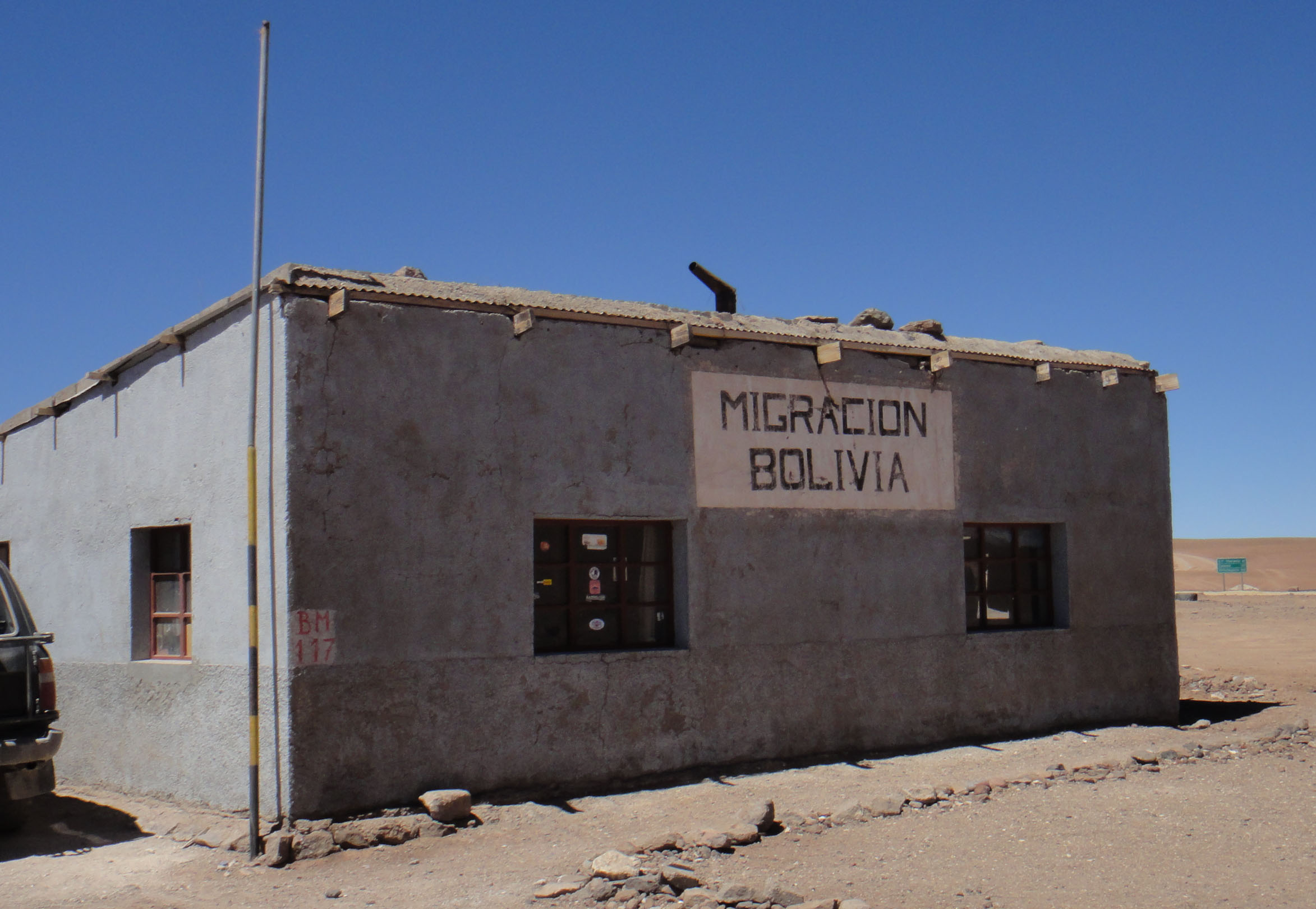
There is a small inhostpitable looking building – and when arrived it was locked. After banging on the door we were let into to a small room.
Inside were a police man and an immigration guy. The immigration guy took our passports and then showed us a piece of paper which said, in English, that there was a B15 charge each for leaving the country.
Well we weren’t sure if this was a scam or not so we went on the offensive and refused to pay. After a short argument, in which the policeman joined in, he dropped the charge, stamped our passports and we were d the one.
We got back in the Beast and drove up to the barrier. The policeman came rushing out and lifted it and we were through.
Chile – San Pedro de Atacama
The Chile border post is actually another 40km down the road at one end of San Pedro de Atacama. It can be really busy but we were lucky that it was deserted when we arrived.
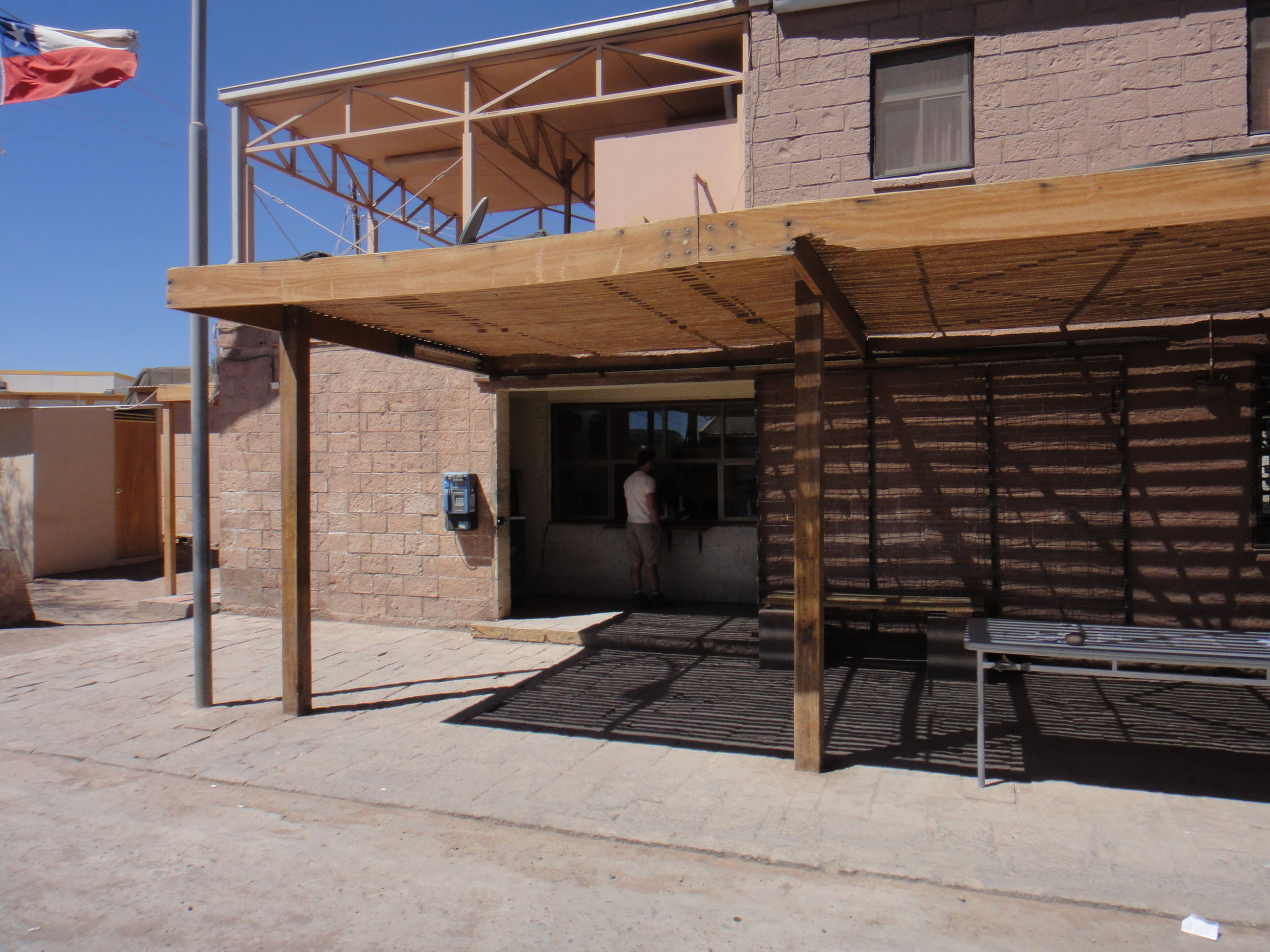
First stop was Migracion where we had to fill out an entry form but this was easy and our passports were stamped with 90 days straight away.
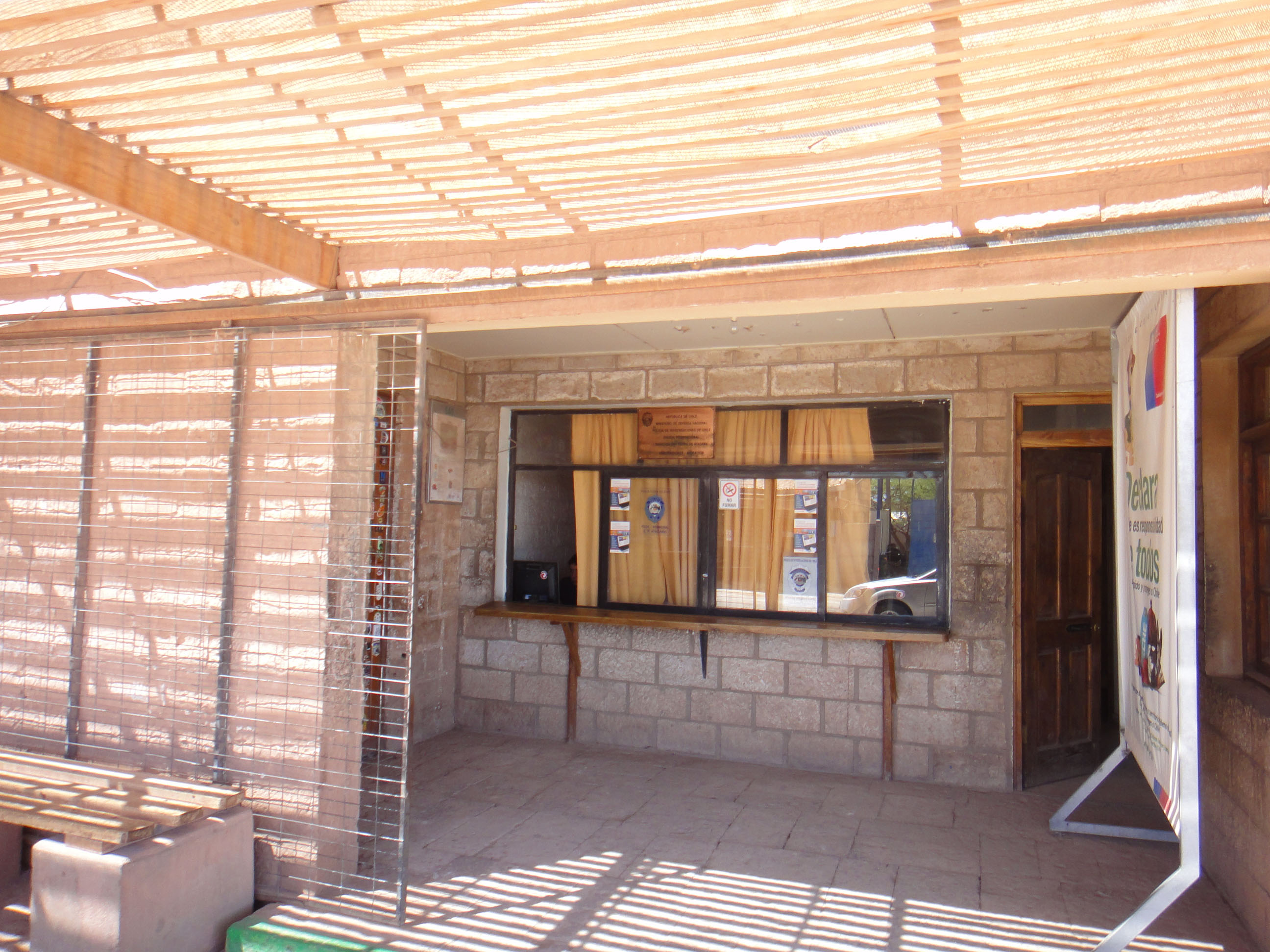
At the other end of the building is Aduana and this was simple too. A quick form to fill out, hand over your registration documents and we were issued with our TIP straight away.
However at this point you fill out a customs form related to what you are bringing into the country. It is really important to tick the Yes box relating to illegal food. If you do this any foods found that are not allowed in Chile will be confiscated but no fine levied.
The real problem with crossing the border into Chile is the restrictions on food. The officals from SAG will search your vehicle and will decide what to confiscate. Uncooked meat, fruit and vegetables are there main targets, although they will also take things like Honey as well.
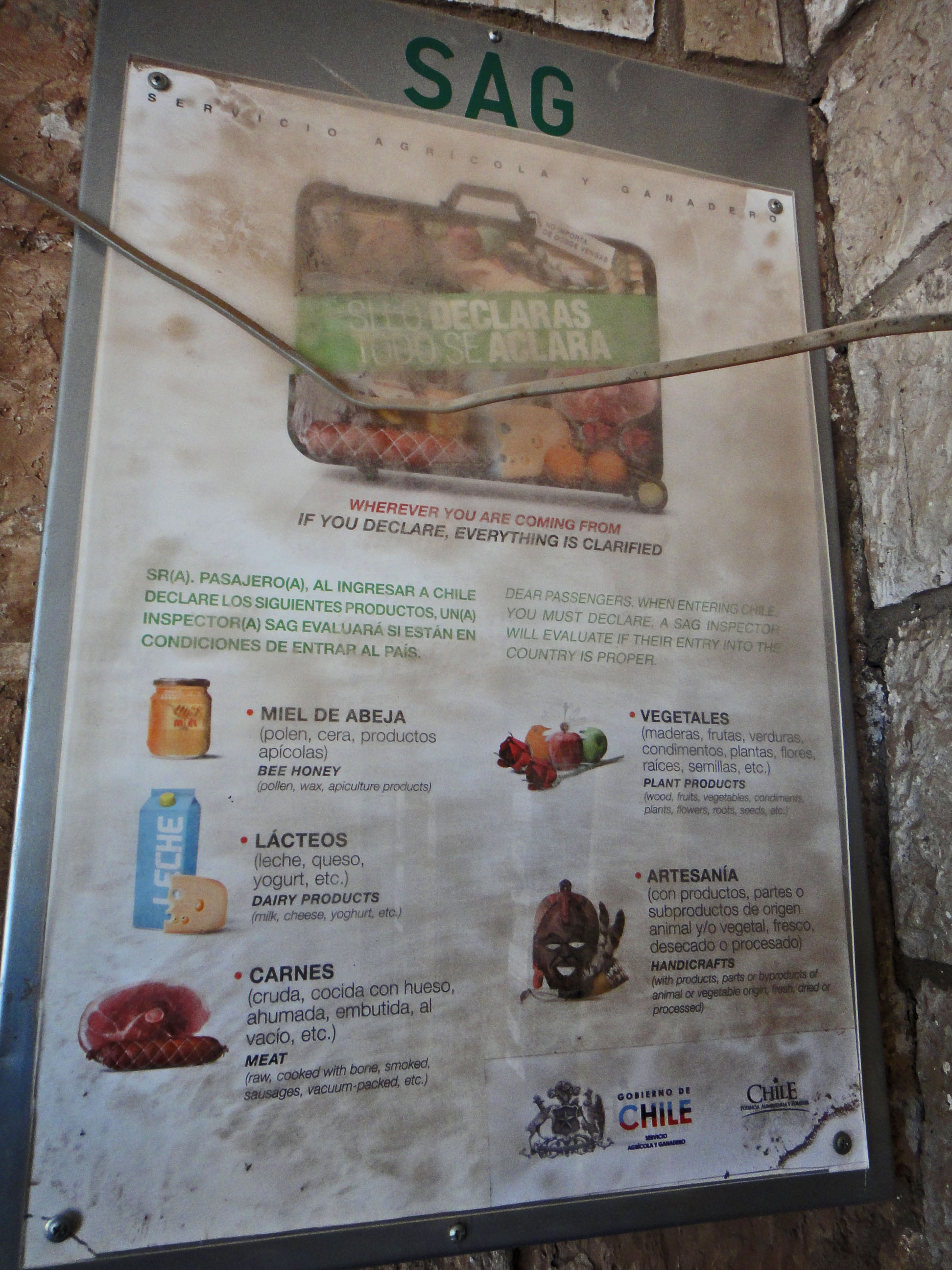
The search of our truck was pretty cursory although the SAG woman did go through the fridge thoroughly. We lost avocados and onions but we’d eaten all our meat.
Once the inspection is done you are in Chile and free to go. These guys can really take most of your food if they are in a bad mood though !
Diesel in Bolivia
Getting fuel in Bolivia is a pain in the Arse.
It all stems from how Bolivia gets its fuel. Bizarrely the government buys the fuel from Chile (where it costs around USD 1.38 per litre. The Bolivian government then subsidises the pump prices to around USD 0.5 per litre. This is much cheaper than the surrounding countries so it was no surprise the Peruvians, Argentinians and Chileans started coming to Bolivia to fill up. Couple this with enterprising Bolivians selling fuel across the border and it was all costing the Bolivian government a fortune.
To resolve this situation Bolivia introduced two new rules:
1) Banned exports of fuel across the border. This in practice means that you shouldn’t be able to take more than 80 litres of fuel out of Bolivia
2) Introduced an international pump price for fuel which was triple the Bolivian price.
In reality the first rule shouldn’t impact overlander’s too greatly. We have heard of people having trouble because of jerry cans so it’s a good idea to hide your cans when leaving Bolivia. We were not checked leaving into Chile from Eduardo Avaroa Park.
The second rule is much more of a pain. Almost without fail when you arrive at a station and ask how much the fuel is you will be told about the international price.
So you have to try and negotiate a lower price. Usually this will involve asking for the fuel without a receipt. We had success with this and managed to reduce the price to an average of B7 from B9.40. The amount of the reduction will depend on how good at negotiating you are and how good your Spanish is, other overlanders have managed to get it for less.
There are a number of excuses you might get though:
1) We haven’t got any fuel: this is usually genuine – many of the stations just don’t have fuel because they have run out. Between Copacabana and La Paz we didn’t find any diesel at all.
2) We haven’t got a licence to sell to foreigners.
3) Come back later when my boss isn’t here – difficult to argue against.
4) We’ve got cameras so we can’t – some people have had success at getting a cheap price by presenting jerry cans and parking round the corner.
Sometimes they just don’t want to sell you fuel because its too much hassle for them – there’s not much you can do about this.
It’s generally much easier to buy fuel in the lowlands than the Altiplano because they seem more relaxed.
Some general rules of thumb for Bolivia are:
1) Fill up when you can and get the best price you can by negotiating
2) Carry a couple of jerry cans just in case
3) The fuel is terrible so enter the country with a new fuel filter and change it when you leave
4) The more obviously foreign your vehicle the harder you have to work to get a lower price – sponsor stickers etc just don’t help, a beaten up landcruiser is just the ticket !
An Overlander’s Guide to Bolivia’s Southwest Circuit
An Overlander’s Guide to Bolivia’s Southwest Circuit
There are two main parts to the attractions of the Bolivian Southwest:
1) Salar de Uyuni
2) Reserva Eduardo Avaroa
The base for explorations of both these areas is the only town of any size in the region, Uyuni. Uyuni is definitely not much to look at and I wouldn’t recommend spending any longer than necessary here. The days are warm (hot in the sun) and the nights are cold – for us the town of Uyuni was colder than the Salar itself.
It is possible to urban boondock in Uyuni – one of the best places is outside the Tonito hotel (which houses the excellent Minuteman Pizza). This is in front of the army base with 24 hour security so a pretty good place. We also stayed in Hostal Marith which has a small (two overlanders at a pinch) secure parking area and hot showers. The Tonito hotel does have space in a secure lot for one vehicle although it is more expensive.
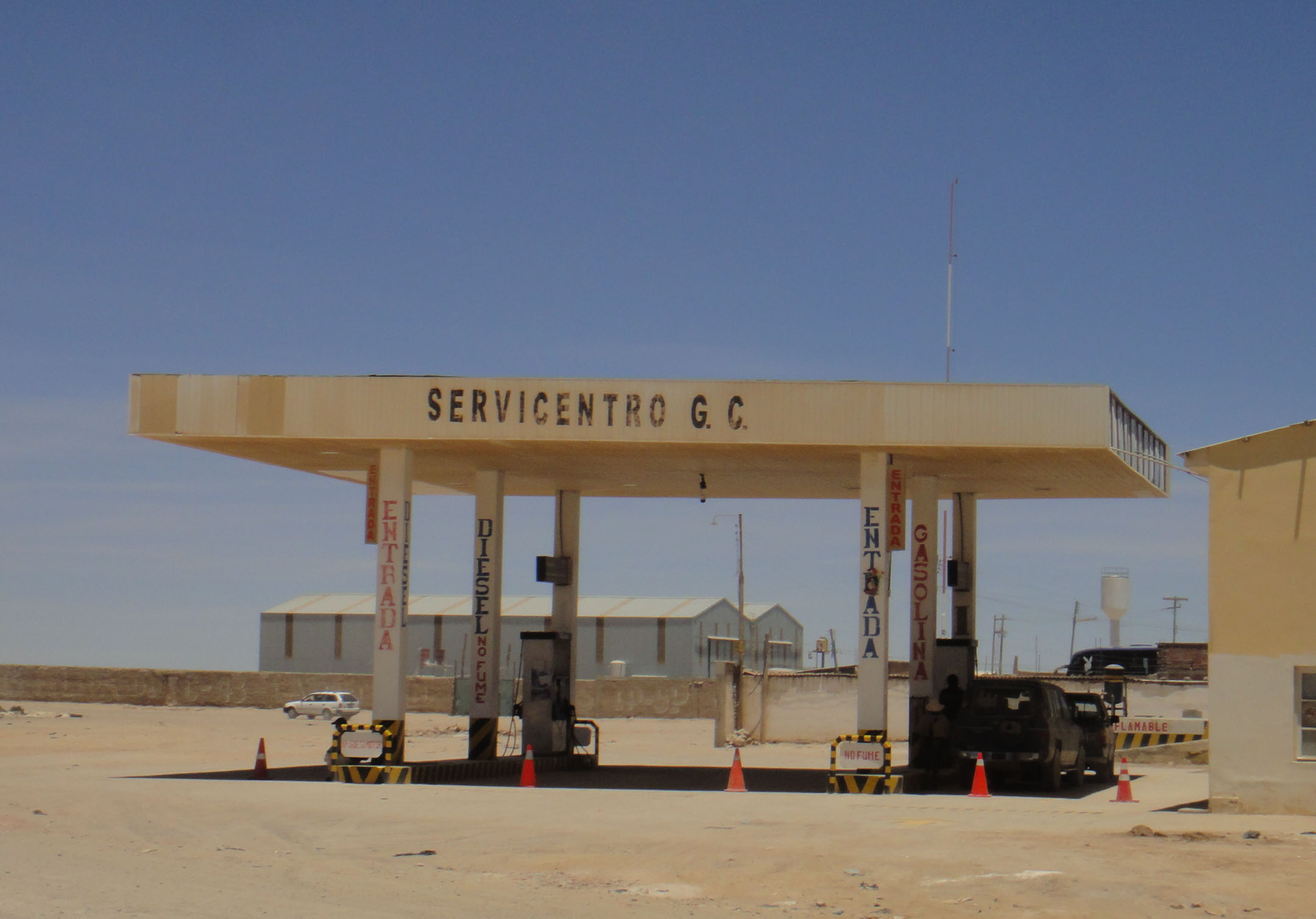
There is reliable fuel in Uyuni – we found the best petrol station was Servicentro at the South end of town. This is next door to a number of car washes where you can get salt from the Salar cleaned off if you return to Uyuni before taking on Reserva Eduardo Avaroa.
The car washes will also spray the underside of your vehicle with used oil before venturing onto the Salar and this will help protect your chassis from the salt on the Salar. This is highly recommended. The salt on the Salar will coat the underside of your vehicle in thick chunks so any protection has to be a good thing.
UYUNI GPS Co-ordinates
- Parking for Train Cemetery S20 28.633 W66 49.850
- Truck Wash S20 28.156 W66 49.172
- Servicentro GC (Fuel) S20 28.185 W66 49.204
- Hostal Marith S20 27.941 W66 49.602
- Tonito Hotel (Minuteman Pizza) S20 27.912 W66 49.495
GPS Maps
The following maps for Garmin GPS have coverage of SW Bolivia:
Mapear v.9.8 Mapas Electronicos Argentinos – Provides a very basic map but not recommended for SW Bolivia. It is the map of choice for Chile and Argentina however. The Salar part of the route is not covered.
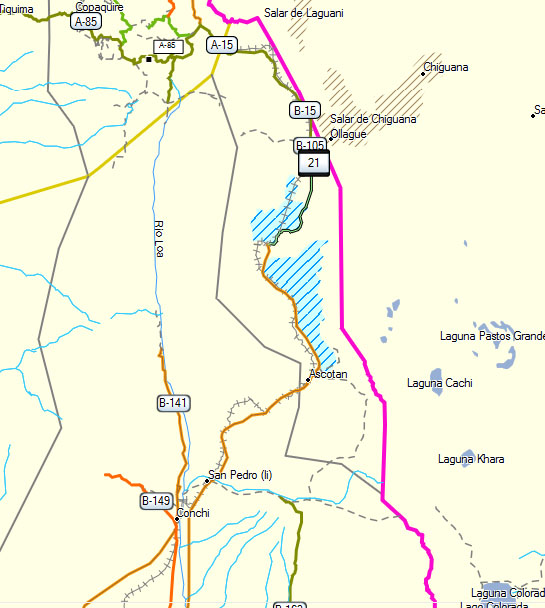
Viajeros Mapas 11.10 – This map is not routeable but has by far the best topo map of the South West circuit. This is the only map that had all the tracks that we used – including the track past Chillucani.
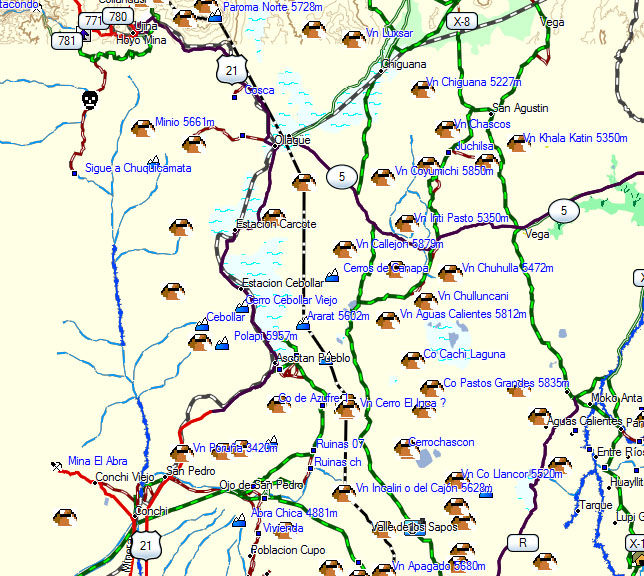
Bolrut 3.5 – This is a commercial product that is available on the internet as a download (Noeman.org is a good place to look). The map is ok for Bolivia and is routeable. This comes as a file for download direct to your GPS and cannot be loaded into Mapsource, without significant work.
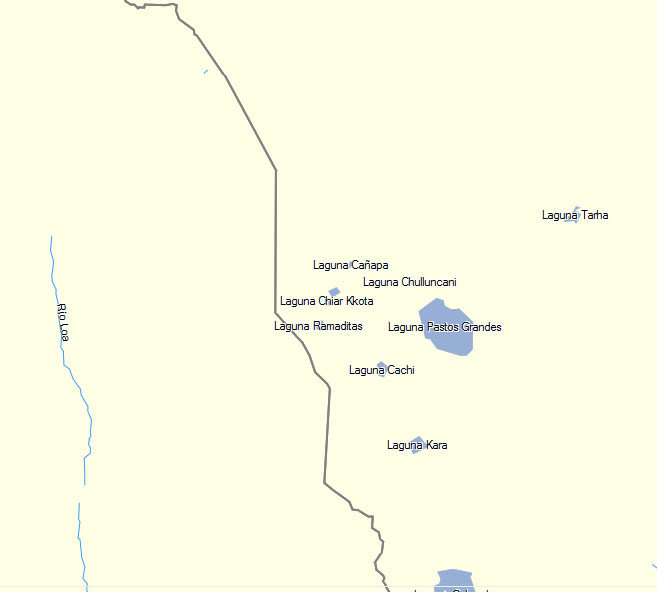
OpenStreetMap – Is a good basic map and the best routeable map for the region.
Fuel
Fuel is available in Uyuni and San Pedro de Atacama. The fuel in San Pedro de Atacama is quite expensive and it is cheaper to fill up in Calama (this adds another 100km to the journey).
From Uyuni to San Pedro de Atacama via the Lagunas route we drove 300 miles (460km) – (363 miles to Calama (581km)). This was all at high altitude (4000m+) and mostly in sand or rocky tracks so our mileage was lower than normal (We usually average 11 miles per US Gallon and on this route we only made 9.2 miles per US Gallon) (in metric usually 4.6Km per litre and on this route 3.9km per litre).
This is the mileage if you return to Uyuni to refuel after visiting the Salar. If you don’t refuel in Uyuni but do return, a Salar trip adds around 130 miles (210km). If you were to just do a trip through the Salar and out it would add around 70 miles (110km). Of course any side trips or additional exploration of the Salar can significantly increase this.
There is a fuel station available in San Christobal, around 50 miles from Uyuni. However the availability of petrol or diesel at this station is patchy and it is best not to rely on it.
Large jerry cans are available for purchase in many of the shops in Uyuni.
Salar de Uyuni
The road to the Salar is one of the worst roads we have ever driven. It consists of hard, tight corrugations which shake you to bits at anything over about 5km/hour. The good news is that there is a better parallel road under construction but it is of course anyone’s guess how long until this is finished.
Alongside this terrible road are some tracks which are smoother, although there are some deep sand patches on these other roads. We pulled a local car out of the sand in one place. However we would advise avoiding the main road and driving on one of the sandy tracks alongside.
The main entrance of the Salar, and nearest to Uyuni, is the Eastern entrance which is 5km from the very small town of Colchani. It is very important to get the entrance to the Salar right as the edges are often wet and are the weakest part of the Salar.
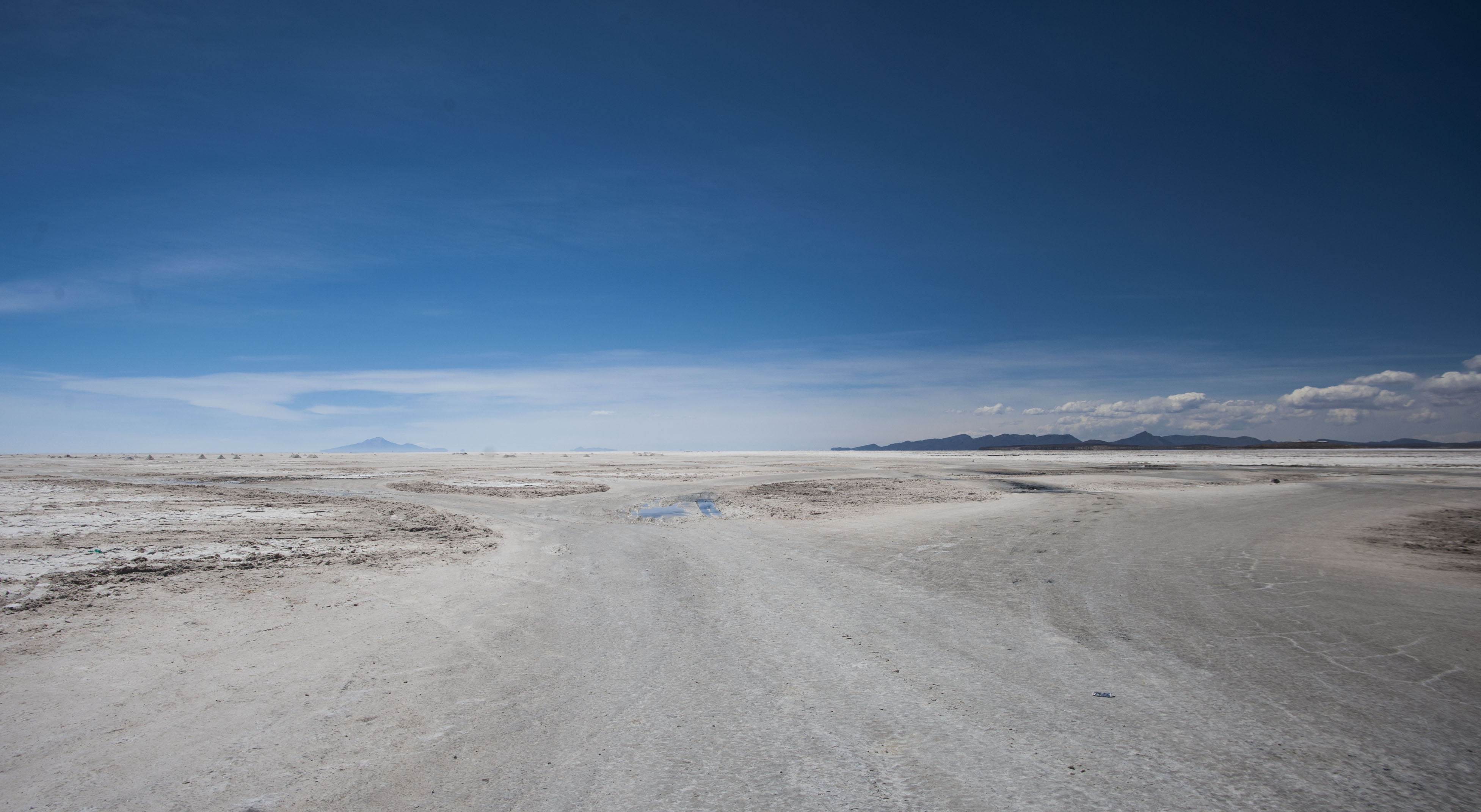
There is a raised causeway that travels over the slushiest part of the Salar and then gives way to a maze of tracks over the next 200 metres bridging onto the Salar itself. Follow a clear track until on the solid salt and all should be good. We stopped at the end of the causeway, had lunch and watched a few vehicles enter and then followed a route that a full sized bus took.
Once on the Salar proper it’s a smooth ride, the only real danger are the holes in the salt – some are proper axle breakers – so keep an eye out and avoid these. It is very tempting to go full speed on the flat even surface but it is far better to keep a moderate speed and watch for problems in the surface.
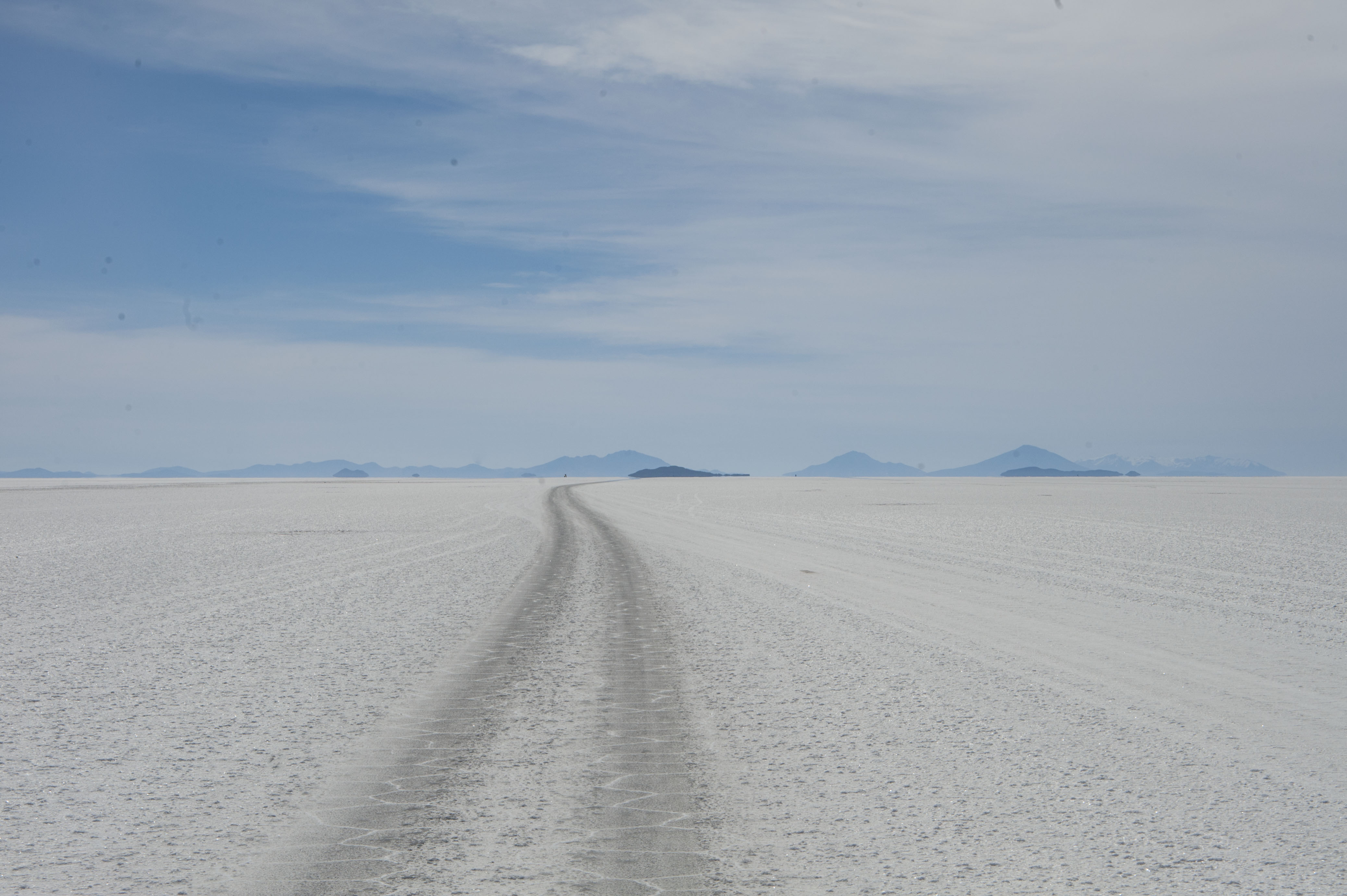
There are very clear tracks made by the tyres of the landcruiser tours – these are very useful for navigation. If not using these its best to use GPS as there are no distinguishing marks on the salt and it can be very easy to veer off course.
Breaking Through – We have met two sets of Overlander’s who have managed to break through the salt and get stuck. This leads to probably the nastiest type of recovery you can imagine in Overlanding. Our advice is just don’t risk it.
The guys who broke through – 1 was a big truck like ours and the back axles broke through – the recovery was 4 days and involved the army helping. The other was in a Land Rover, having missed the exit ramp they were caught in the slush at the edge of the Salar – this recovery was only 2 days, managed by themselves with their winch (and half their belongings as anchors !)
There are a number of islands which make a good destination. Isla Incahausi is the most popular and is covered in cacti and is a great place to spend the night. There are toilets on the island, tables at the edge of the salt and even a restaurant. It was busy during the day but by sunset everyone else was gone and we were alone. There is a nice hike up the island which costs B30 per person.
Isla Pescada is about 20km further on from Incahausi and is not developed. It is a much quieter place to stay.
On both islands it is best to park several metres away from the shore as the salt can be weak at the island’s edge.
Salar GPS Co-ordinates
- Eastern Entrance to Salar S20 18.973 W66 58.853
- Southern Entrances to Salar S20 28.300 W67 45.500
- S20 35.100 W67 36.400
- Northern Entrances to Salar S19 53.934 W67 45.521
- S19 51.585 W67 46.056
- S19 54.500 W67 37.250
- Salt Hotel S20 19.828 W67 02.802
- Isla Incahausi S20 14.470 W67 37.655
- Isla Pescada S20 08.522 W67 48.609
Road Conditions on the Laguna Route
The first 100 miles (160km) of the route are on a dirt road which is very flat and smooth. We averaged around 65km/h on this stretch of the route.
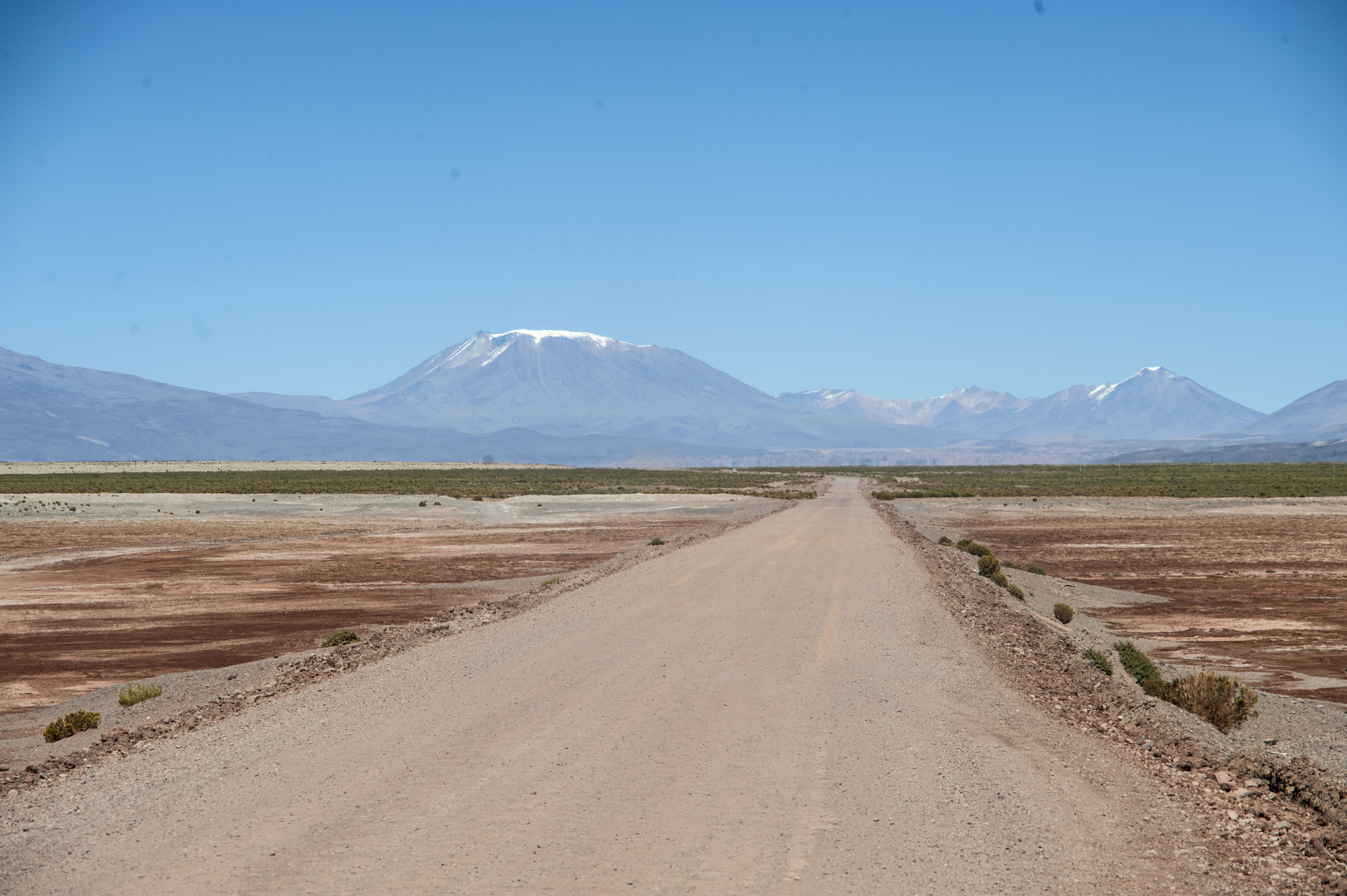
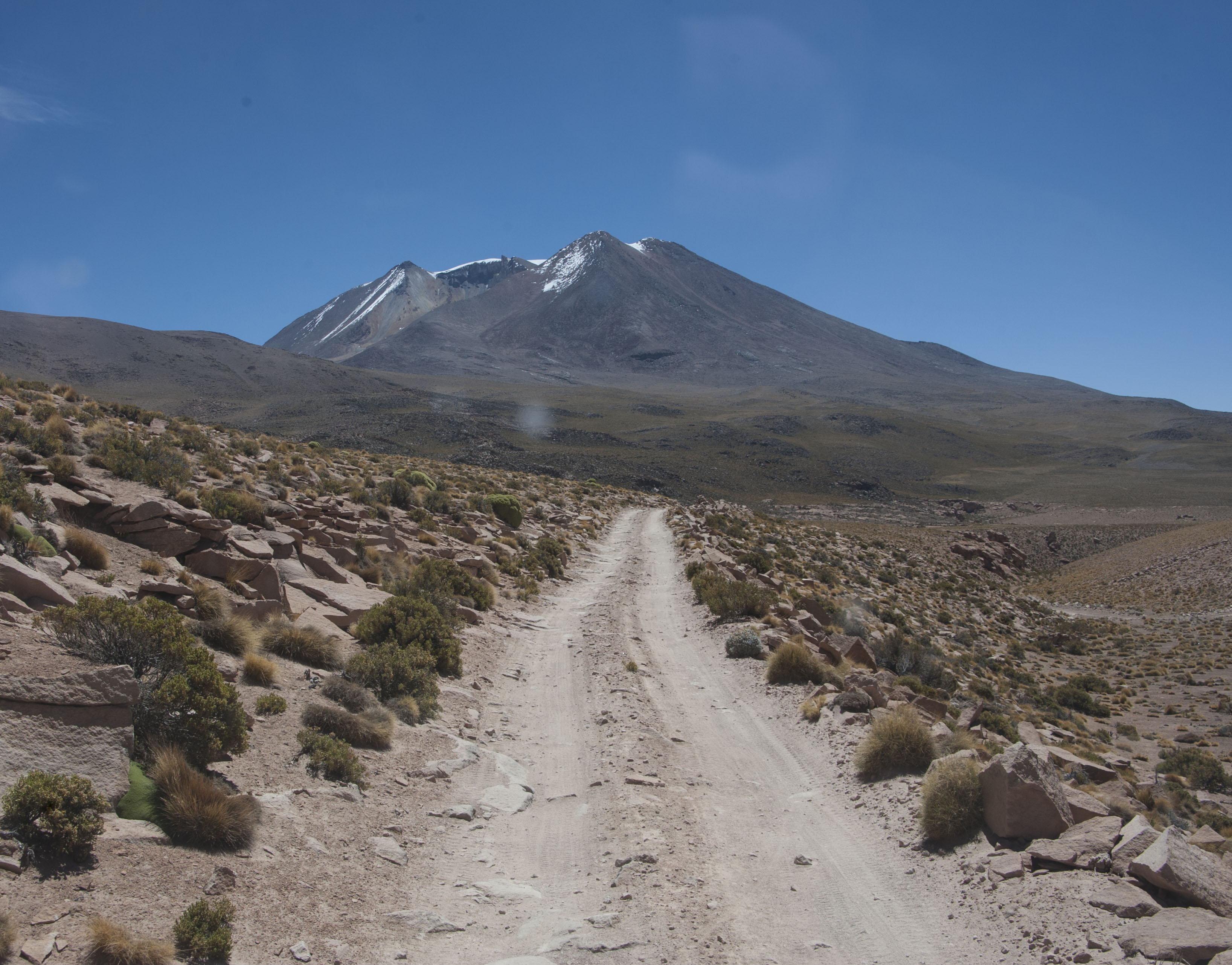
The next 15 miles (25km) of the road becomes terrible as you drive towards Laguna Chillucani, easily the worst of the whole route. There are several rocky canyons to negotiate and narrow rocky roads. I would be very hesitant to do this part of the route without 4×4.
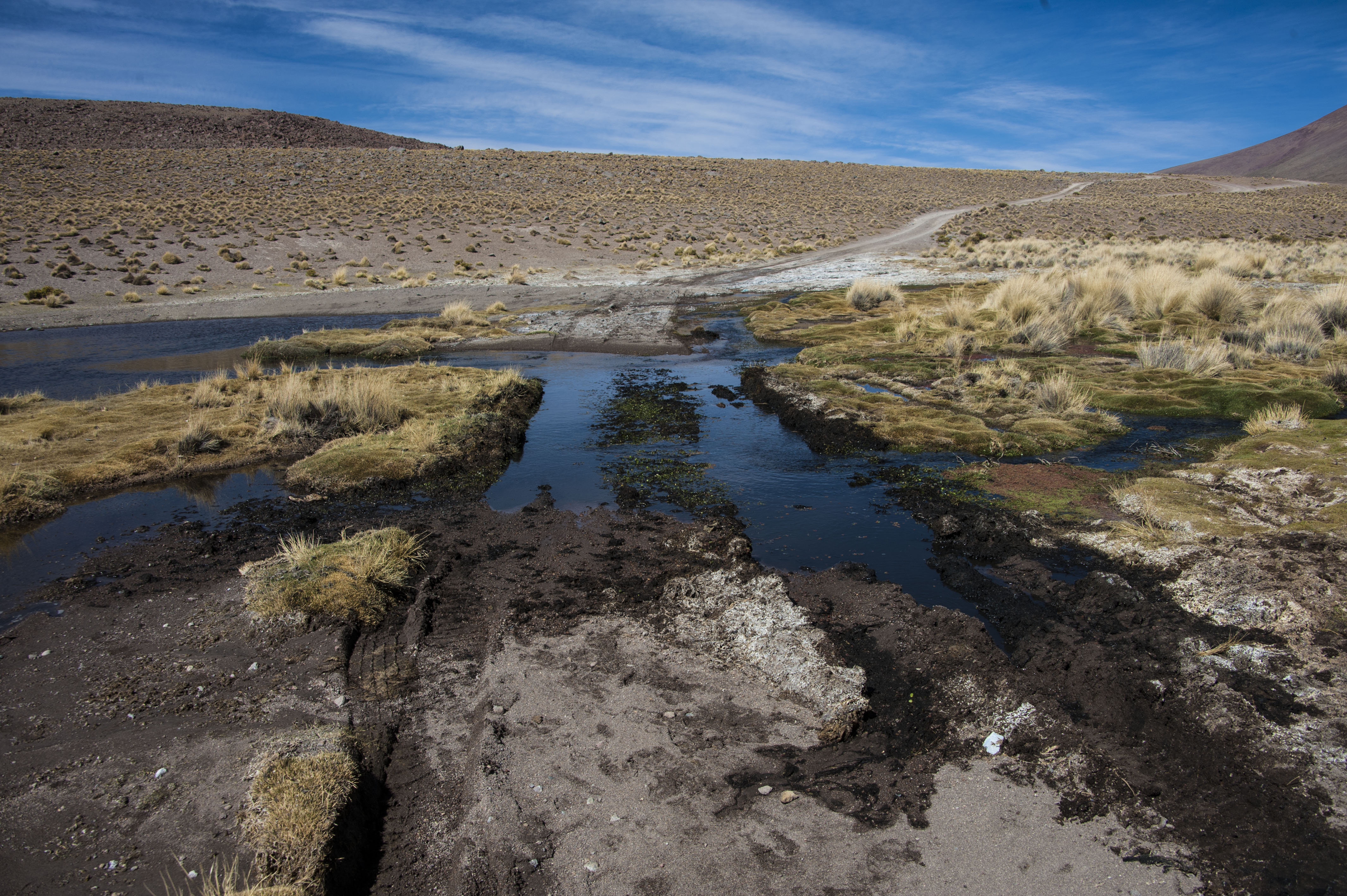
In this section there is a deep water crossing to negotiate. There are two sides to the crossing. One is shallow water with deep mud – the other is deep water (close to 1m) with a firm bottom. Take your choice. It would be a bad place to be stuck as the landcruiser tours do not come this way and we saw no other vehicles.
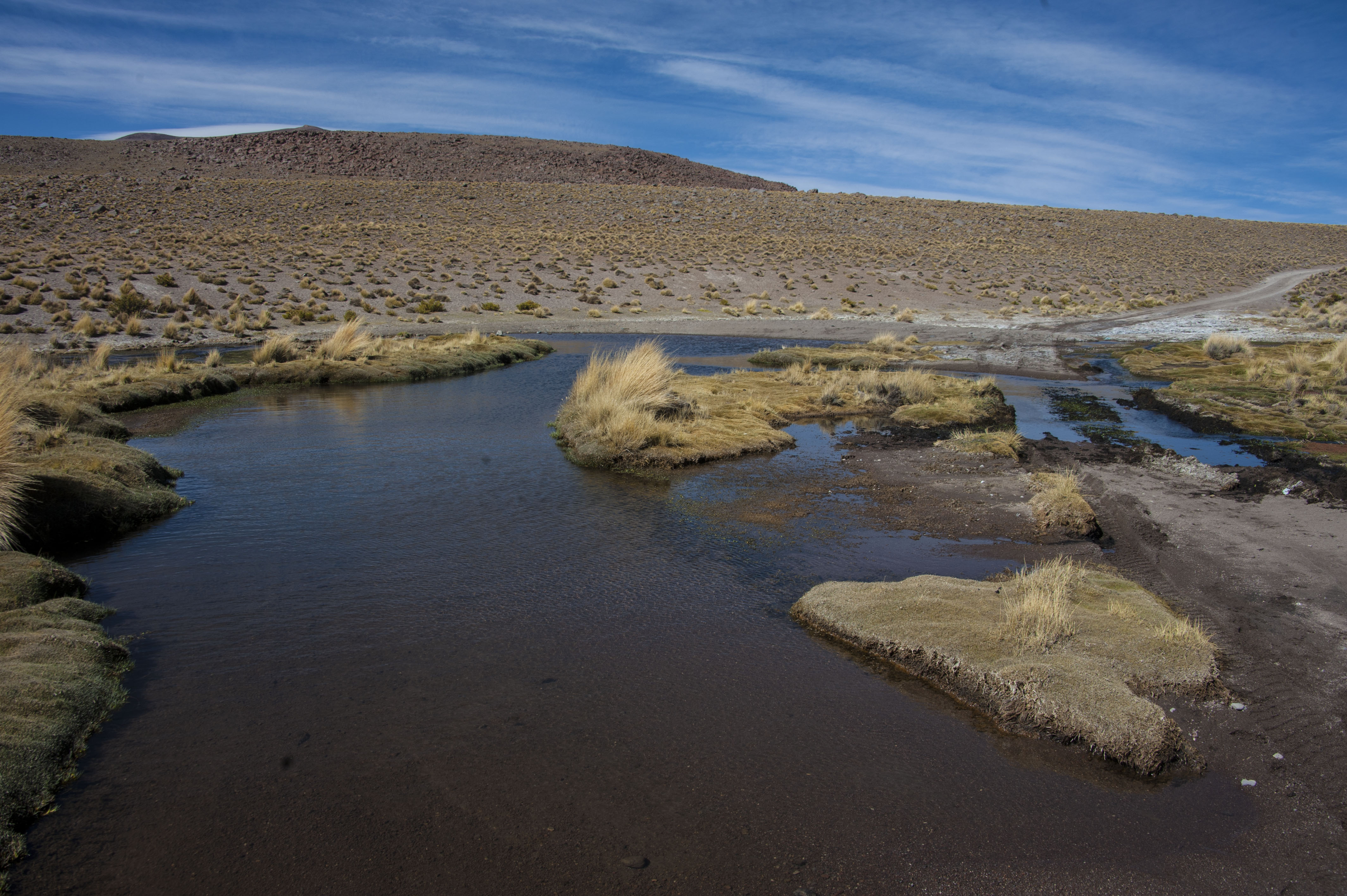
5km’s after the water crossing the track merges with the main track which the landcruiser tours take. The track does improve as you move past Laguna Hedionda although increased traffic means more corrugations.
From this point onwards there are many tracks all going in the same direction – all eventually merge back to the main path. In most cases the main track is heavily corrugated and it is best to drive along one of the lesser tracks. These lesser tracks may involve deeper sand or some tufty plants but will deliver a smoother ride.
After passing the 3 lakes – Hedionda, Chiar Kota and Honda – the tracks are along the bottom of a valley in sand. Apart from a rocky gully or two the going is easy and after a while the valley widens out into a sandy valley called the Desertio de Siloli. This stretches to Laguna Colorado and the entrance to the park.
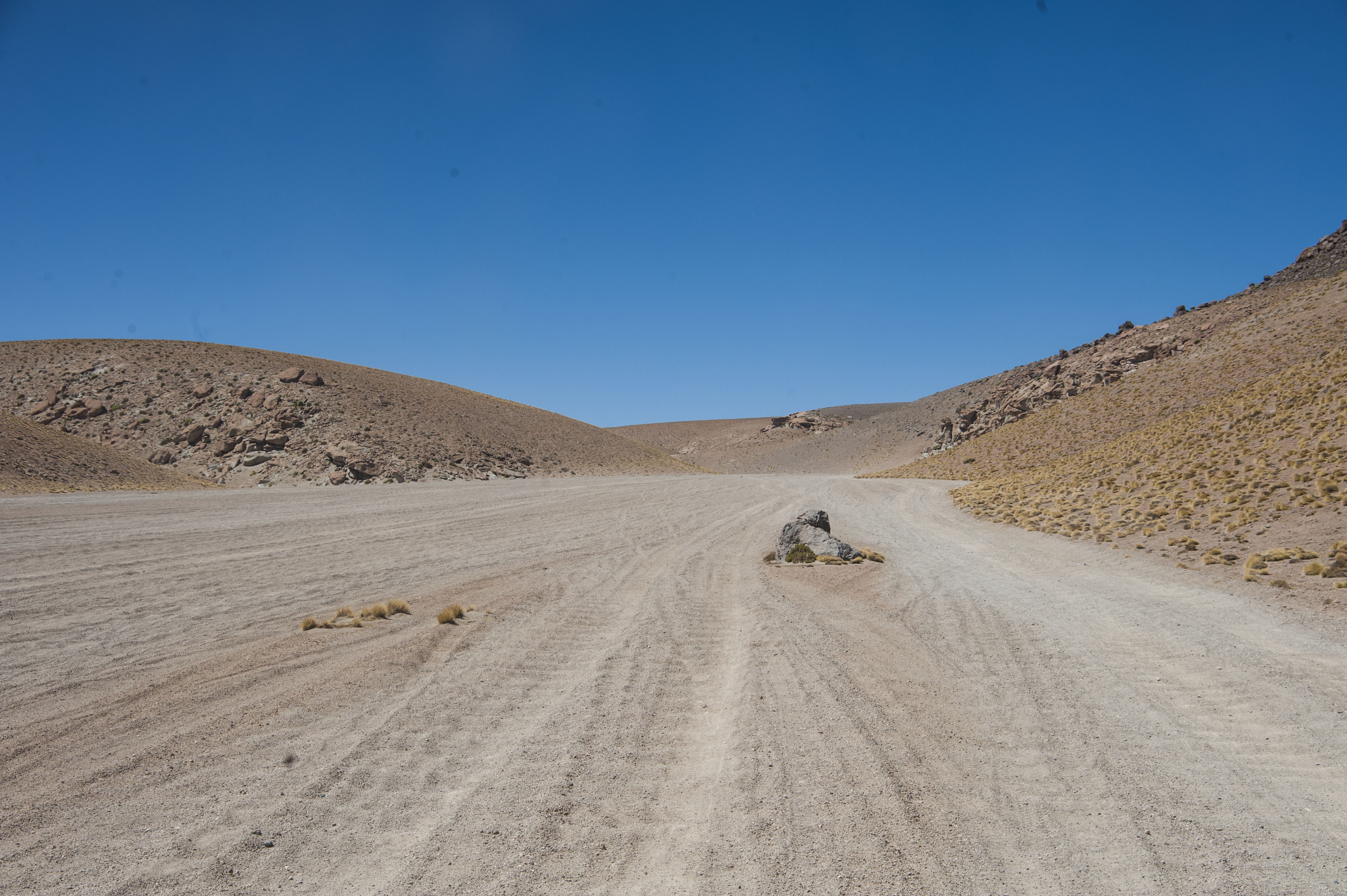
Once in the park the corrugations get worse and it is more difficult to drive off the main track due to ditches and large piles of sand at the side of the road. You also feel more guilty as it is National Park. The routes are also much more obvious in the Park.
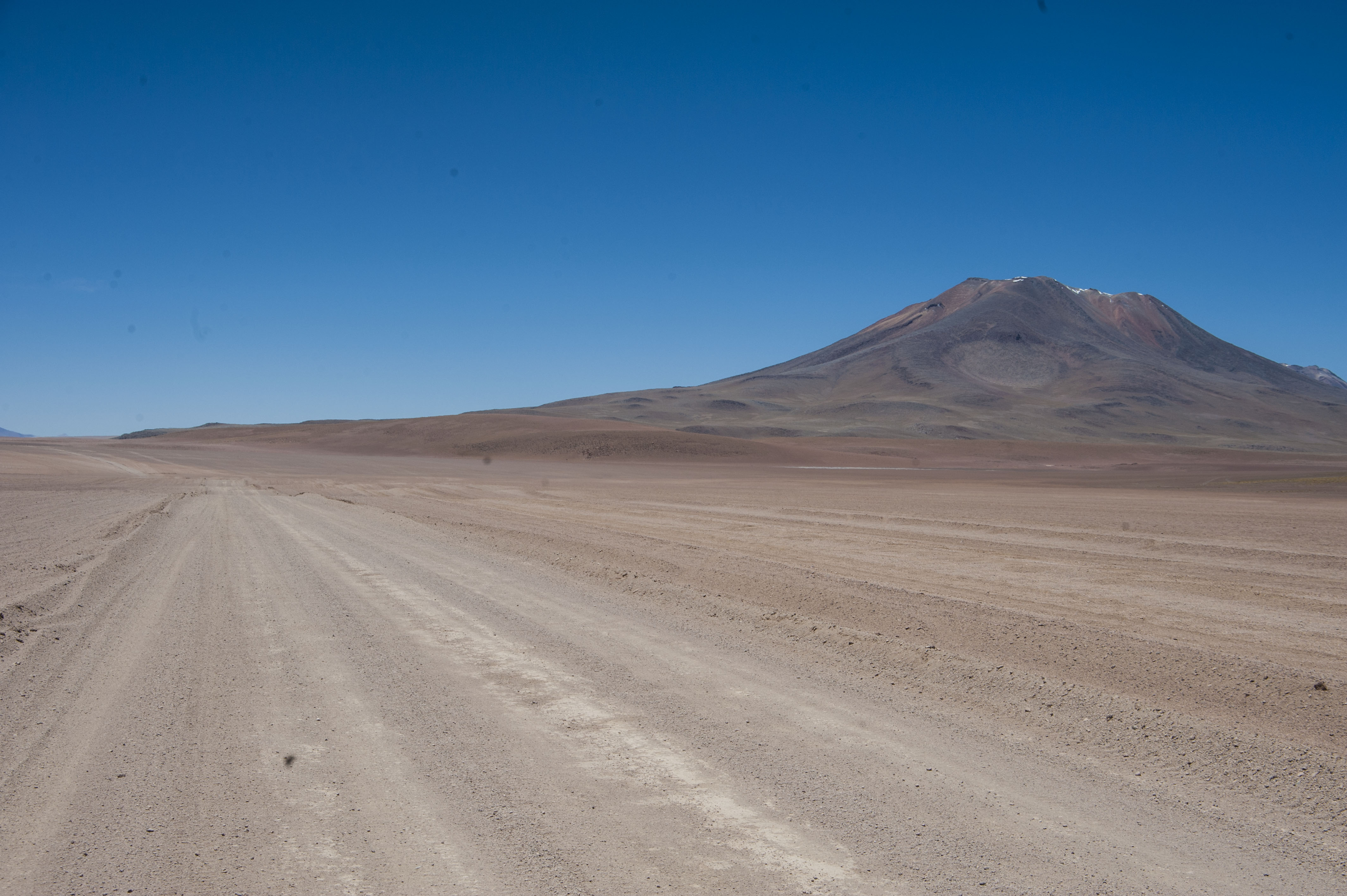
The only seriously bad bit of road is the detour to the Geyser basin which is rough. The rest of the dirt tracks are fairly easy going – apart from the corrugations. We did find a grader in operation just South of Laguna Colorado which made the going much better !
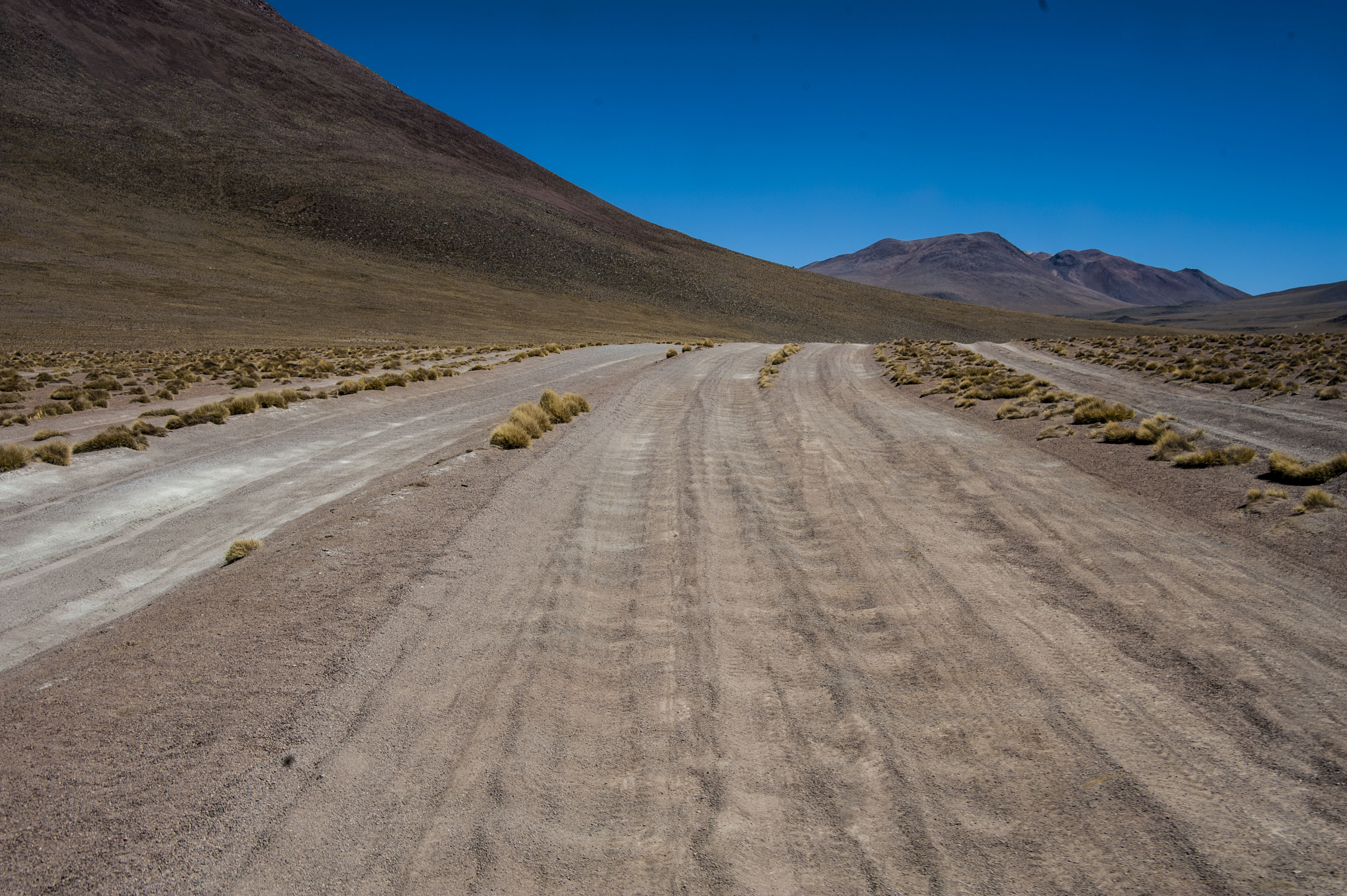
The detour to the Laguna Verde overlook is also a bit rough but nothing to really worry about.
Shortly after Migracion you hit asphalt for the long descent to San Pedro de Atacama. This is a 40km steep downhill which will really test your brakes. Go slow and in low gear or you’ll be getting your brake pads replaced sooner rather than later.
Weather
Get ready for the cold and the wind. Nights can be very cold – our worst was -14c but in June/July it can get down to lower than -20c. During the day the sun will be shining bringing some much needed warmth.
However on most of the route expect a strong biting wind, which does die at night, but during the day it lowers the temperature right down. We saw cyclists on the route having to push as the wind was too strong for them to cycle through.
It was so cold at night that we had to park the Beast so that the sun in the morning would be on the engine. This enabled us to start without too much trouble. We also considered the wind and parked lengthwise to the wind to minimise the rocking in the night !
Camping on the Laguna Route
It is possible to camp virtually everywhere on the Laguna Route if you are happy to bush camp. The key requirements of a place for the night are getting out of the ever present gale force wind or at least orienting yourself so its manageable.
For those without campers and a tolerance for cold tent camping it is possible. There are numerous places to get out of the wind – at least to some degree. However you should expect any liquids to be frozen in the morning !
There are also a number of hostels where those on landcruisers stay – these are very basic and the toilet facilities are very poor.
Customs
We met two different overlanders who had missed customs and had to drive the 80km each way back to aduana after hitting migracion. This put both of them at the limit of their fuel reserves. Don’t forget to stop off at customs – it makes their day as they are pretty lonely and don’t get much traffic !
San Pedro de Atacama
This small town with adobe buildings and dirt roads feels like civilization after a few days in Southwest Bolivia. However it doesn’t take long before the excessive prices and hordes of tourists become wearing.
To meet other overlanders, stay at the Los Perales Campground. However there is also a municipal car park in town which overlanders also stay in overnight. There are also numerous bushcamping sites around the town – perhaps most notably on the cliff overlooking Valle de la Luna.
Lagunas Route GPS Co-ordinates
- San Christobal Fuel S21 09.420 W67 10.100
- Turn off to Laguna Chillucani S21 26.758 W67 50.701
- (any track for 2-3km’s before this would be good)
- River Crossing S21 33.056 W67 54.771
- Junction with Main Track S21 33.687 W68 01.933
- Arbol de Piedra S22 03.106 W67 52.999
- National Park Entrance Station (North) S22 10.279 W67 49.048
- Turn for Customs (Southbound) S22 24.958 W67 46.749
- Turn for Customs (Northbound) S22 25.488 W67 46.426
- Hito Cajon – Customs S22 26.438 W67 48.346
- Sol de Manana Geyser S22 26.126 W67 45.431
- Hot Spring S22 32.135 W67 38.967
- Laguna Verde S22 47.200 W67 49.213
- National Park Entrance Station (South) S22 49.876 W67 46.735
- Bolivian Migracion S22 49.876 W67 46.735
- Back on the Asphalt S22 55.028 W67 47.802
- Chile Immigration/Aduana S22 54.662 W68 11.626
- Fuel in San Pedro De Atacama S22 54.802 W68 11.930
- Los Perales Campground S22 54.935 W68 12.028
This is one of the most amazing drives in the world and is to be thoroughly recommended. On 90% of the route help is not too far away in the form of the Landcruiser tours. Prepare thoroughly for the conditions and it should be one of the best experiences of any overland trip in South America !
Bolivia’s Southwest Circuit
The drive from Uyuni to the Chilean border has the reputation of being one of the best off road adventures in the world. The drive takes you past beautiful high altitude lakes filled with flamingos, through upland deserts and by massive volcanoes. The altitude of the drive is between 4000m and 5000m and the nights are bitterly cold so it challenges diesel vehicles with its extreme conditions.
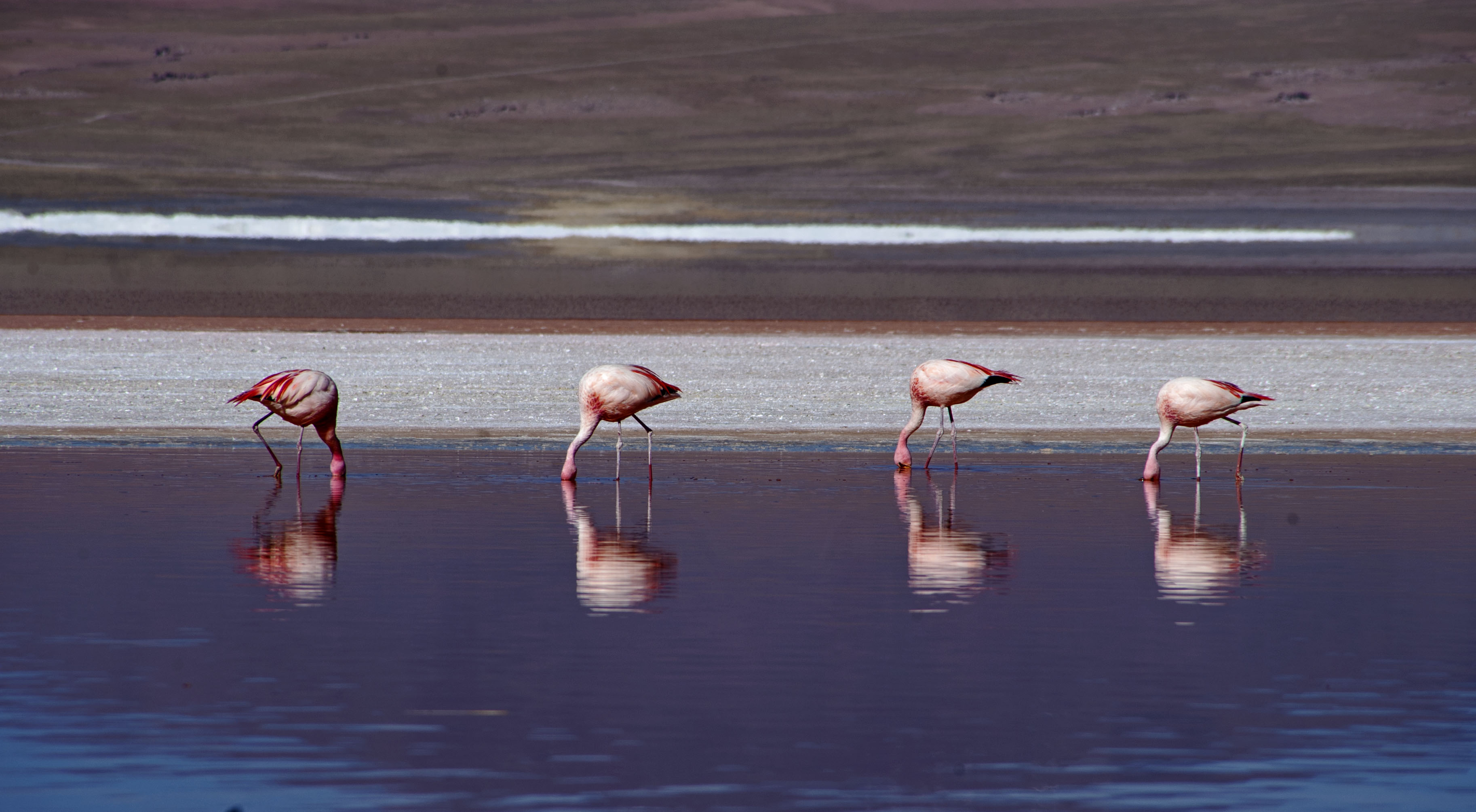
The most beautiful part of the drive is through the Reserva Eduardo Avaroa. We didn’t reach this area until our third day of driving though.
We started moving quickly down the unpaved (but surprisingly) good road which heads South from Uyuni – after around 160km and passing through the Valley of stones we turned off the main road and onto a rough track.
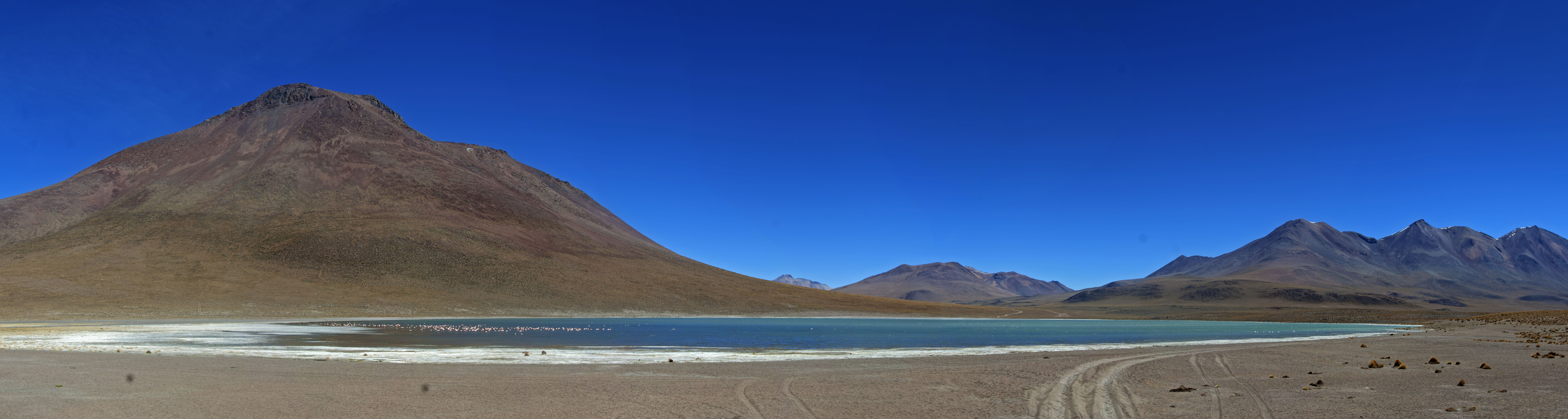
This area proved to be the hardest section of the journey as we passed Laguna Chullicani, our first view of flamingos, and continued on our way towards the Reserve. We were temporarily stopped by a water crossing with two choices.
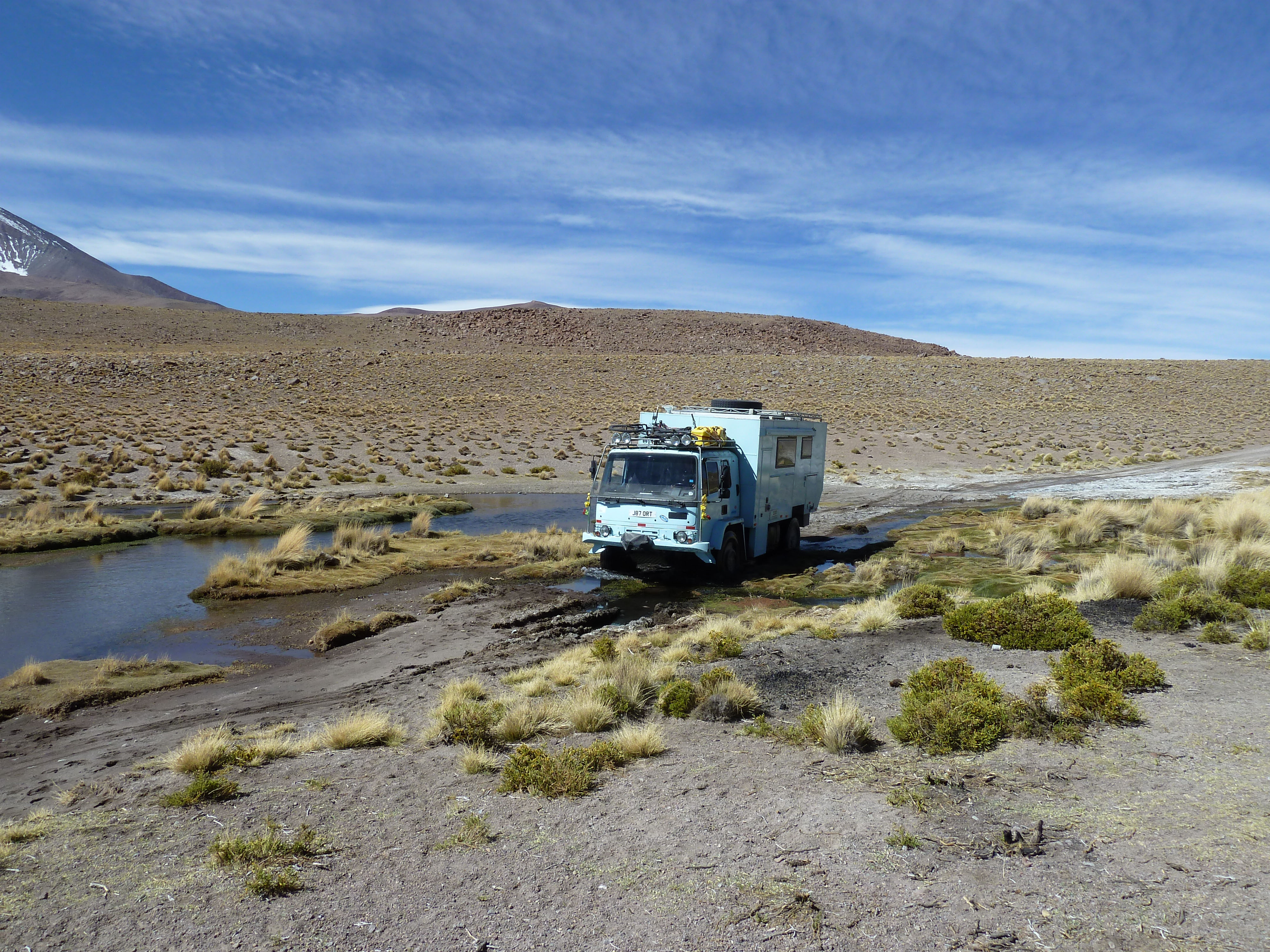
The left hand side was a muddy swamp in about 6 inches of water and the right hand side was a deep water crossing (close to 1m) with narrow ledges to place your tyres and a drop-off to 1.5m in between.
We decided to go for the muddy side and spent 20 minutes or so dropping some stones in the mud to provide a better base. Low range, diff locks on and we powered on through.
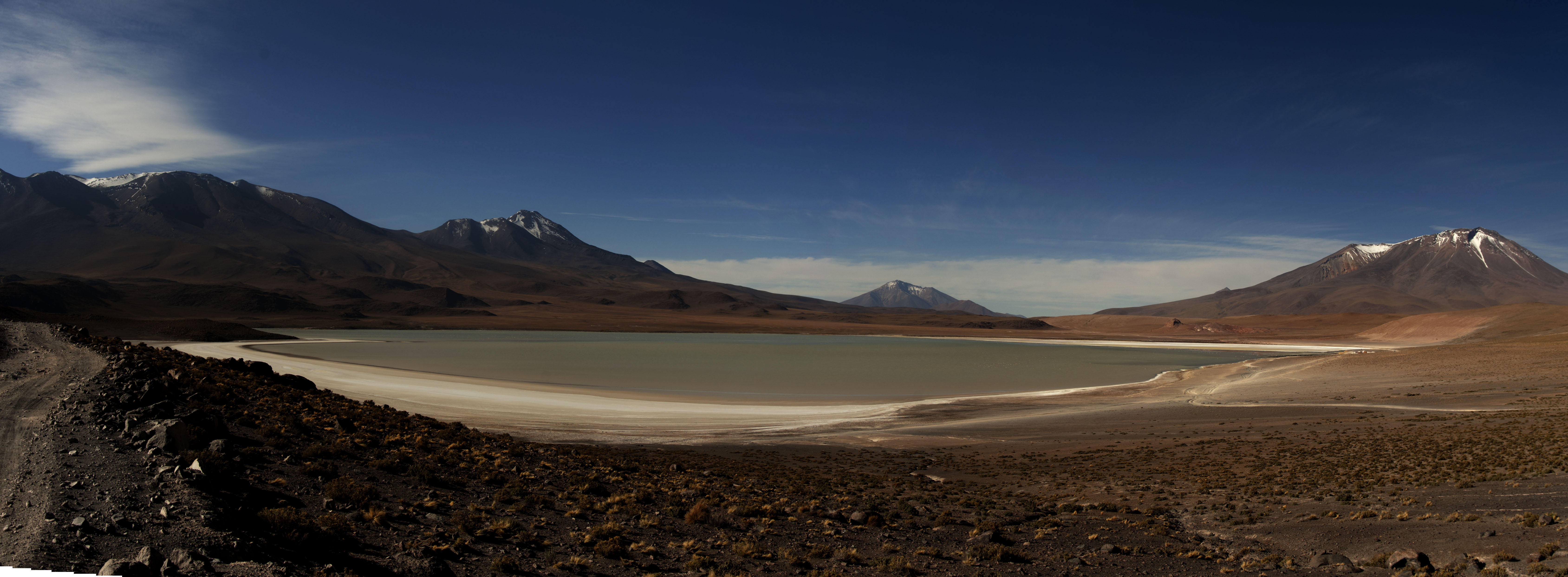
After about 3 hours we’d covered 20km and broke through onto the more commonly trafficked part of the circuit as we drove around Laguna Hedionda. There are four flamingo lakes in a row and we decided to call it a day at the fourth lake, Laguna Honda, where we camped right on the shore.
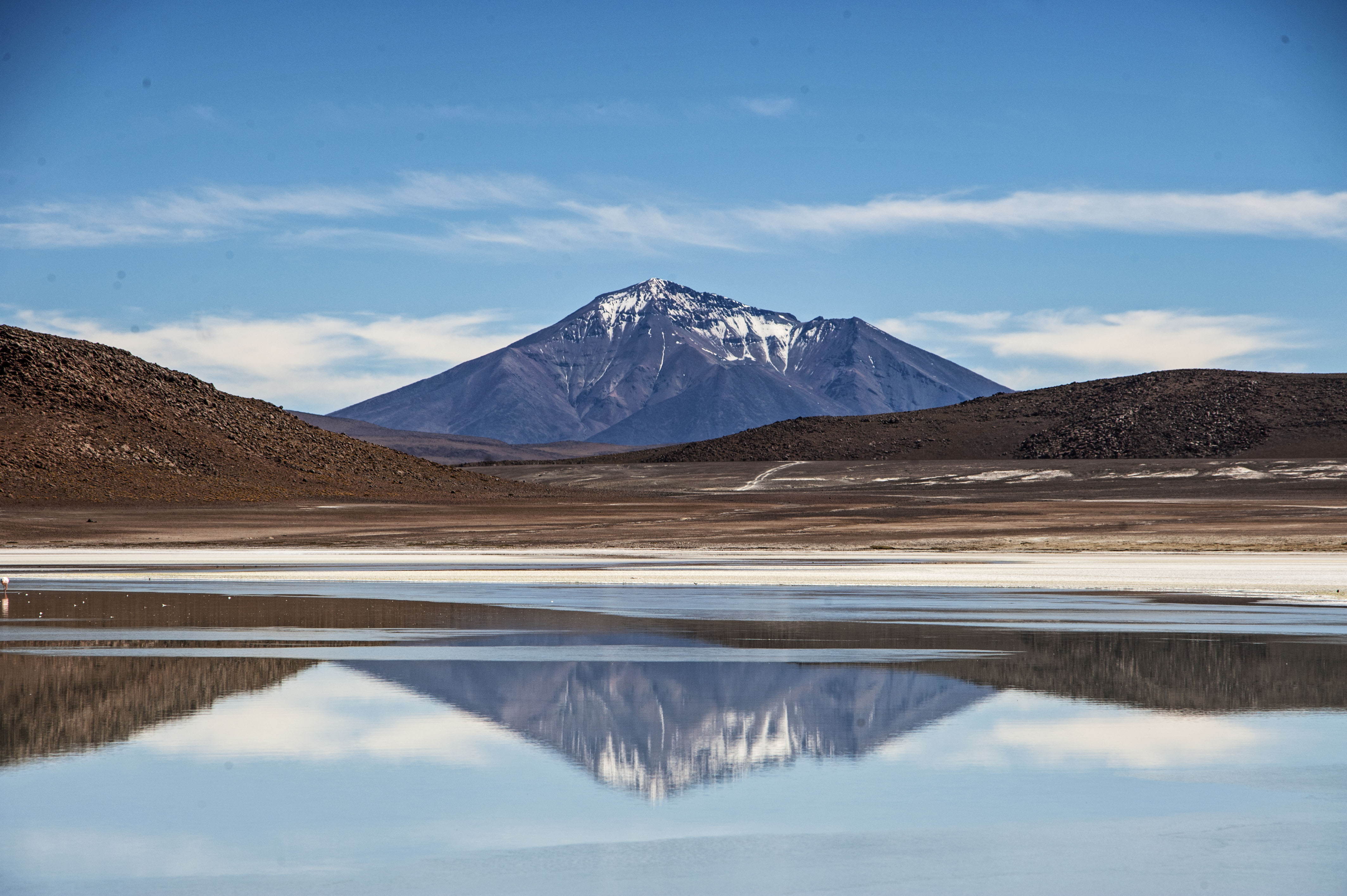
This was to be our coldest night in Bolivia as the mercury dropped to -14c. This is the coldest we have had on our whole trip and we were pleasantly surprised that we were warm in bed all night. In the morning though we discovered that the condensation on the insides of the windows had frozen.
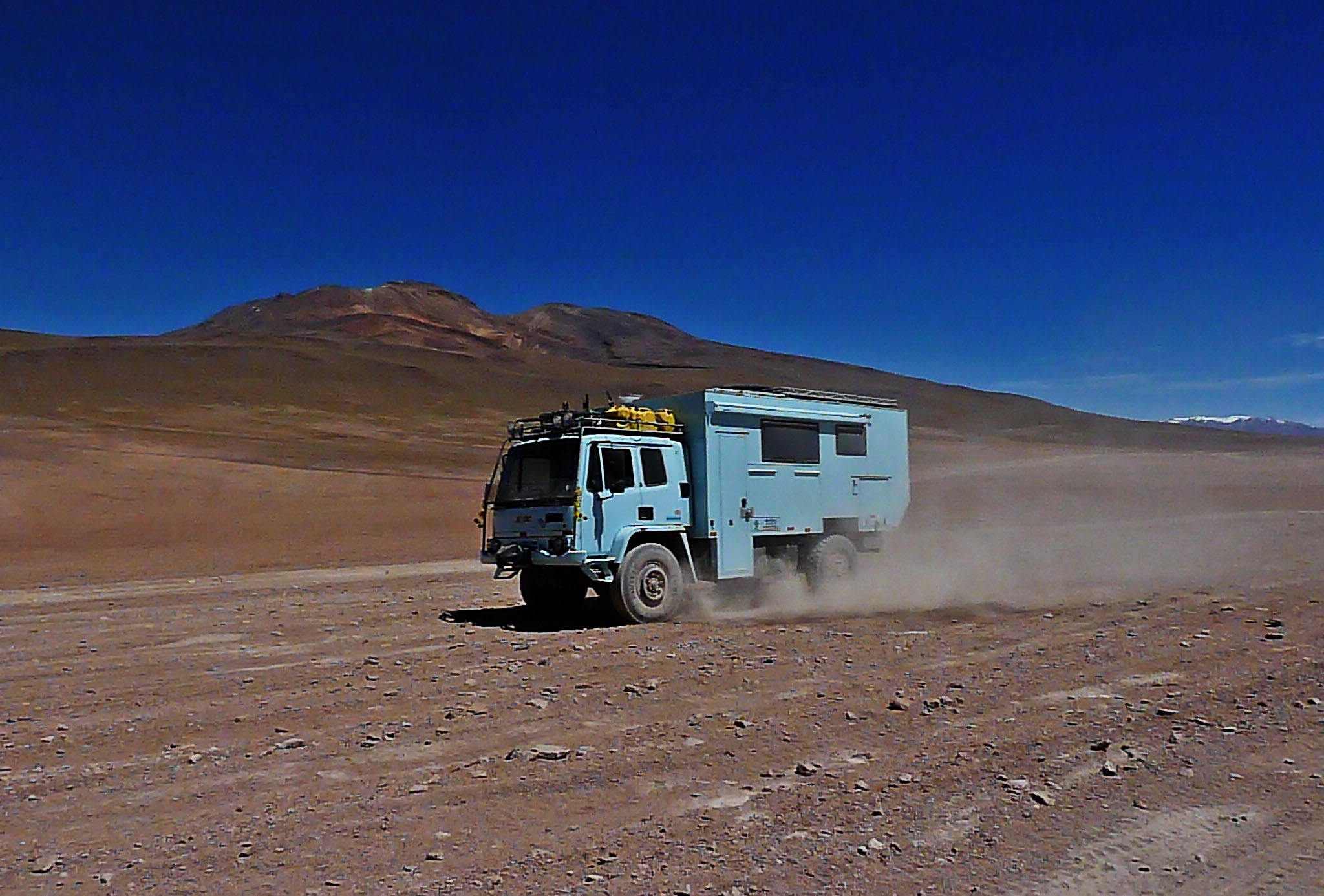
Day 2 of our adventure involved driving through the Desertio de Siloli where the whole of a valley bottom was the track but almost all of it was corrugated from the Landcruiser tours. The main track was the least comfortable path and we spent the whole day driving through sand away from it. The colours in the desert were stunning but a strong wind and cold temperatures kept us in the truck.
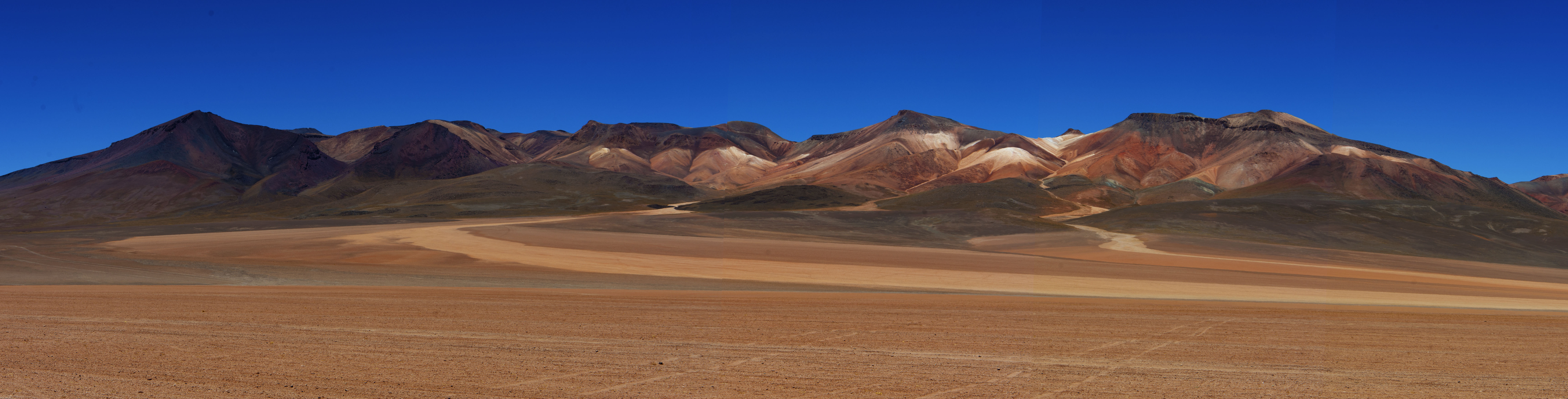
There were a few rough bits to negotiate linking different areas of the desert but nothing to strenuous.
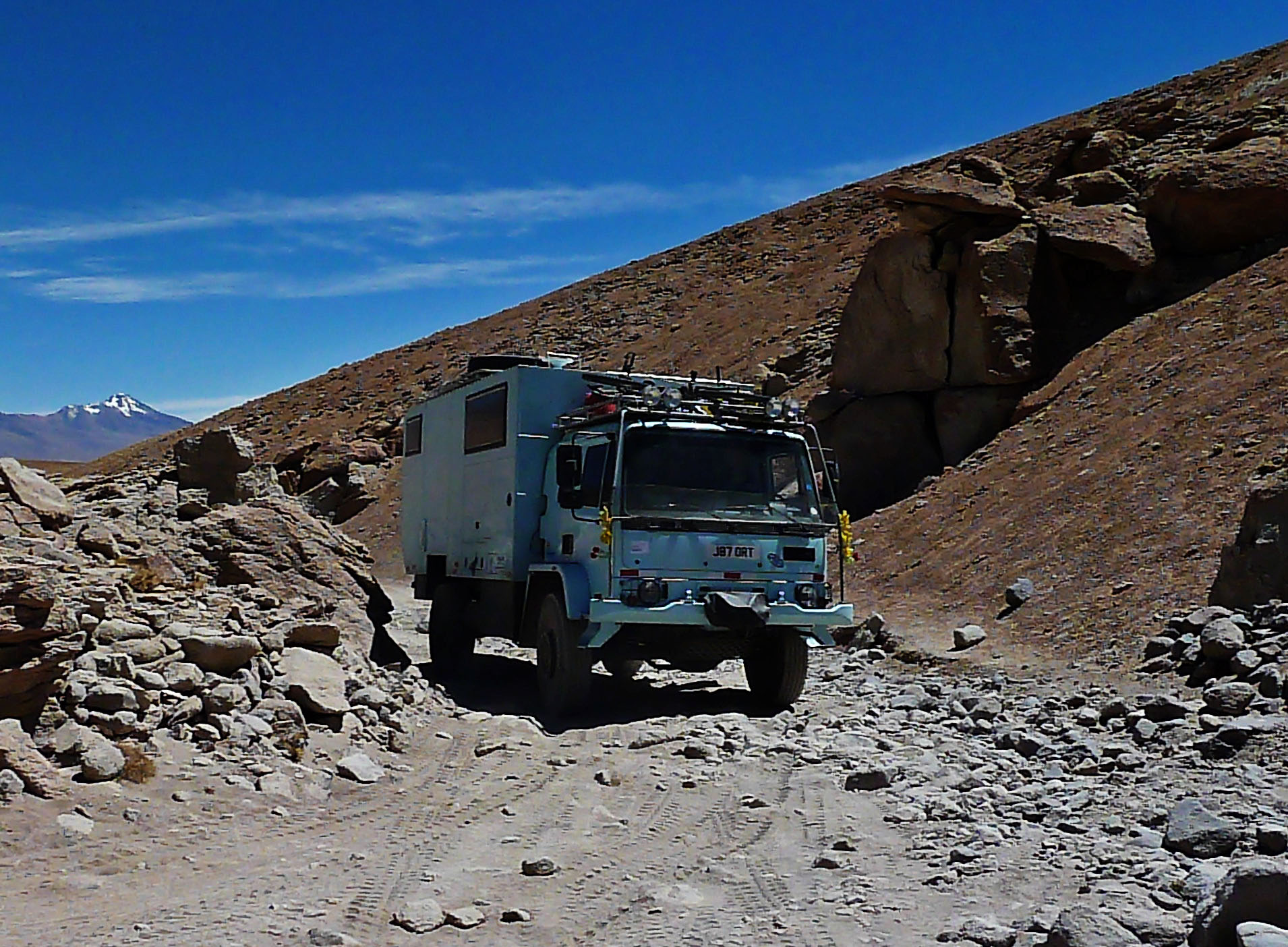
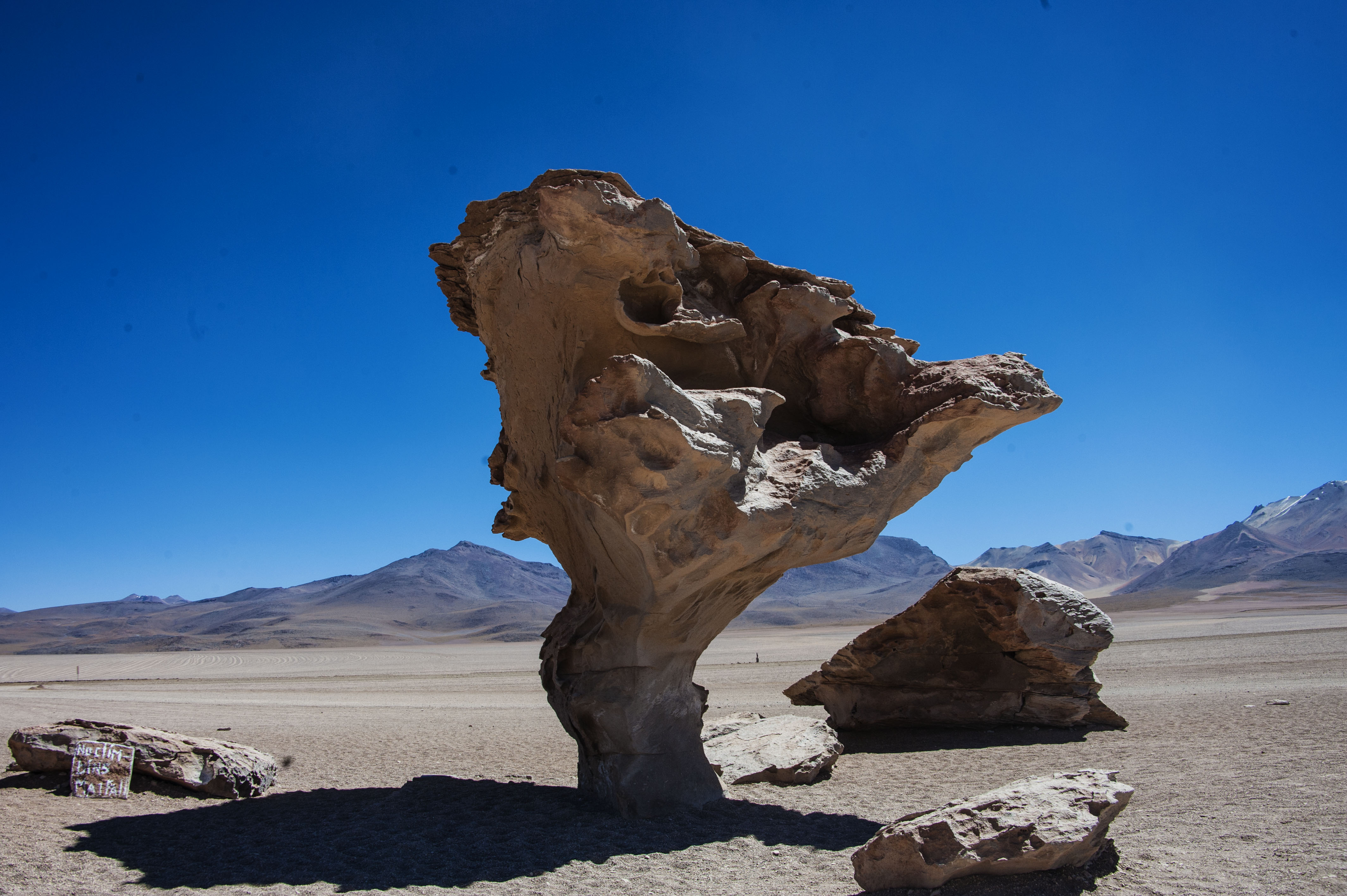
We reached one of the major tourist attractions of the area – the Stone Tree. We weren’t really sure what all the fuss was about though !
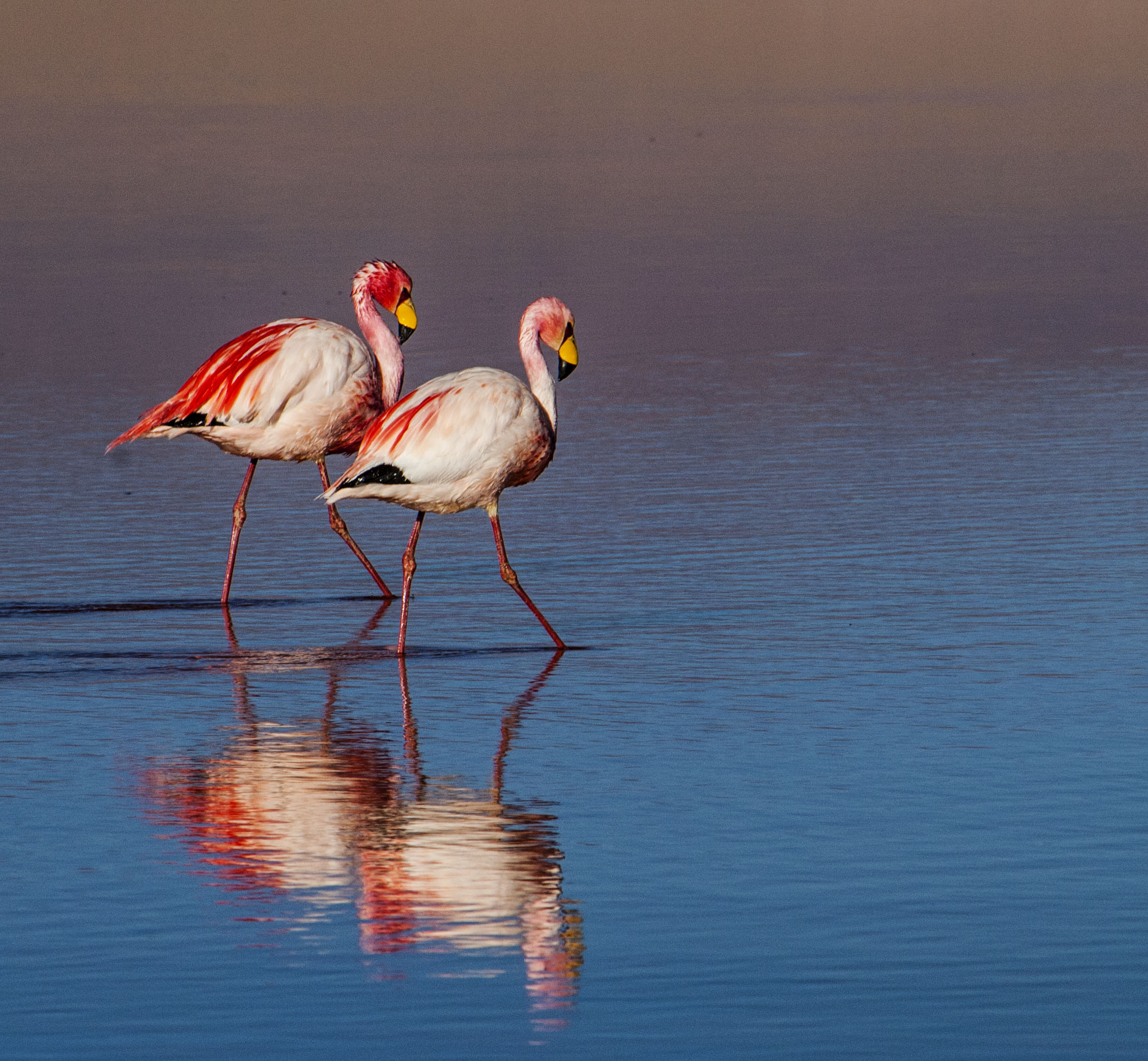
Towards the end of the day we got to the borders of the Eduardo Avaroa Reserve and after paying our entrance fees we circled Laguna Colorado and found a nice place to camp on a ridge overlooking the laguna. The laguna was a deep red colour and occupied by three different species of flamingos.
The wind dropped in the night to give us a good nights sleep which was significantly warmer than the previous night.

In the morning we drove Southwards, first having to off road across some deep sand piles to get onto the road. Our diff locks came to rescue again. From Laguna Colorado we climbed to over 5000m to get to the Bolivian customs office. Its 80km from the border and hidden in a processing plant but necessary to hand over your vehicle import documents before leaving the country.
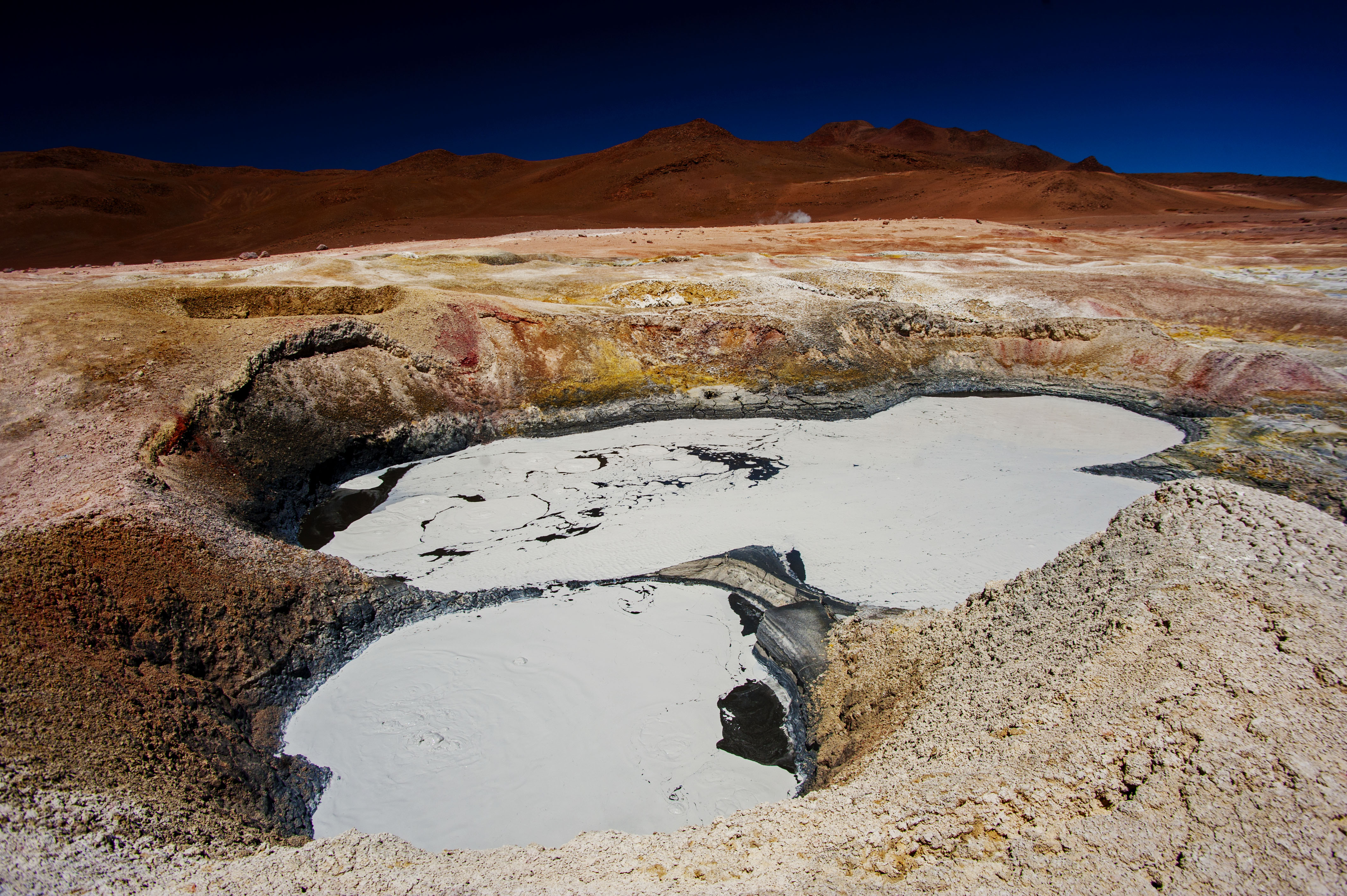
After Aduana we drove into a geyser field with bubbling mud pools. No Health & Safety here – we drove right up to an active geyser. Again though the freezing wind kept us from making our way too far from the truck.
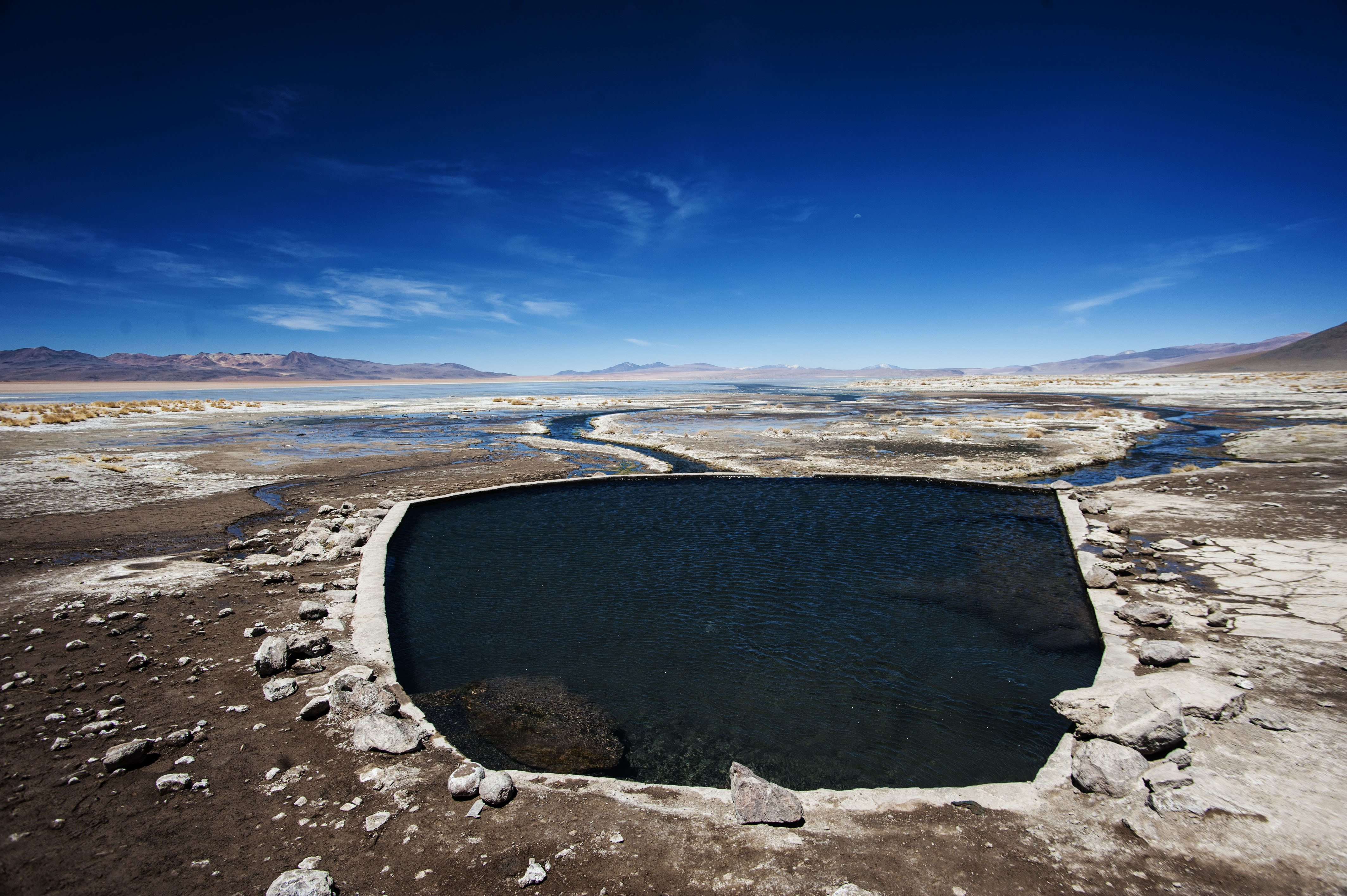
The next stop on our tour was a small hot spring next to a partly dried salt lake. There were loads of landcruisers here but we stopped for lunch and by the time we’d finished they’d all gone. This allowed us to have a relaxing soak in blissful solitude. The water was bath warm and very relaxing. However there was a gale force wind blowing making the dash back from the hot pool to the truck somewhat testing !
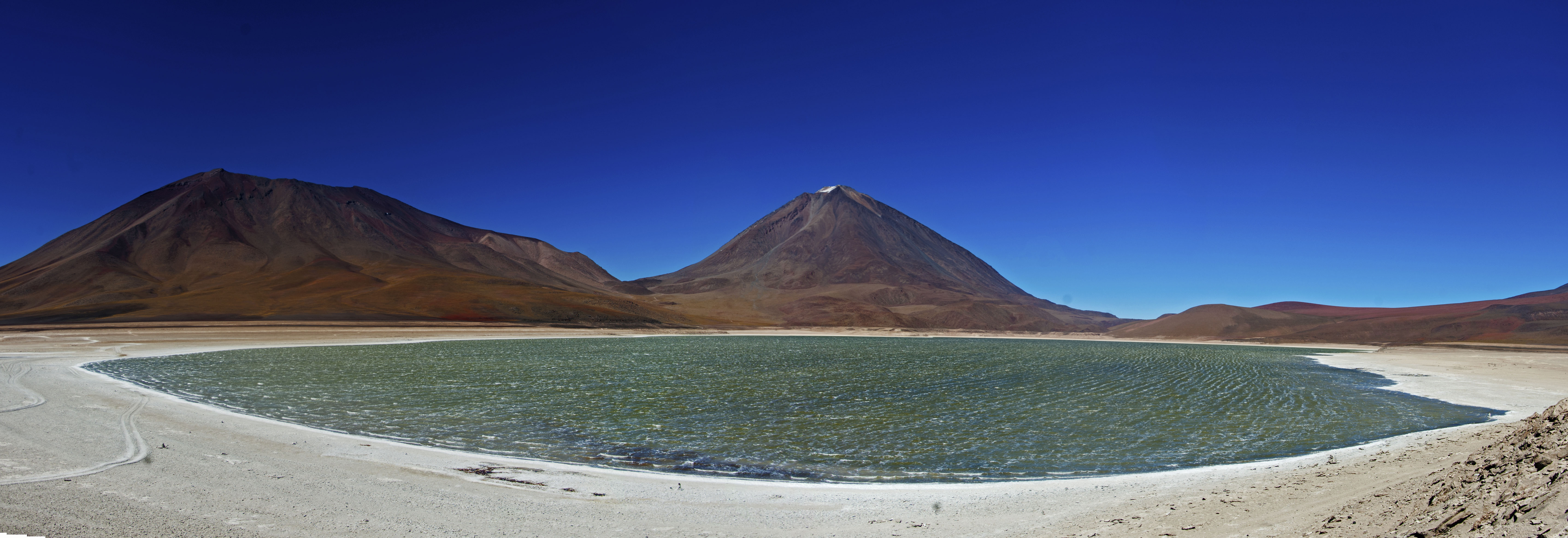
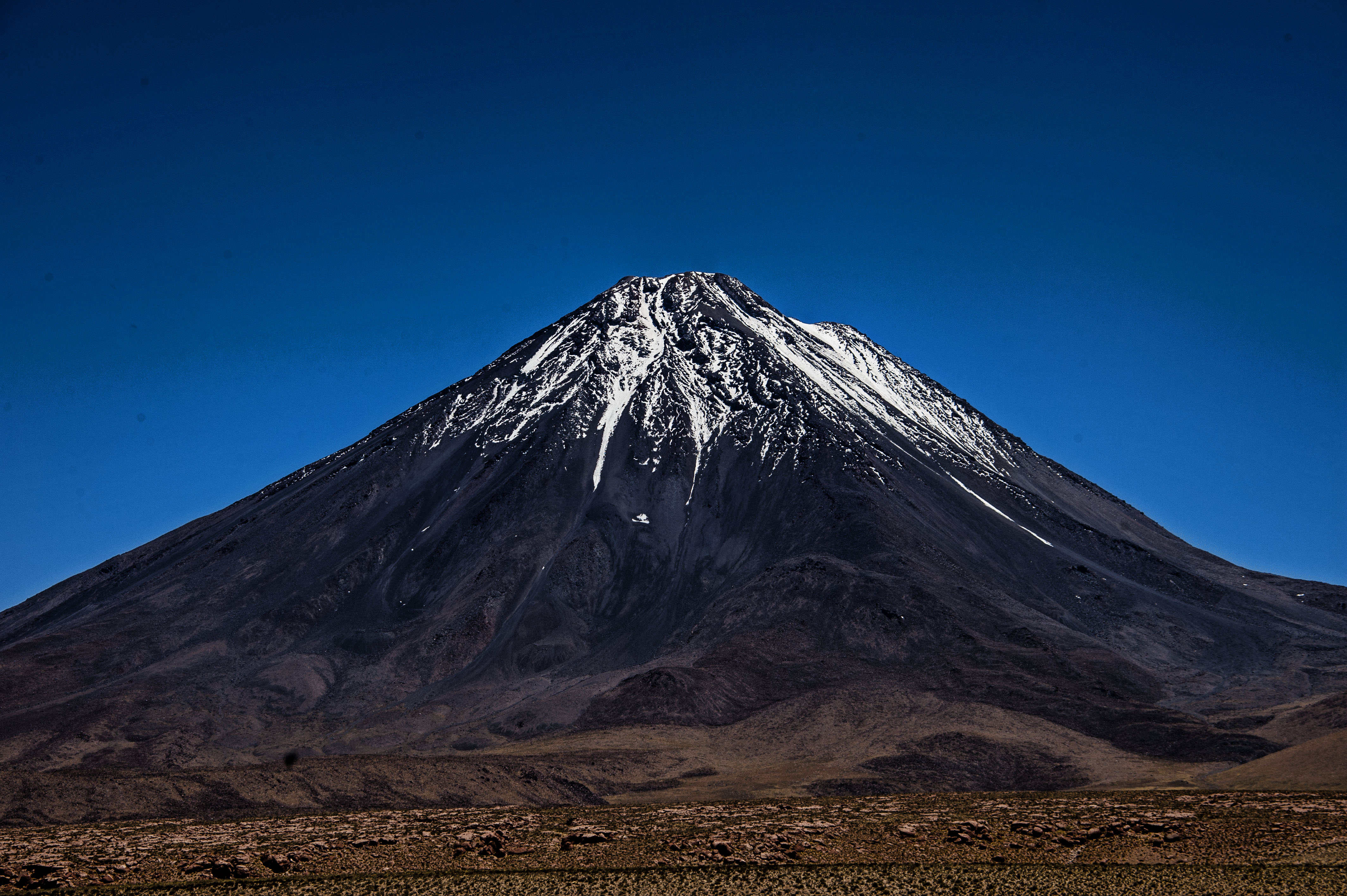
The route from here drops back down to the low 4000m as you cross through another desert which contains the Dali rocks – randomly placed rocks which look slightly surreal. We kept going until we reached the twin lakes of Laguna Blanca and Laguna Verde where the massive Volcan Lincanbur towers overhead. We camped here for the night in a gale force wind which didn’t let up all night. It was only -10c this night – practically balmy, although the wind in the morning made it feel much colder when we went outside.
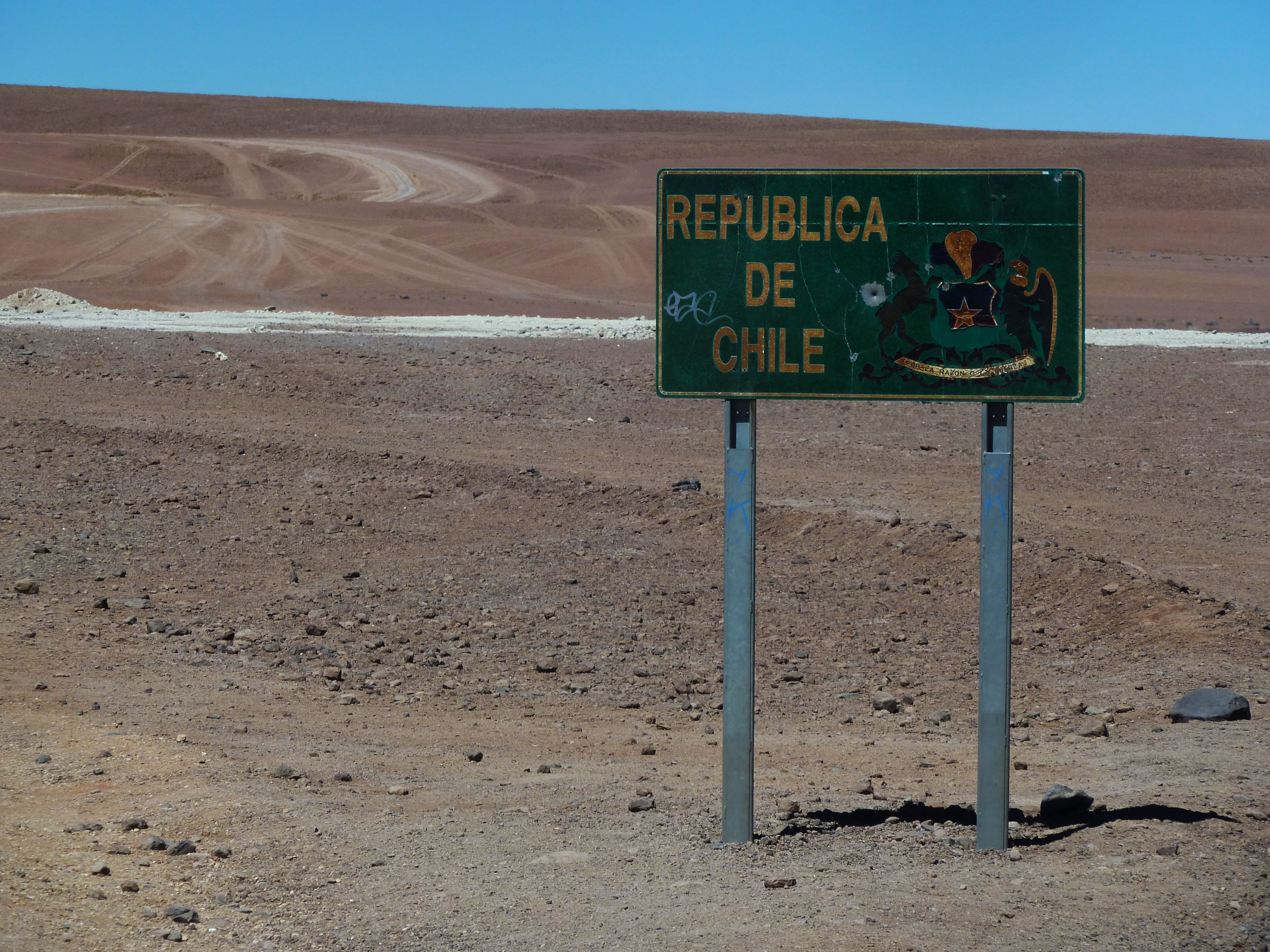
From here it is a short drive to the park office where you check out and then only another 5km to the border with Chile. Shortly after the border the road becomes Asphalt and its then a 40km downhill road (with no less than 14 runaway truck runoffs) to San Pedro de Atacama, where the warm sun is very gratefully received.
Uyuni and the Salar De Uyuni
The newly paved road from Potosi to Uyuni is very good making the journey to Uyuni pretty painless. However, as is often the case, as soon as you hit the town you leave behind the smooth pavement.
There isn’t much to get excited about in Uyuni. It’s has the feel of a frontier town, although its not near the border, and the large numbers of tourists heading off in landcruisers for tours on the Salar feel very incongruous.
Treat Uyuni as a place to fuel up, stock up (although don’t expect a supermarket) and prepare for a trip to the Salar and then across the SouthWest circuit and you won’t be disappointed.
We had decided to visit the Salar de Uyuni (one of the biggest salt lakes in the world) and then return to the town before heading off through the wilds to the Chilean border. We wanted to do this not least because we wanted to fill up with diesel and wash off the salt before the second half of our trip.
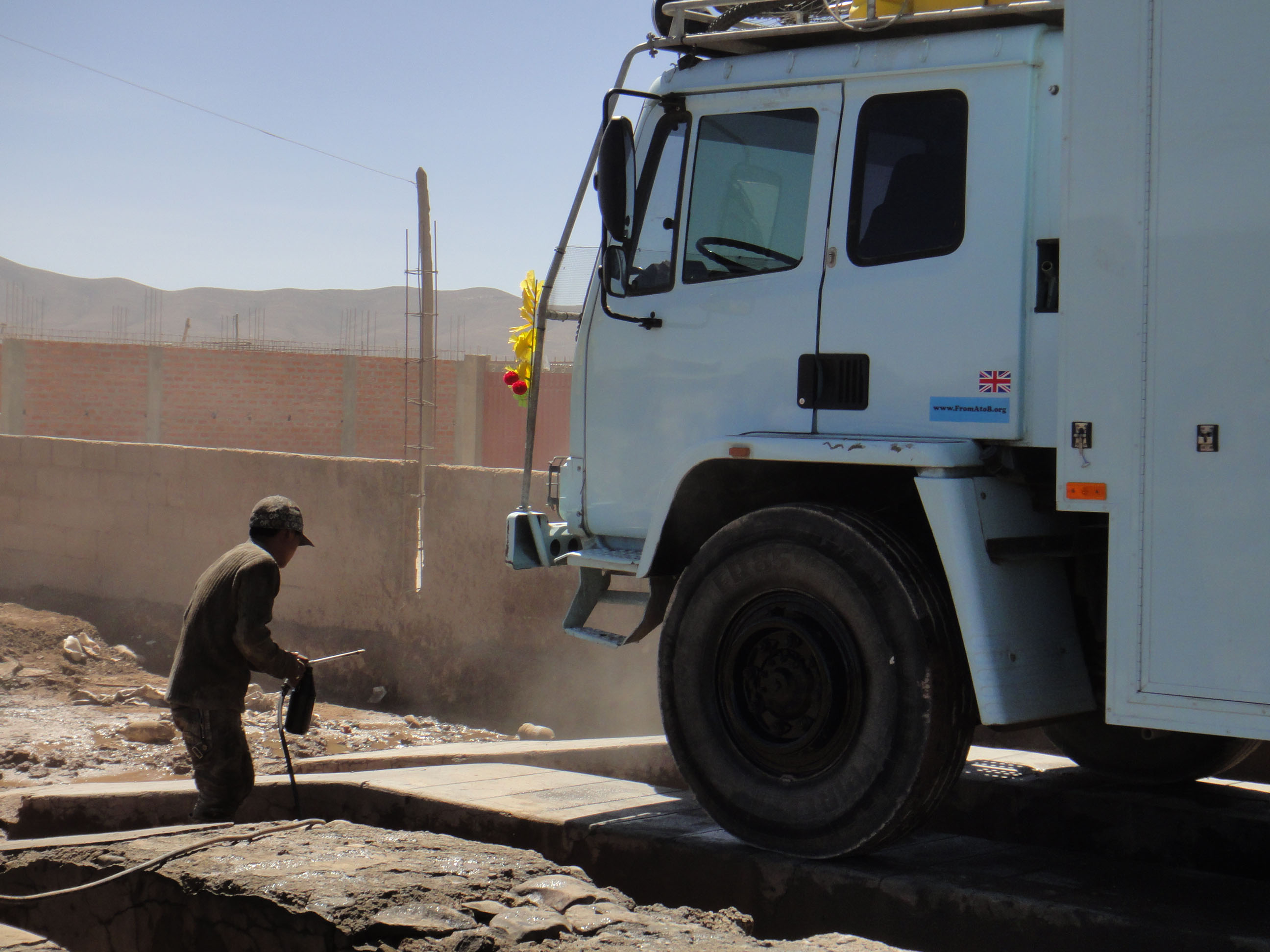
Before our trip to the Salar we visited one of the many car washes that are at the Southern end of town and had the Beast fumigated. This means that we had a layer of used oil sprayed on our underside to help protect against the salt from the Salar.
After this we were ready to leave town. The road to the Eastern entrance to the Salar (about 25km’s from town) is not that obvious and we ended up on the wrong road away from town – a sandy track which roughly paralleled the right road. However we went right past the Salar entrance before we found our way back to the right place. The up side of this is we avoided a checkpoint that looked like they were charging a toll.
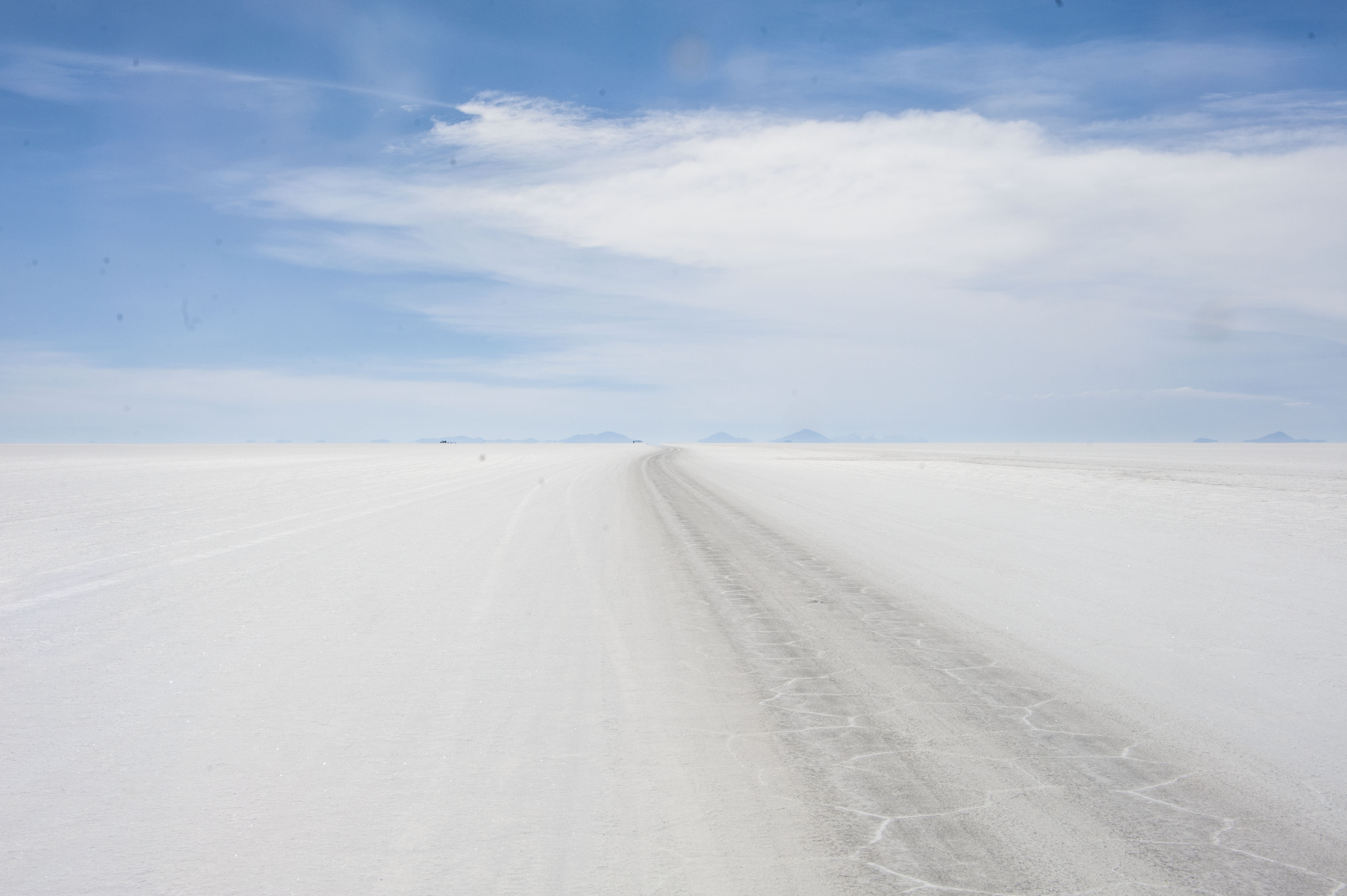
Its really important to enter the Salar at the right place as the edges of the Salar are the weakest part and the place that it is most likely for a vehicle to break through. We have met two couples who managed to break through the salt and both had a nightmare multi-day recovery to get out.
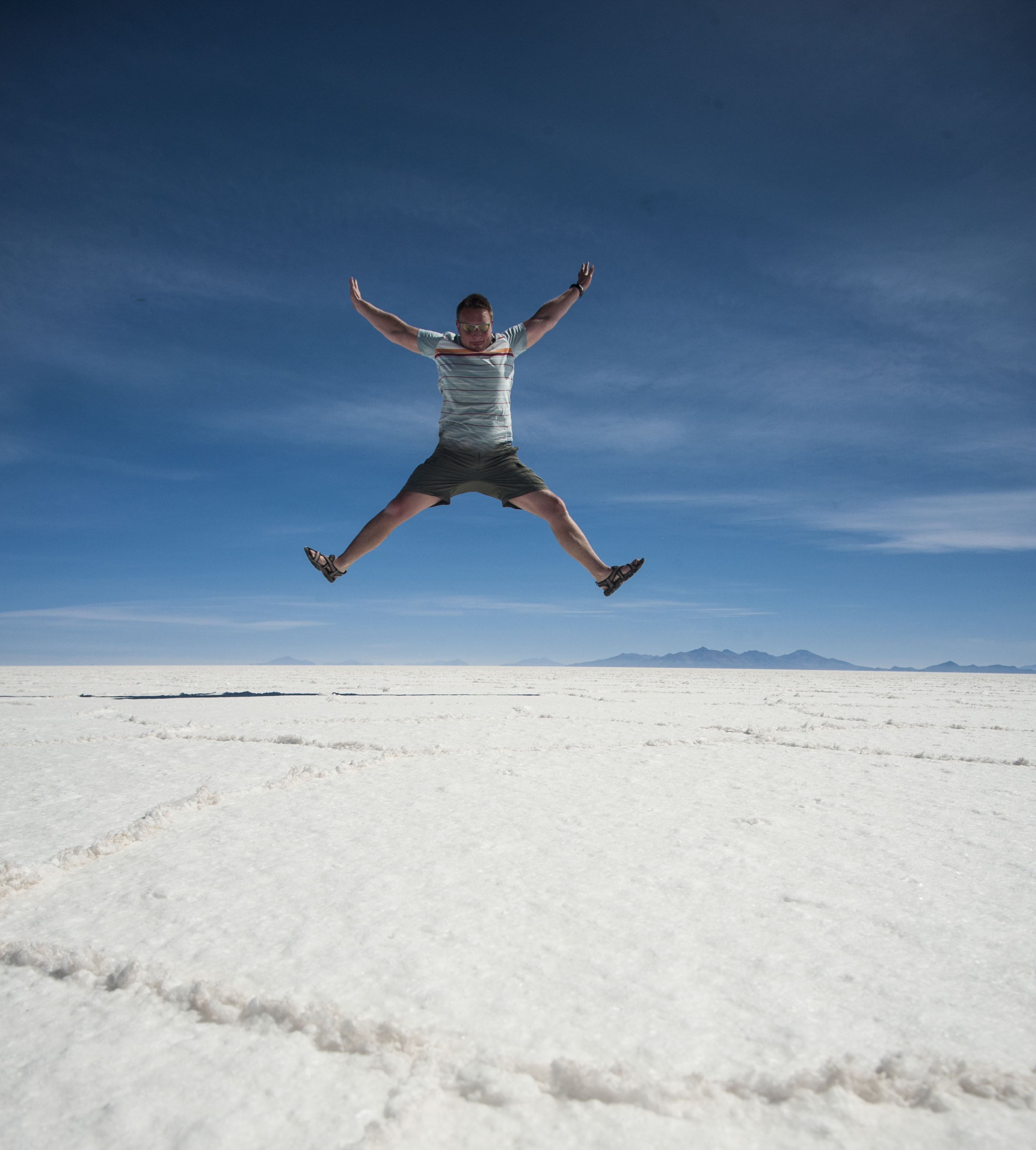
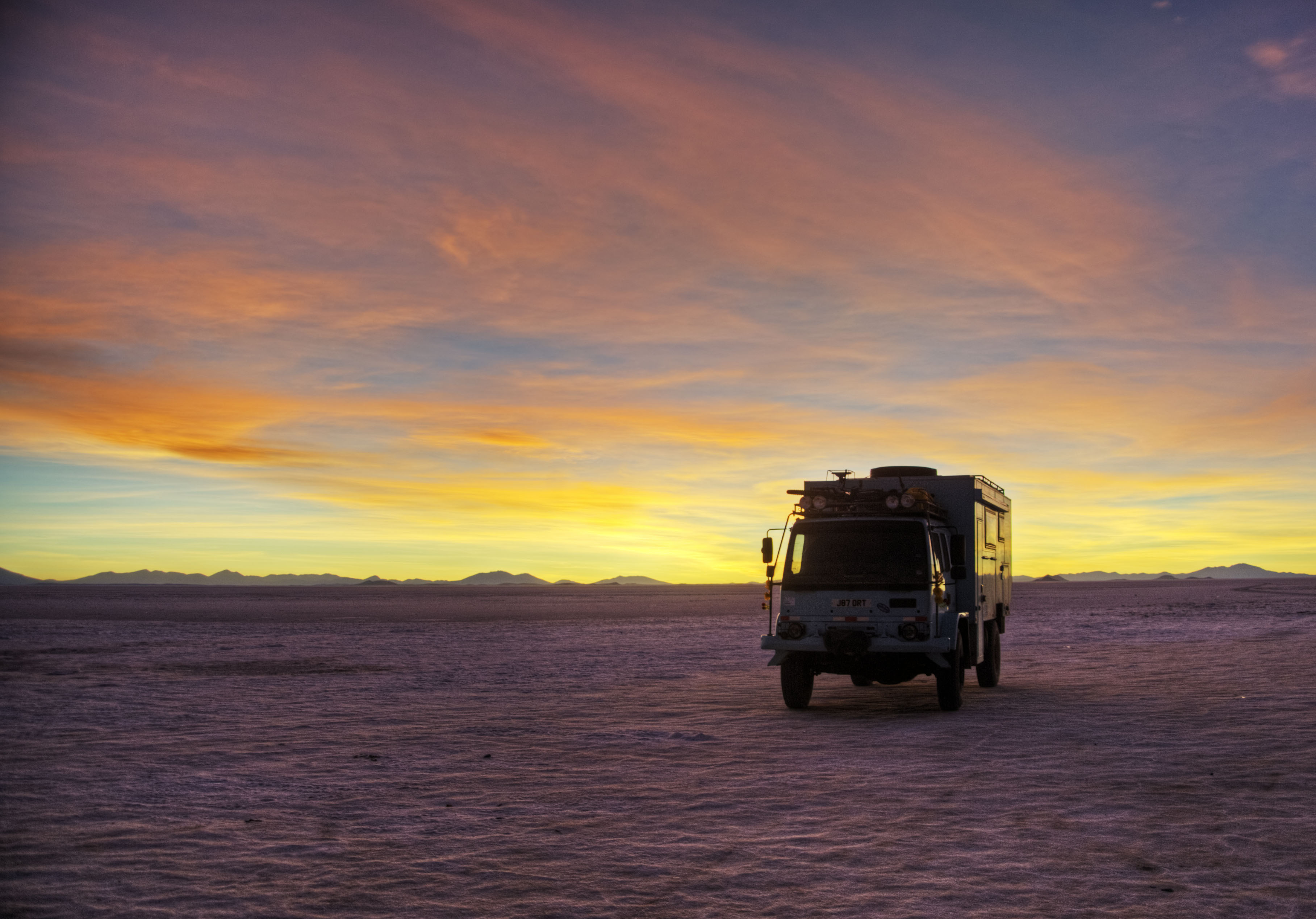
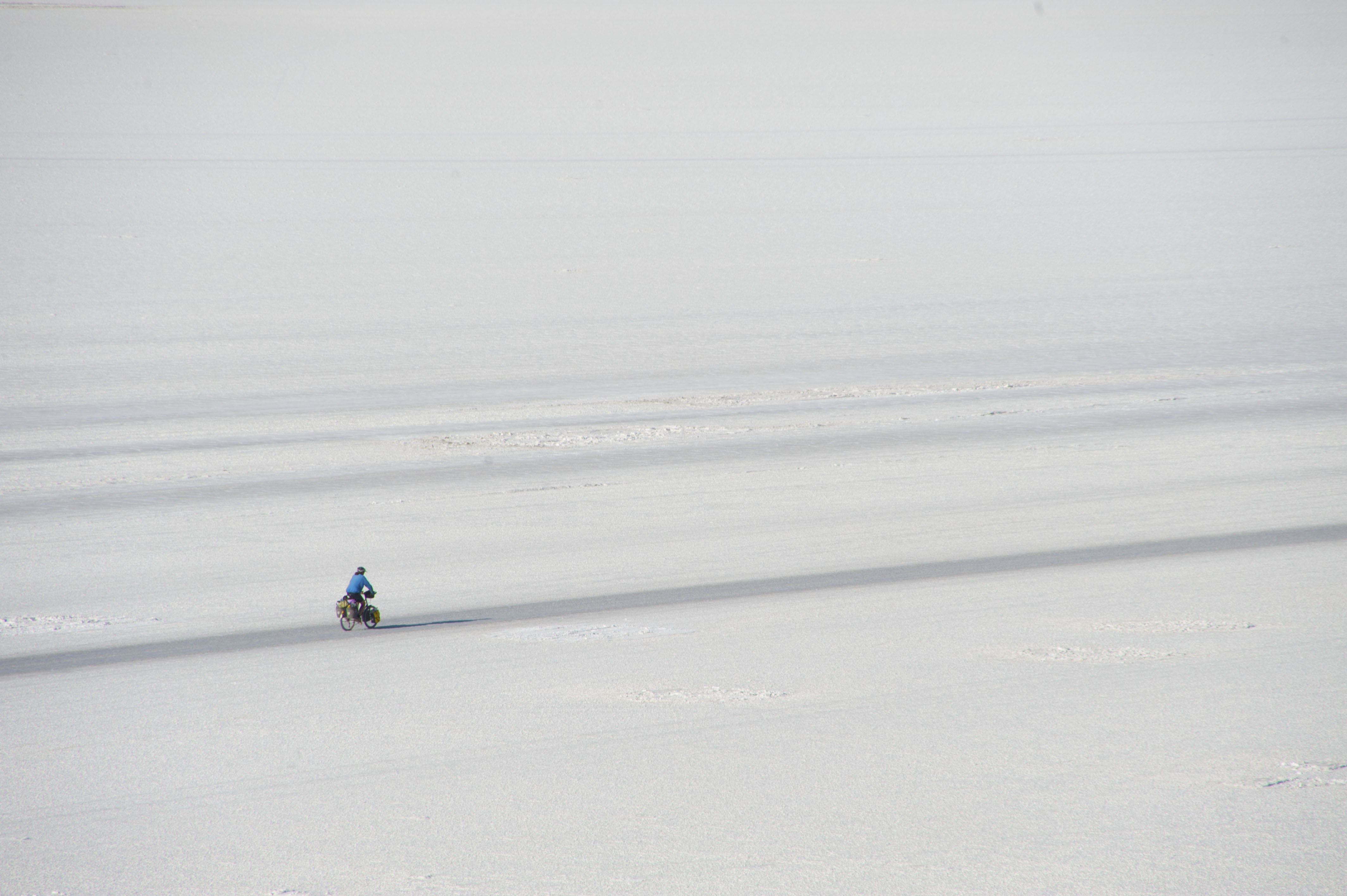
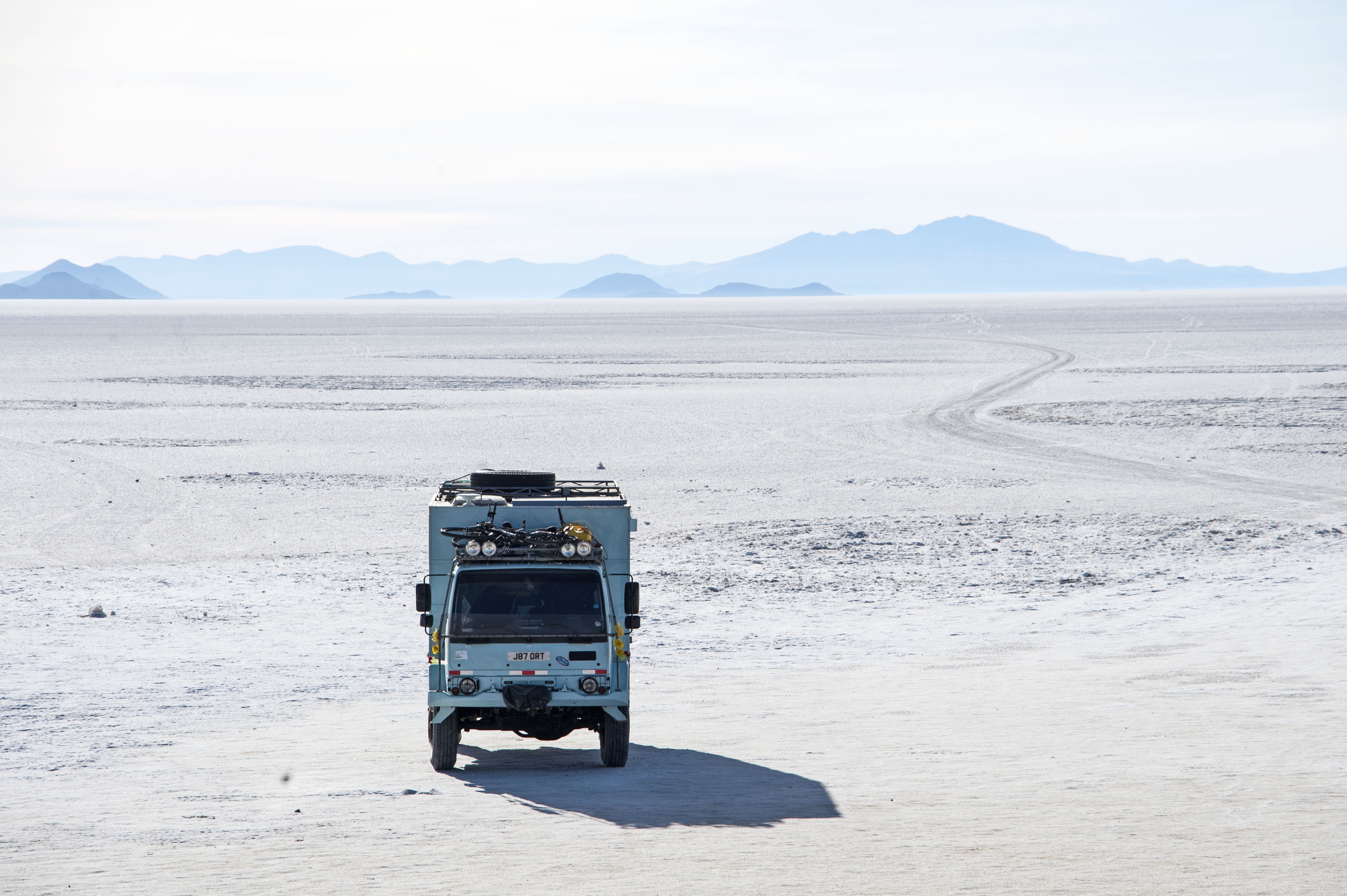
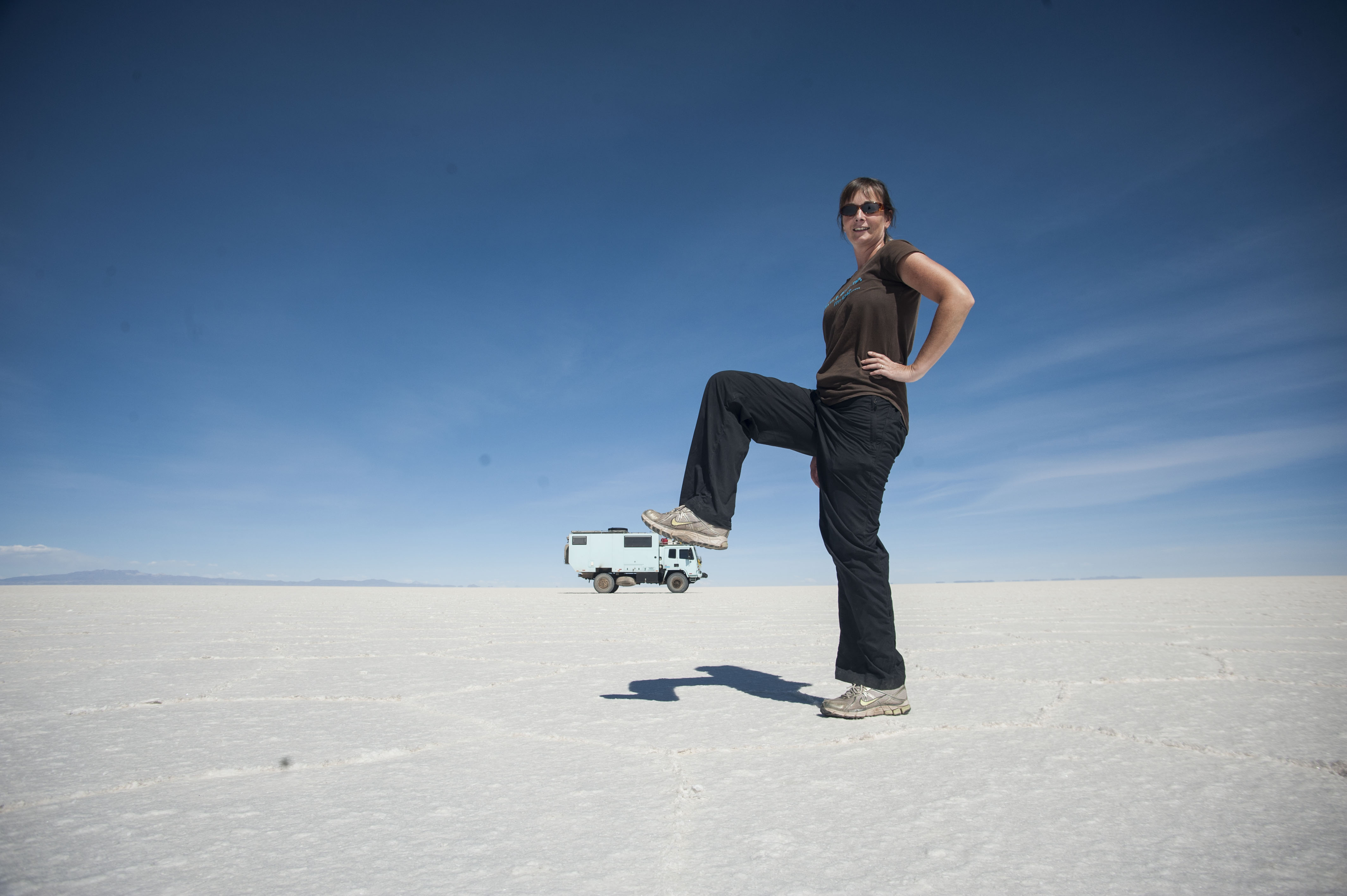
After watching the route onto the Salar taken by a bus we followed and we were soon on the hard, flat surface of the Salar. There is actually a lot of traffic on the Salar as there are a large number of landcruiser tours ! This means that roadways have formed, with black tyre marks, where you know your vehicle is safe. Driving on the Salar is fun and it is possible to drive fast although its important to keep your eye out for the occasional hole in the salt which wouldn’t be fun to drive through.
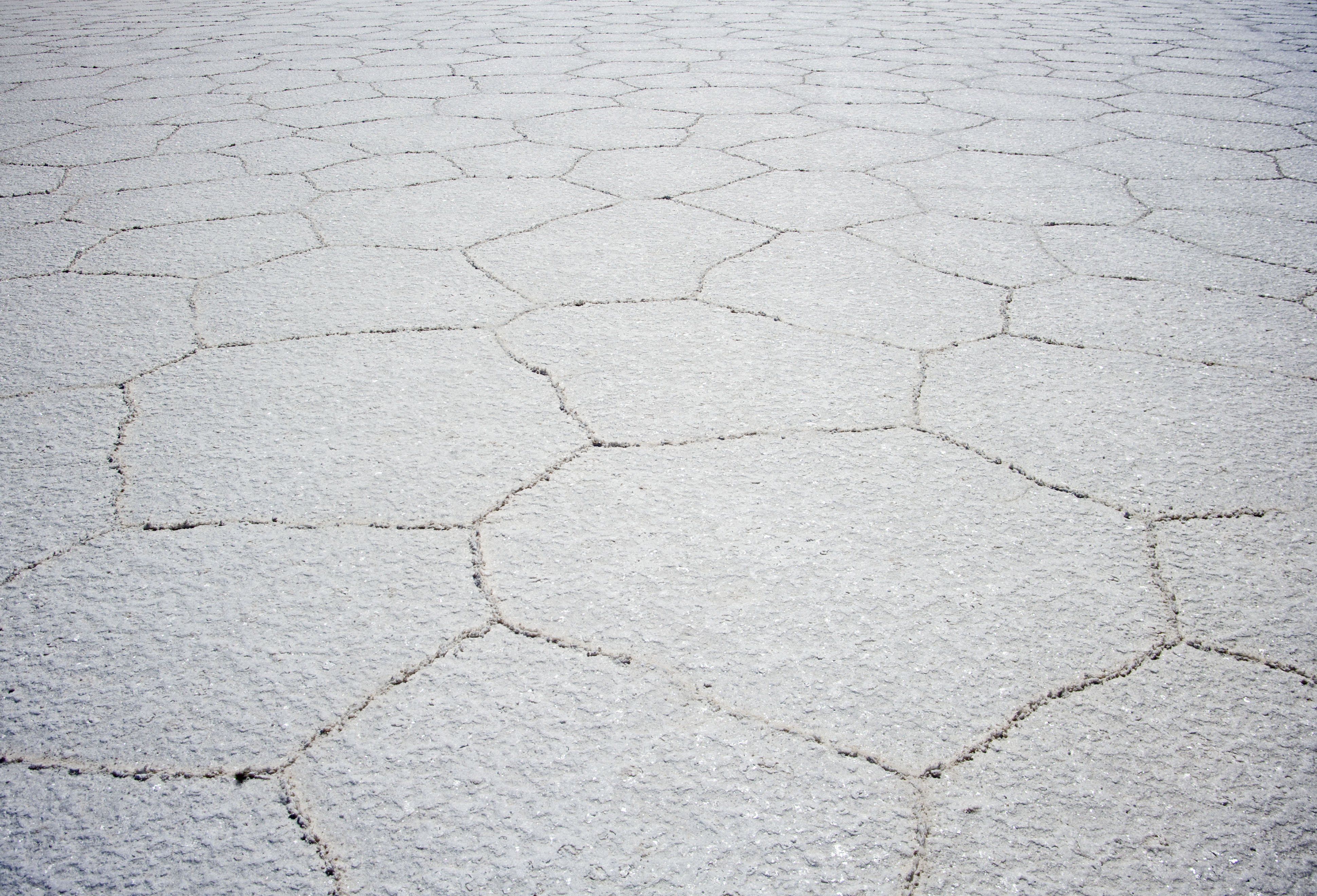
We drove to Isla Incahausi which is one of the bigger islands in the salt and covered in cactuses. There is an enjoyable hike to the top of the island which gives you a great view of the surrounding salt.
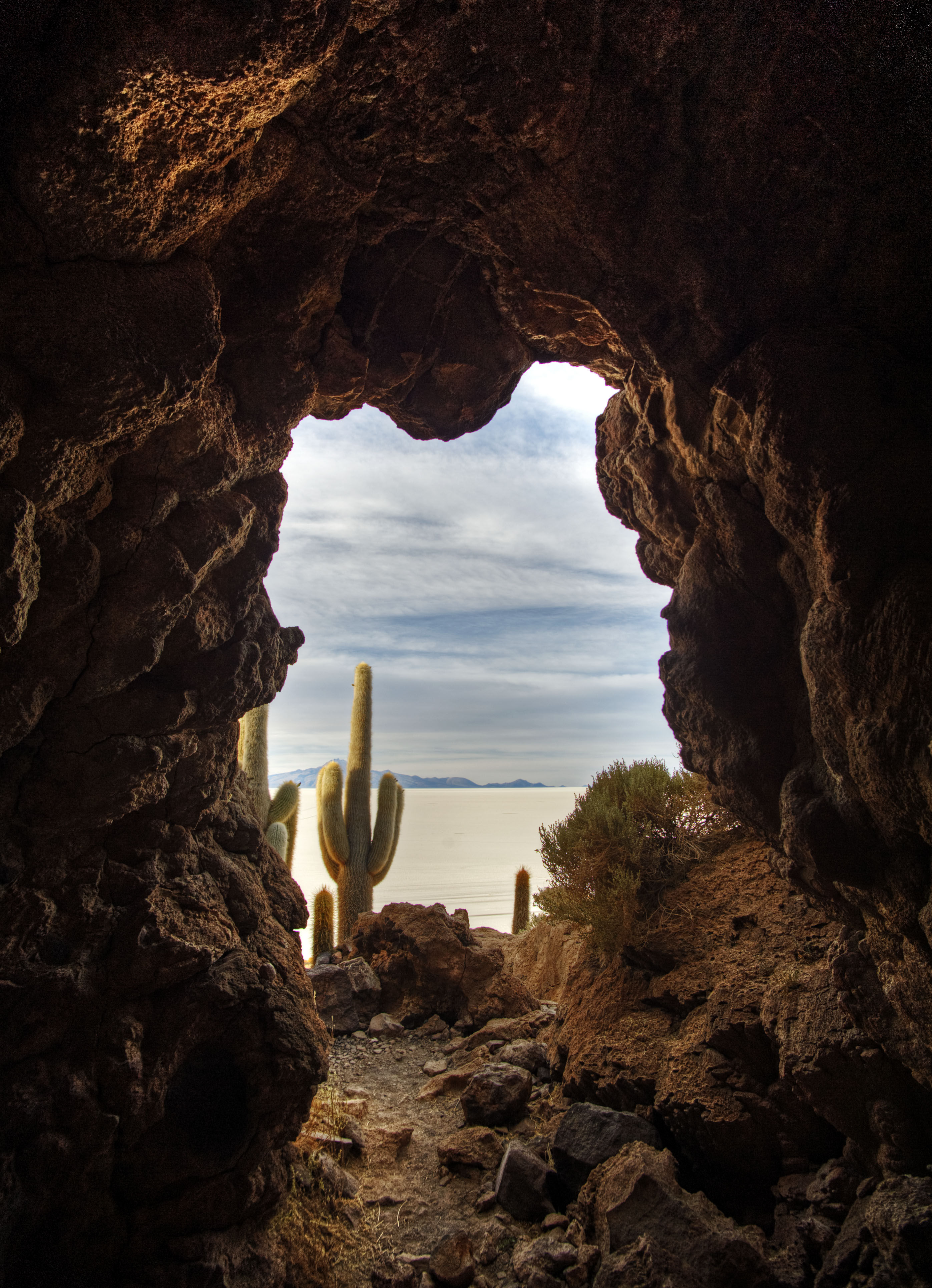
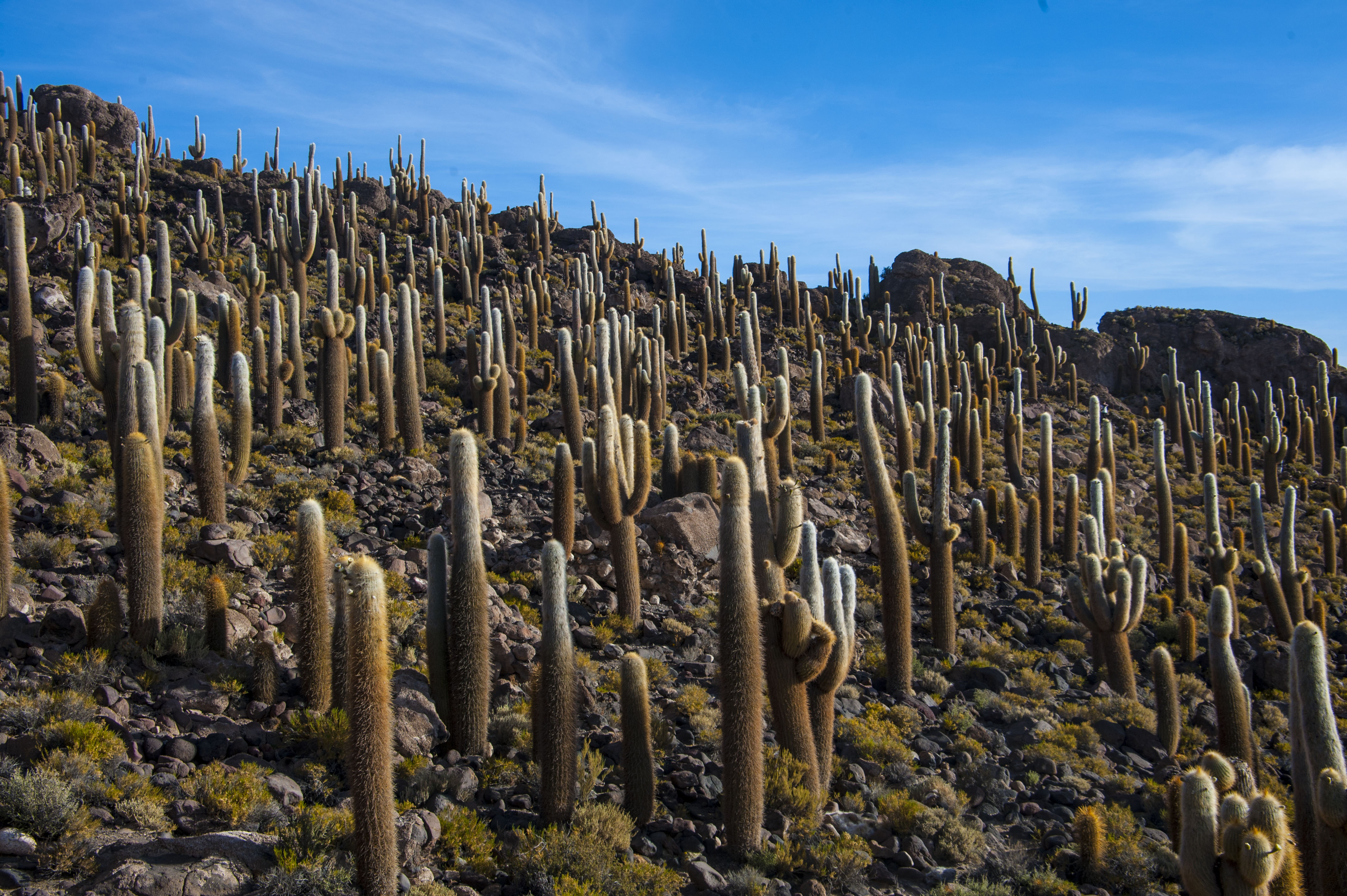
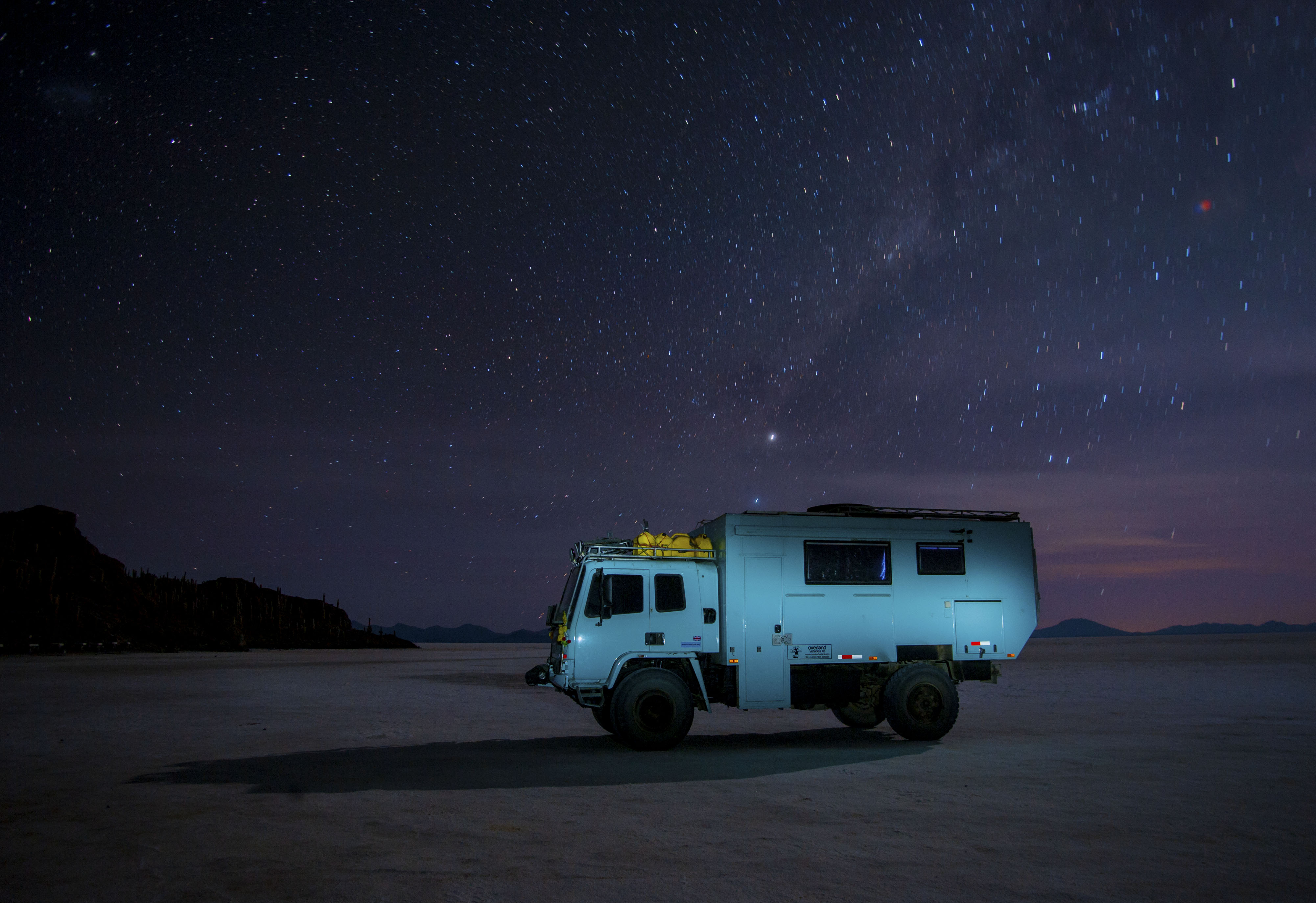
We decided to spend the night here before retracing our steps back to the place where we had entered.
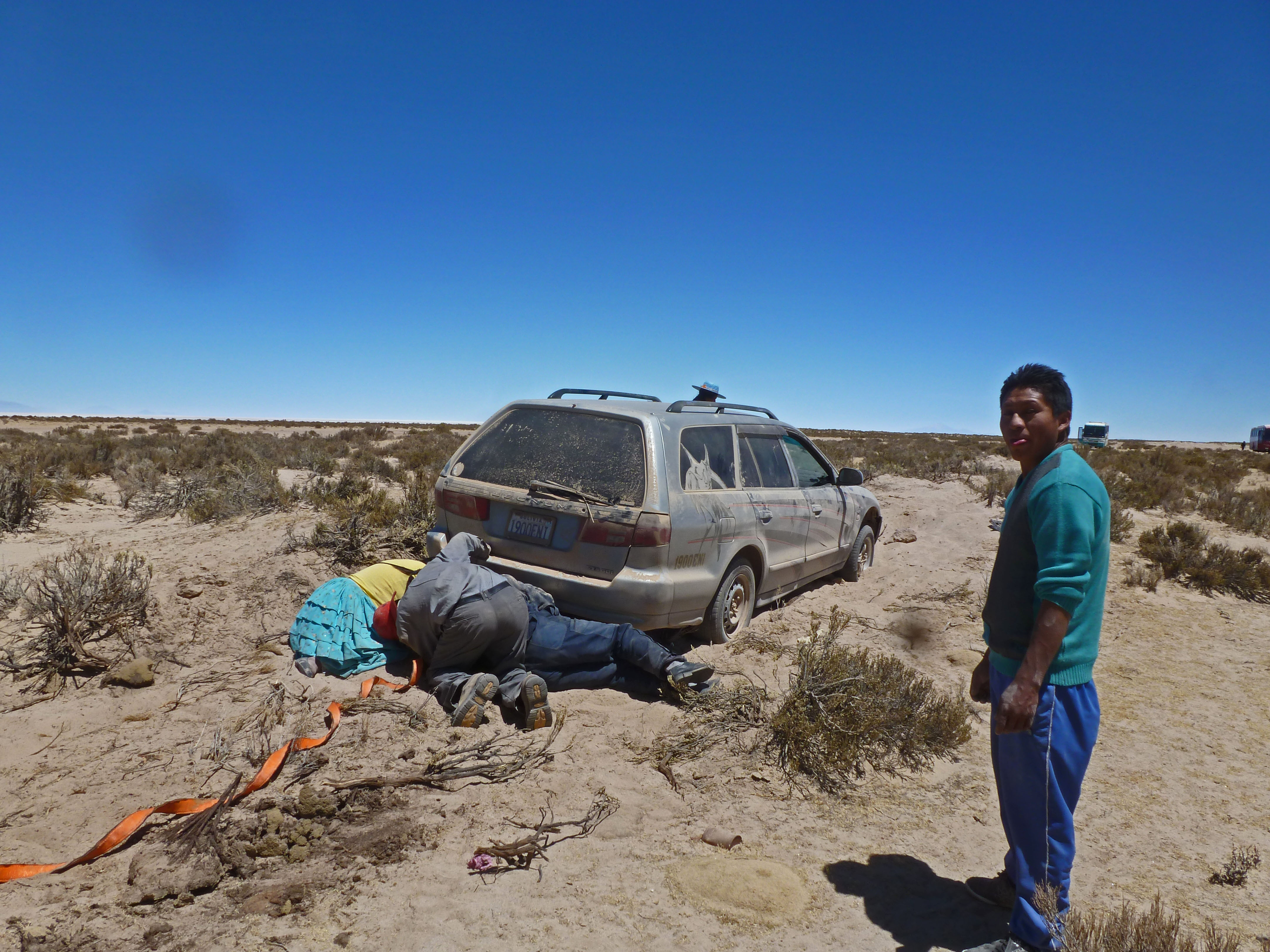
The proper road back to Uyuni is one of the worst roads we have ever driven – very hard tight corrugations. Fortunately there are tracks either side of the main road which are soft sand and much more pleasant to drive. Everyone does this but not everyone can cope with the sand and we ended up pulling a local car out of axle deep sand on our way !
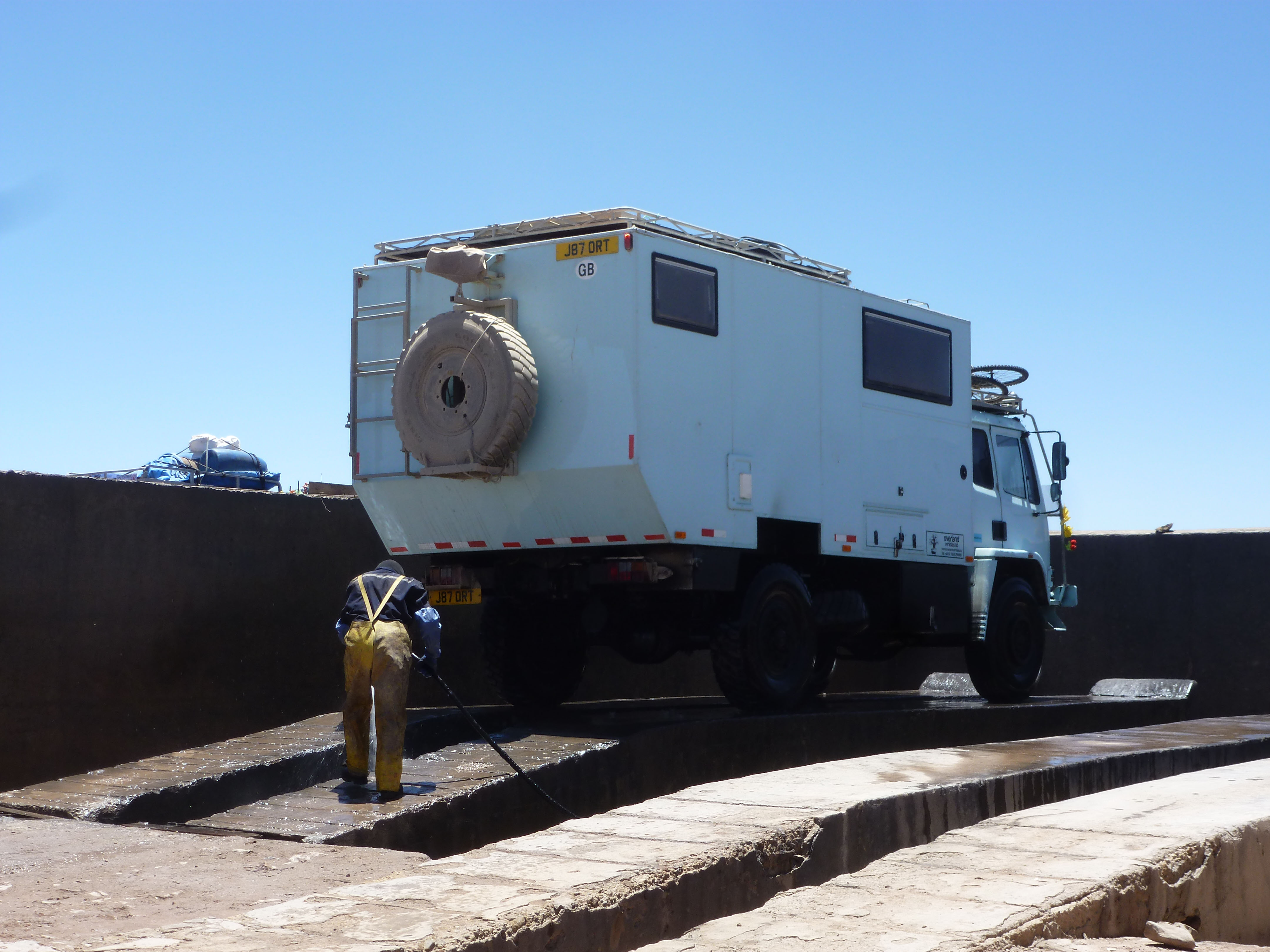
As soon as we got back to Uyuni we headed back to the car wash area to get the salt washed off the Beast. We wanted this done straight away because thick crusted salt can lead to rusting pretty quickly.
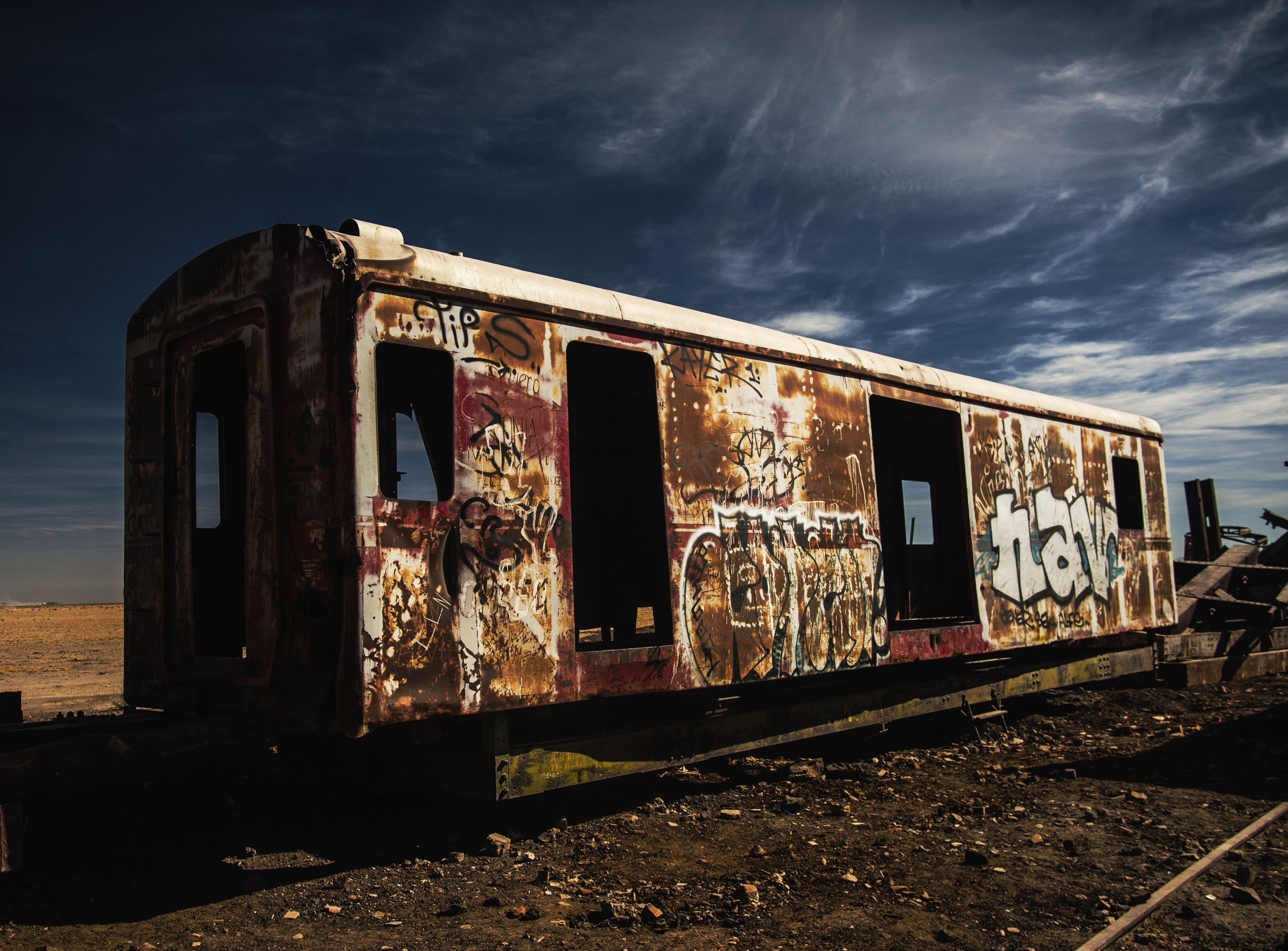
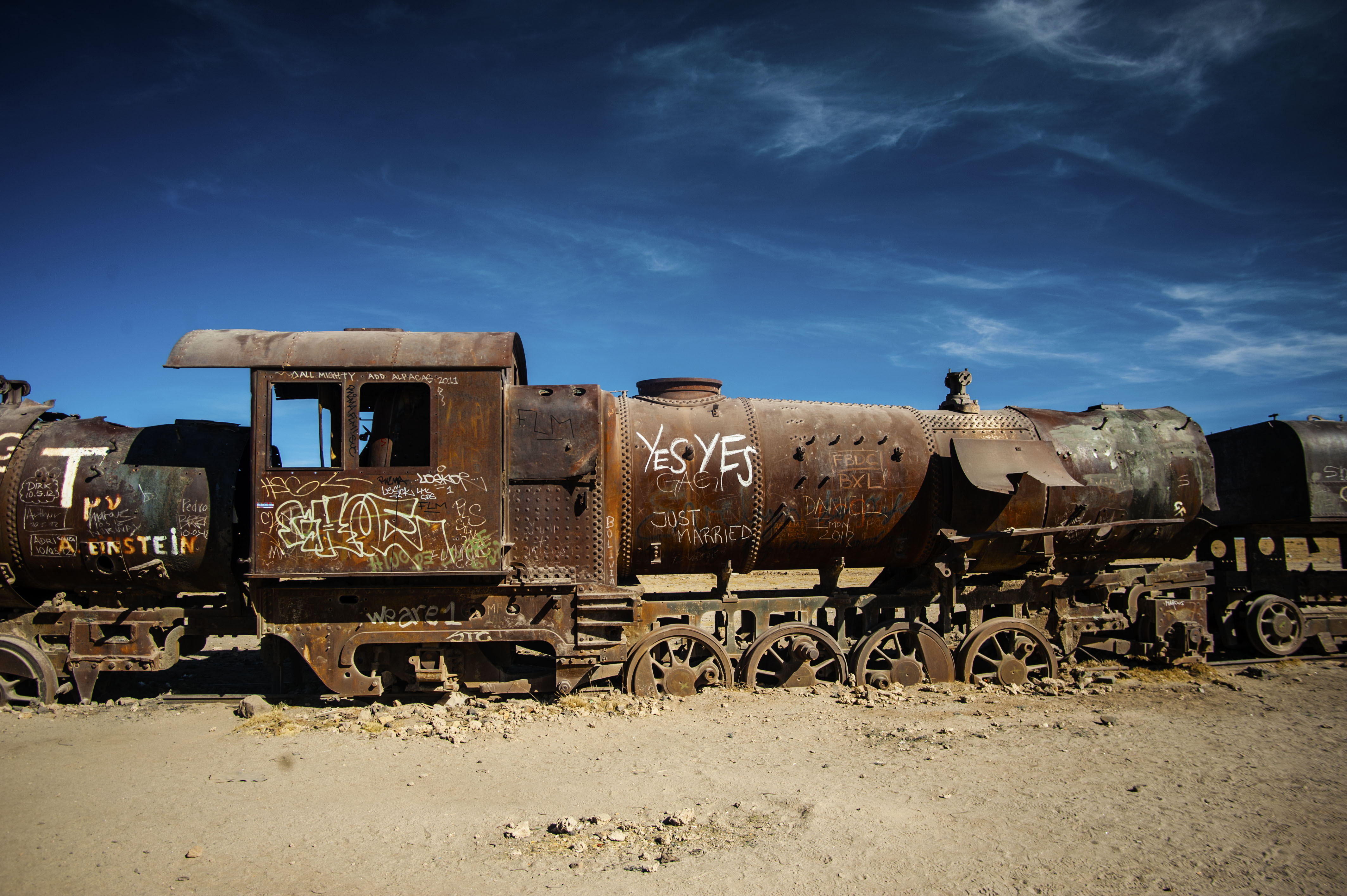
After this we visited the Train graveyard. This is just outside town and a large number of engines and trucks have been left here to rot for many years.
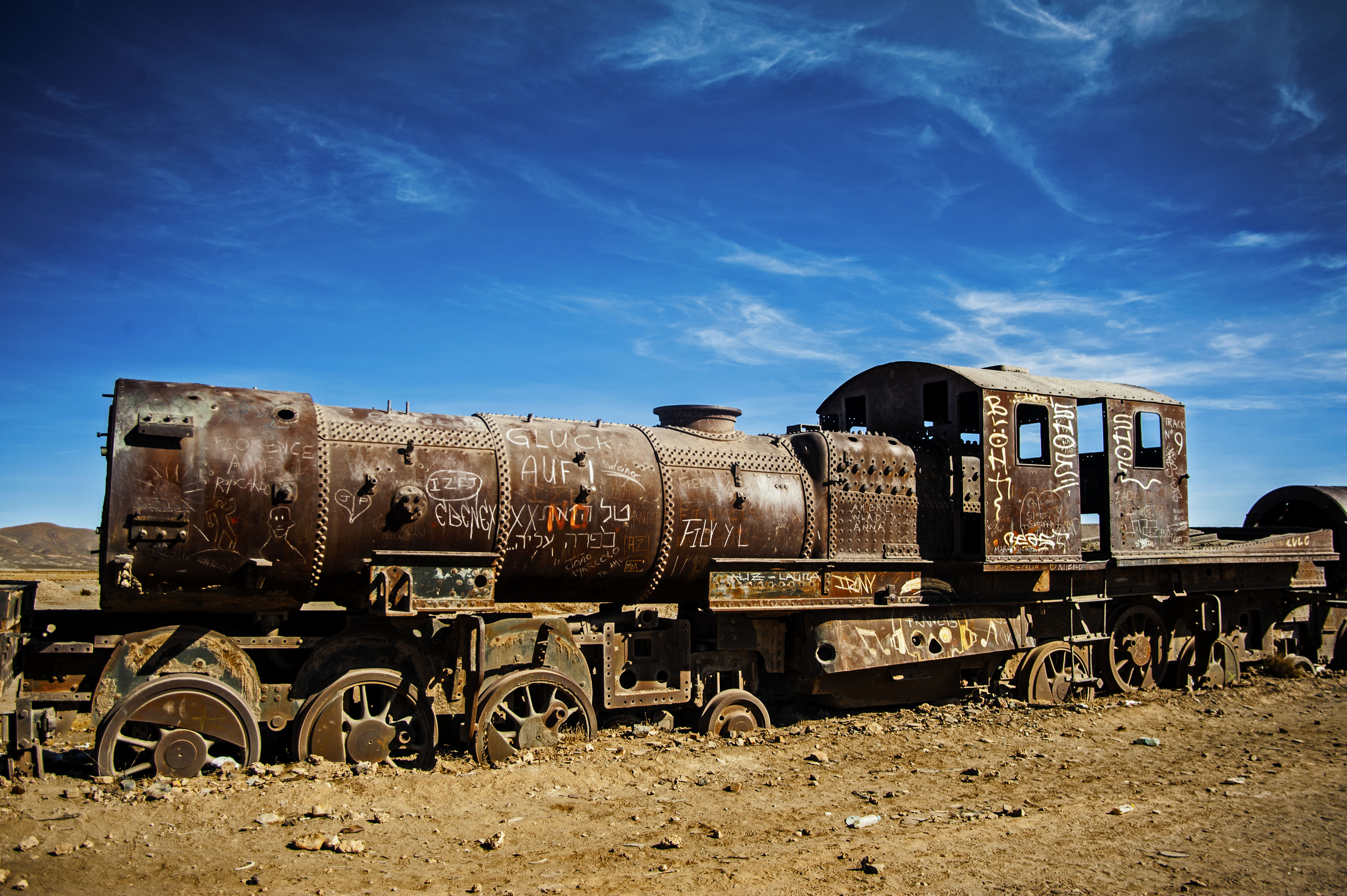
We spent our second night in Uyuni parked outside the military base which meant that we weren’t far from Minuteman pizza in the Tonito hotel. Minuteman makes what are reputedly the best pizzas in South America. I wouldn’t go quite that far but they were good !
Ojo Del Inca
The journey from Sucre to Uyuni is a long one, particularly as the drive from Sucre up into the mountains is slow. We decided to break our journey at a hot spring near Potosi.
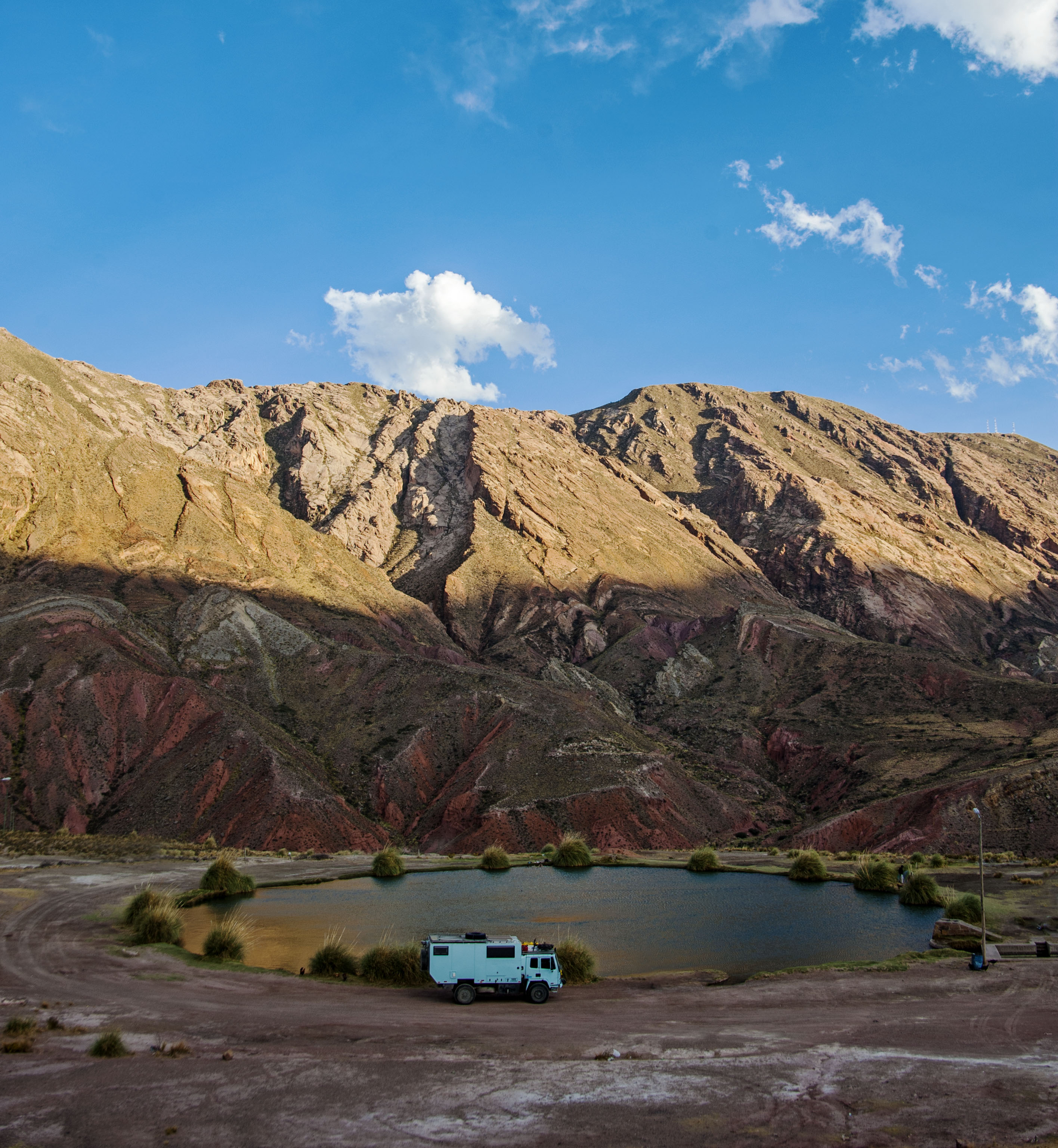
Conveniently located only a couple of Km’s off the main highway – and then 500m up a bumpy track – is the gorgeous natural hot spring of Ojo del Inca. Like every other hot spring in the Andes it was a favourite spot of the Incas – these guys liked their hot soaks.
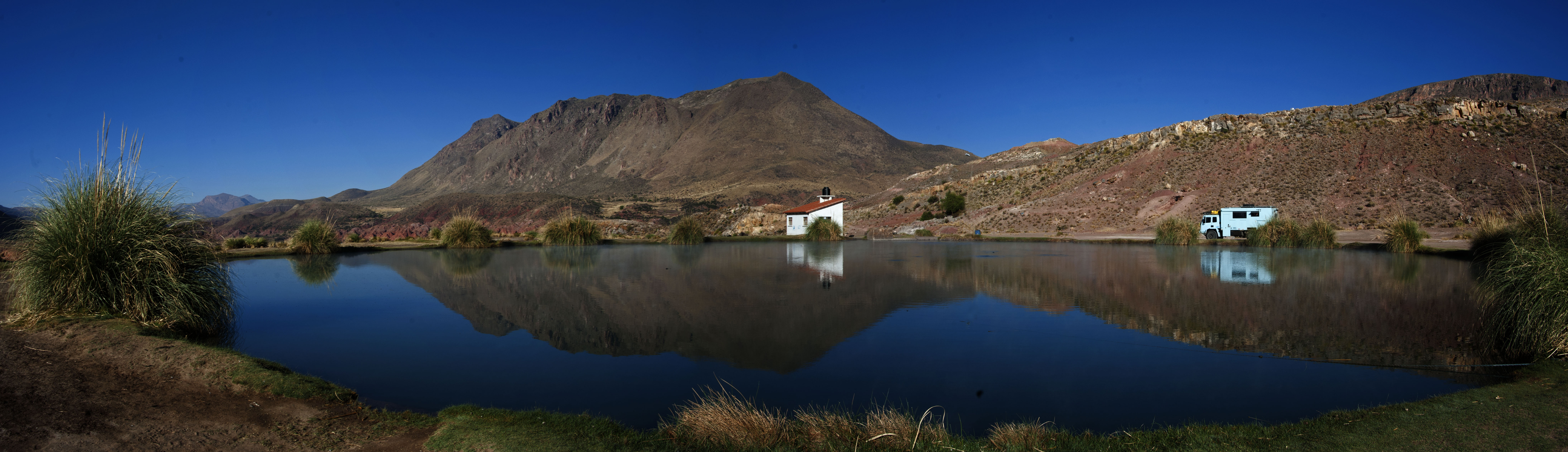
The pool itself is around 100m across and circular in shape and unlike most hot springs is very deep in the middle, which is where the hot water bubbles up. The temperature is around 30c at the edges and 35c in the middle !
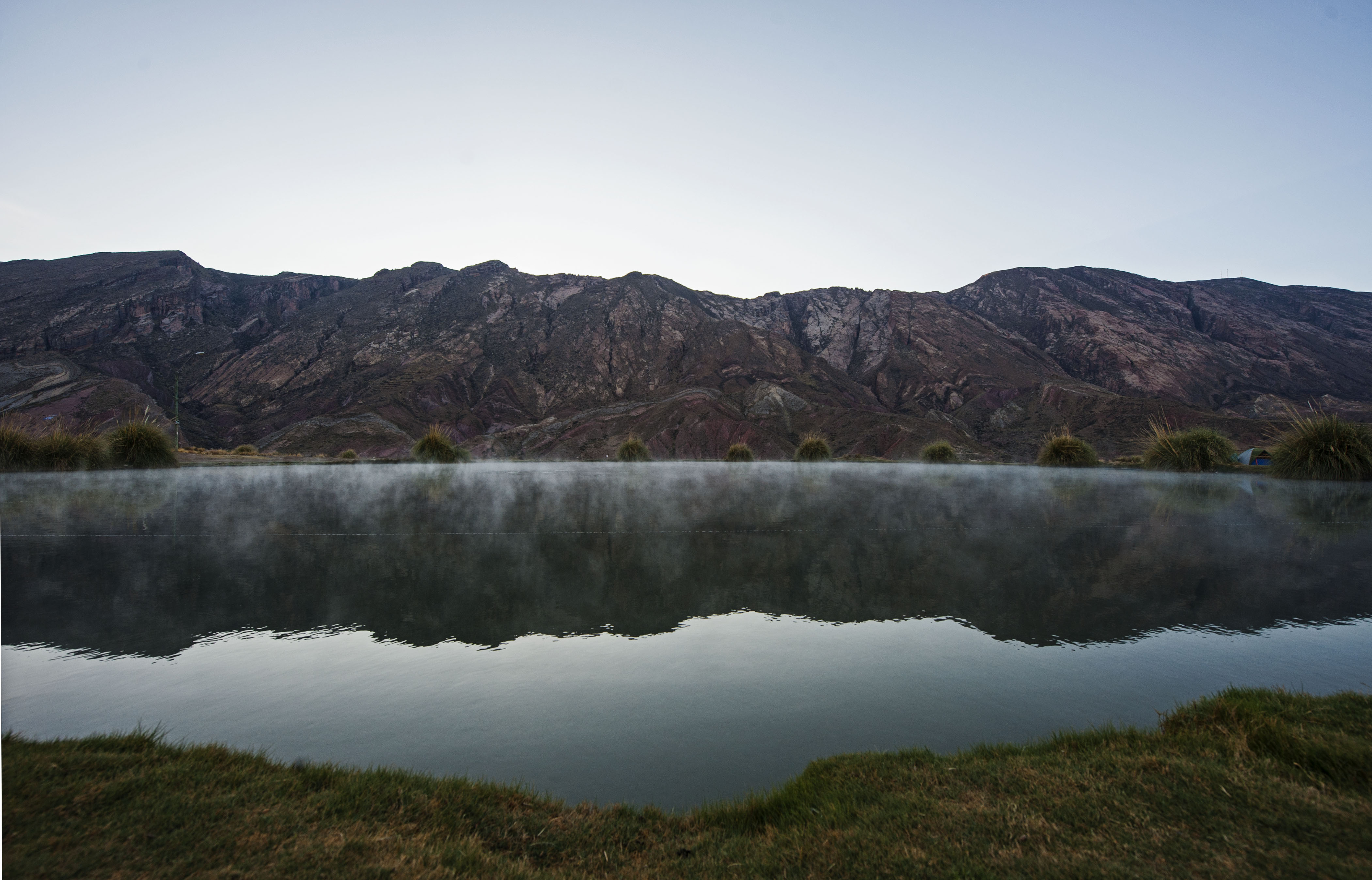
The best thing about the Ojo is that you can camp right on the edge. In the day it can get quite busy with tourists from Potosi but as night approaches everyone disappears. We had a very quiet night and then in the morning an early morning soak in solitude was a fantastic way to beat the early morning chill.
Sucre
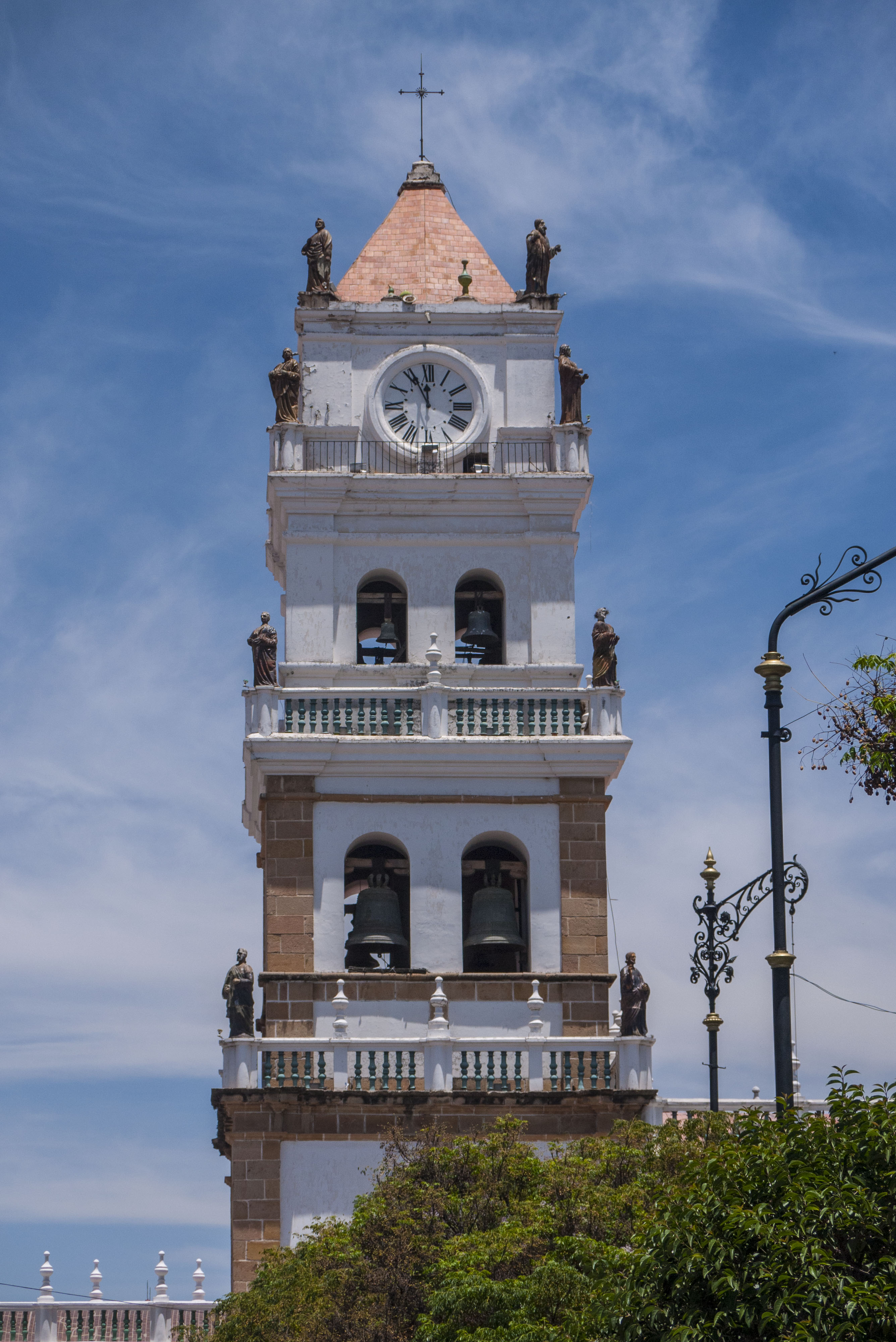
After a few weeks at high altitude we wanted a few days lower down and a bit warmer so we drove down off the Altiplano to Sucre which is the official capital of Bolivia. It is known as the White City, along with what seems like half the other cities in South America.
The traffic as we entered Sucre was terrible but we managed to battle our way to the hotel outside the bus station that we knew had parking for vehicles of our size. When we got there we had a slightly bizarre conversation where we were told that camping was B120 but taking a room was only B100. We ended up taking a room and sleeping in the truck for B100 – go figure !
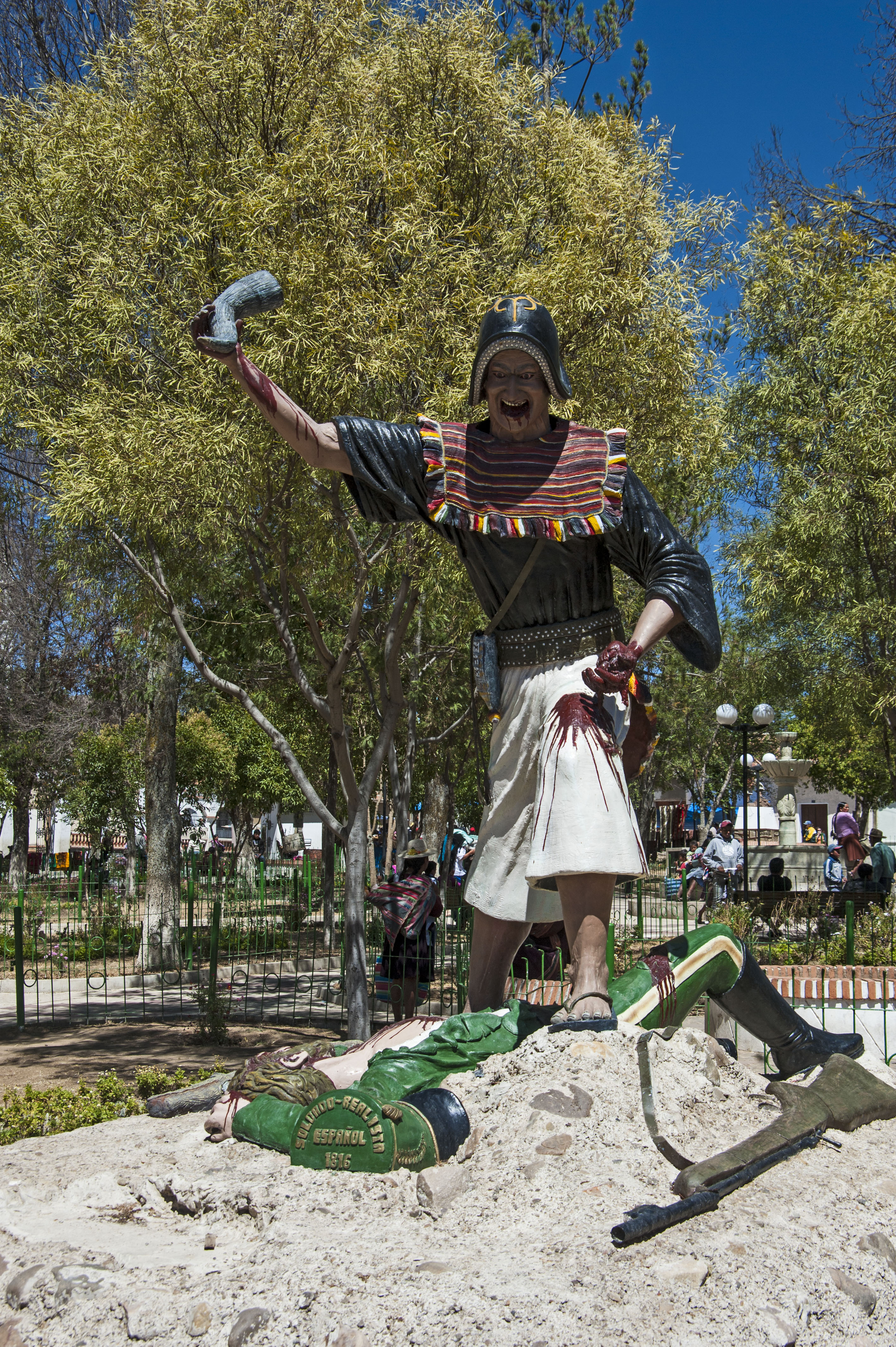
The centre of Sucre itself is lovely with a beautiful central square with lots of shaded benches to sit relax on. The shade is needed because the day time is really hot.
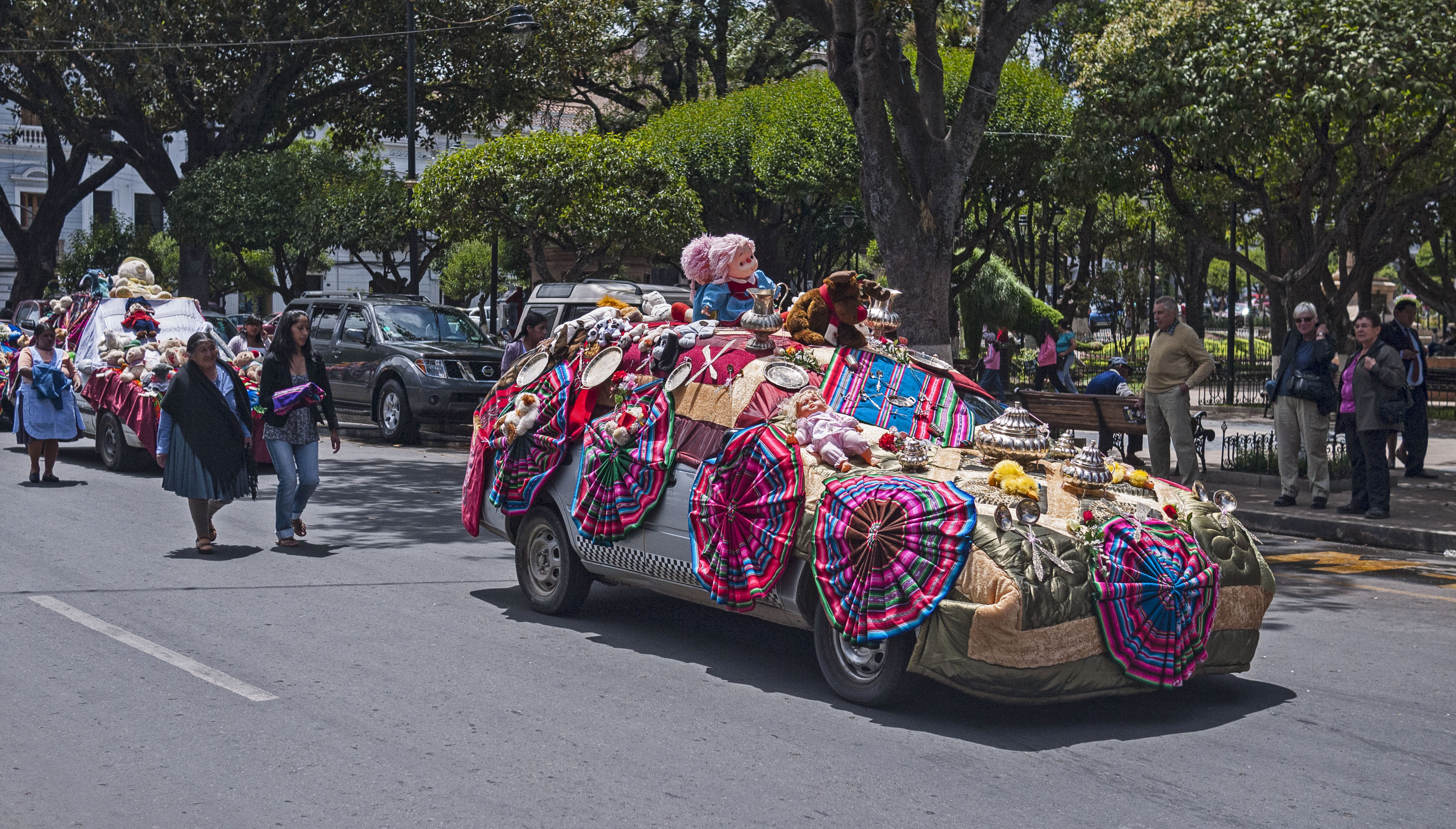
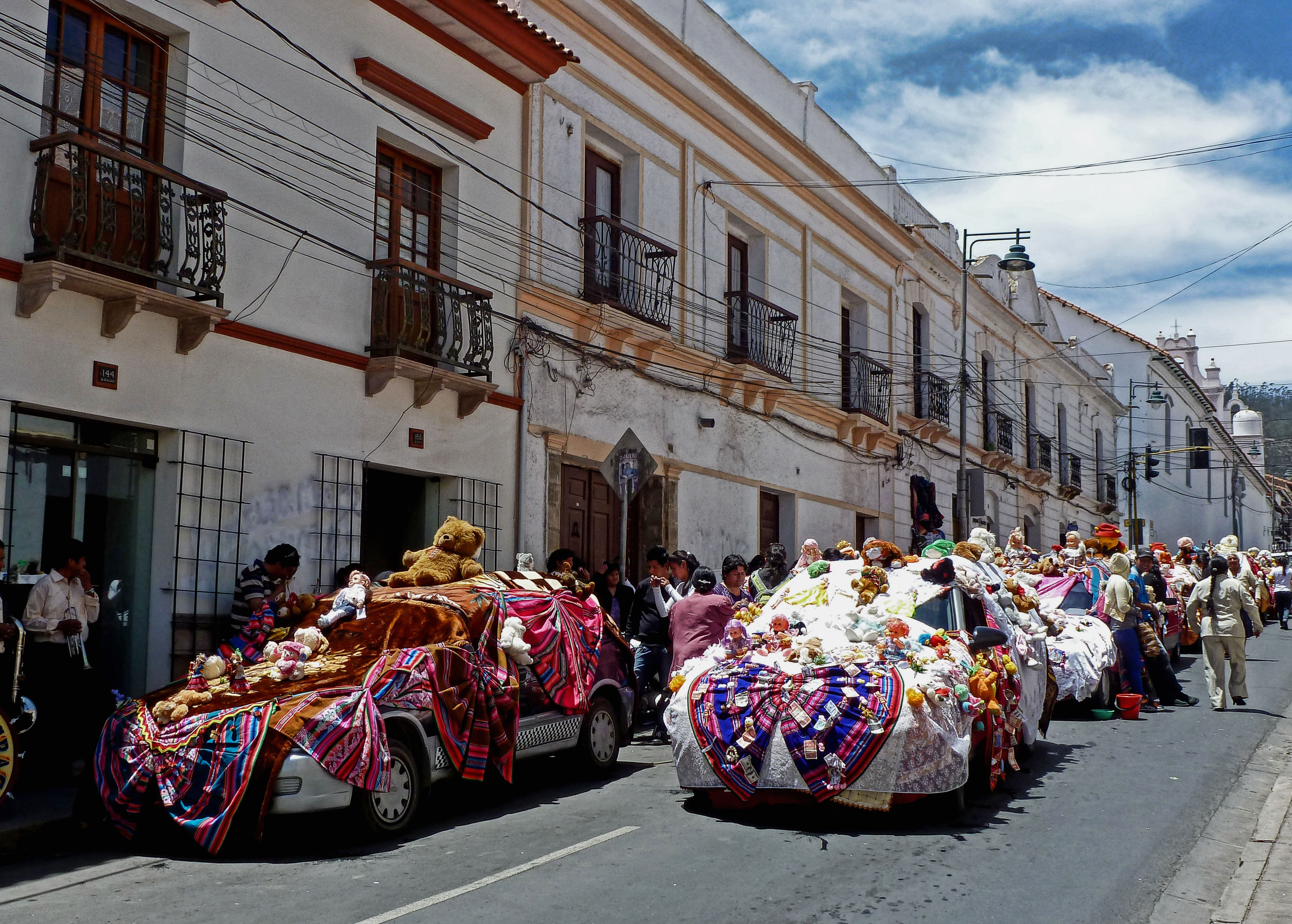
When we first arrived at the square there was a weird procession taking place with cars decorated with cloth and children’s teddy bears ! This ended in a street near the square where there was some dancing and the cars were being blessed with alcohol.
We arrived on a Saturday and arranged to go on trip to the famous Tarabuco market the next day. This was another occasion where the trip cost was less than round trip diesel cost.
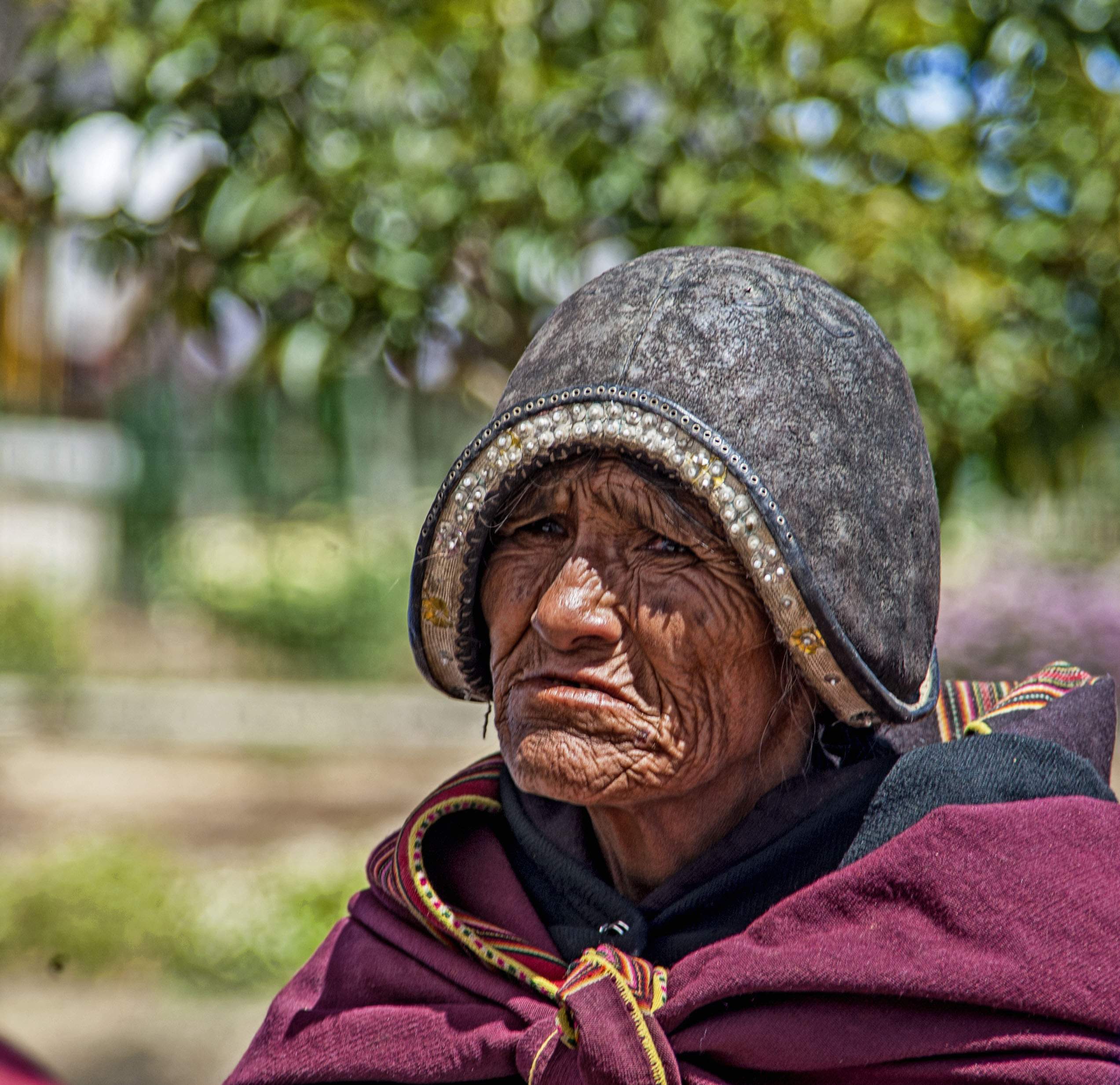
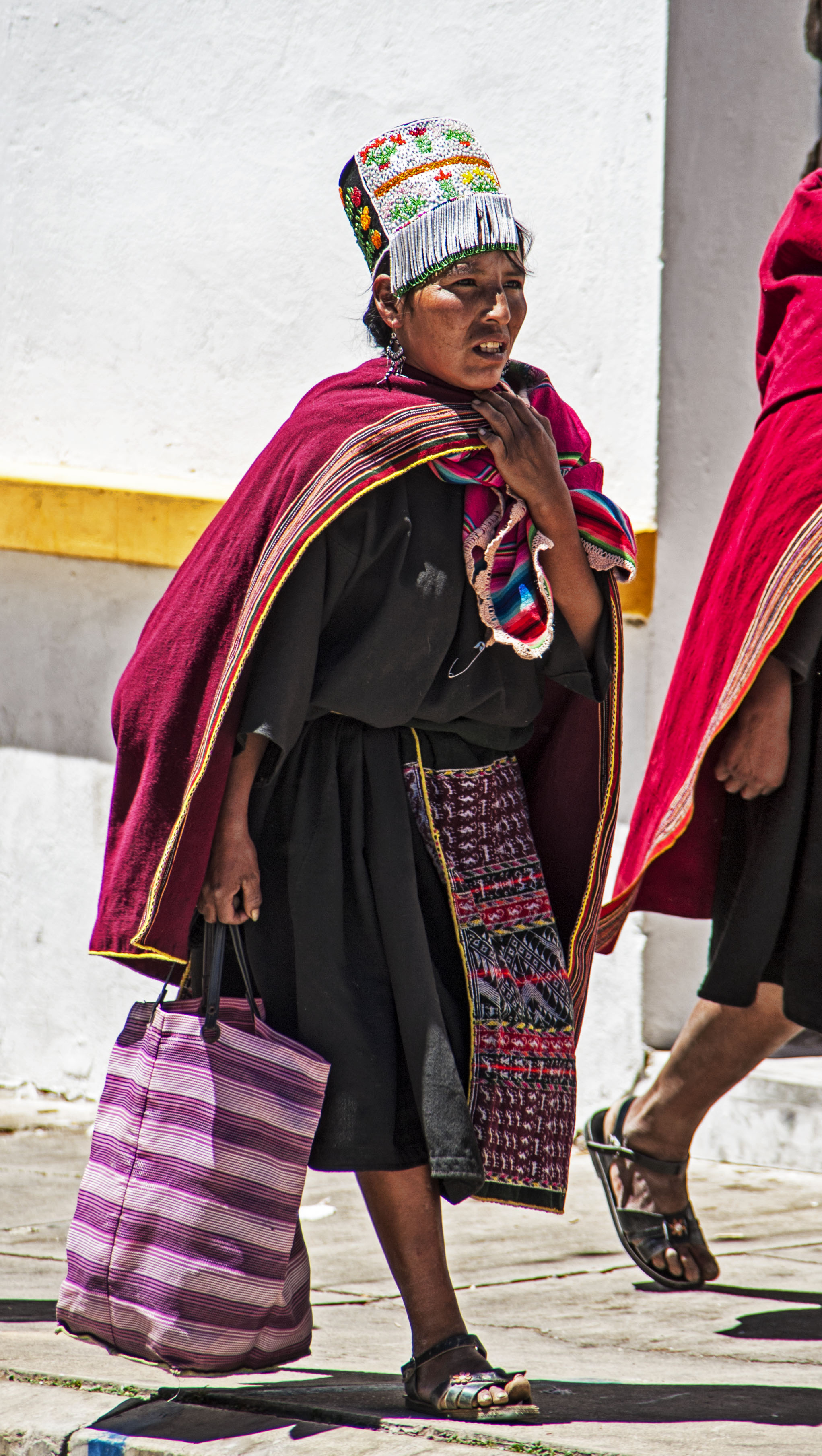
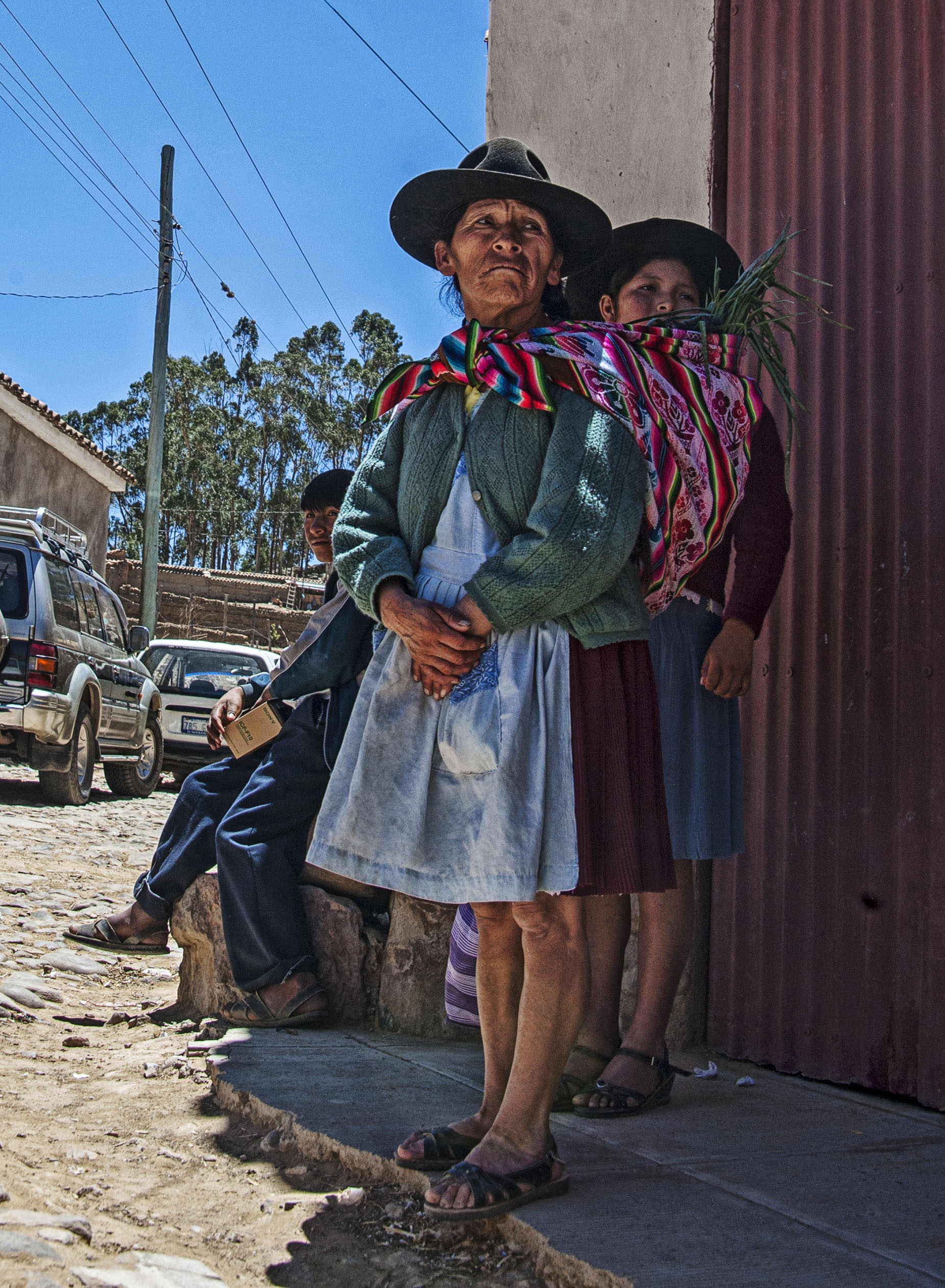
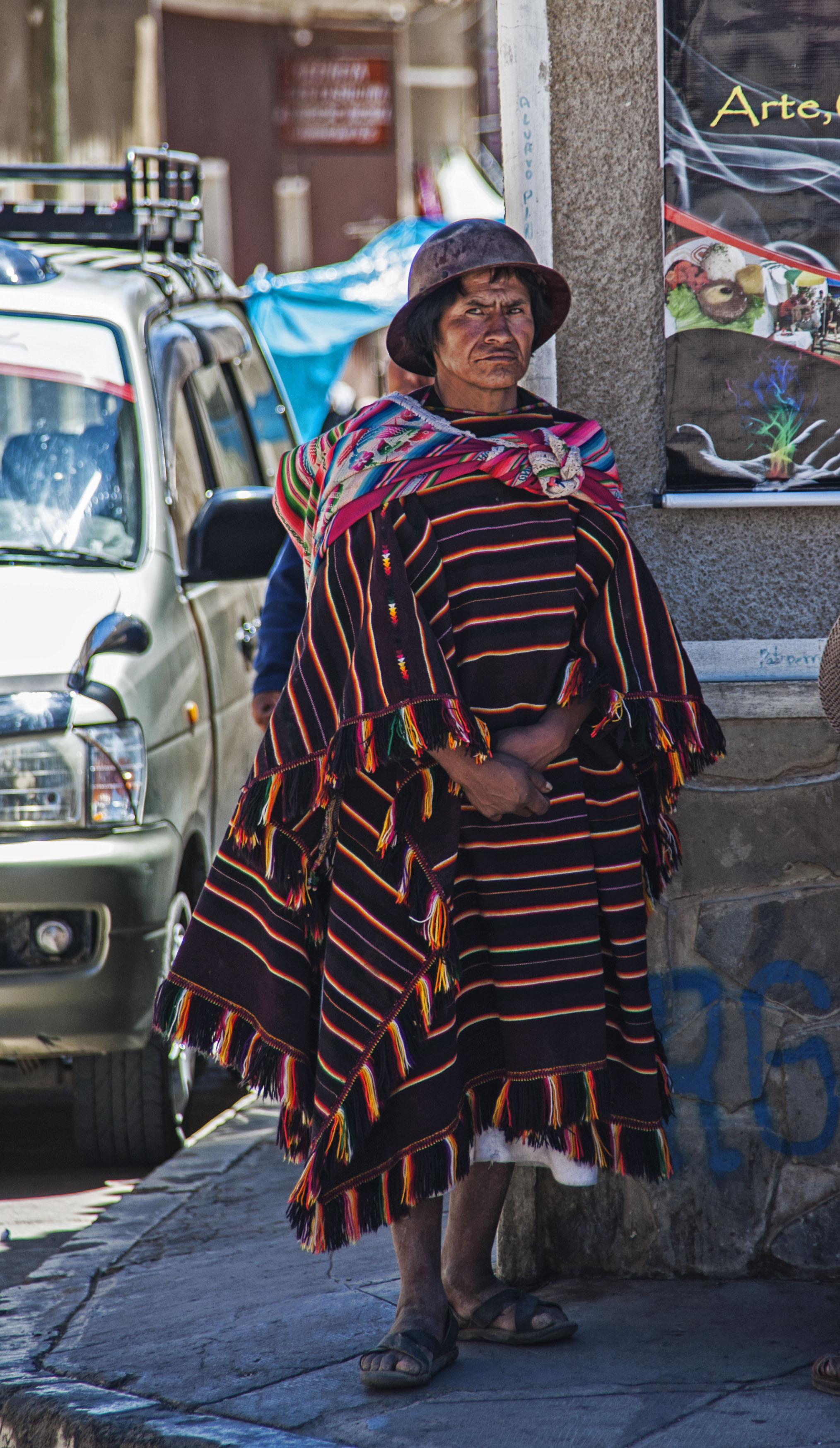
The Tarabuco market was not as interesting as we had hoped. There were lots of people dressed in indigenous clothes but the market itself was not that big and only really took an hour to walk round. However there were some interesting tapestries to buy.
Sucre is famous for its high quality chocolate and we managed to buy a couple of bars of this – having been starved of decent tasting chocolate for ages.
Our visit to Sucre was soured on our last day when Sarah was attacked by a dog in the hotel. She ended up with a huge bruise on her leg in which you could clearly see the imprints of the dogs teeth. Fortunately the dog only just broke the skin (through trousers) and didn’t draw blood.
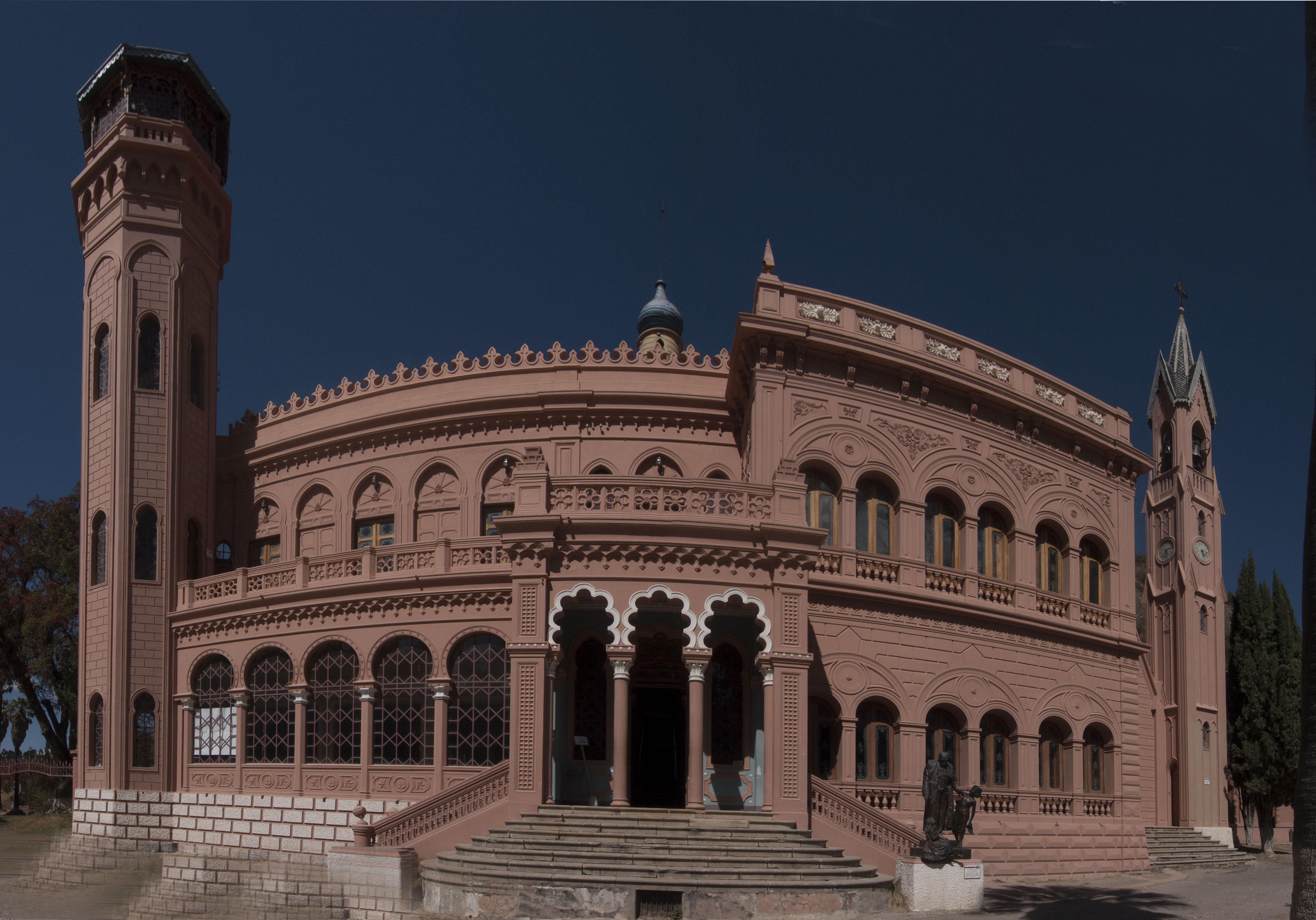
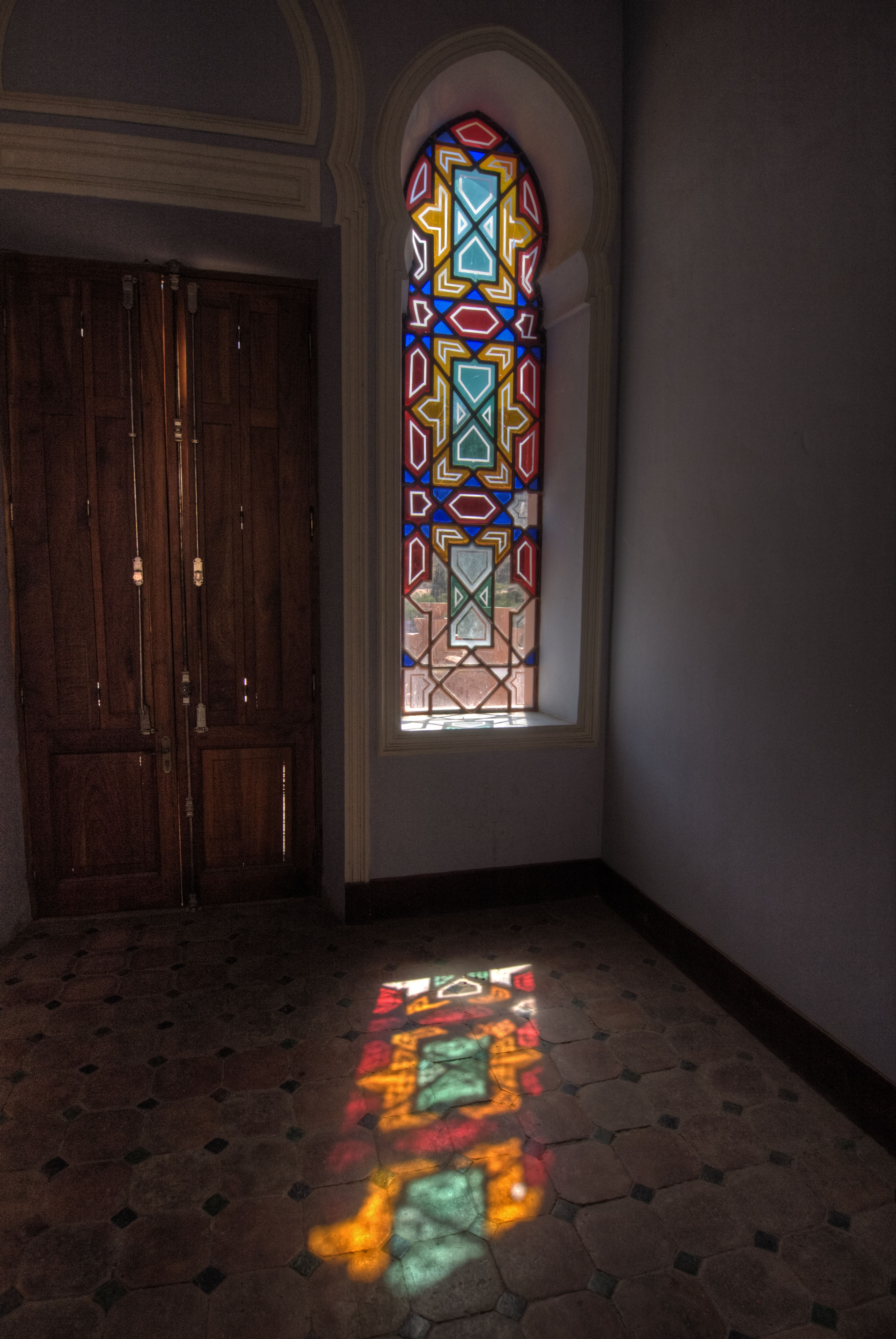
After a few days we were on our way again but as we were leaving Sucre we visited a large mansion house built in the late 19th century , which is bizarrely situated in a military base. It is called the Castillo de la Glorieta and was built by a wealthy local who was declared a Prince by the Pope to become the only Bolivian royalty ! There is a lot of neglect in the house and grounds but it must have been quite grand in its pomp and it feels very out of place in Bolivia!
 FromAtoB