Potosi
Potosi is a high altitude (3800m) town that has grown up around the richest silver mine in town. The mine is in Cerro Rico, the mountain that towers over the town.
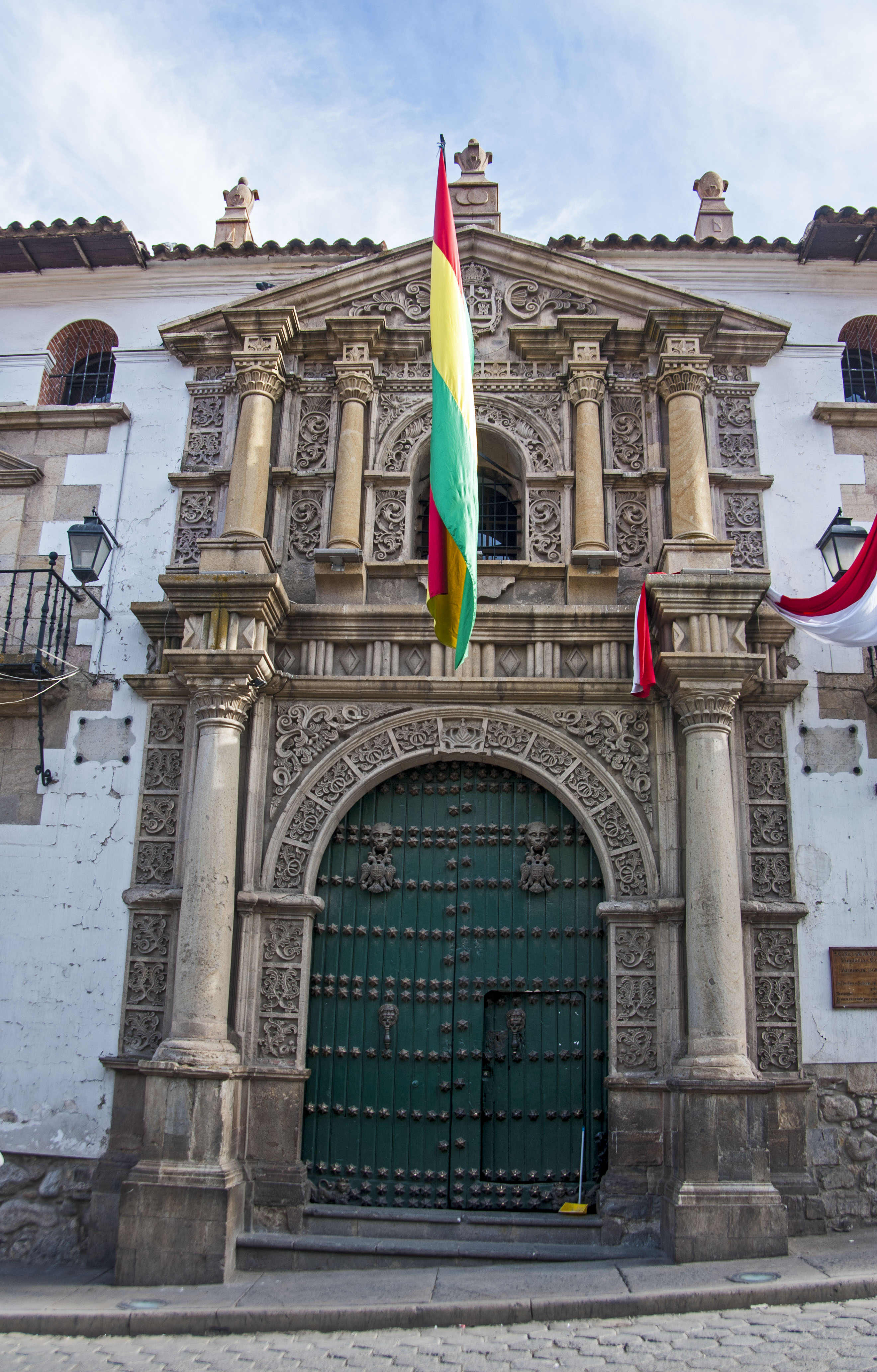
It is said that the amount of silver taken from the mine was enough to create a bridge to Spain but that you could build two bridges of bones from the people that died mining the silver. The Spanish conscripted indigenous people into the mines and estimate of the deaths run as high as 9 million. It is thought that out of every 10 men sent to the mines (working up to 1 week at a time without a break) 7 died.
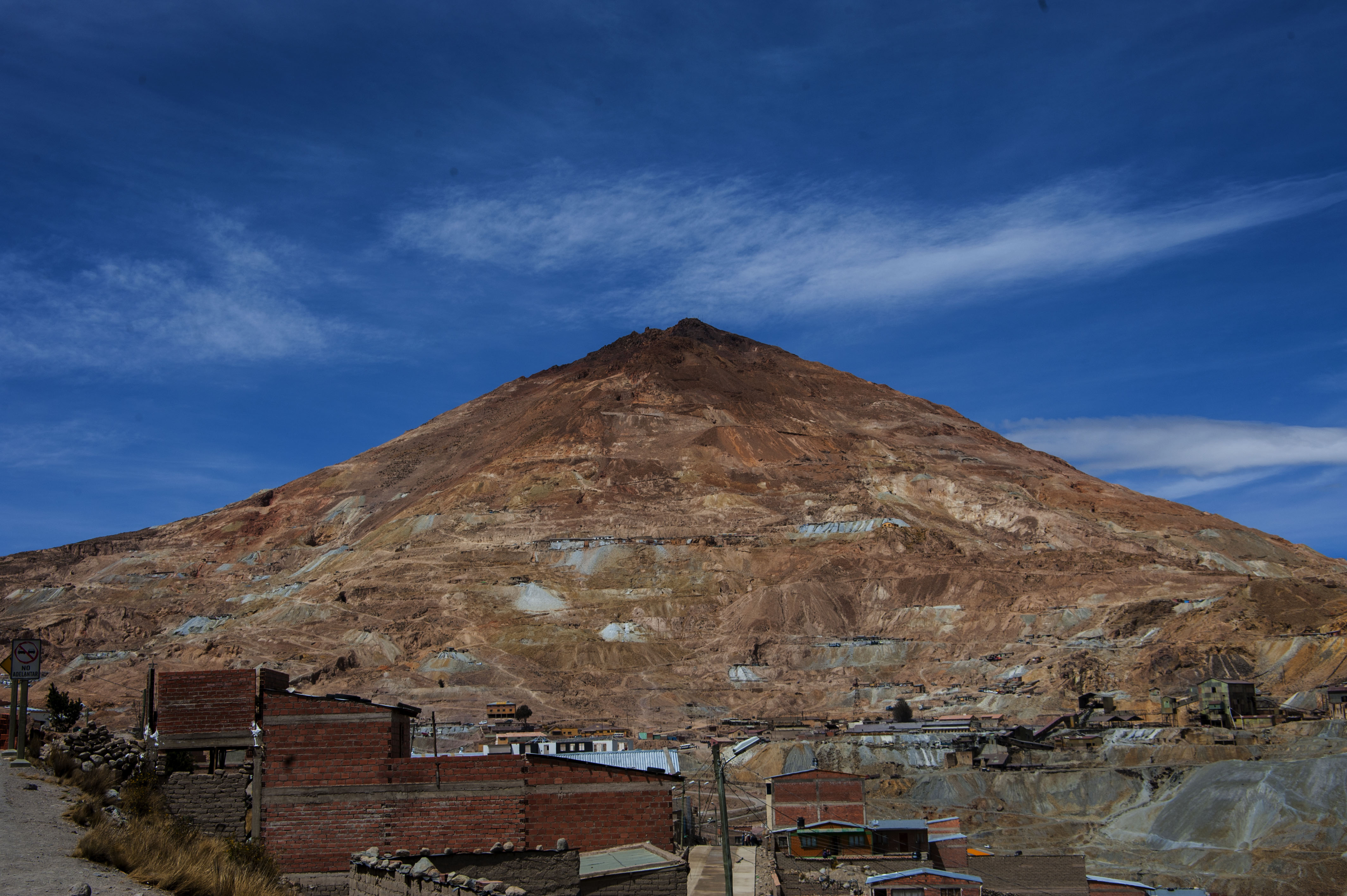
The town of Potosi itself has narrow streets and a large number of churches. At its centre is the Casa Real de la Moneda (Bolivia’s mint, which was in operation until the mid 1900’s).
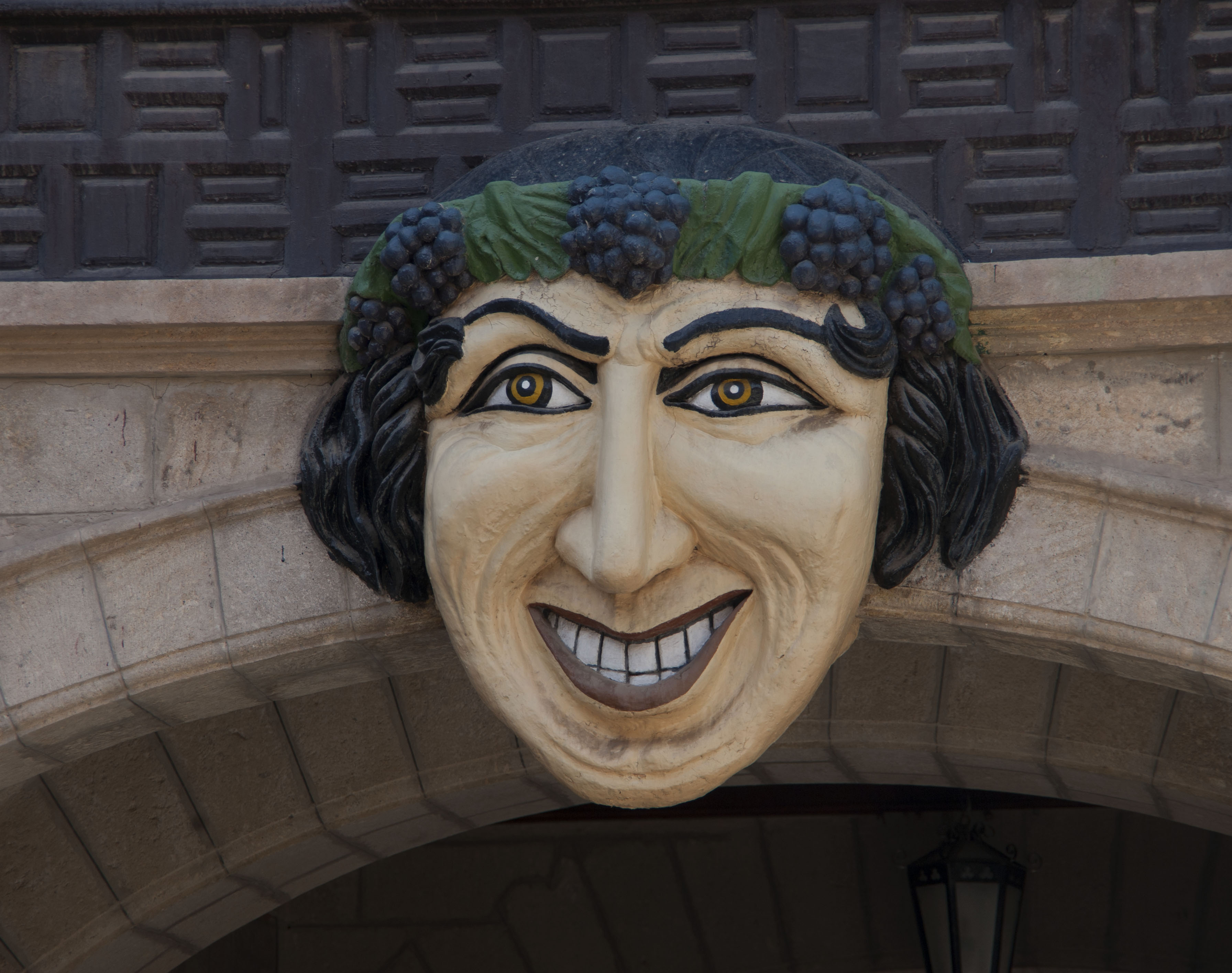
We had trouble finding somewhere to stay in Potosi – the standard overlander’s hangout was too small – but finally we stumbled across a parking lot with secure parking only a 15 minute walk to the centre and we were sorted.
The first thing we did in Potosi was sort out a tour of the Cerro Rico mine for the next morning and then we settled in to explore the town. 30 minutes later we’d seen the main sights ! Although there was some pleasure to be had by just wandering the streets.
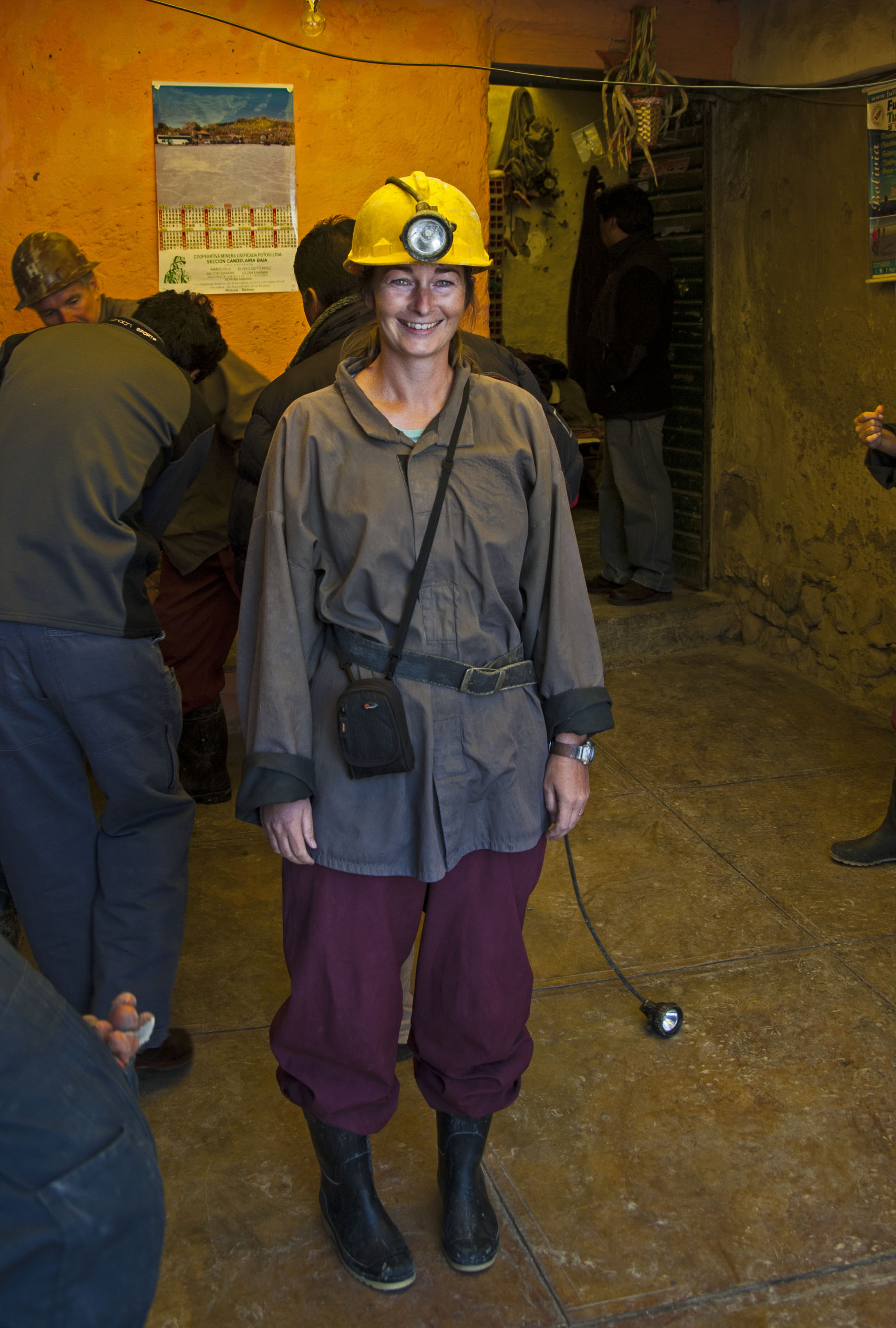
Bright and early the next morning we were off on our tour of the mines. The first thing was to get kitted up and we were taken to the companies base to get our clothes and miner’s helmet, complete with light powered from a belt mounted power pack. So we looked the part.
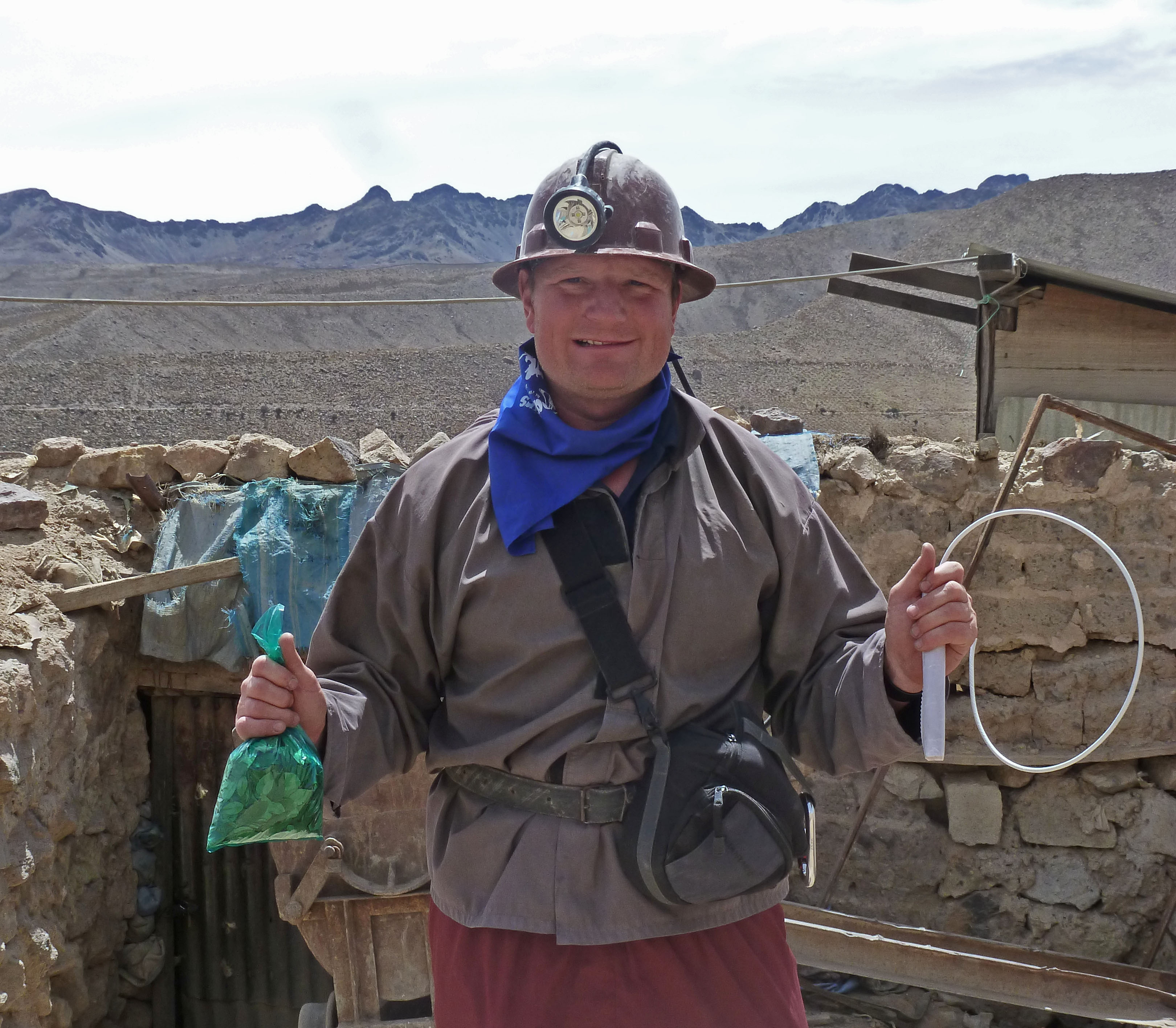
From here we went to the miner’s market – a street filled with small shops selling all the essentials. Here we were encouraged to buy some presents for the miner’s we would meet in the mine.
Bolivia is the only country in the world where you can just walk into a shop and buy Dynamite – so one of our presents was a stick of dynamite plus the detonator. I wanted one for myself but Sarah firmly put her foot down!
We also bought another essential ingredient for the miners – a bag of Coca leaves. Chewing these relieves exhaustion, the effects of altitude and eliminates hunger. The miners can’t eat while underground as it causes upset stomachs due to the various gases in the mine.
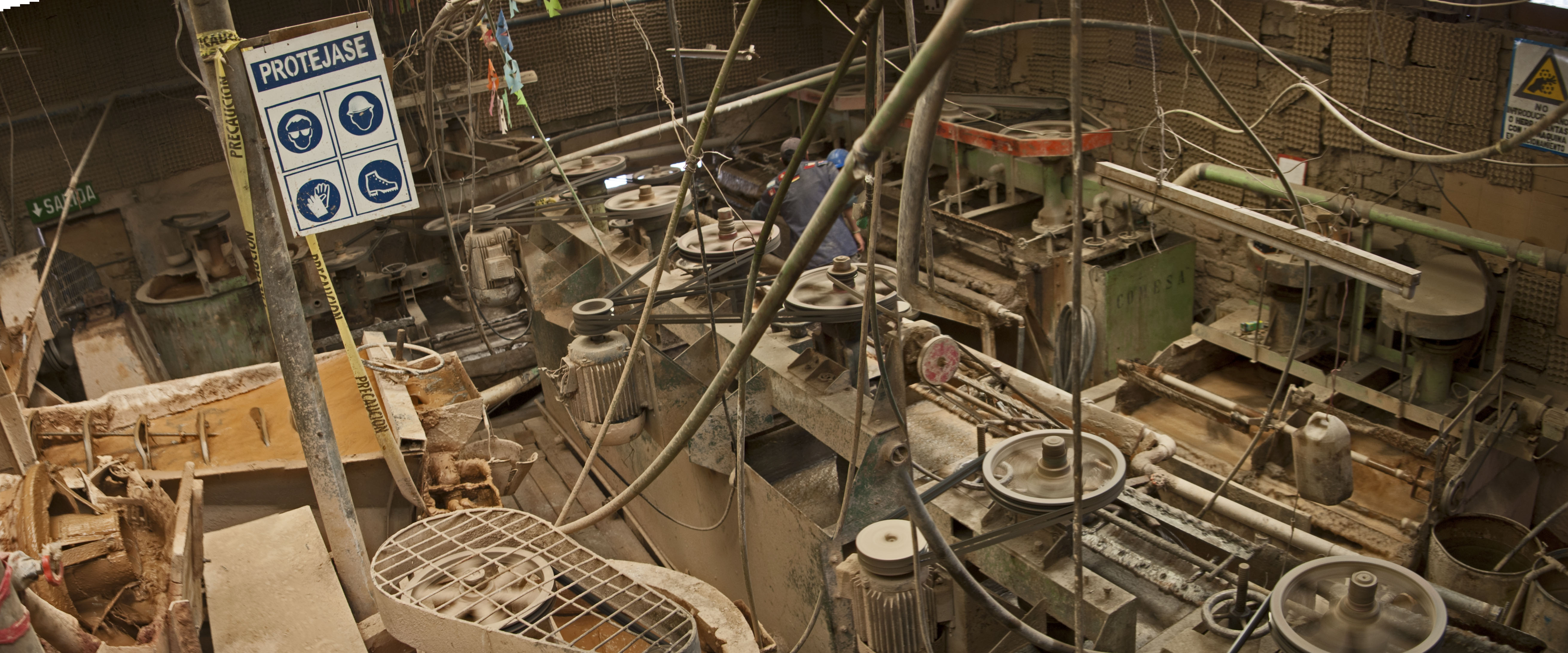
Our next stop was at a silver ore processing plant. Looking around the plant Health and Safety was non-existent and there was even an open vat of cyanide used in the processing. None of the workers used any form of protective gear. The finished silver is a powder which is dried and sent elsewhere for the creation of ingots or used without further processing in industrial processes.
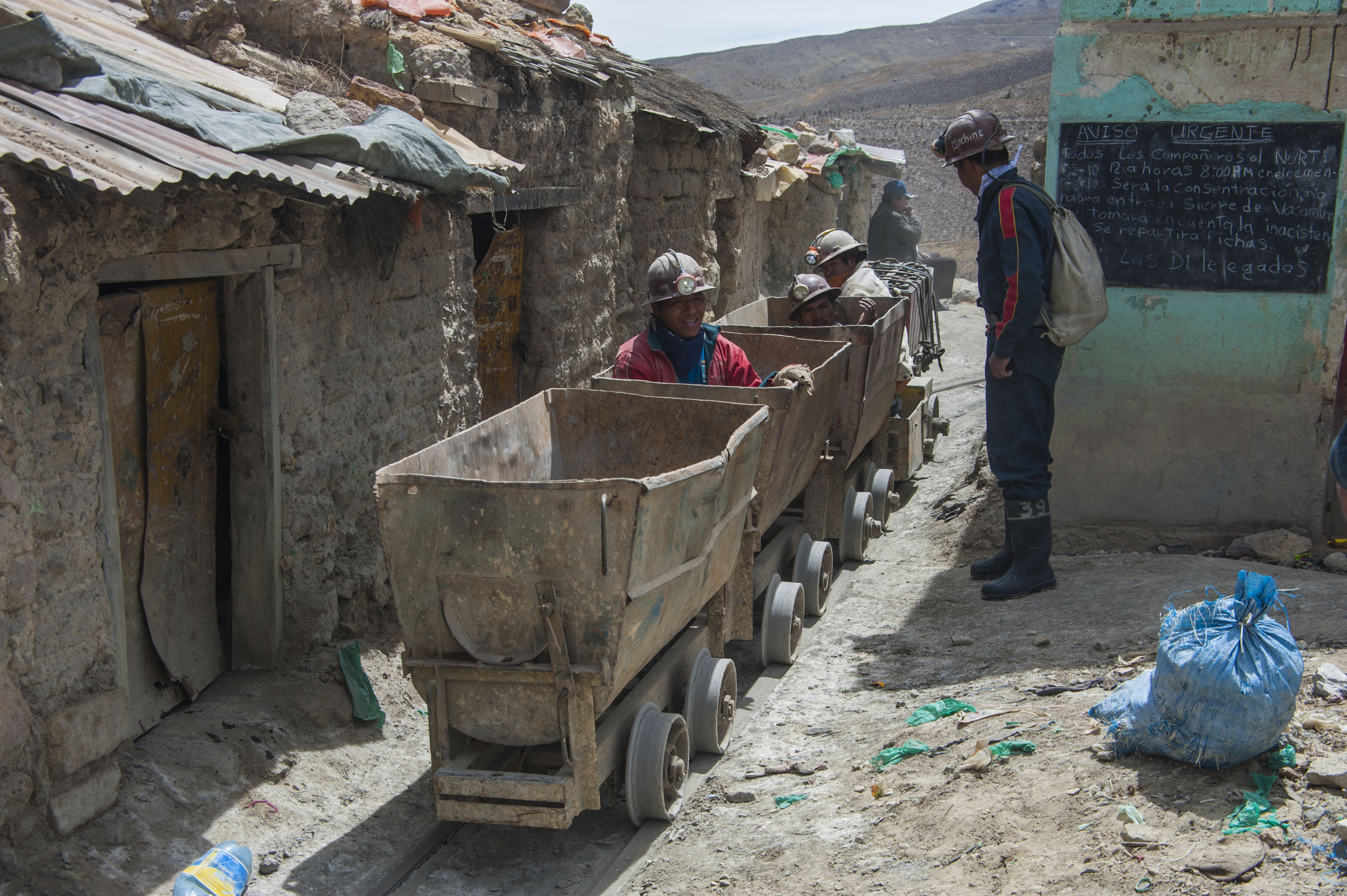
After seeing the plant we went to the entrance to one of the actual mines. There are hundreds of different mines in the area each worked by individuals or a collective. We were taken to the Candelaria mine.
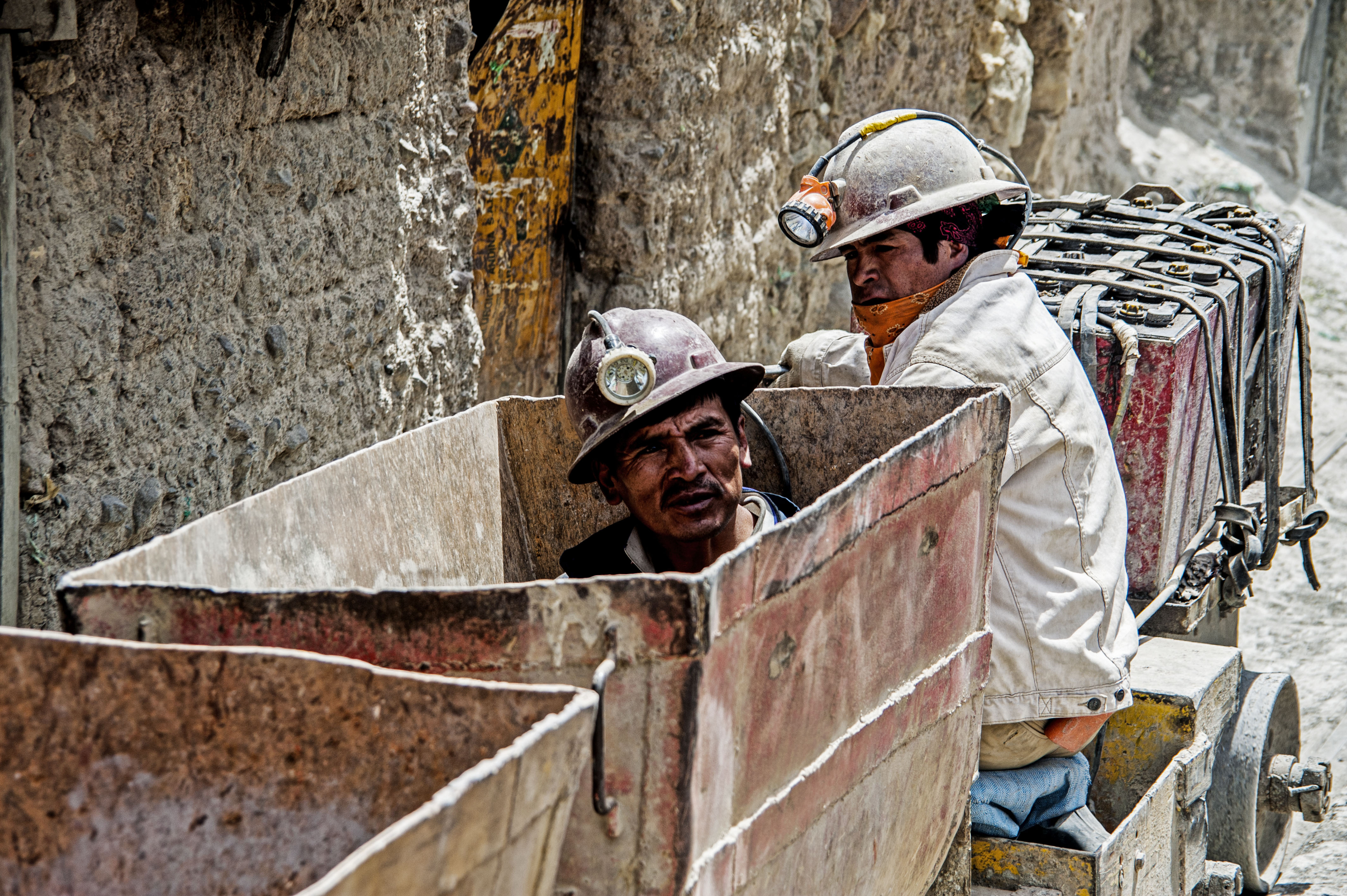
The initial tunnel was dug in colonial times and was quite large with high quality stonework shoring up the workings. As we moved deeper in the mine we reached an area of current mining. We could only get to this after passing through a couple hundred metres of tunnel with really bad air that had us all coughing because of mineral particles in the area.
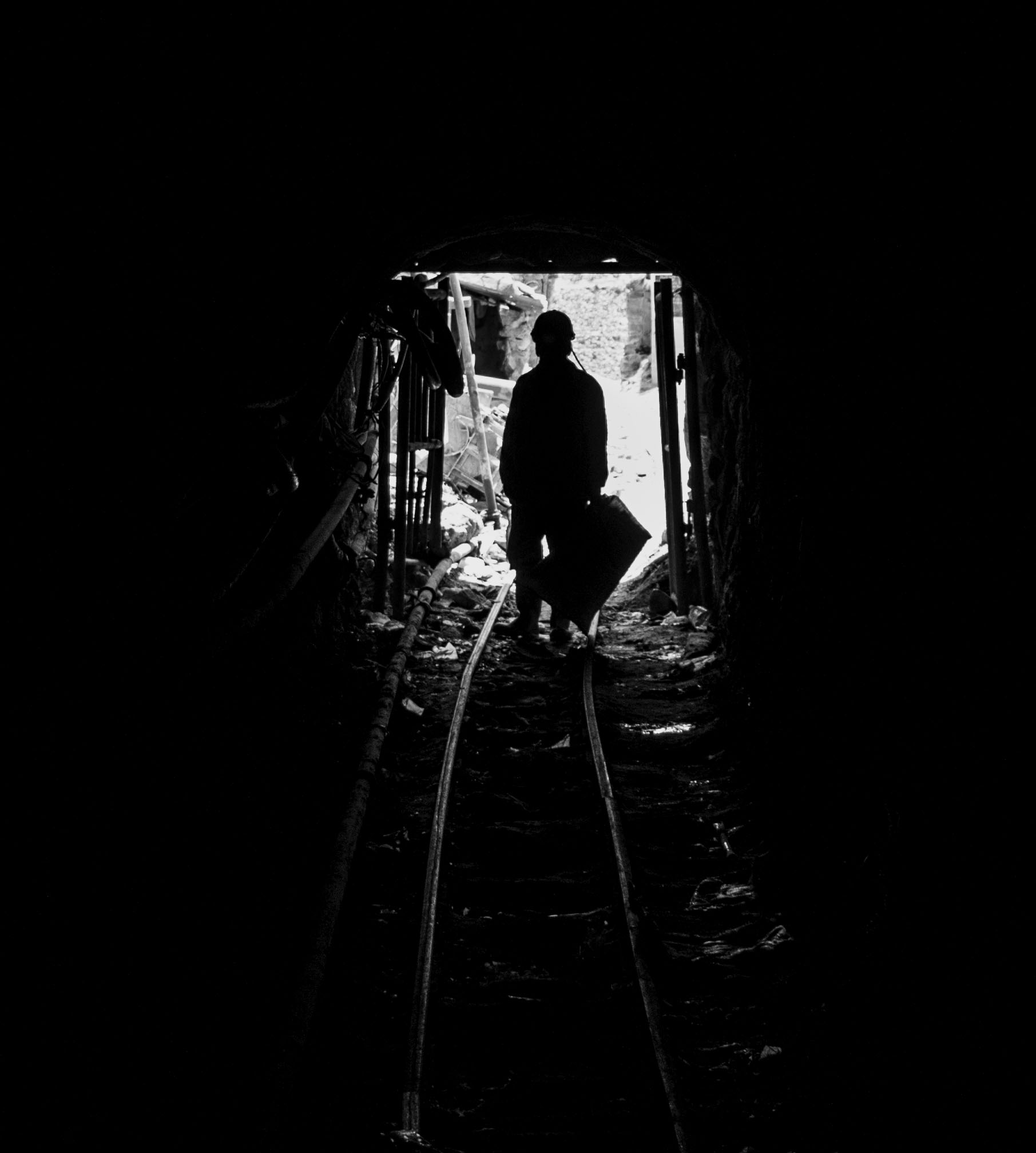
Walking through the tunnels you have to keep aware of the small carts that fly down the tracks which have been laid everywhere.
We moved down into the third level of the mine where the air was stuffier and the heat increased. To get there we had to climb down a vertical shaft and through a tiny tunnel where we had to crawl on our stomachs.
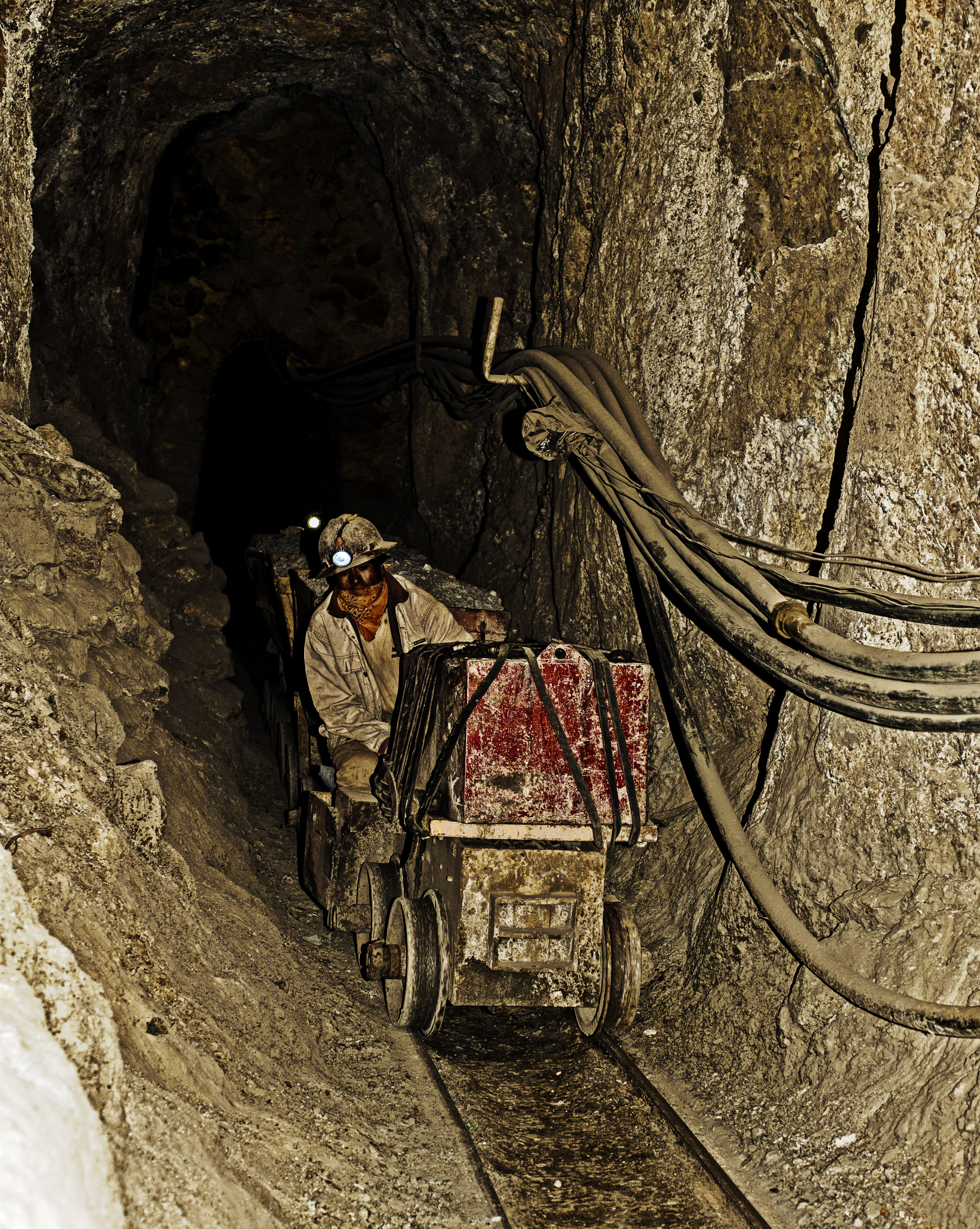
Here there were miners shovelling ore, which had been dislodged by explosives the day before, into buckets to be winched up to the surface. I had a go at shovelling and discovered that it was much harder that it looked with the heat, altitude and dust.
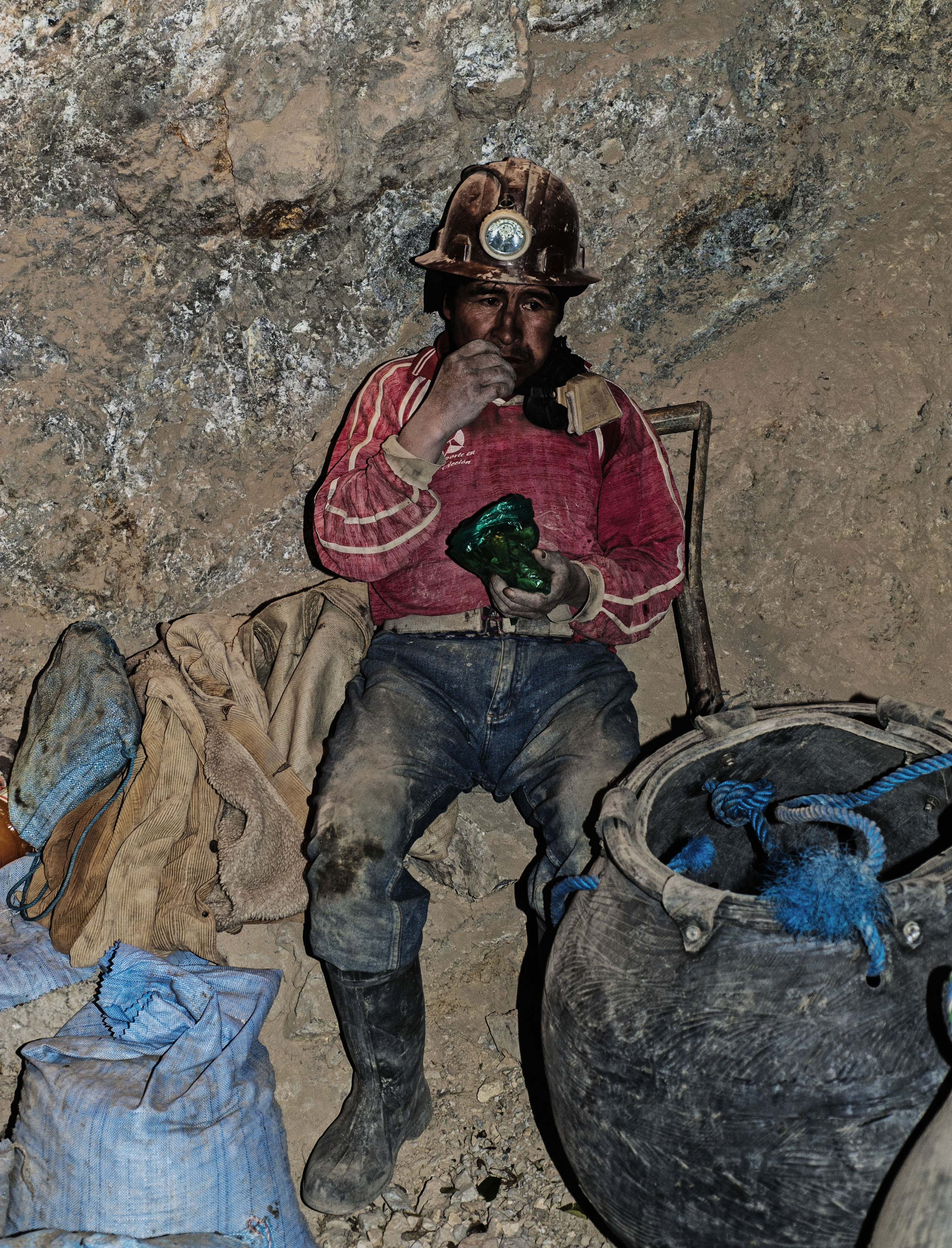
The finish of our tour was a visit with a group of miners on a break who decided we should do some of their work for them so got us to move a pile of ore bags – at 50kg each which was pretty hard work.
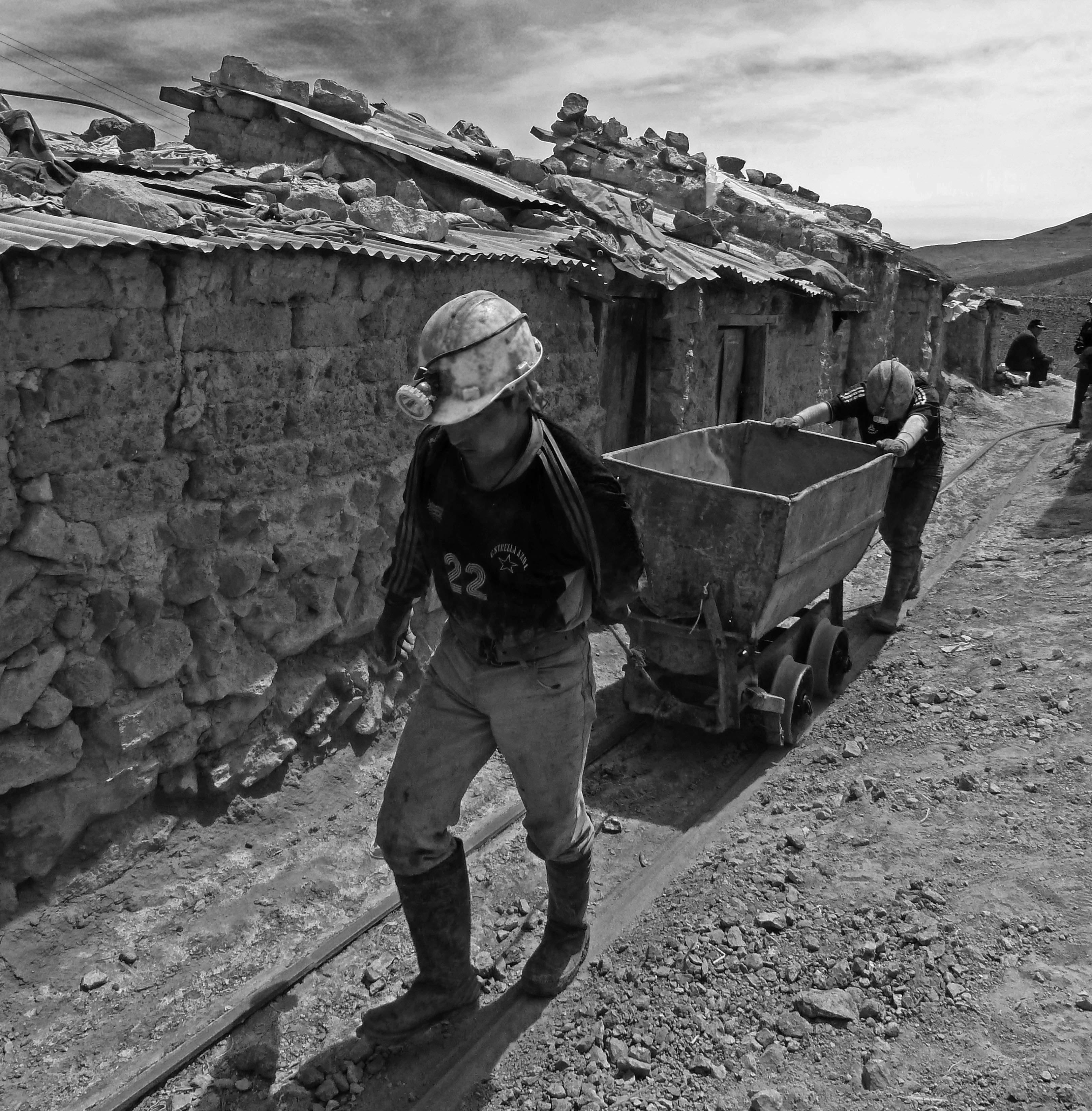
After returning from the mine we visited the Bolivian mint- where no pictures are allowed (unless you pay a camera fee !) but a free guide is provided. This was really interesting as the original minting equipment was still in situ including a press developed by Leonardo Da Vinci.
Blockade Runners
Around mid-way between La Paz and Potosi lies the town of Callapata. I’d love to give it a description but I can’t because we never made it into town.
As we arrived at the toll station on the outskirts of the town we pulled up into a long line of trucks and buses. Wondering what was going on I got out of the truck and walked up the queue. It turned out that the road was blockaded and no vehicles were getting though.
This happens in Bolivia from time to time.
I decided to walk a-ways down the road and see what was up. I became slightly worried at the first line of burning tyres but carried on. A couple of hundred metres further into town there were a few hundred guys milling around and people were taking potshots at a helicopter flying overhead.
Now was the time to turnaround and get out. Just as I started leaving a group of about 50 men started running towards me – oh shit I thought and for a few seconds I was pretty bloody worried – fortunately they ran straight past me.
I quickly made my way back to the truck and then we debated what to do – clearly driving straight through the roadblock was impossible. After some discussions with some of the truck drivers we found out that the unrest might go on for up to a week. Waiting it out wasn’t going to work.
Finally a helpful trucker told us that there was a way around the town through the fields and looking at our truck he felt that we should be able to get through. Although no one else seemed to be doing it!
We decided we’d give it a go and set off through the fields on some very rough roads and through a number of water crossings. We had to navigate by dead reckoning and hoped we would get around the town and not end up right in the middle!
As we neared the main road on the other side of town there was one final water crossing (long and muddy) but finally we were approaching the road only to see a car across the entrance and roughly 20 guys milling around it.
When they saw us coming they fanned out to cover the way to the road and our stomachs lurched. There was only one thing for it – I accelerated towards them but we as got to within 5 metres of them they must have realised we were stupid arse gringo tourists and scattered to let us through. We heaved a huge sigh of relief and waved cheerily in response. This elicited smiles from the blockaders and several peace signs – I’d hate to think what would have happened if we hadn’t been tourists, no wonder no one else was taking the scenic route!
It’s times like this when it would be great to have a couple of photos but it’s also times like this when taking a photo is the last thing on your mind…
After this we were back on the road and sped towards Potosi saying a not-very-fond farewell to Callapata.
Sajama National Park
When we finally dragged ourselves away from La Paz we headed South. La Paz has to win the prize for most under-rated South American city – nothing spectacular but a damn fine place to hang out. However we had heard good things about Sajama National Park which is in the West of Bolivia and right on the Chilean border.
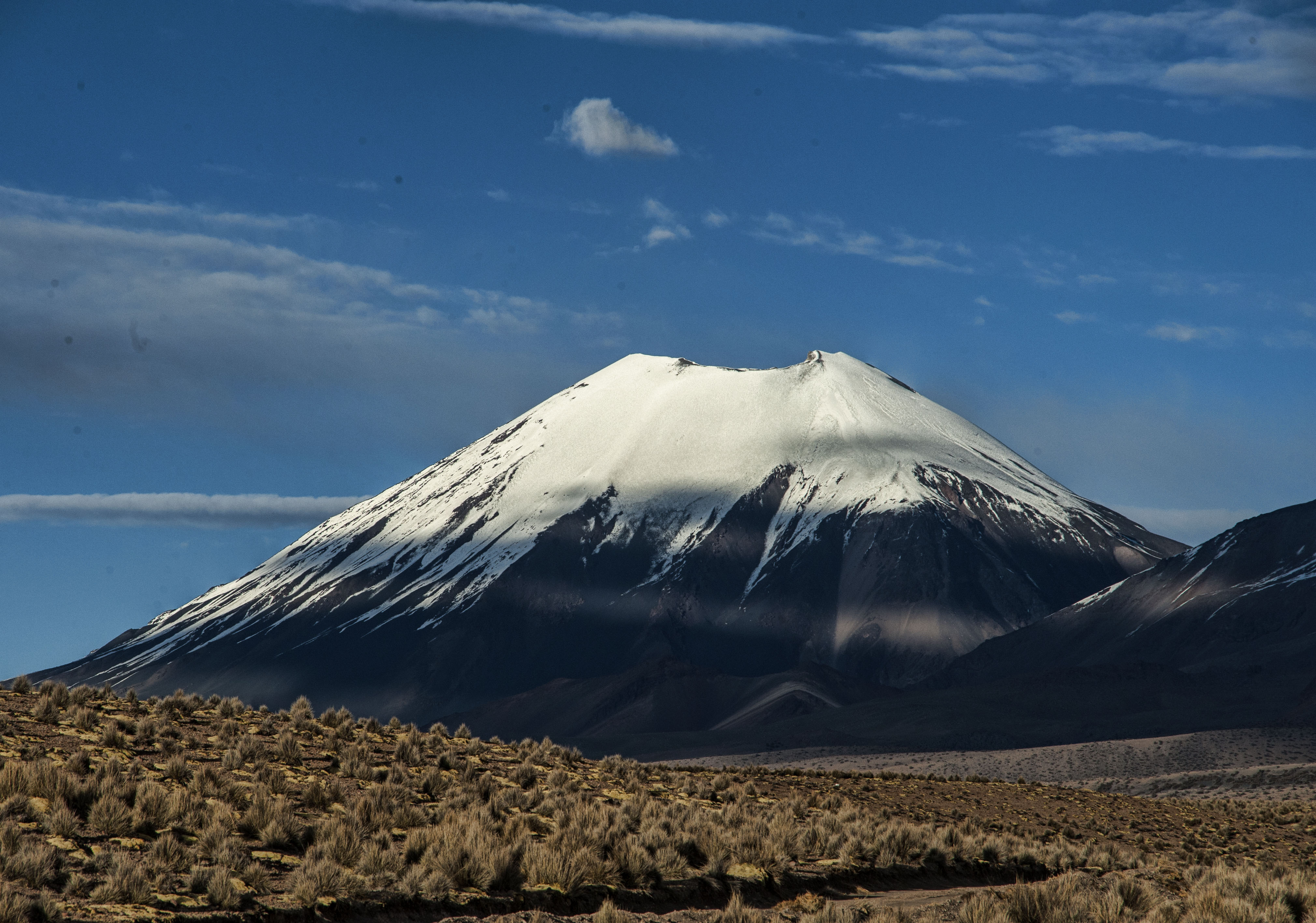
It was only 150km each way detour so we decided to go for it. To our surprise the road was really good and we were flying along through a Utah-eque desert on our way West.
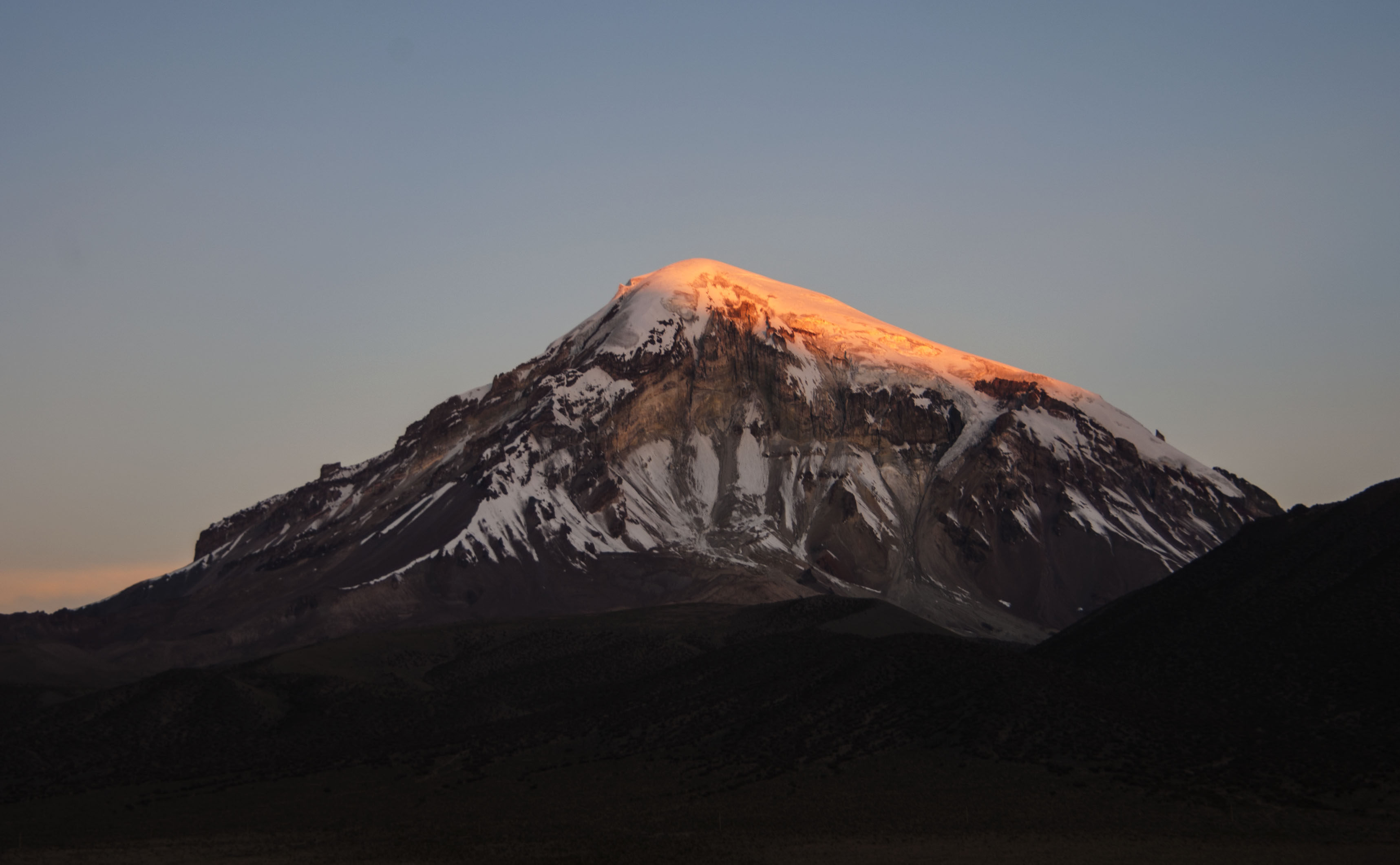
As you approach the park you can see the massive snowcapped volcano, Vulcan Sajama (6542m) from at least 50km away.
On arrival at the park we checked in at the ranger station and paid our entry fee before heading straight for the thermal springs – about 5k down a dirt road from the entry. The last 500m involved a water crossing and driving on a very narrow road.
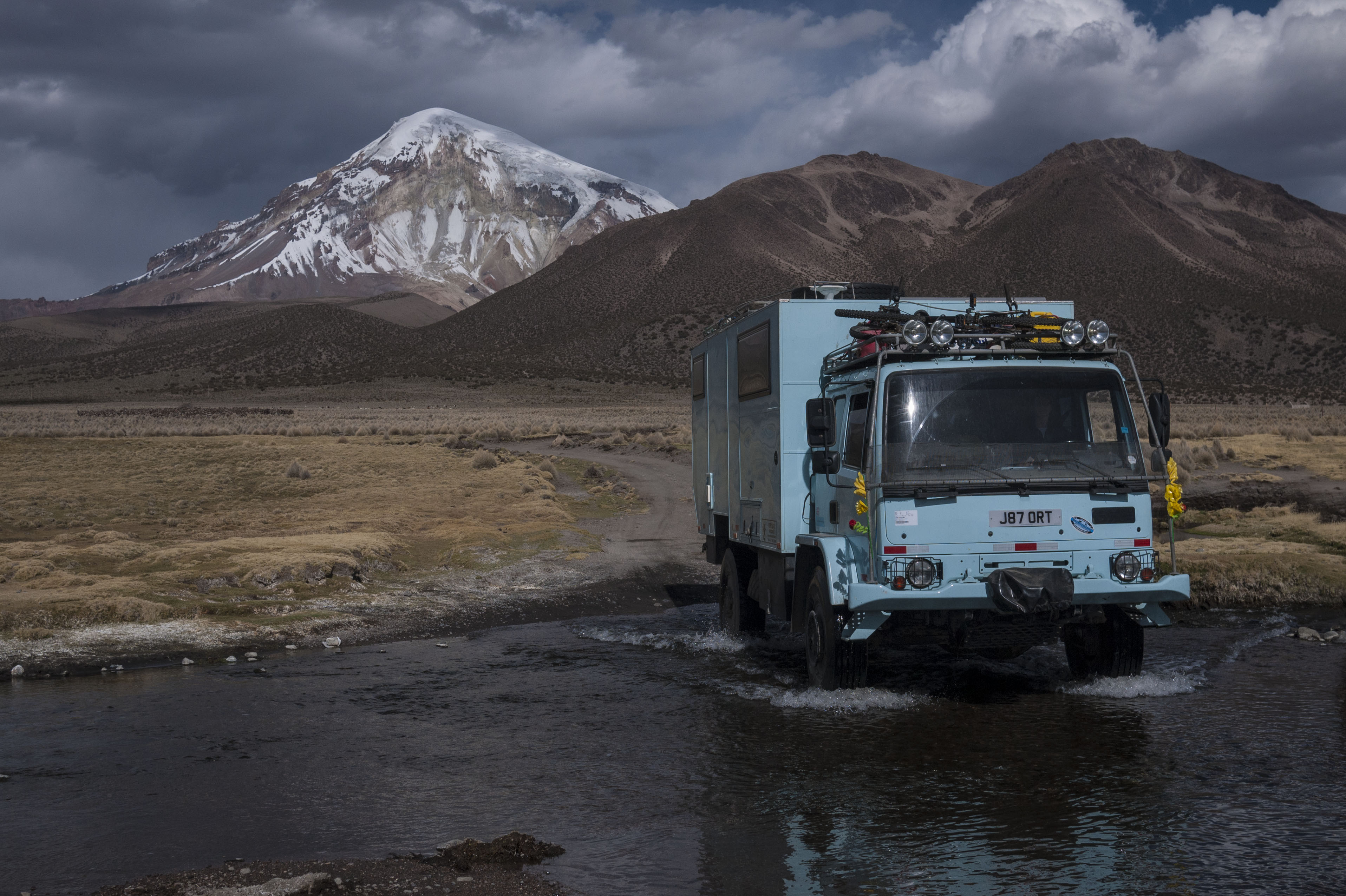
We parked up in a small parking area and walked across the altiplano to the hot springs which were a natural pond with awesome views of the surrounding mountains. At over 4000m it was quite chilly so a warming soak was very welcome.
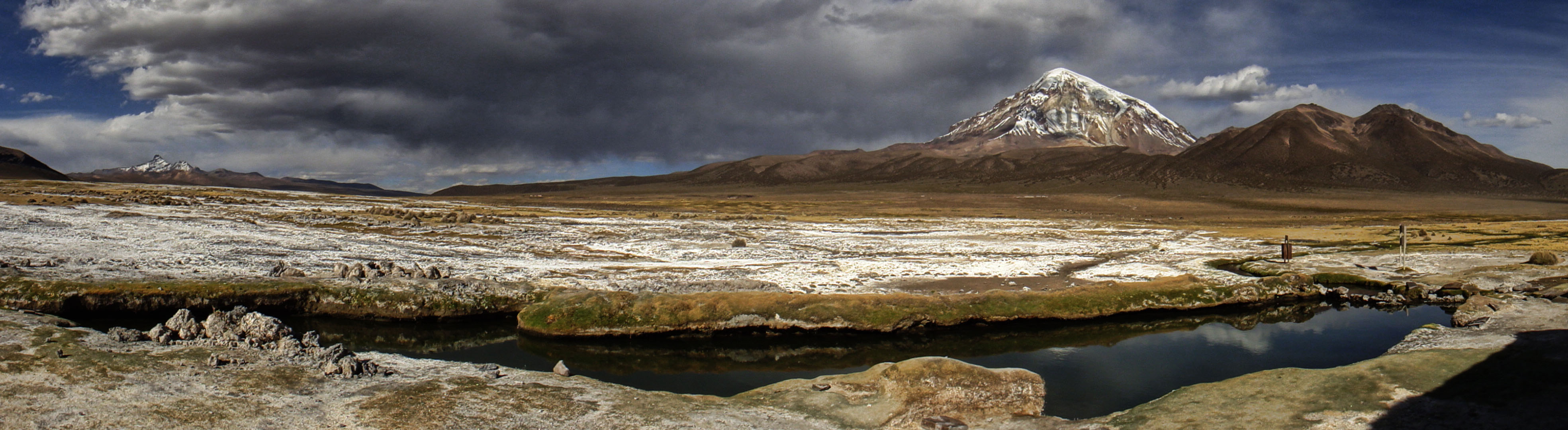
We stayed the night in the car park at the hot springs and it was our coldest night so far at -8c which led to a very sluggish start the next day.
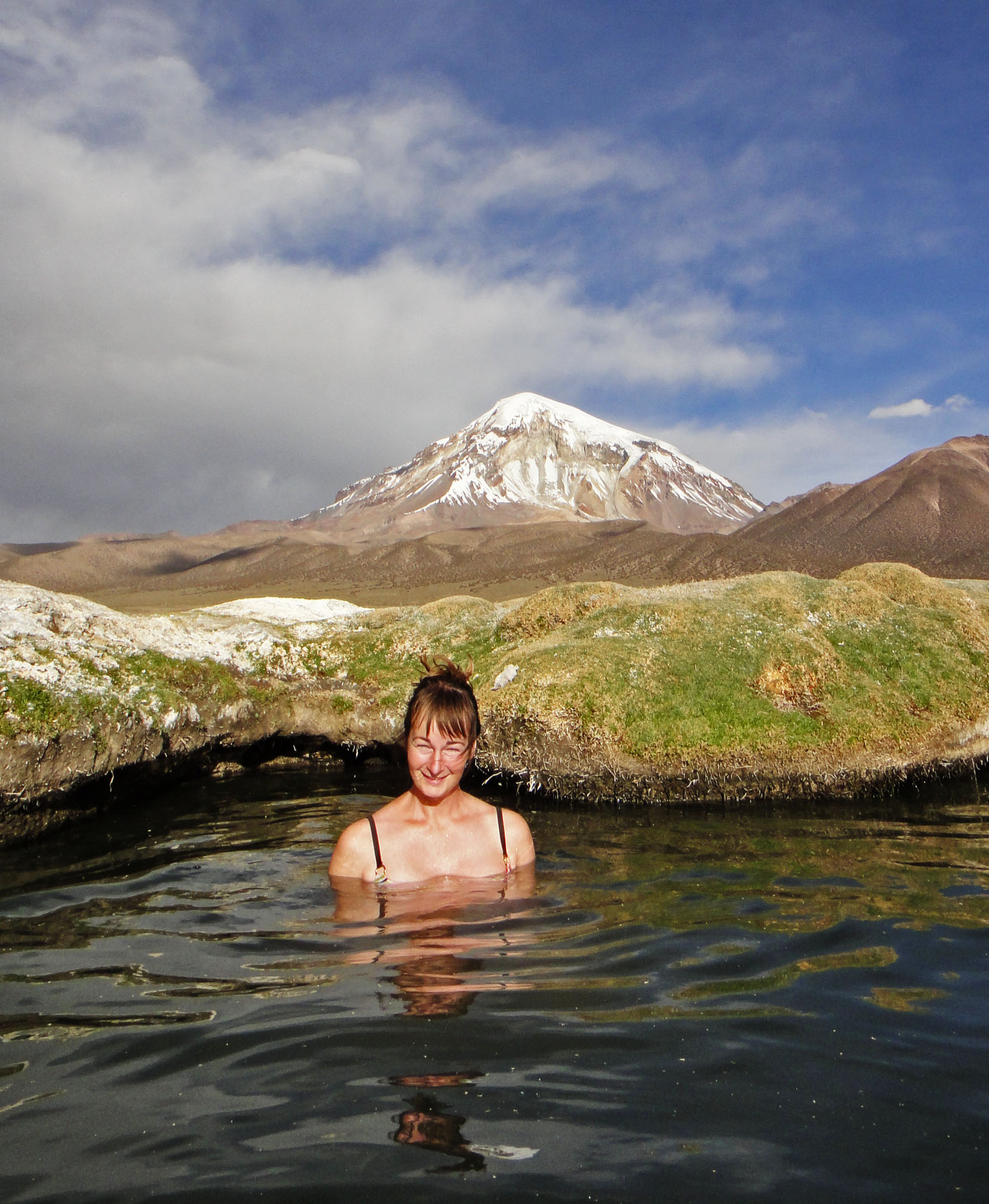
However we headed through the small, and seemingly deserted, village of Sajama and down a track, through a river to a thermally active valley. The last 1km of the road was very narrow with a steep 25m slope on one side – making for some nerves.
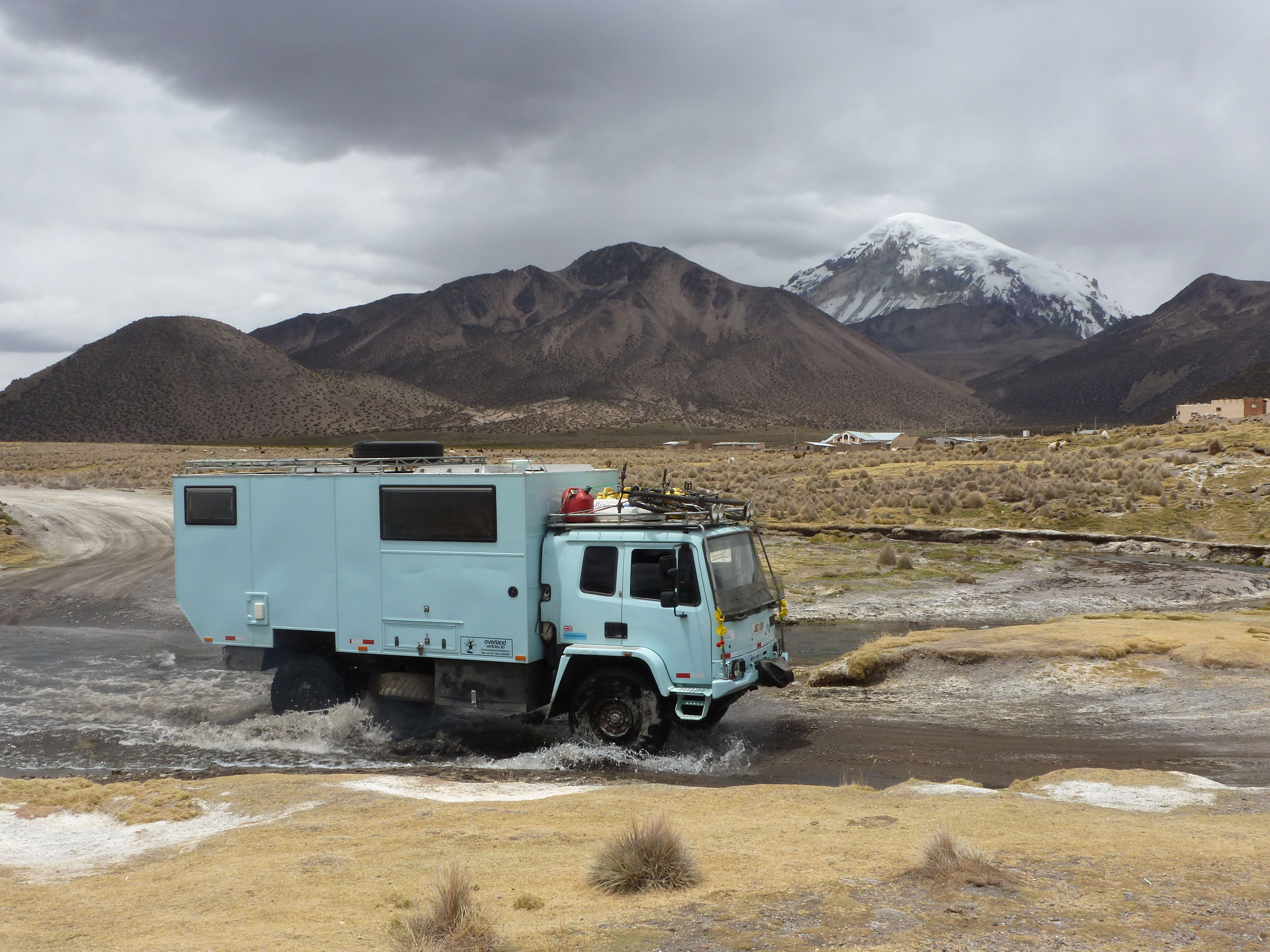
The valley was lovely with at least 50 bubbling active ponds but unfortunately no erupting geysers.
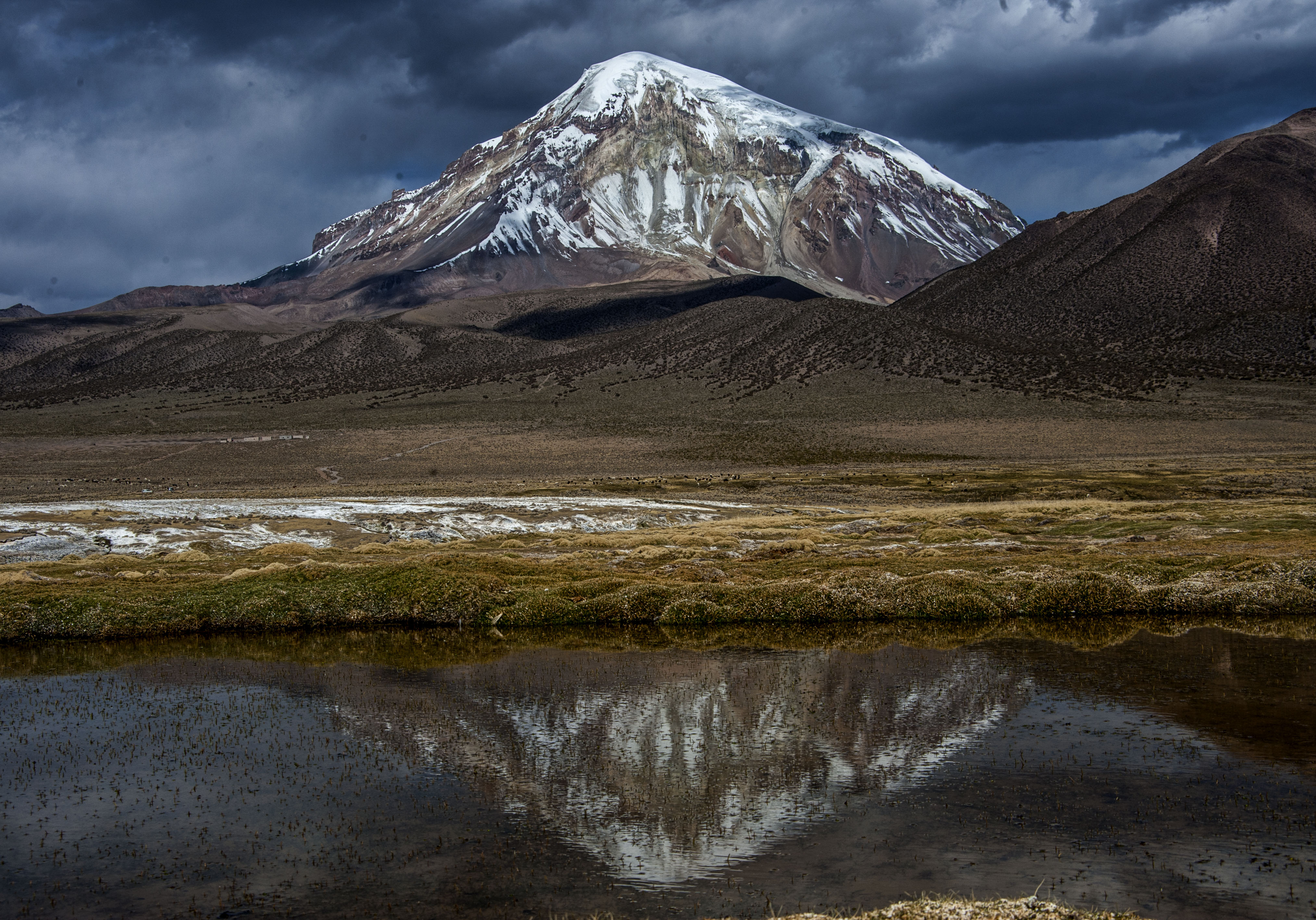
After the Geysers we decided to take the long way out of the Park and round the backside of the Sajama volcano. This left us on a a really remote road where we camped for the night around 15 km from exiting the Park. In the time we were camped not one vehicle came past – not a place to breakdown.
The Death Road Plunge
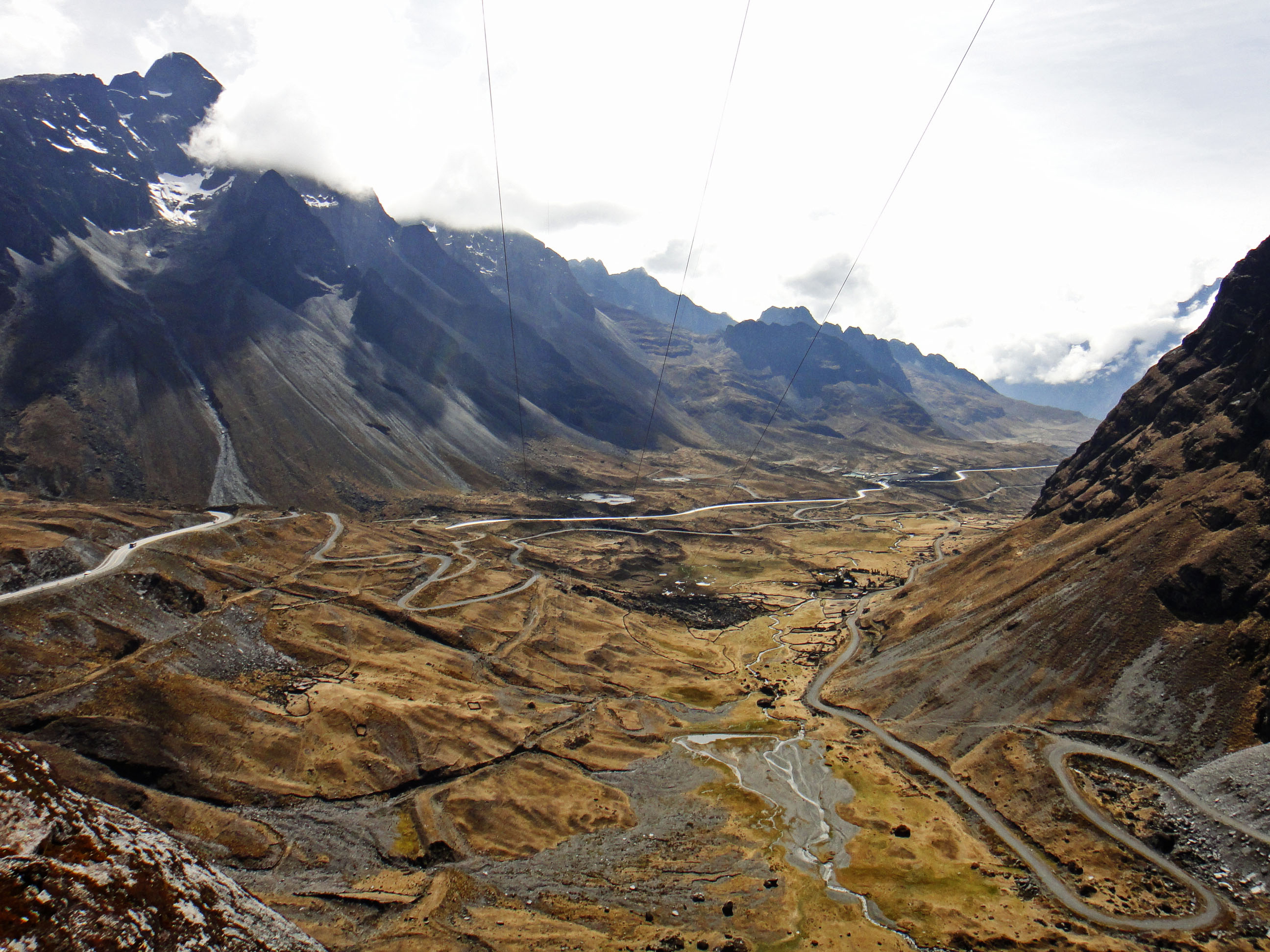
One of the most popular activities in La Paz is cycling the so called Death Road which goes down to Corioco. Over the course of the trip you descend from 4700m to 1100m, down 63km. The first 20 km or so of the road is paved, wide and allows you to absolutely fly. However the road then becomes narrow, dirt and 300-500m drop offs on one side and a cliff on the other – the so called Death Road aka, the world’s most deadliest road.
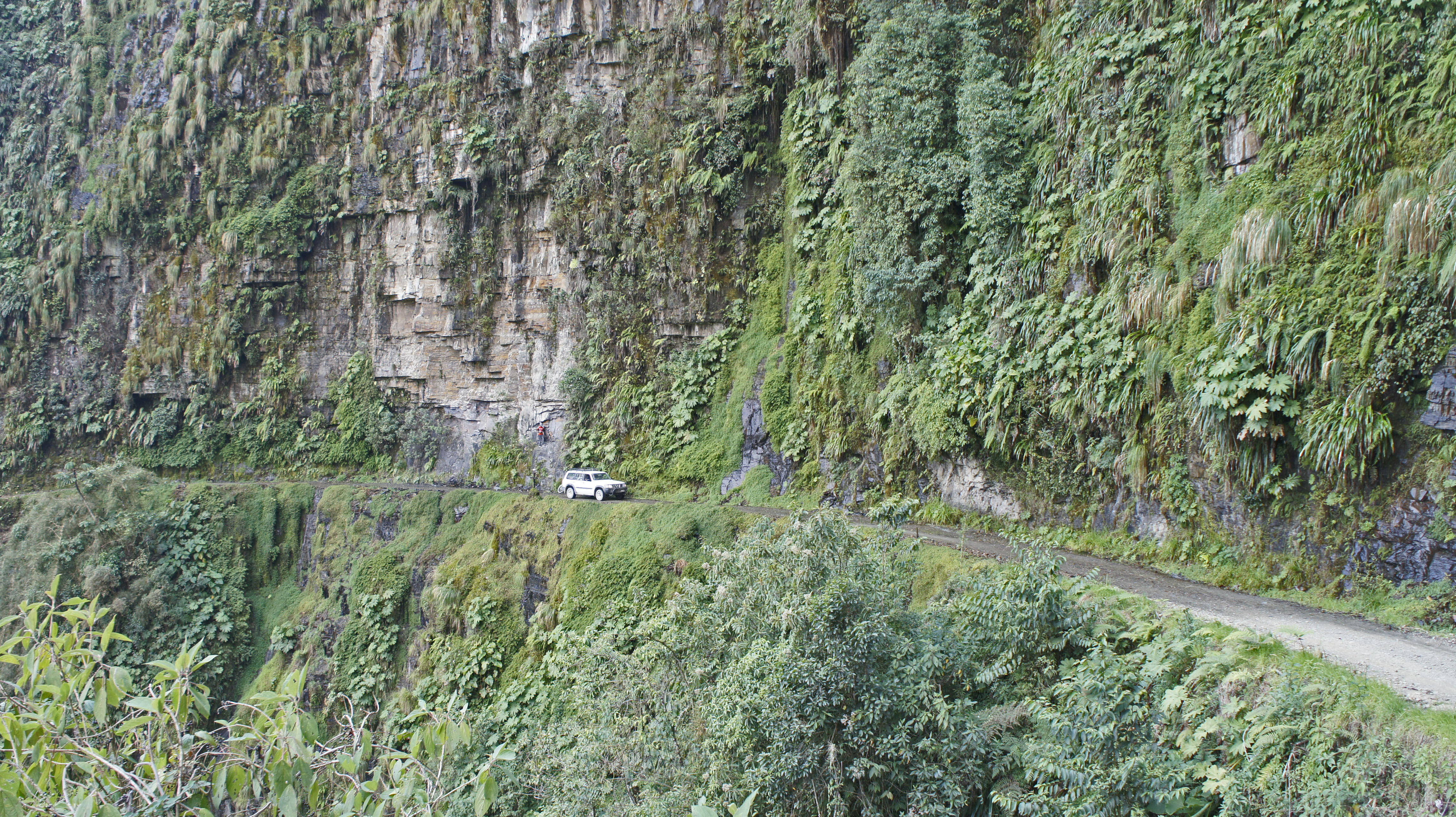
The Death Road gained its reputation in the years when it was the main artery from the Yungas (one of the prime coca growing regions in Bolivia) to La Paz. However in recent years a paved alternative has been built and now virtually no traffic uses the old Death Road (or Yungas Road to give it its proper name).
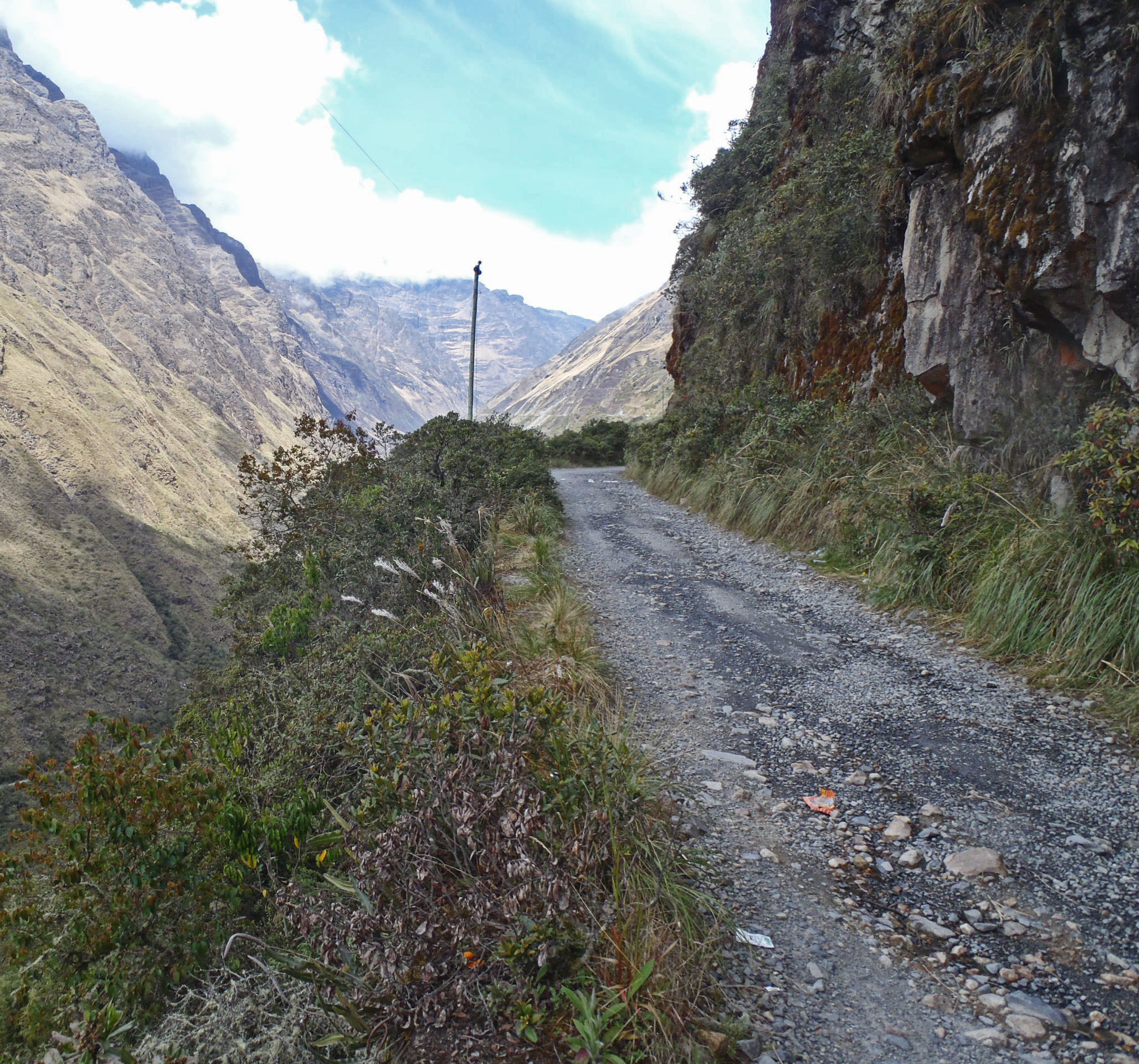
This road should hold no fear (in the dry) for those of us overlanding through South America – there are plenty of roads just as dangerous.
The actual end of the death road cycle is the small village of Yolosa – Corioco is actually above this and would be a hard uphill slog.
We decided to go with Gravity Assisted Mountain Biking who are one of the oldest companies and one of the most reliable – claiming no deaths in their 15 year history (well 1 – but he was a heart attack victim – they didn’t mention if he died of a heart attack on the way over the edge though !). We were very impressed with the quality of the bikes and the guides and would highly recommend them for their very professional attitude. We saw a few other companies groups on the way down the road and this affirmed our choice !
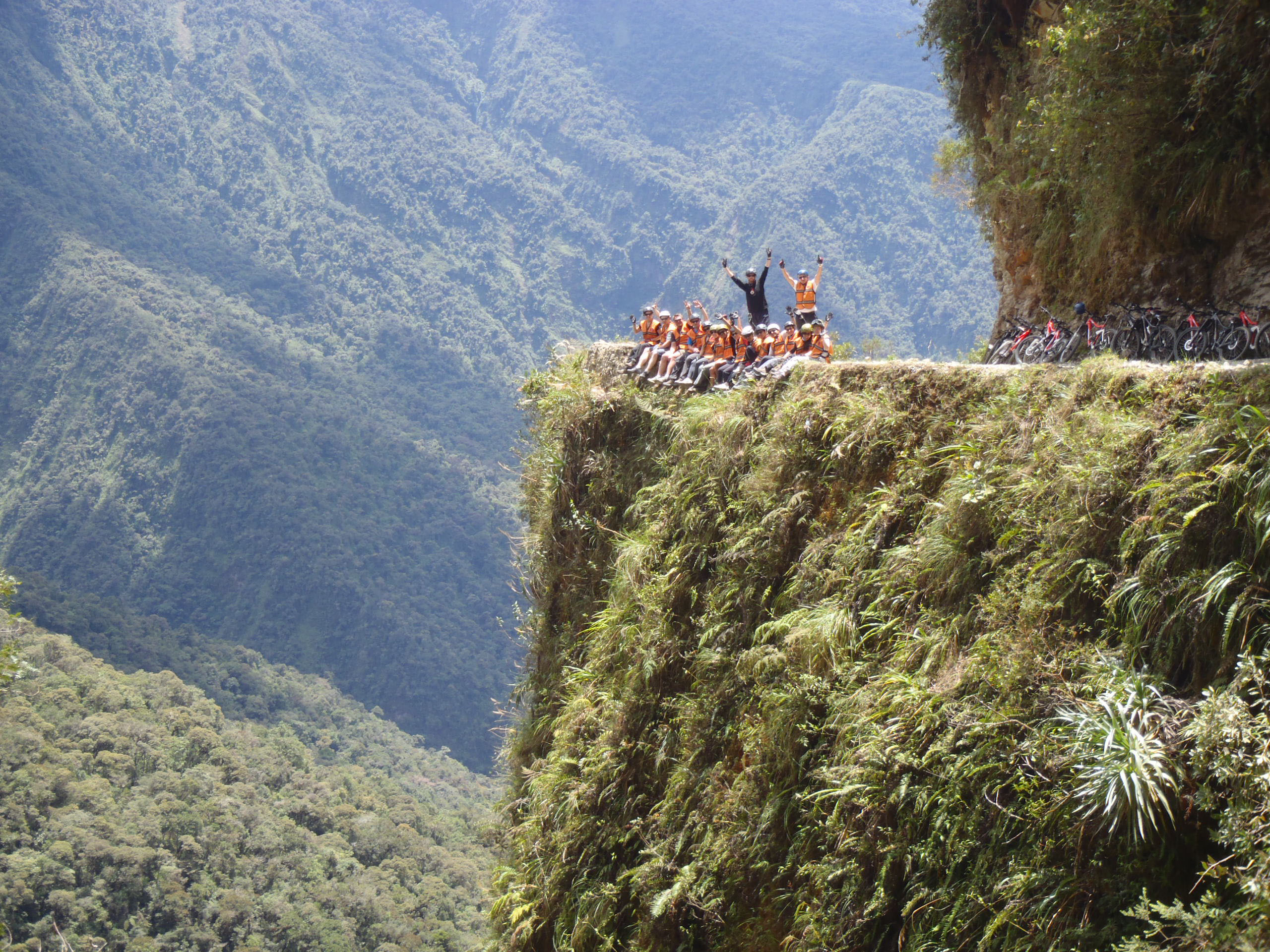
On the first section we reached speeds of up to 70kph flying down the asphalt however the main death road is slower as its dirt and the risks are a lot higher – still I still got up to 50kph on this bit and it felt a lot faster.
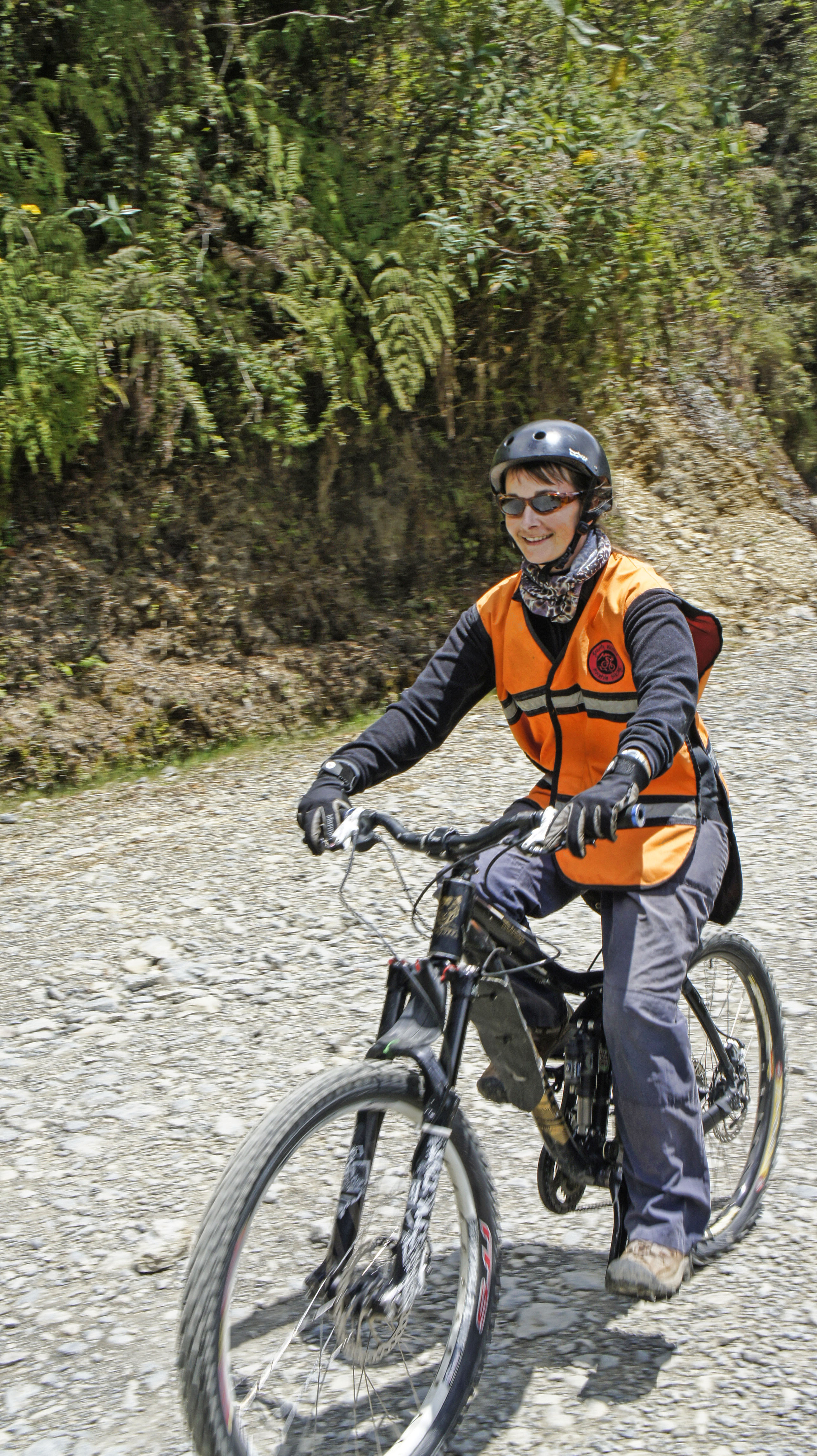
We stopped lots on the way down the road – to let the slower guys catch up with the faster ones and we also stopped to peel off layers as we went from very cold at the top wearing thermals to tshirts and shorts at the bottom where it was incredibly hot.
The day was fairly incident free although several people fell off their bikes (not us I hasten to add) and one girl fell off landing right on the edge of the drop-off.
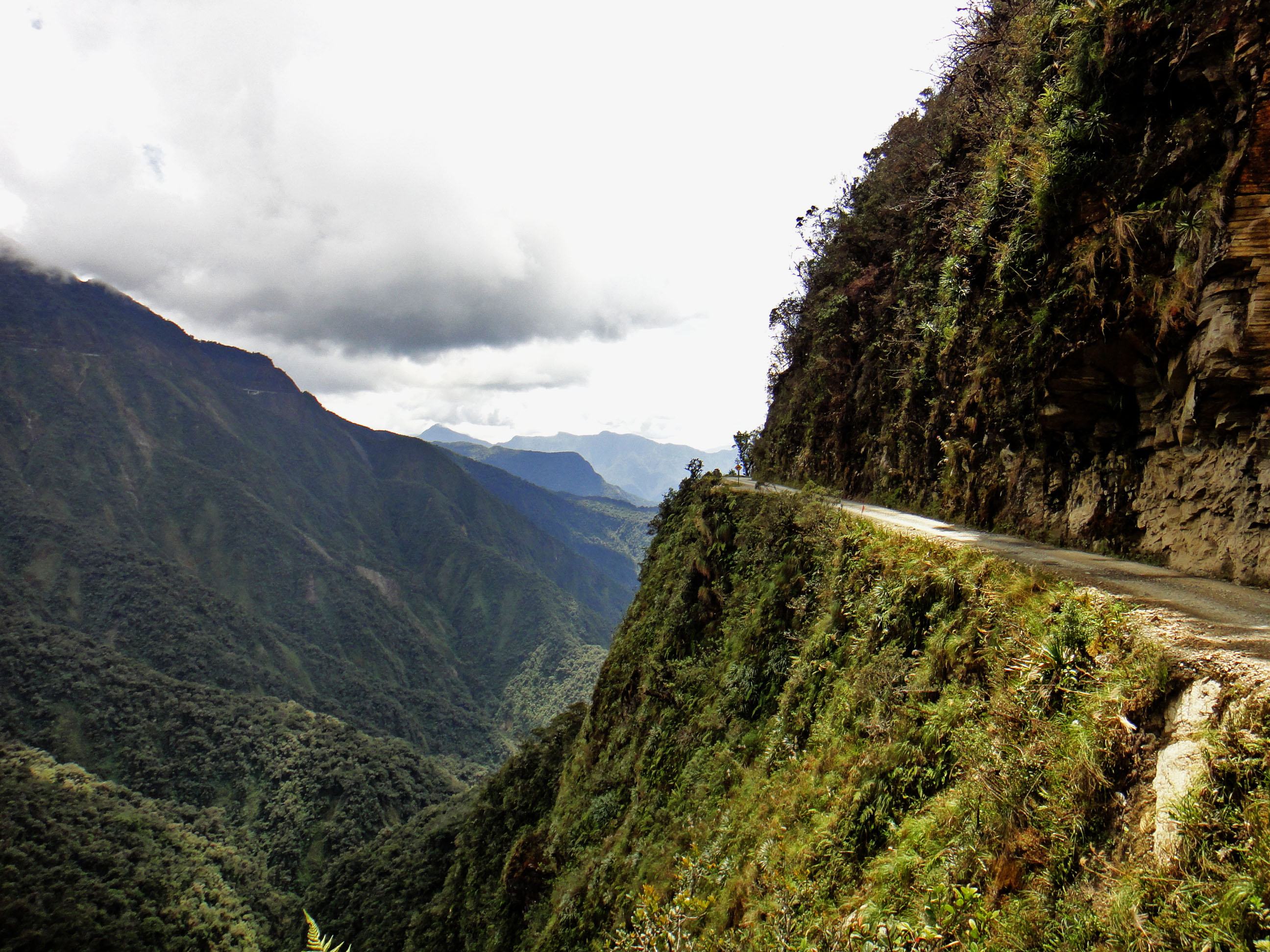
At the end of the road when you reach Yolosa each of the downhill companies takes their group somewhere different and ours took us to a “wildlife refuge” called La Senda Verde where we could have a shower (much needed) and got given a pretty late lunch (it was about 4pm when ate).
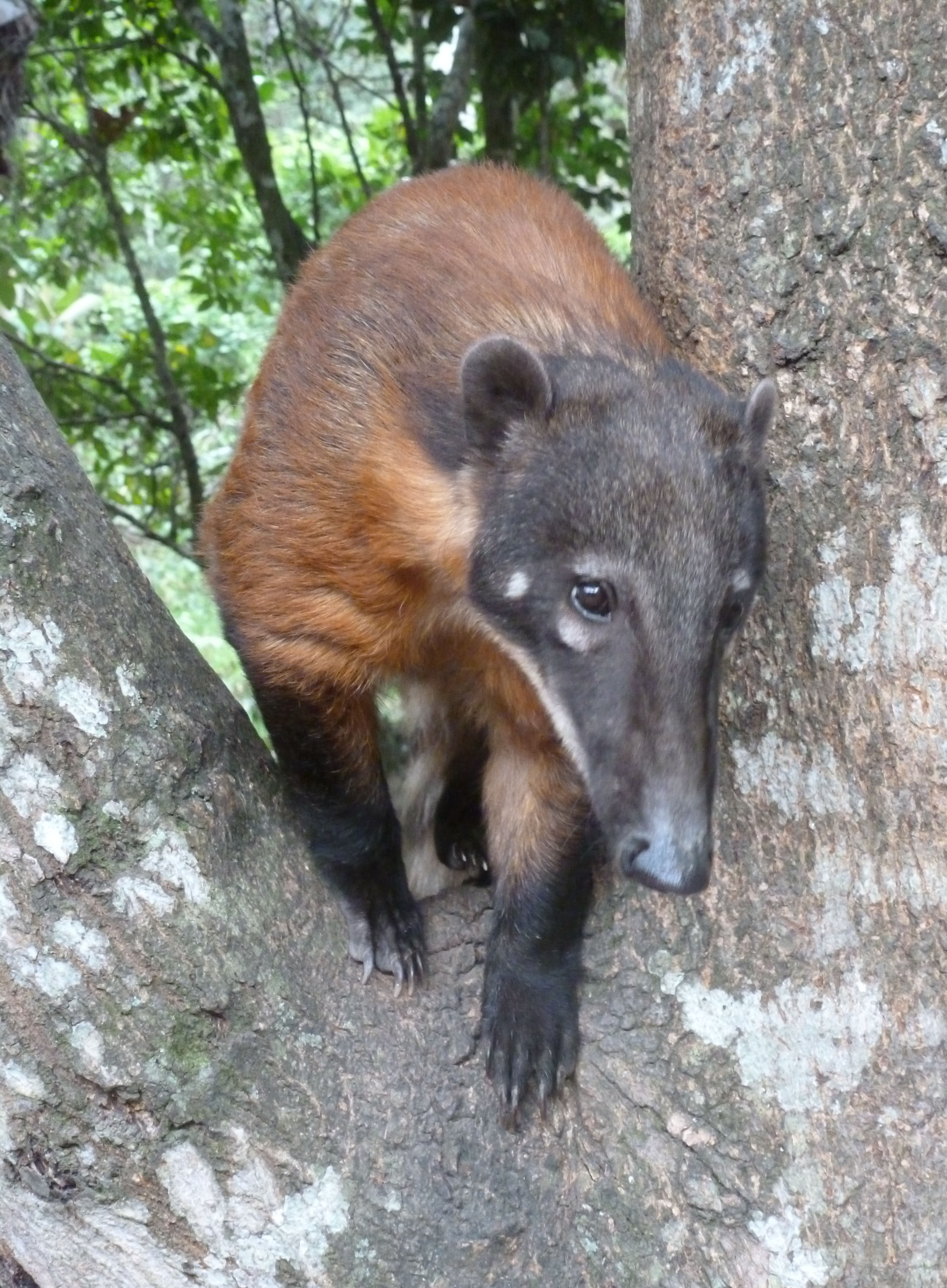
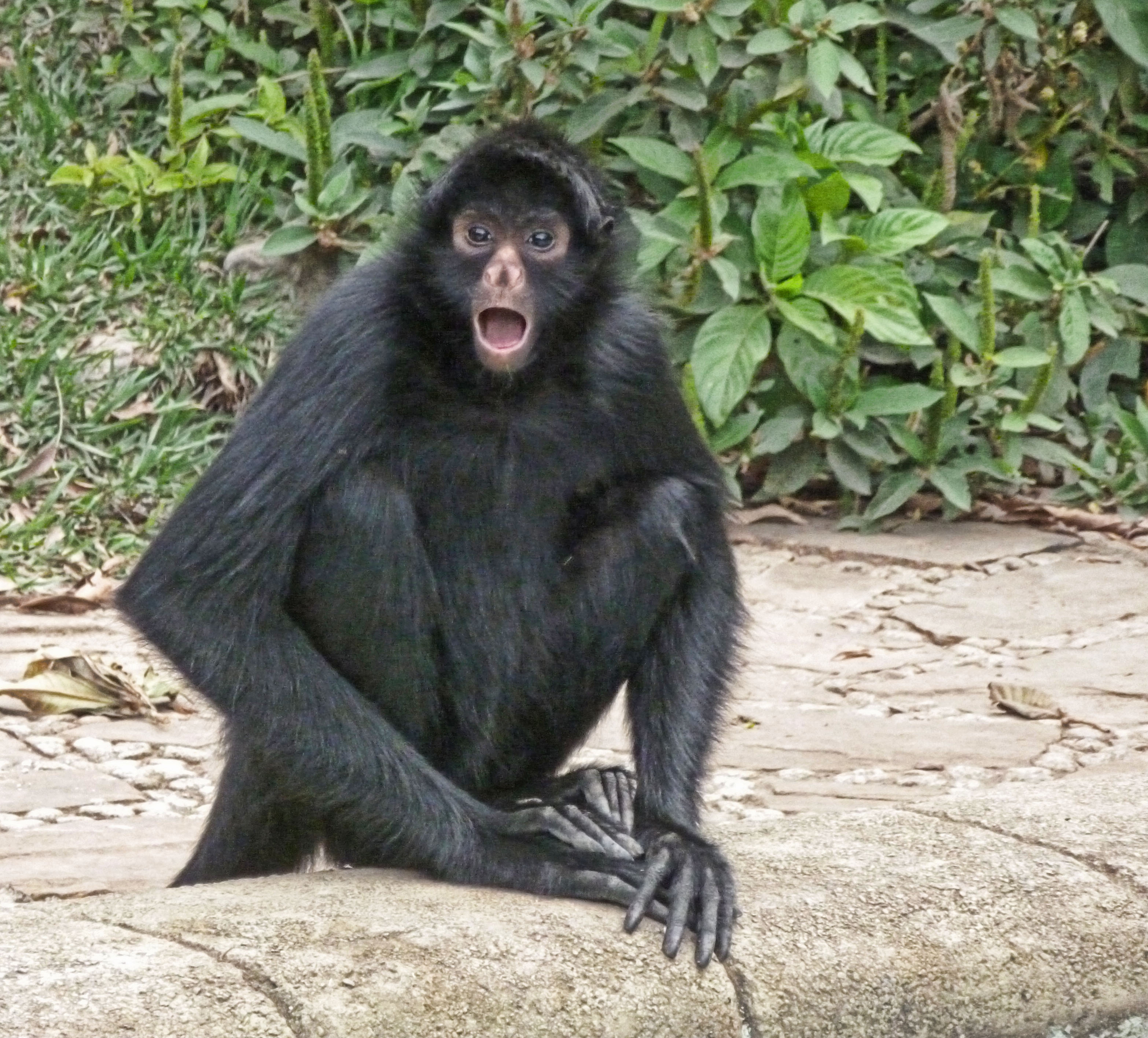
After eating we could go on a tour of their monkey sanctuary. This was pretty disappointing as the many volunteers (all paying) seemed to play with monkeys and pay lip service to rehabilitating them. It seemed less like it was aimed at protecting the monkeys and more as a money making scheme to let do-gooders think they were helping, play with monkeys and pay the owner.
The trip back to La Paz was 3 hours up the new paved Death Road and was pretty uneventful and we arrived around 9pm to end a very long day but incredibly enjoyable days – I’m convinced this is when of the greatest mountain biking rides (suitable for all levels) in the world.
Cholita Wrestling
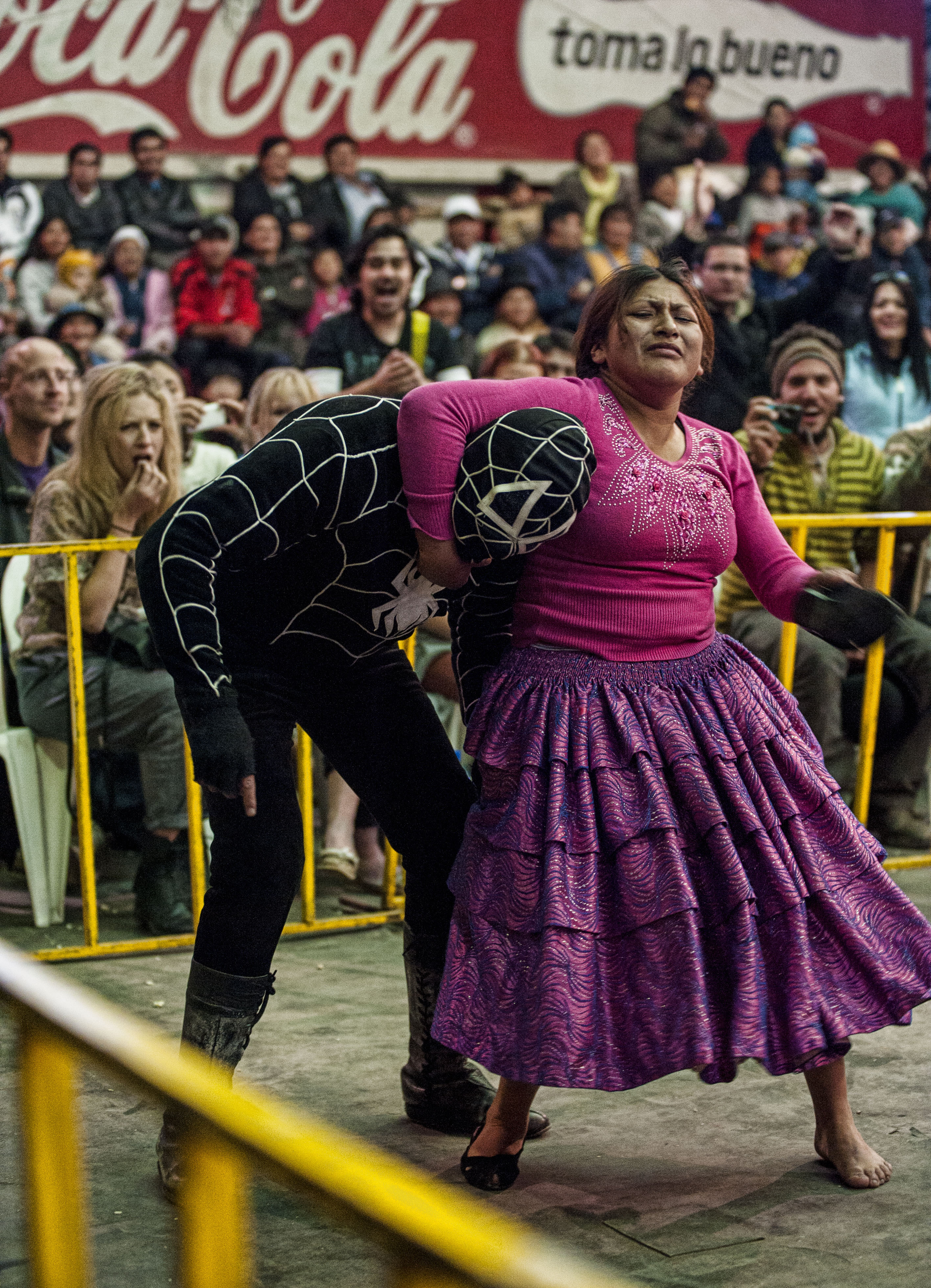
Every Sunday a sports hall in La Paz is taken over by the phenomenon that Is Cholita’s Wrestling. Taking the lead from American WWF wrestling Cholita’s (Bolivian women in traditional dress take on men, superheroes, each other and even zombies) in a tongue in cheek wrestling extravaganza.
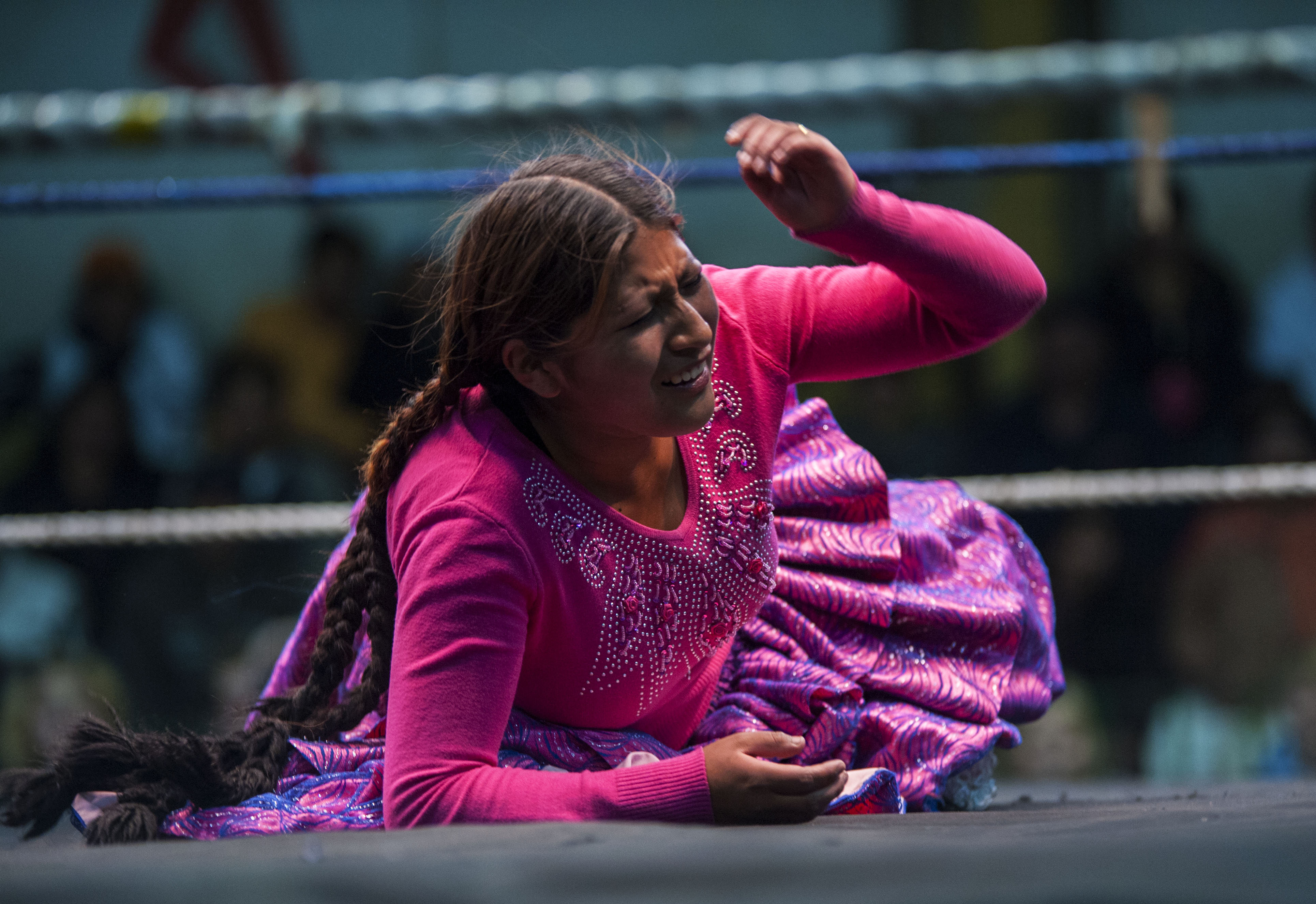
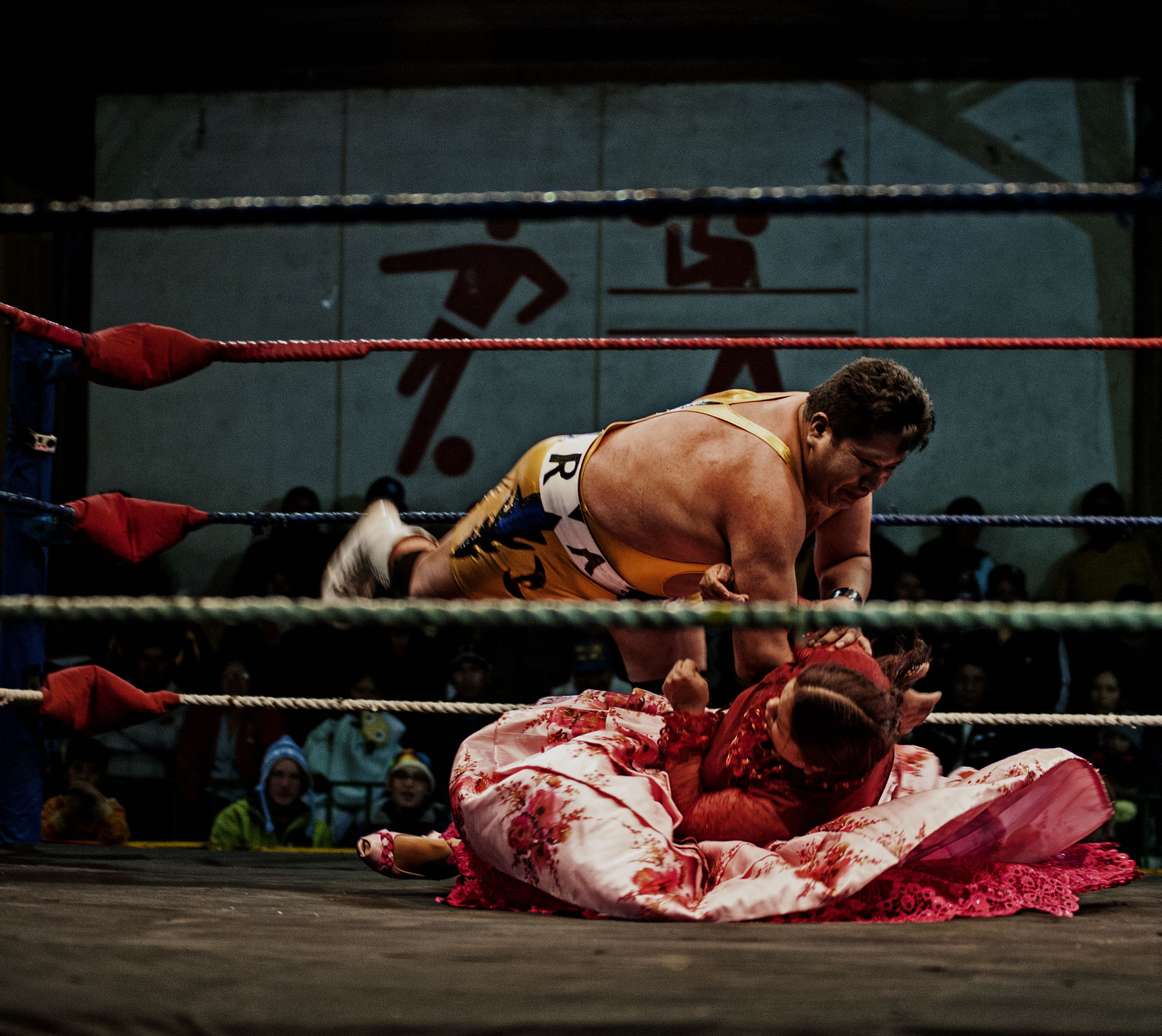
Most of the bouts told a similar story of good v evil. The referee was usually in league with the bad guy and would join in beating down the good wrestler. Eventually the tables would turn and good would triumph over evil.
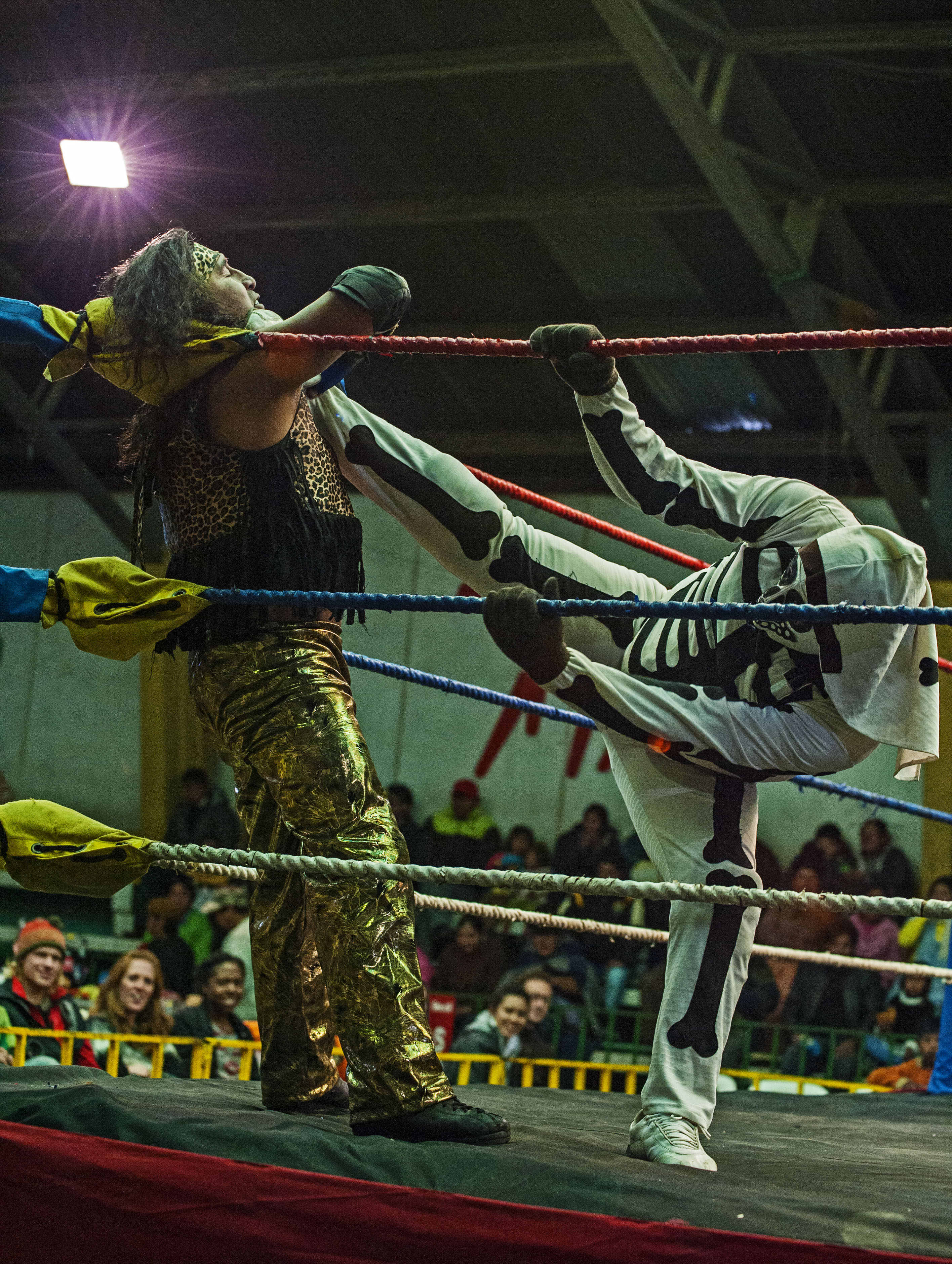
One of the greatest aspects was the costumes which looked like they had been handmade by the wrestlers mums for a school fancy dress competition. There was also a complete disregard for any form of –ism and one of the characters was a comedy gay who spent his time trying to kiss the referee or bury is head in his opponents crotch.
The plots of each bout had twists and turns with evil managers, crooked referees and at the end a finale with a zombie set on fire and wandering through the audience.
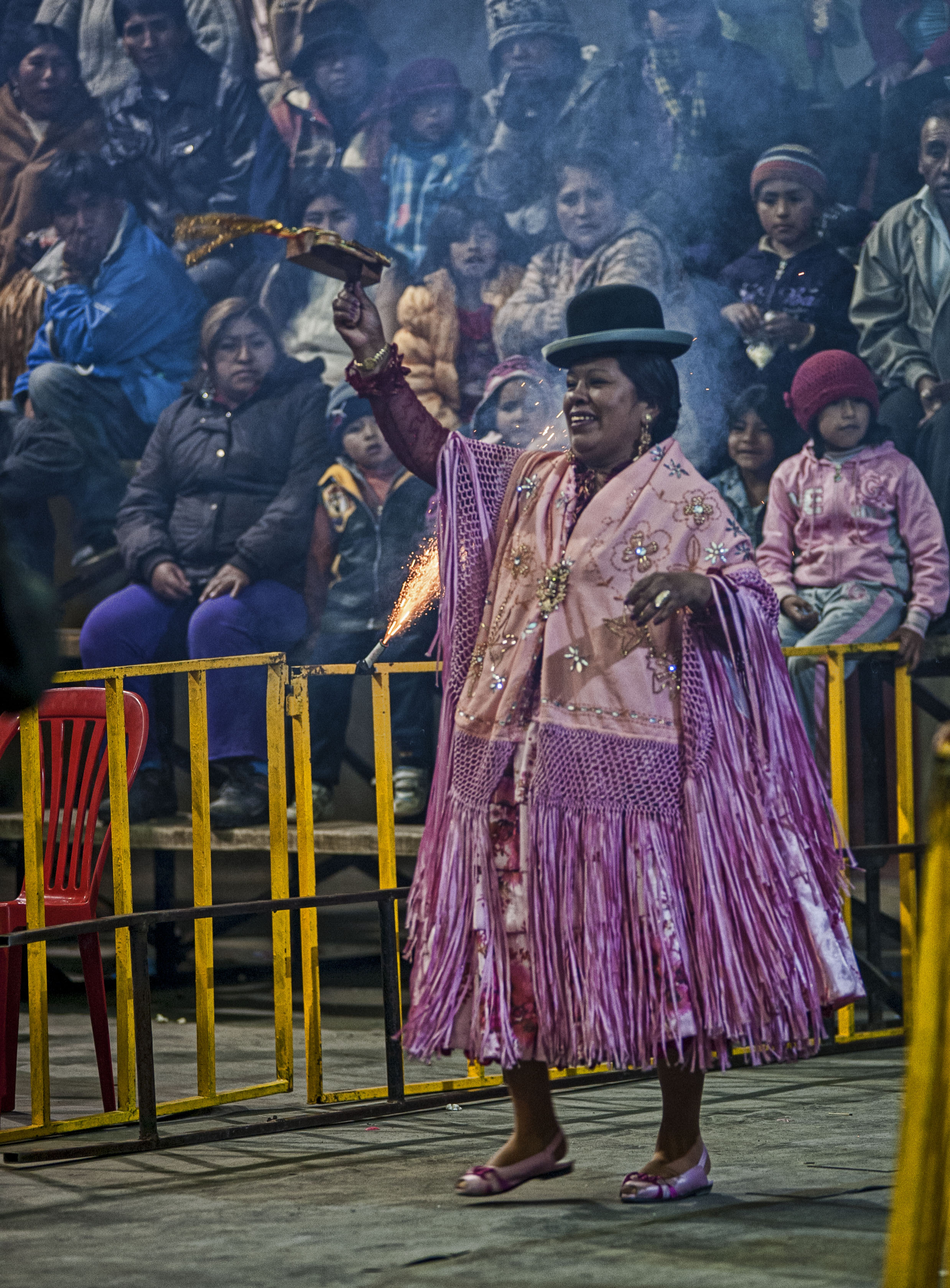
It was enormous fun, albeit taken as entertainment, and the crowd really got into it.
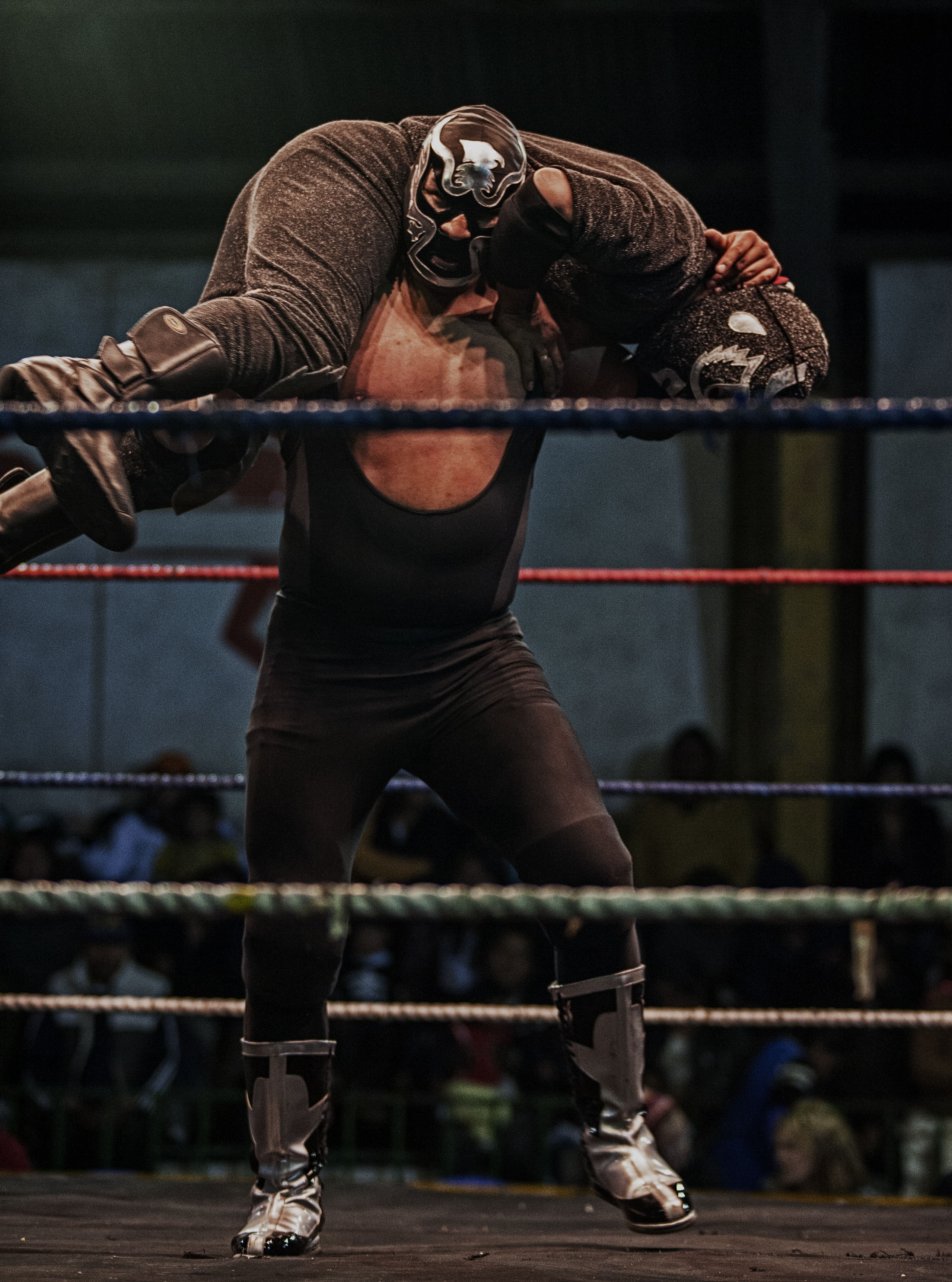
If you happen to be in La Paz on a Sunday night it is a fun (if slightly slap stick) evening out.
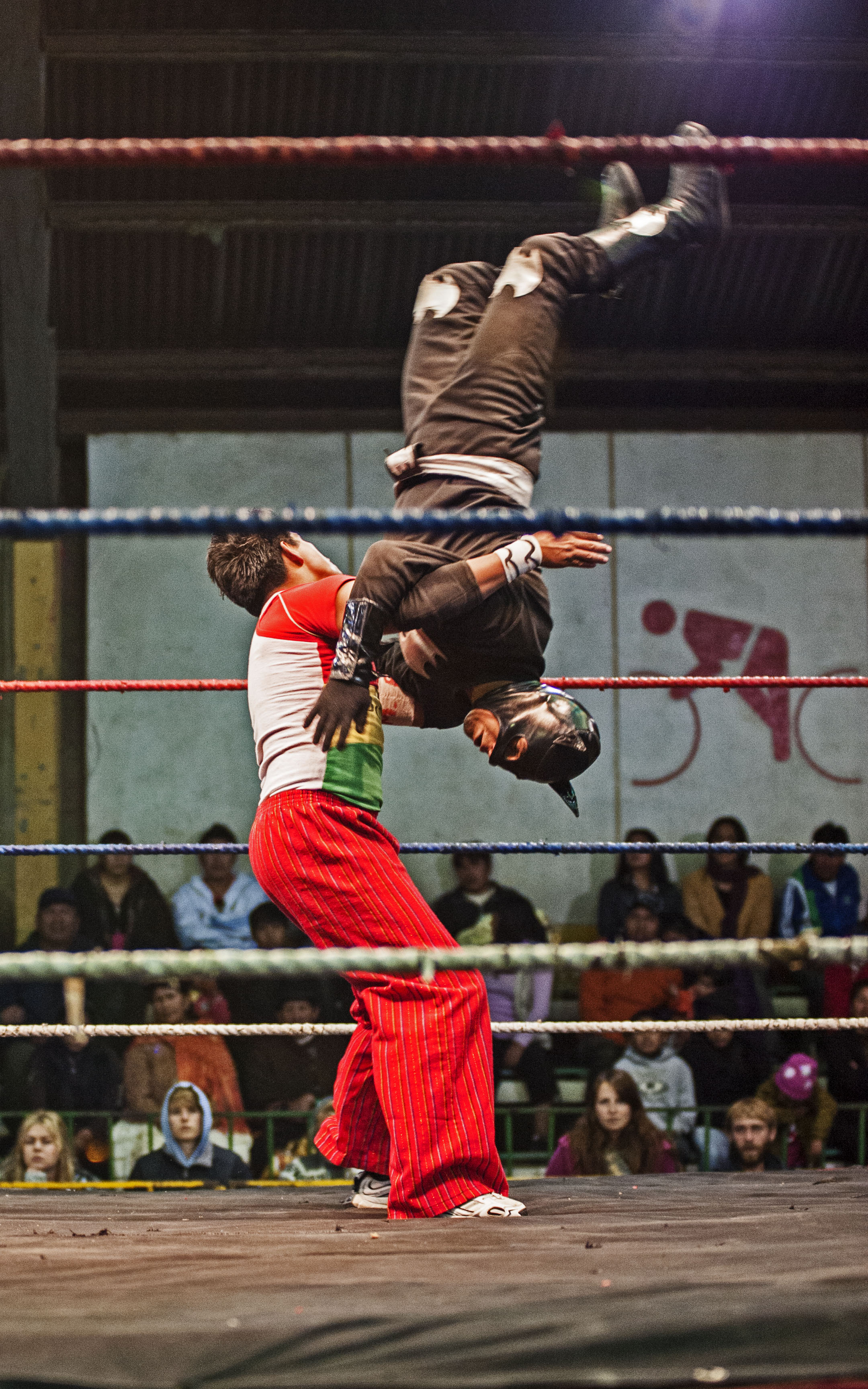
La Paz, Bolivia
La Paz is a big city (over a million people) stuffed into a bowl in amongst the mountains so it feels really busy. It’s also the highest capital (although strictly speaking Sucre is really the capital and La Paz the seat of government) in the world at around 3600m. In addition there is an offshoot of the city called El Alto formed of overspill by indigenous migrants at over 4000m which accounts for another million people.
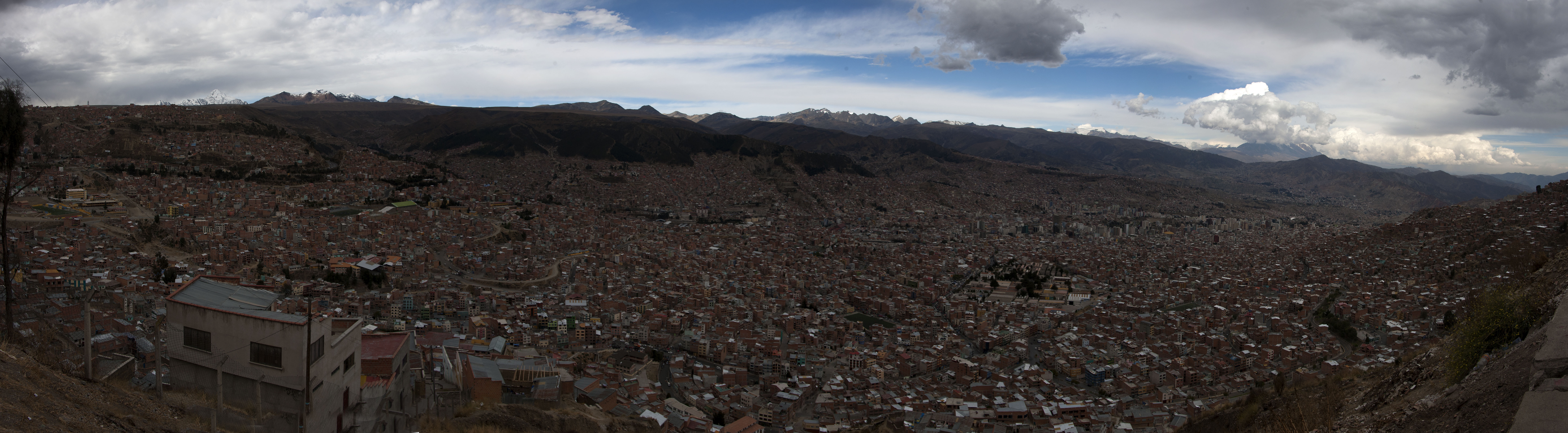
Actually driving into the bowl of the city is really daunting with a maze of streets some of which are incredibly steep. Fortunately for us overlanders there is an oasis just outside the city in the district of Mallasa, which is slightly below the city at only 3300m, not far from the city zoo. The Hotel Oberland is a Swiss-owned hotel which has a parking lot with its own modern and clean toilet and shower block just below the hotel and welcomes overlanders just like any other guest. It also has a very good restaurant and swimming pool – bonus!
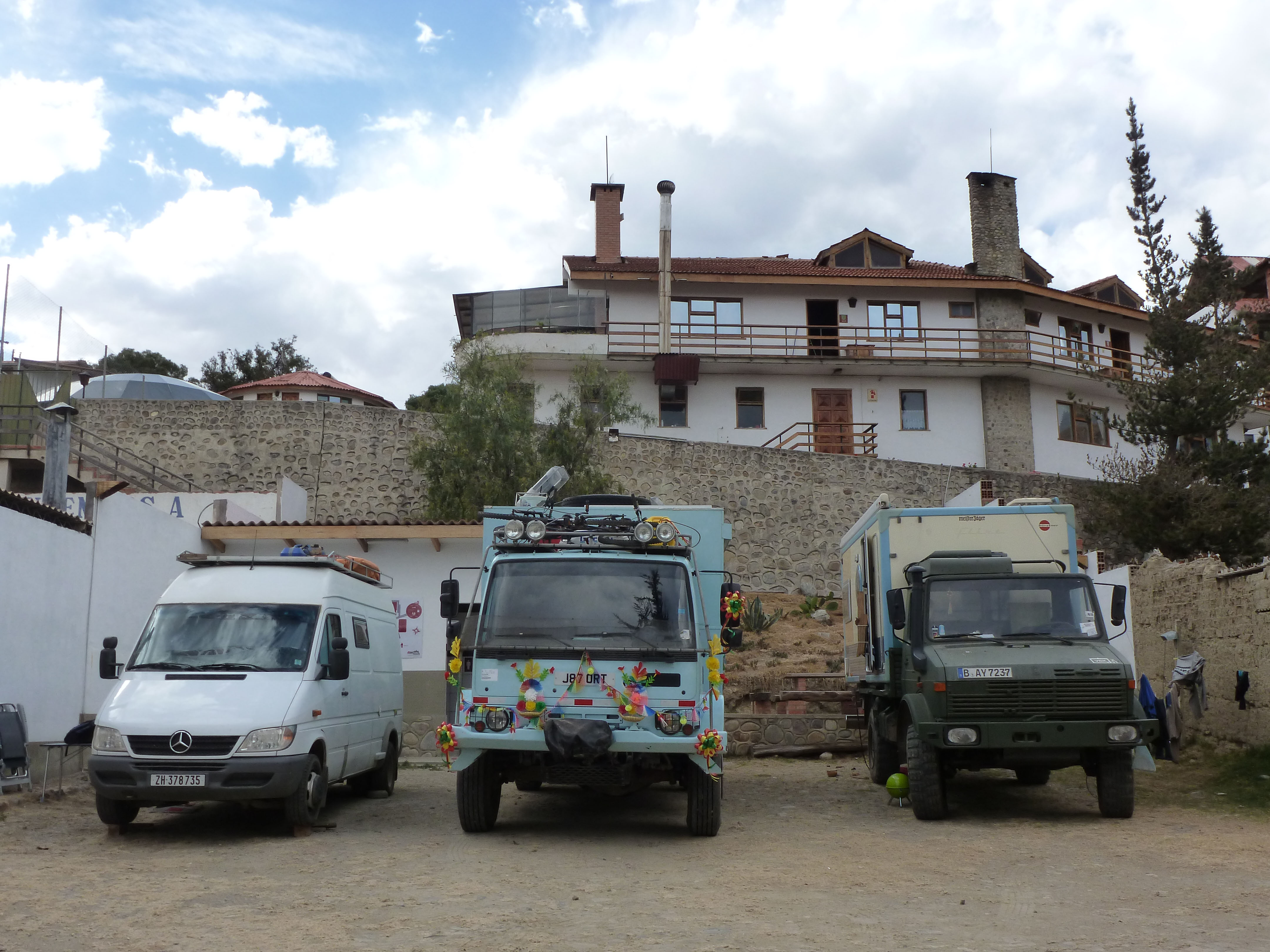
From Mallasa it is easy to get a collectivo/ micro into town and by staying in Mallasa you avoid the noise and hassle of the town at night.
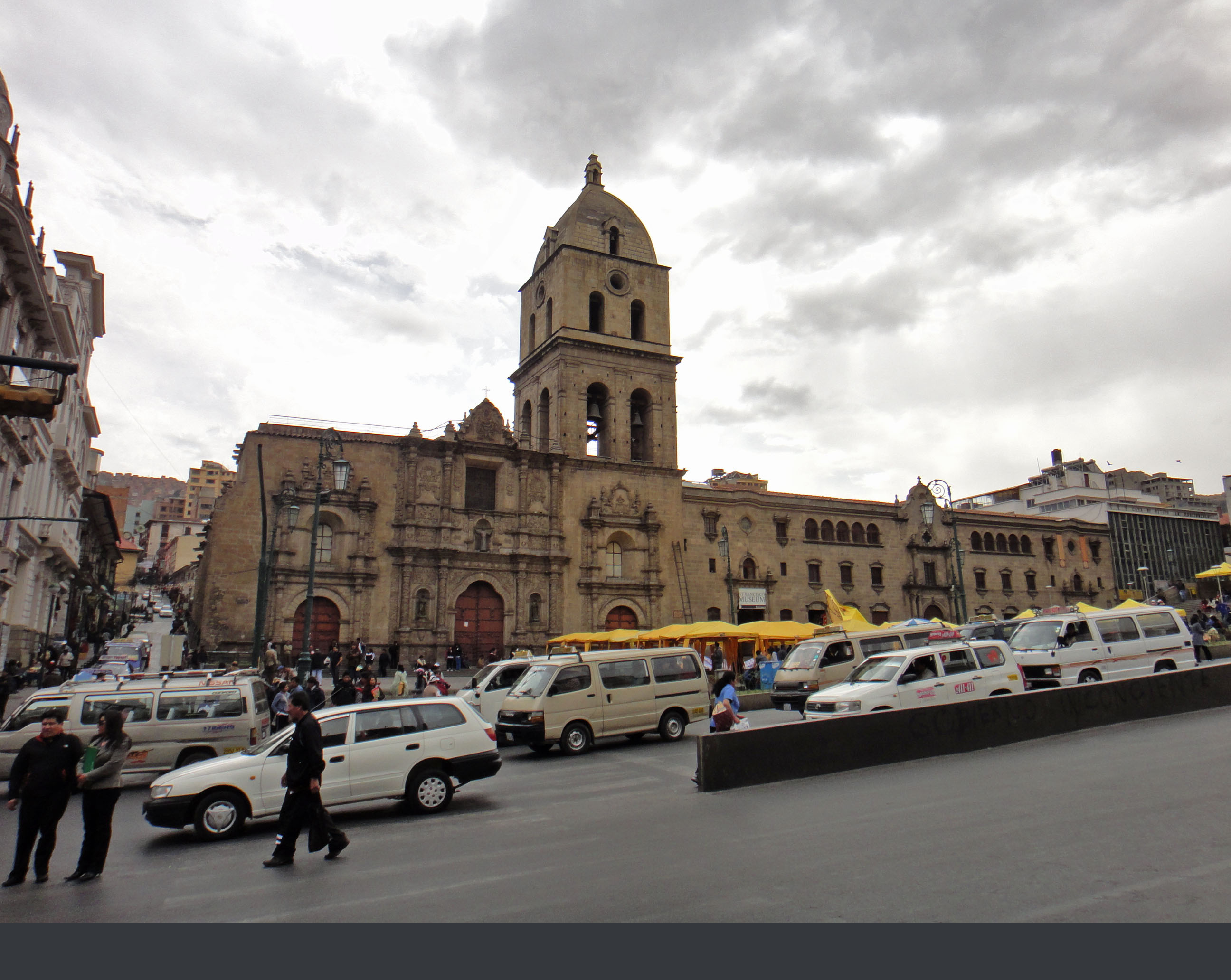
From the Oberland Hotel the following buses go up to Central La Paz:
231, 246, 253, 273, 281 and 902
They cost B2.30 per person and usually take between 20 to 30 minutes.
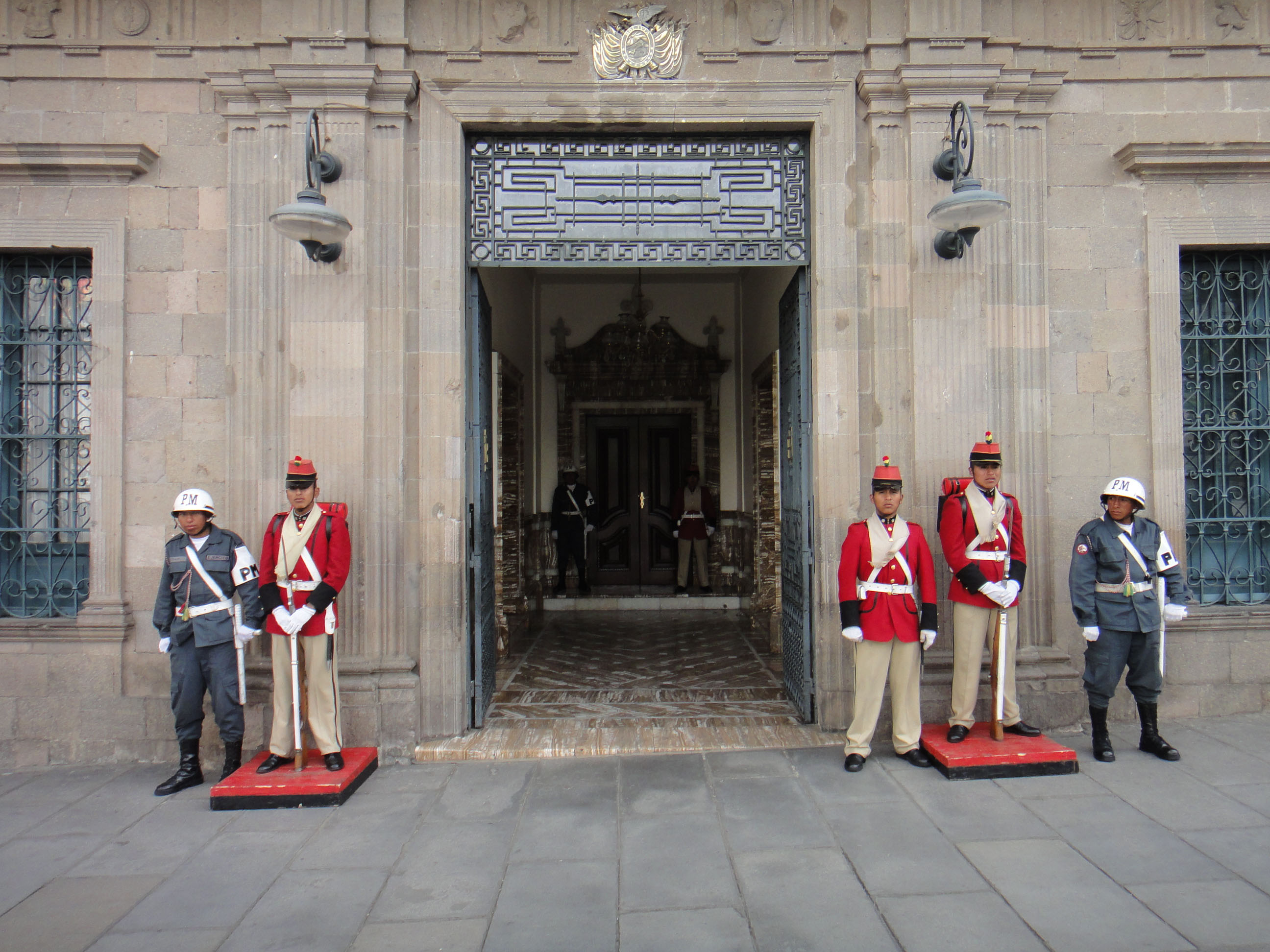
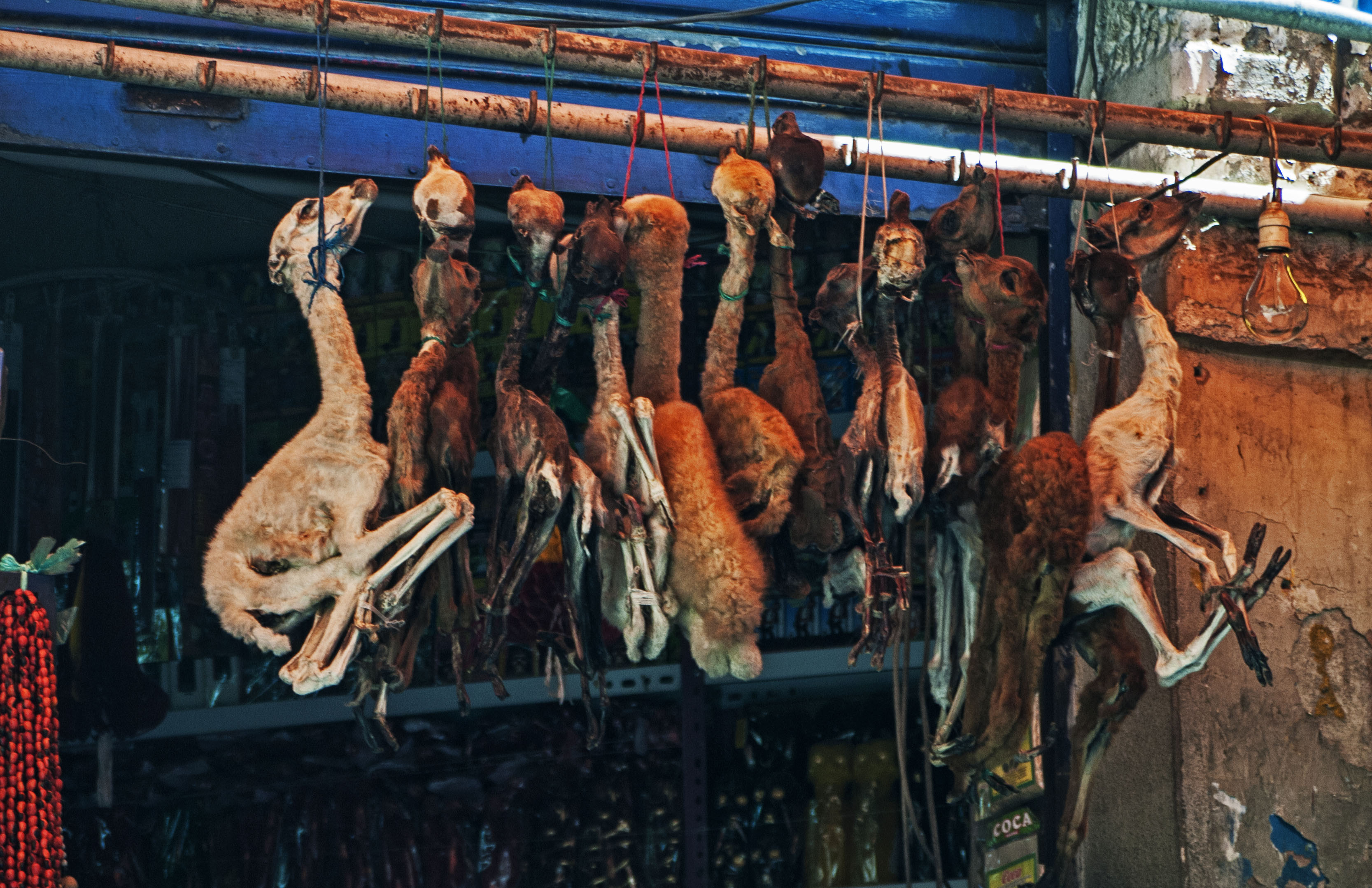
La Paz is not a city that is immediately that likeable. The historic centre is very small and there are not a lot of colonial buildings to be admired. However it’s definitely a grower. Almost half the centre is given over to street markets where the Aymara people buy their goods. There are almost no modern shops but the market serves your needs from the street of hardware stalls to the witches market with all the magic accoutrements you could want (including dried Llama foetuses !).
The people in La Paz are very friendly, and in fact they are throughout Bolivia, and the city has a relaxed vibe despite the hustle and bustle.
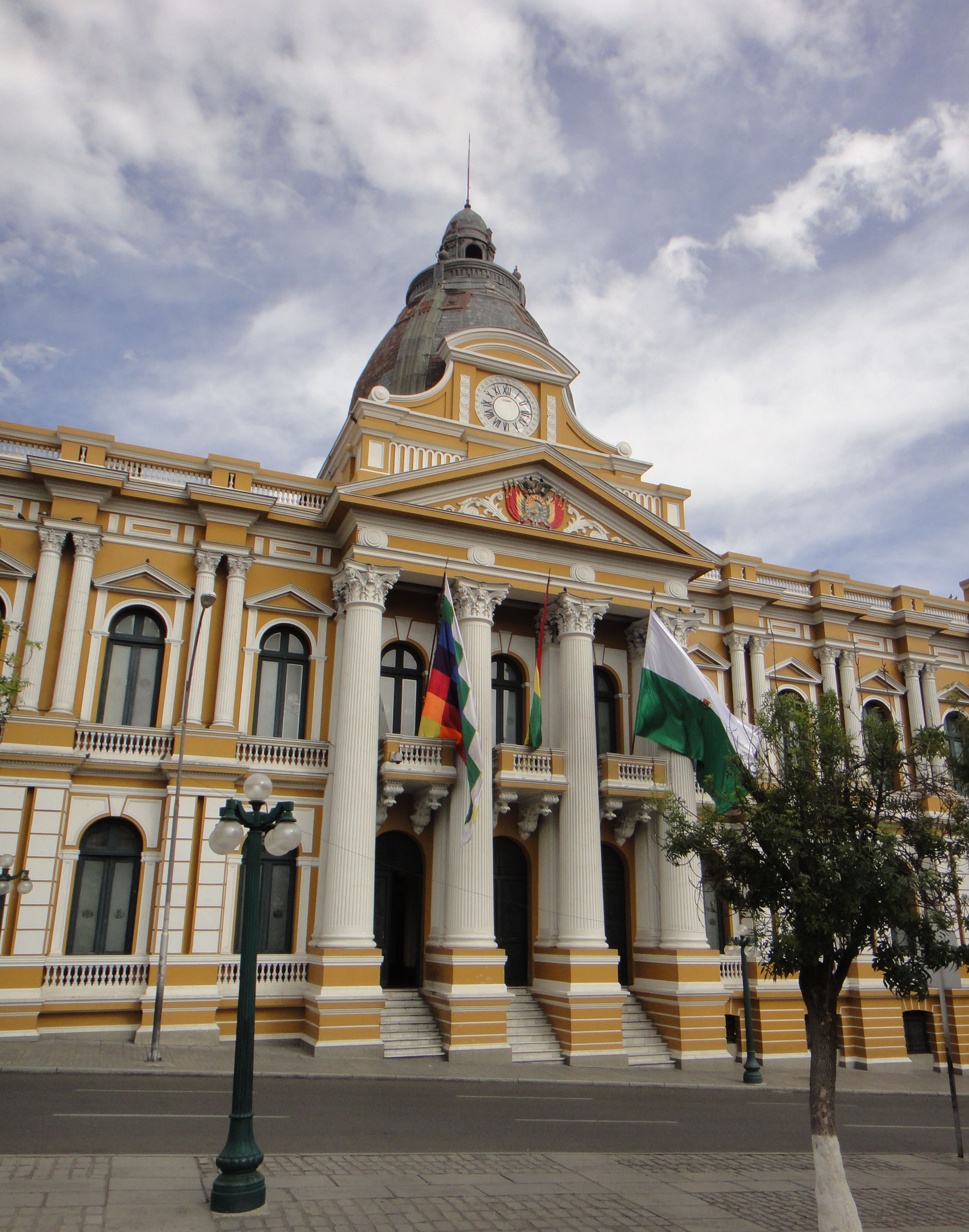
We ended up staying almost a week in La Paz and were never short of things to do – even if it was only hanging out in the market and watching the world go by. We did a few things though – Cholita’s Wrestling and Biking the Death Road were but two of them.
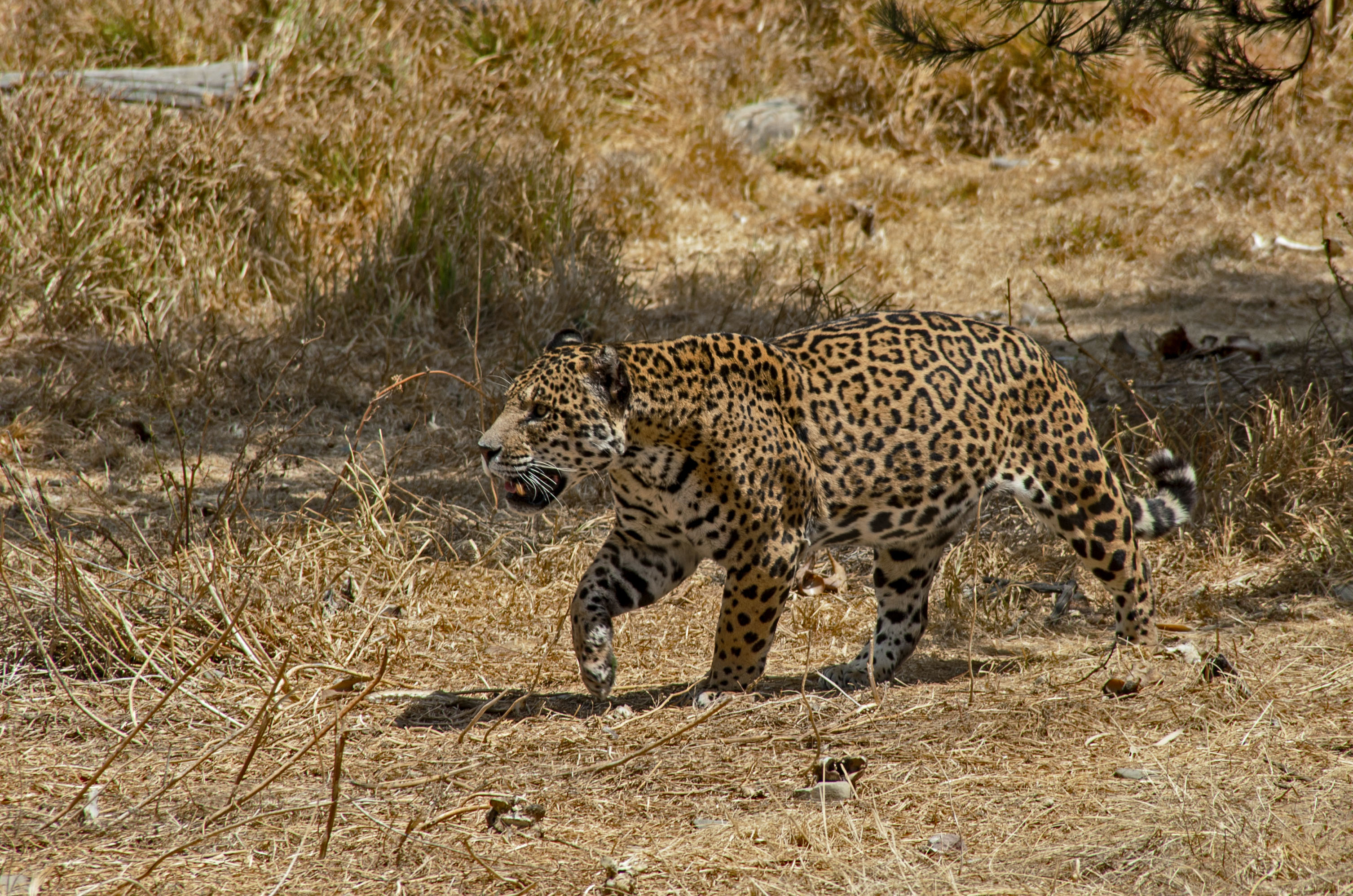
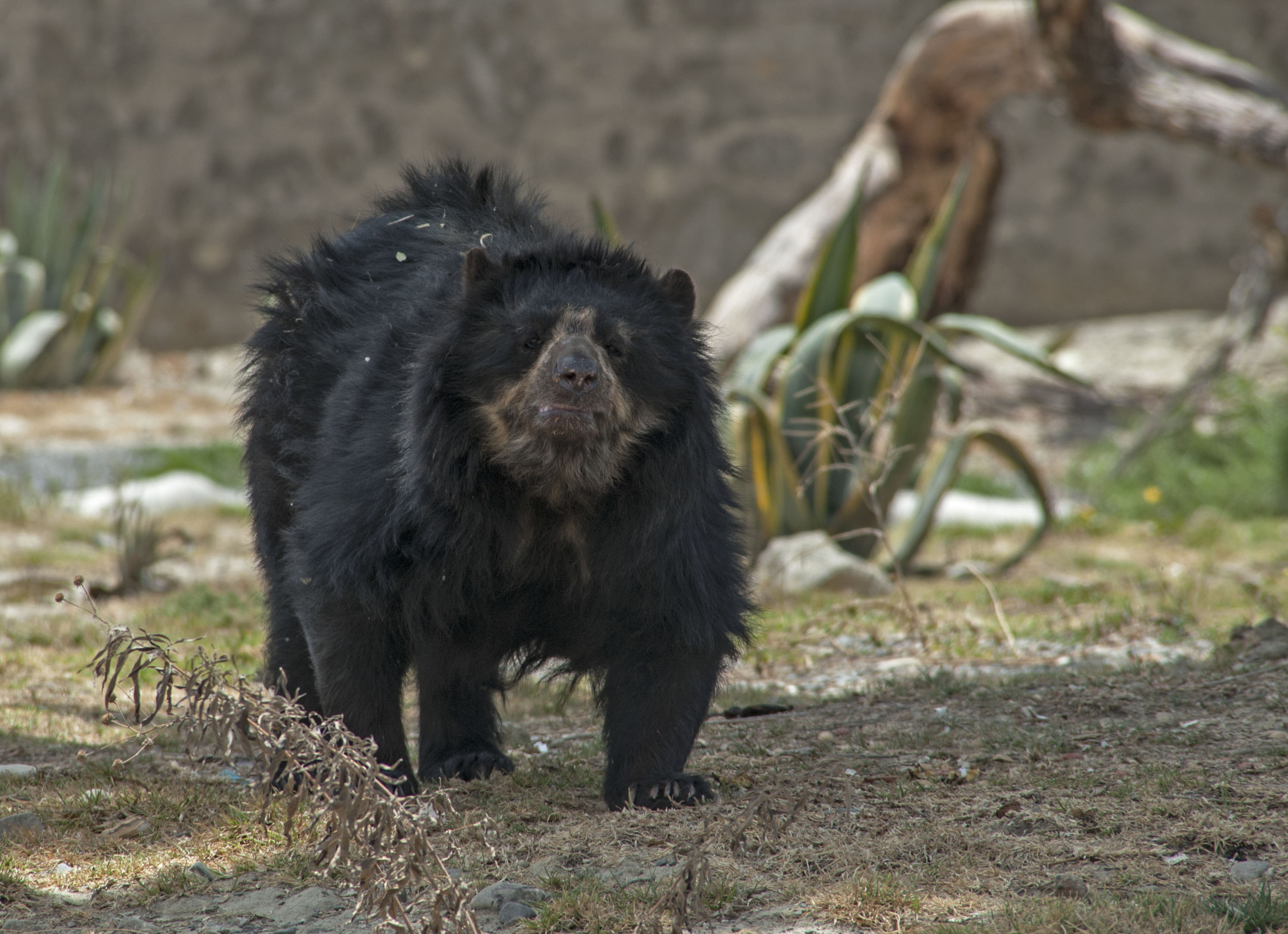
The La Paz zoo is surprisingly good and has a large number of, what seemed to be contented, Jaguars in a big area at one end. Most of the enclosures seemed quite roomy though there were one or two which felt a little small, but unlike many Latin American zoos, it appeared well run and the animals seemed cared for and happy, well as happy as they can be couped up in cages.
Sorata – Sometimes it doesn’t go to plan
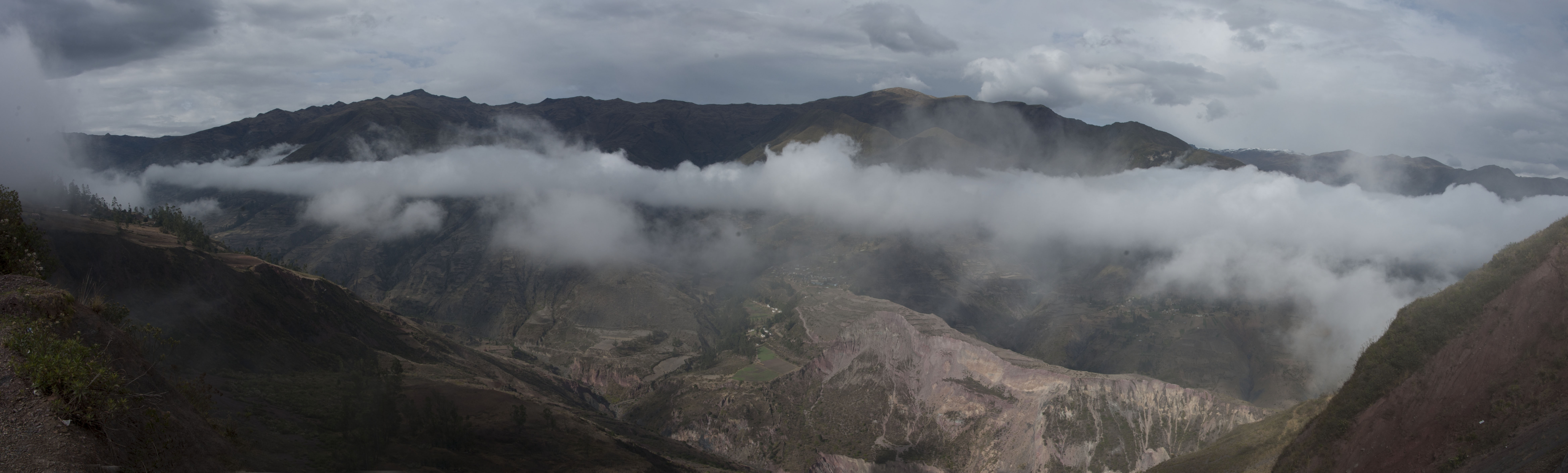
Things don’t always go right when you are overlanding and this is an excellent example of an 80km (each way) detour that just didn’t work out for us.
After leaving Copacabana and arriving on the mainland we decided that before hitting La Paz we would go to the small town of Sorata which is reputed as having some nice hiking.
The road to Sorata heads North from the PanAm and over a mountain pass before dropping down into a beautiful valley. Before we could access this road we had to pass through a military checkpoint (there had been some unrest in this area in recent years) but we got through this without to many problems.
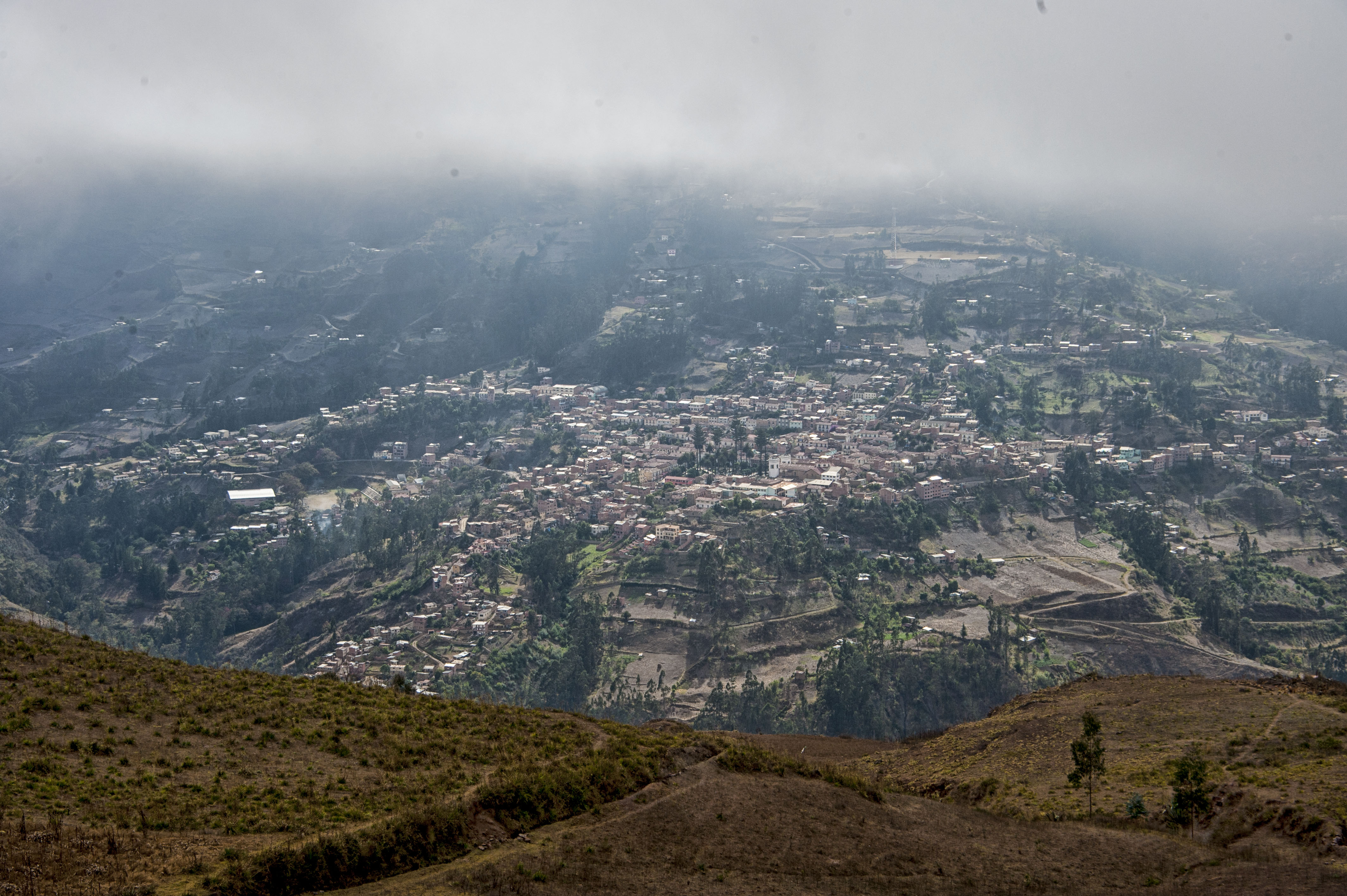
The drive down to Sorata was beautiful and newly paved for almost the whole way. We were really looking forward to a couple of days here.
However when we arrived in the town the traffic was absolute chaos. The hub of the town – the central square, had been dug up meaning all traffic was funnelling down one side of the square which had parked cars and trucks on both sides. This meant one lane for everyone and trucks getting stuck forcing all the other vehicles to back up and try to get out of the way. In one word Chaos !
After 10 minutes we managed to force our way through the square – which had been where we thought we would stay – and out the other side of town.
Our backup camping spot was a small lodge called Altai Oasis which was accessed by a very narrow dirt road where tree branches brushed the sides of the truck all the way down – absolutely nowhere to turn around.
On arriving at Altai we found we could just about squeeze in – with difficulty as even cars needed to reverse down the driveway as the turn from the road was too sharp, but as (bad) luck would have it, the very friendly English-speaking owner told us that they had a large number of campers arriving the next morning to compete in a cycling race and therefore she was very sorry but we couldn’t stay! Arrrghhh ! Thankfully she told us that another 300 metres down the track the road split and that was our 1 and only opportunity to turn around. We took her warning not to miss it very seriously as the idea of reversing 1 km back up the narrow windy road was not one we relished. We knew about some caves further along the road and considered carrying on and spending the night there, but with darkness descending and not knowing what we would find up ahead we decided to turn back and head out of town in search of a ‘cosy’ lay-by for the night. Getting out of town was actually much harder as by this time there was complete gridlock. Eventually a lorry had to reverse the whole way back out of town to allow the rest of us through.
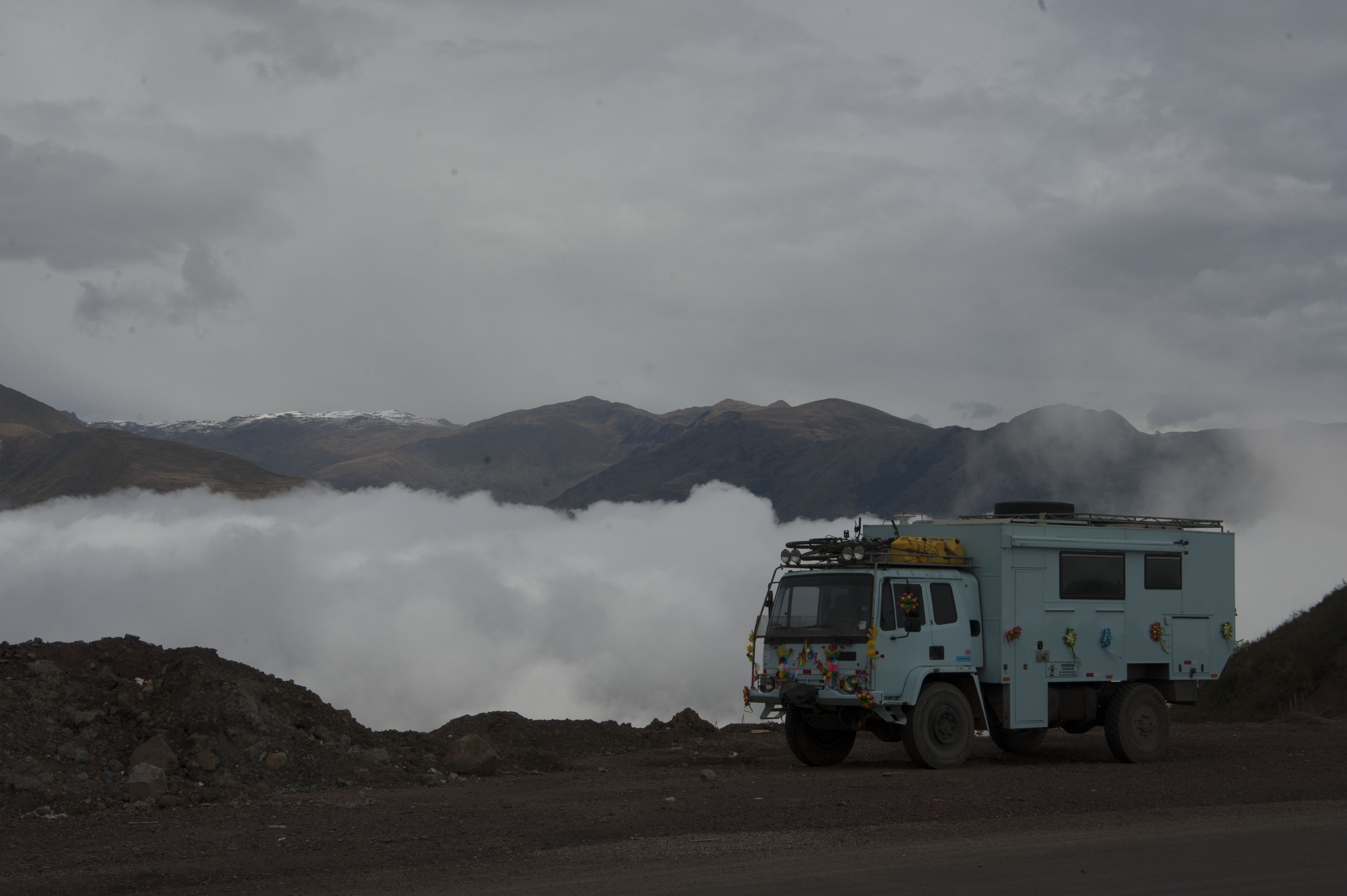
We ended up spending the night about 10km up the road back towards the PanAm on a ridge overlooking the Sorata valley and the neighbouring valley. In the morning we carried on to La Paz and gave up Sorata as a lost cause.
Copacabana – Not that one
“At the Copa, Copacabana
Music and passion were always in fashion
At the Copa…. they fell in love”
The song refers to a nightclub in New York not the small town on the banks of Lake Titicaca but it could easily refer to the Bolivian town which has the feel of a faded British seaside resort.
As soon as our painless border crossing was completed we headed down the main road to Copacabana. However to our dismay the perfectly good asphalt road was closed and there was a diversion down a fairly ropey dirt road. We thought we would be clever and nipped back on the asphalt halfway along but soon came to a massive pile of dirt on the road so had to double back onto the dirt track.
Anyway eventually we reached the small town of Copacabana and settled right by the beach to watch the sunset with a beer.
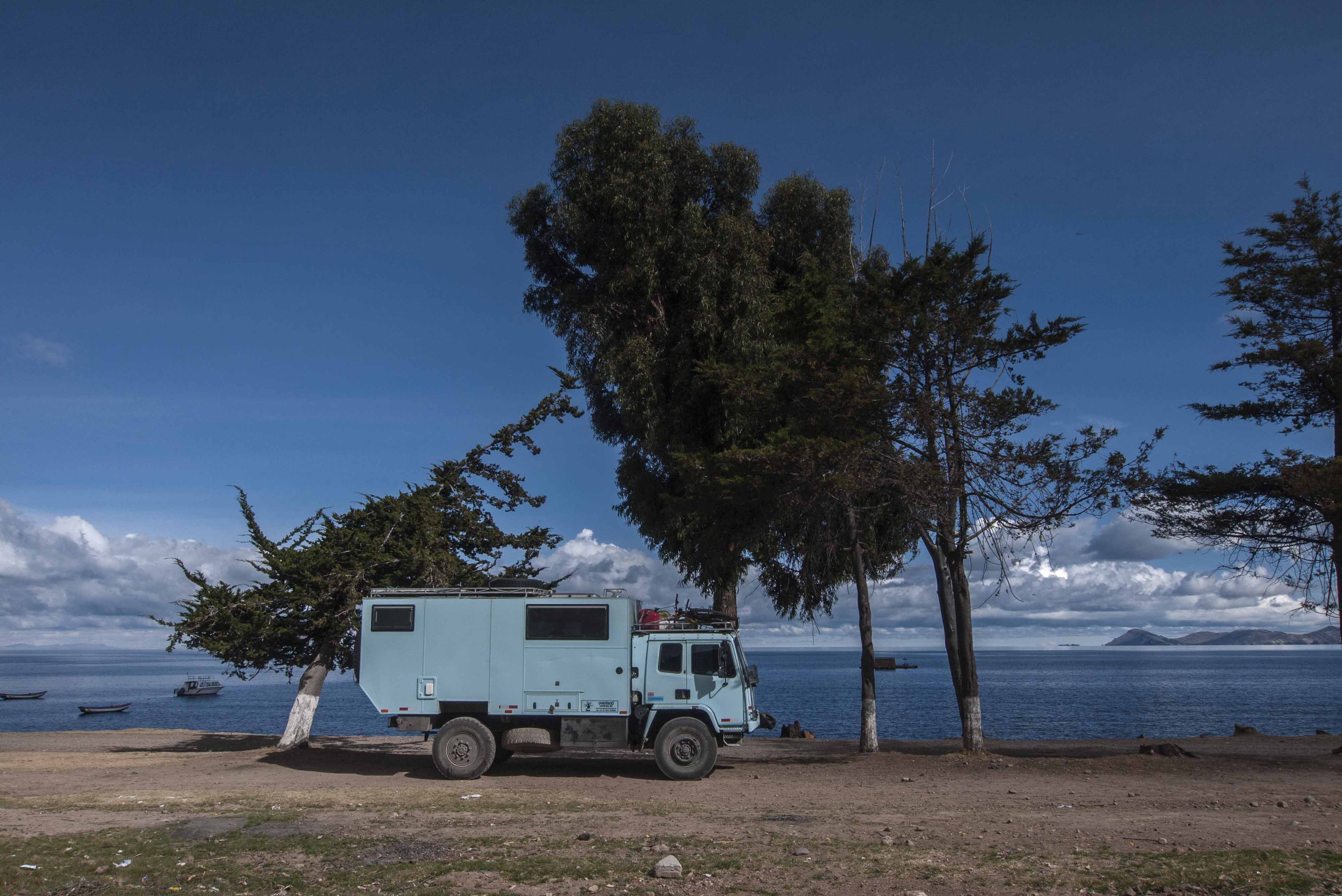
Copacabana itself is a really chilled place and outside religious festivals is pretty quiet. In the main square of Copacabana there is a massive cathedral which houses the Virgin of Candelaria. The interesting thing here is that the priests at the cathedral will bless your vehicle (for a small fee – 10).
We couldn’t resist getting the Beast blessed. This is known as Ch’alla The first stage is to dress your vehicle up with fancy decorations. In the square outside the cathedral are a number of stalls run by indigenous women who gleefully decorated our truck with colourful rosettes and plastic flowers.
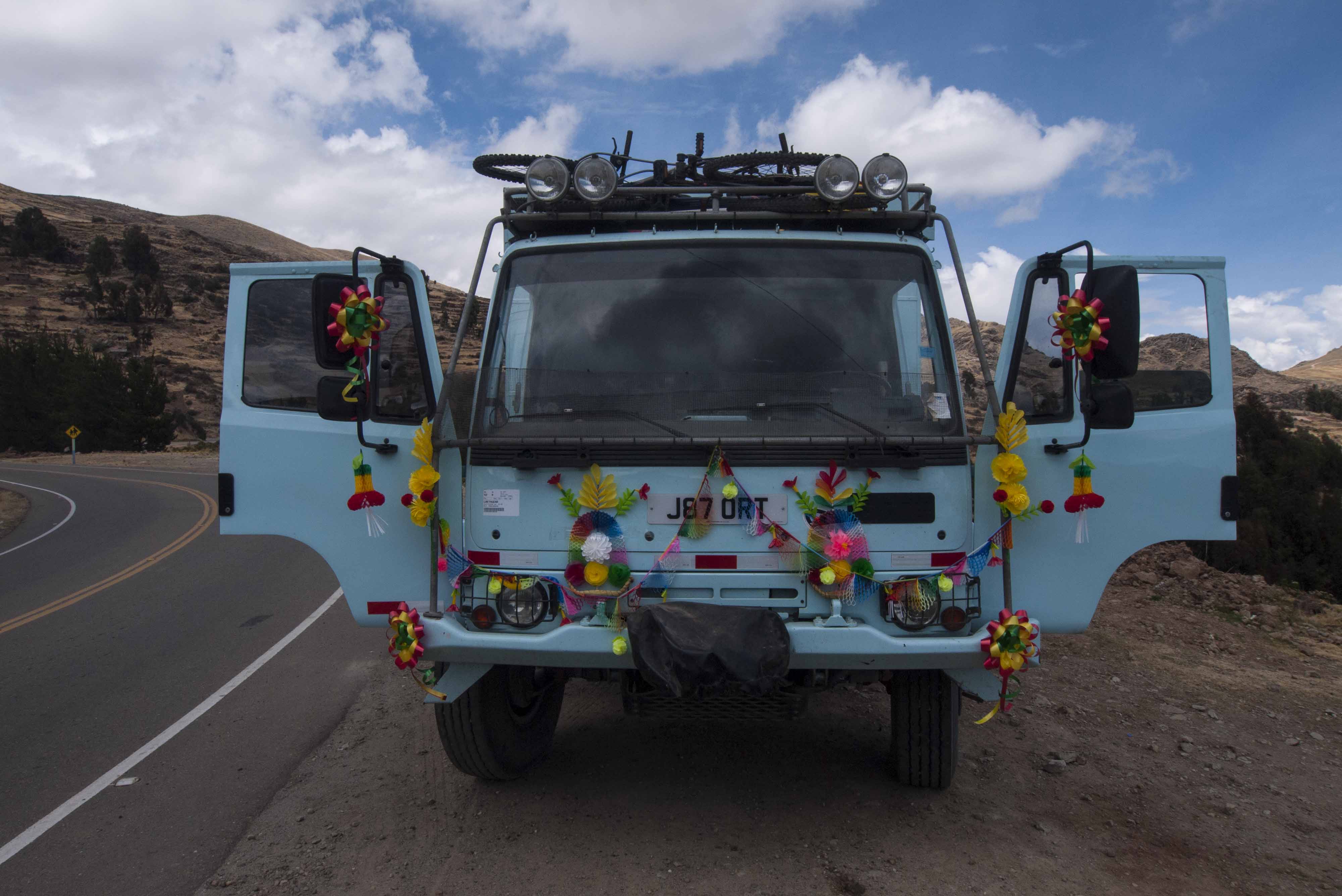
Then you have to go round the back of the cathedral to a small indoor booth where you buy a blessing ticket.
When the priest comes outside (there are set times for the blessing and a sign outside the cathedral telling you when they are) he will take the ticket and start blessing the vehicle with some latin words and liberally spraying holy water on the front then all around including on the driver’s seat. Some people even open their engine hood to get the motor blessed. After this he will bless you, putting holy water in your hands – which you’re meant to wipe off through your hair – and then you are done.
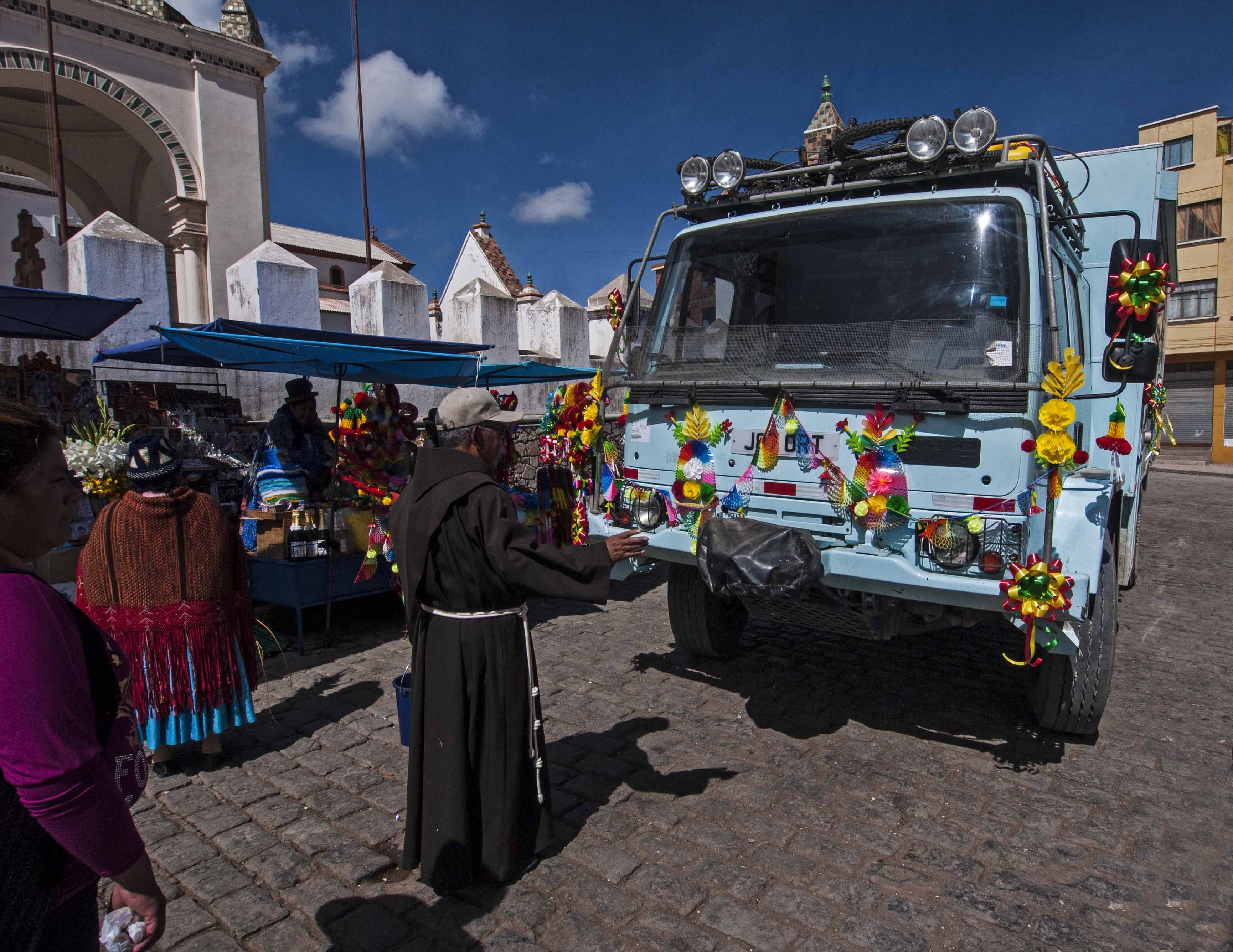
The next thing to do is to christen the vehicle with some local champagne or beer which is poured over the wheels (including the spare) and of course the occupants take a swig as well !
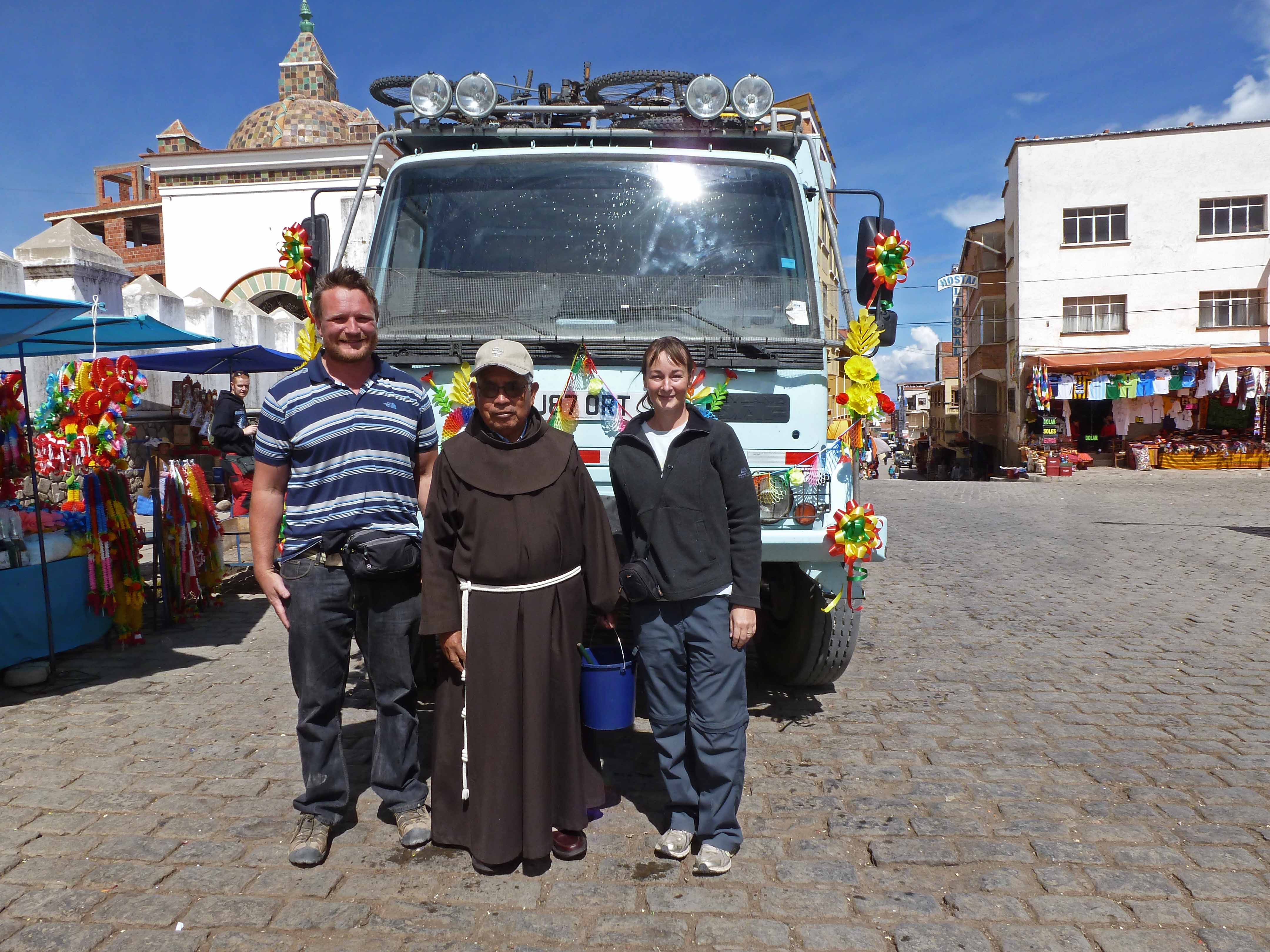
Blessing over it was time to set off for the mainland of Bolivia. After only about 30km of driving we came to a small town and a ferry terminal where barges cross the 500m of water to the mainland.
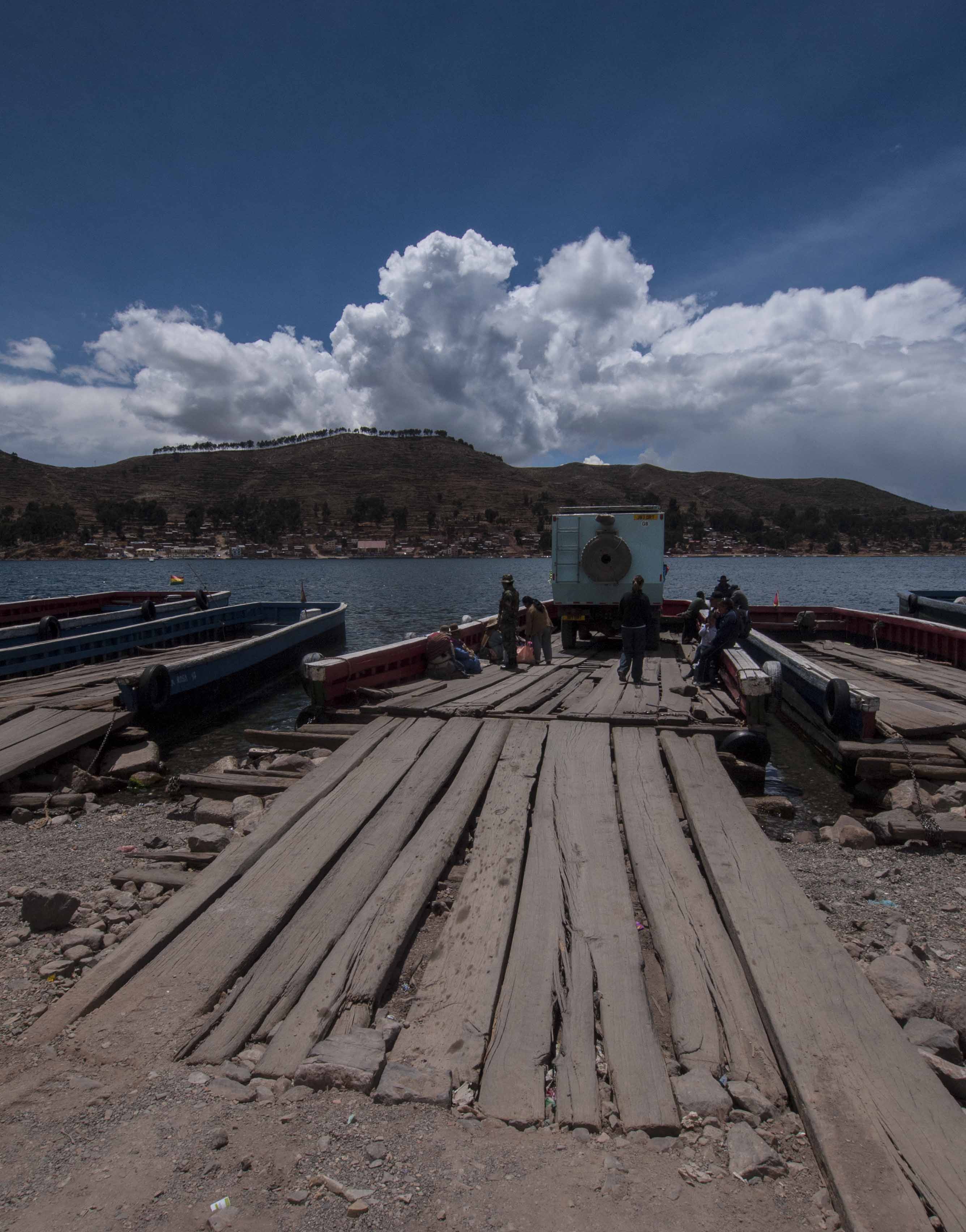
We drove straight onto one of the barges and the owner asked how heavy we were. We told him and he said in a worrying tone “Muy Pesado” – very heavy ! Ok we were now worried. A number of locals piled on board and we set off with the owner poling us off the shore. Once we were clear of the shore he started up the tiny outboard motor and we were on our way.
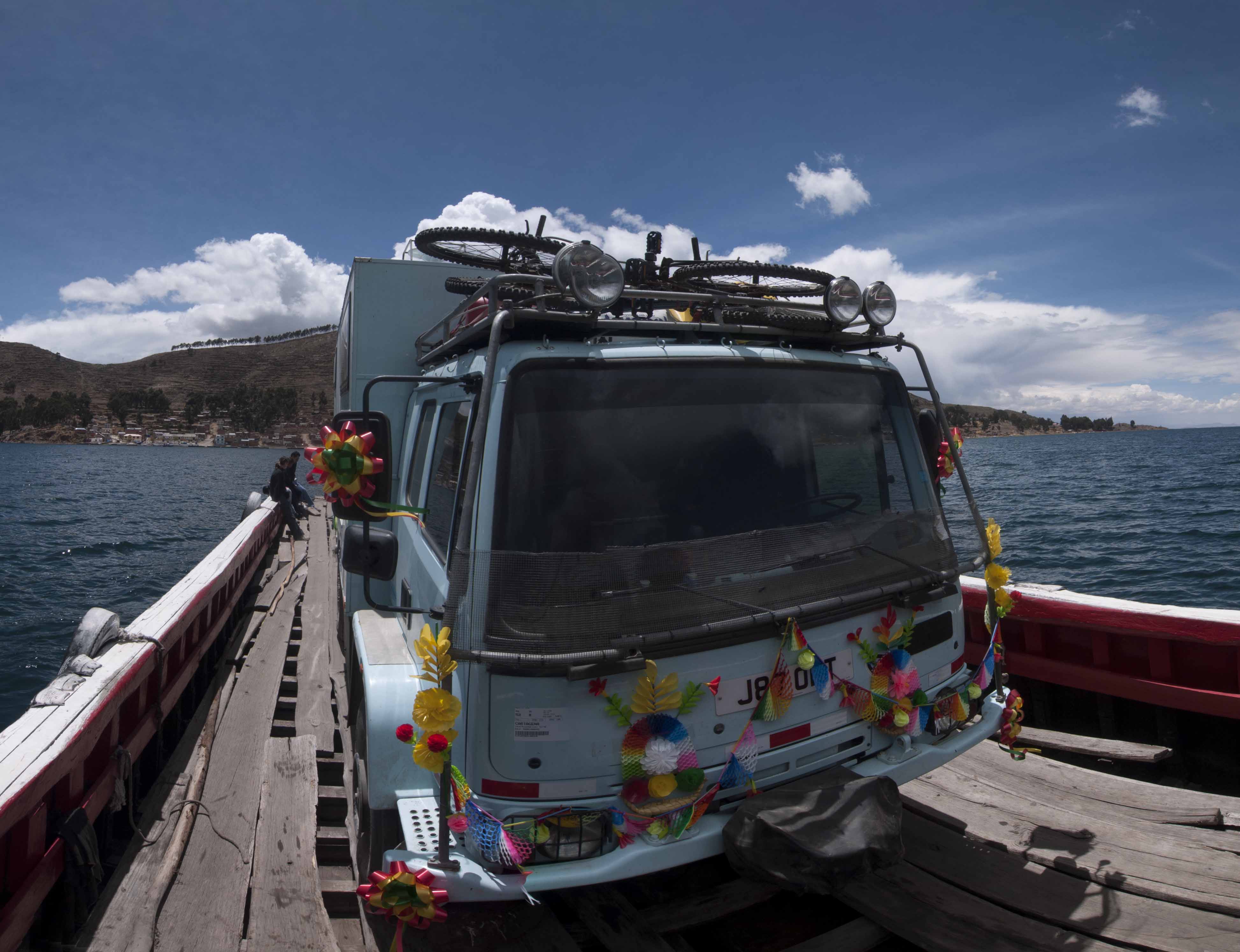
As we crossed the barge wobbled alarmingly making loud creaking noises – we were very glad of the blessing we had just had as we hoped that the barge didn’t sink – like others had before !
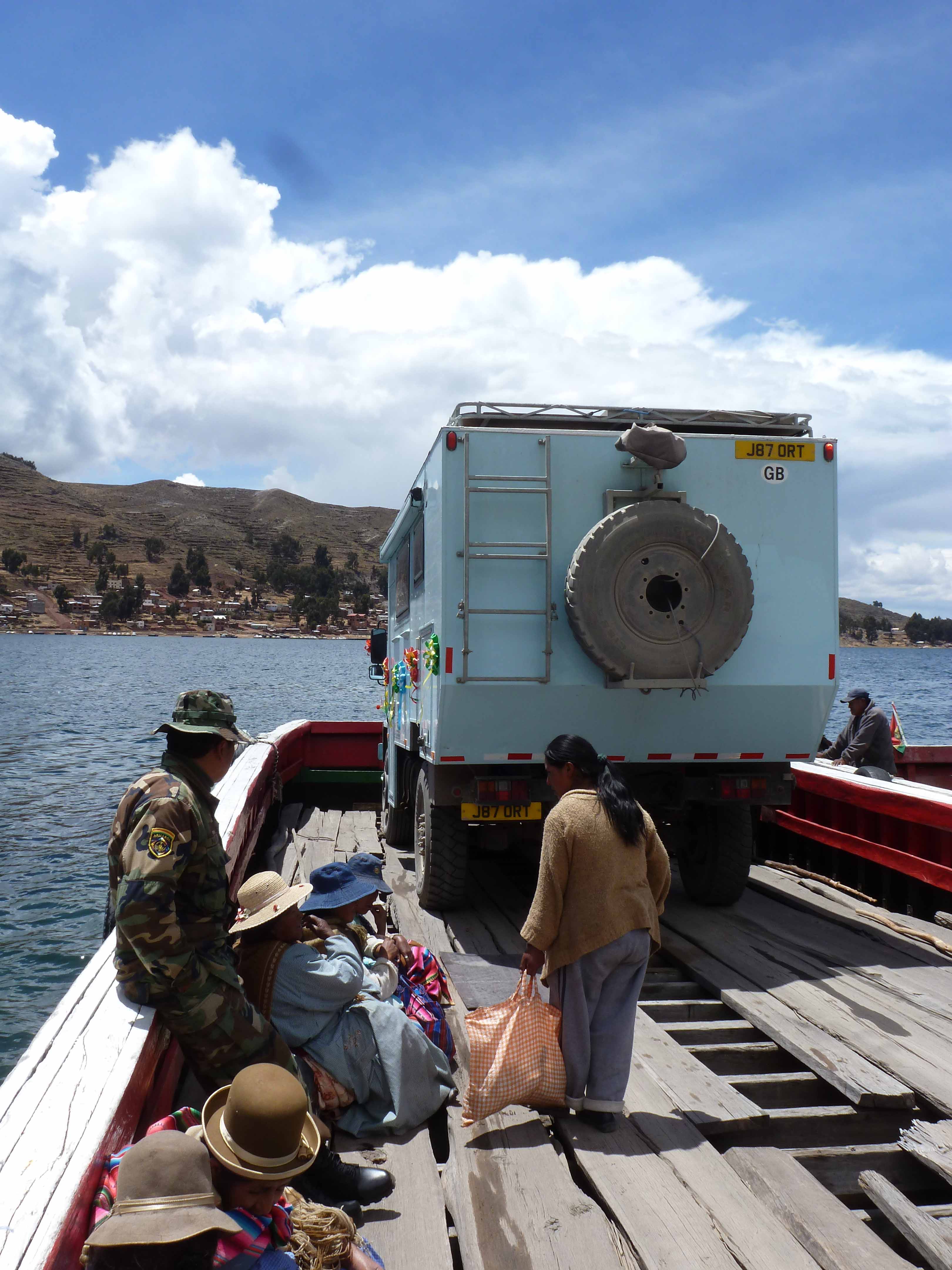
We were very relieved to reach the other side and reverse off onto dry land. We noted that none of the foot passengers seemed to pay and we fitted the bill for everyone who had crossed with us !
Peru to Bolivia Border Crossing (Yunguyo to Copacabana)
Peru to Bolivia border crossing
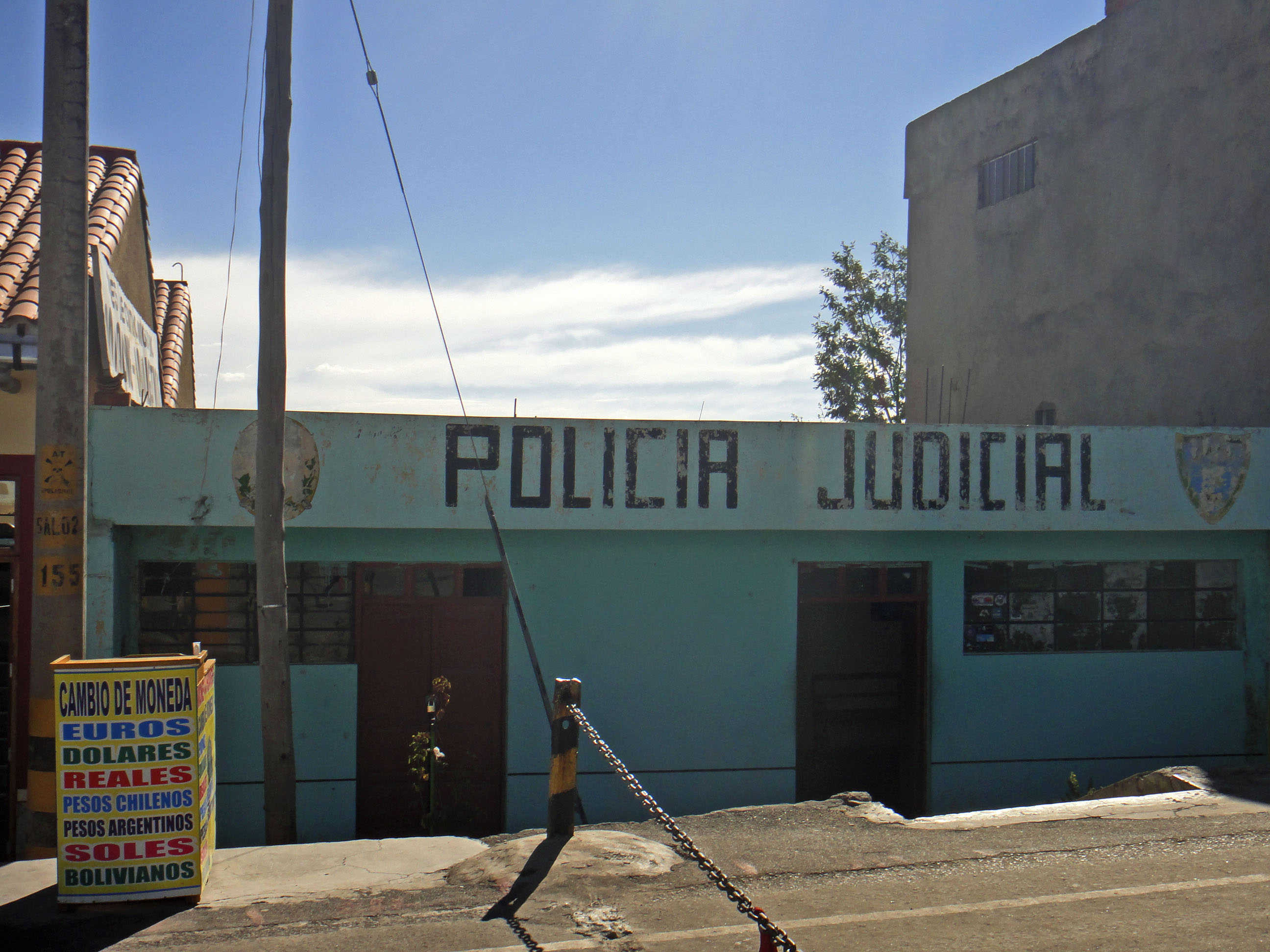
About 2km after Yunguyo you reach the border with Bolivia. It is fairly clear as there is chain across the road. Pull up in front of the chain. The border was very quiet when we arrived.
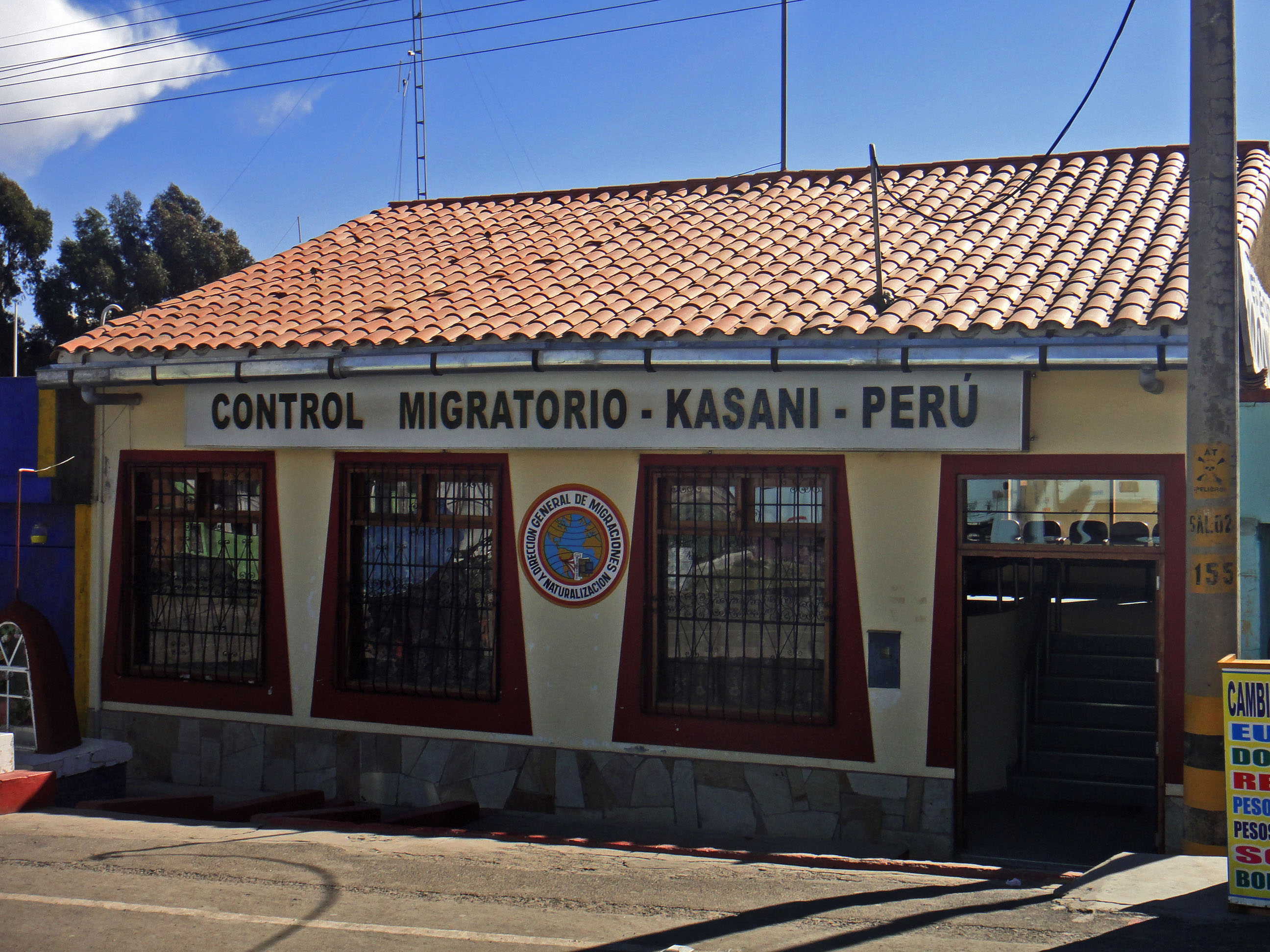
Migracion is on the left and next door (on the right) is the police. First port of call should be the police where you. Need to collect a stamp on your tourist card. Once this has been collected go to the Migracion office to get stamped out of the country.
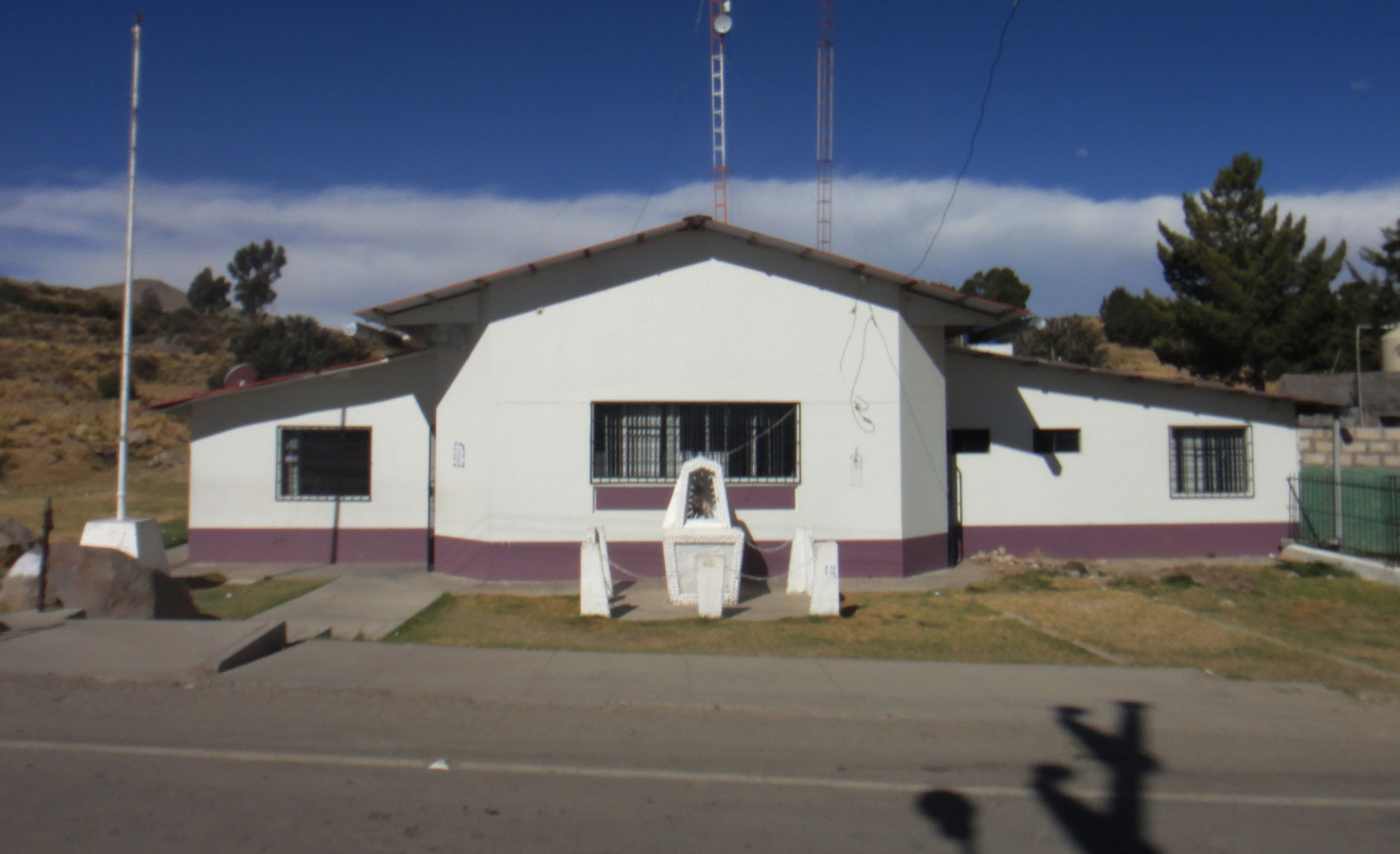
Next walk back across the road to the Aduana office which is the white building directly across from Migracion. On the left hand side there is a window through which you can conduct your business. The customs officer asked for our TIP and our registration document. He also wanted to see the truck so I had to pull it forward 20m.
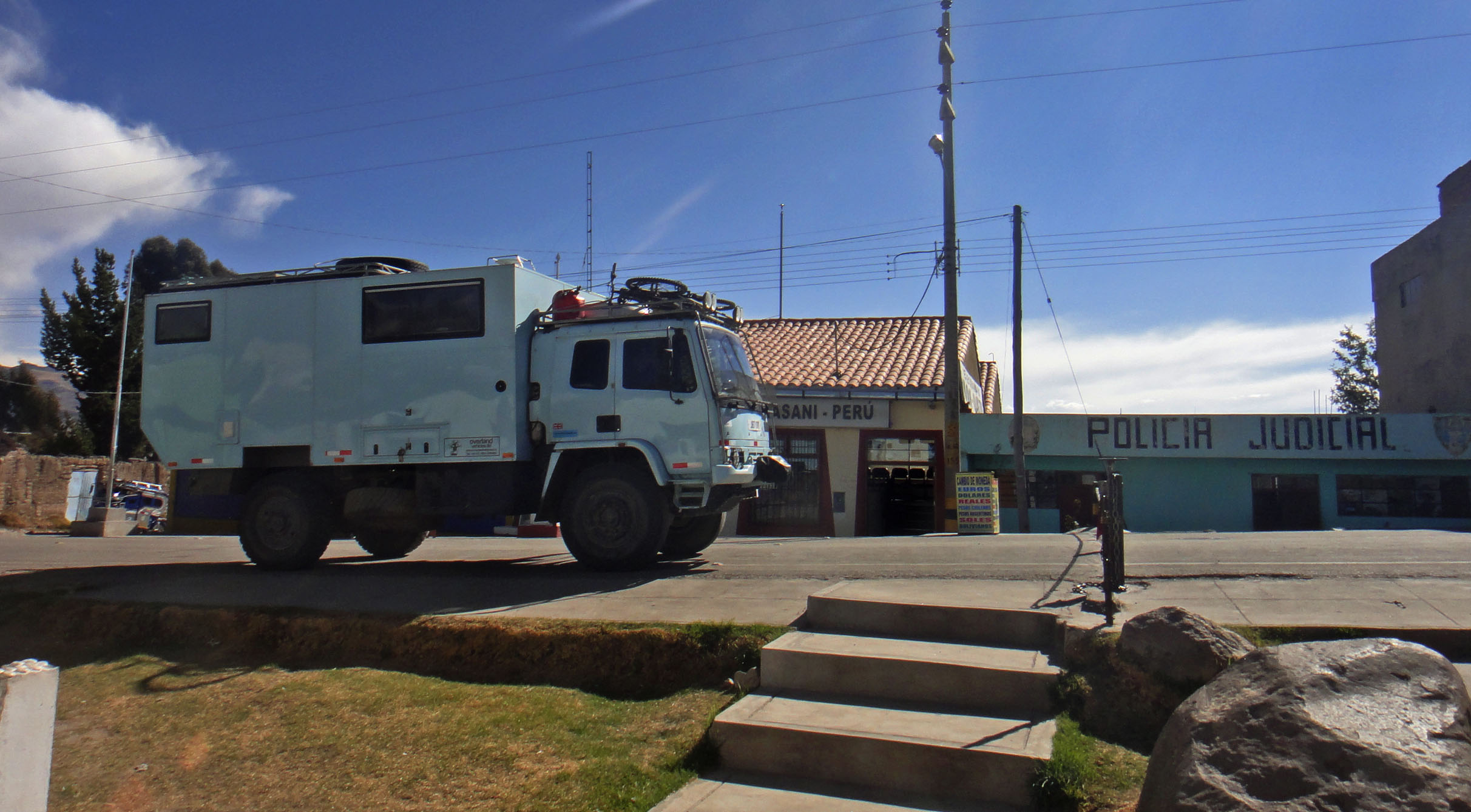
After 5 minutes we were done here and he came out to lower the chain.
The Bolivian side of the border is 200m ahead through an arch over the road. We parked up in a large parking area on the left.
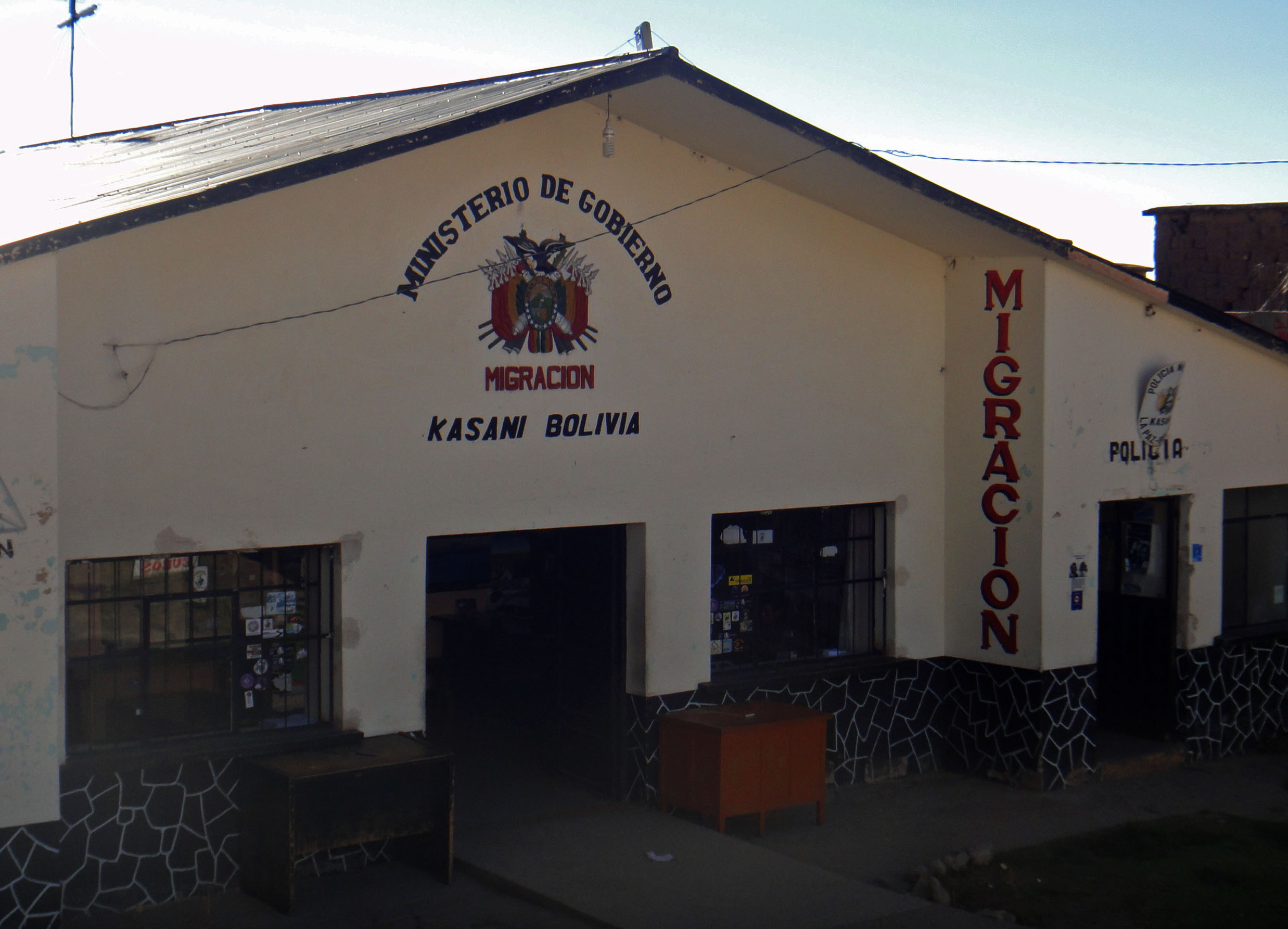
Both customs and Migracion are on the left hand side of the road. We visited Migracion first. Here there are some police who first examine your passport and then give you a tourist card to fill out. Once this is filled out you must return to the desk next to the police where a Migracion officer will stamp you in. In Bolivia you will only receive 30 days (this can be extended to up to 90 days in major cities).
After our passports were stamped the police tried to run a scam involving taking your picture. The immigration guy warned us to be quiet and not fall for it so we just told them no and walked off.
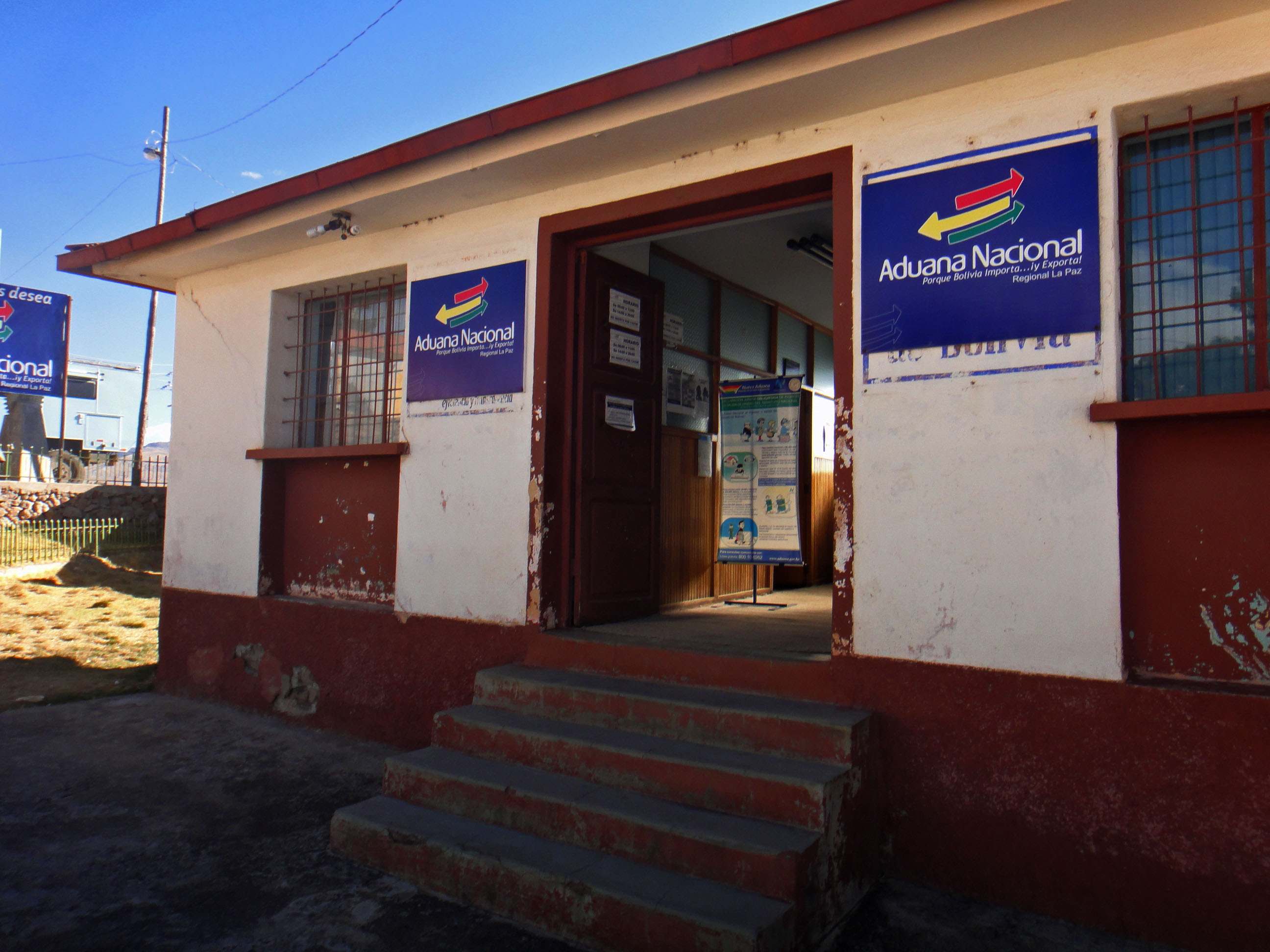
The next stop was Aduana where we went into a small office back towards the truck. Here the guy asked for driving licence and registration documents plus a copy of the registration.
This took longer than it should have because the system was down. After a few minutes it came back up and he gave us a Temporary Import Document. He did check my passport to ensure that the number of days matched.
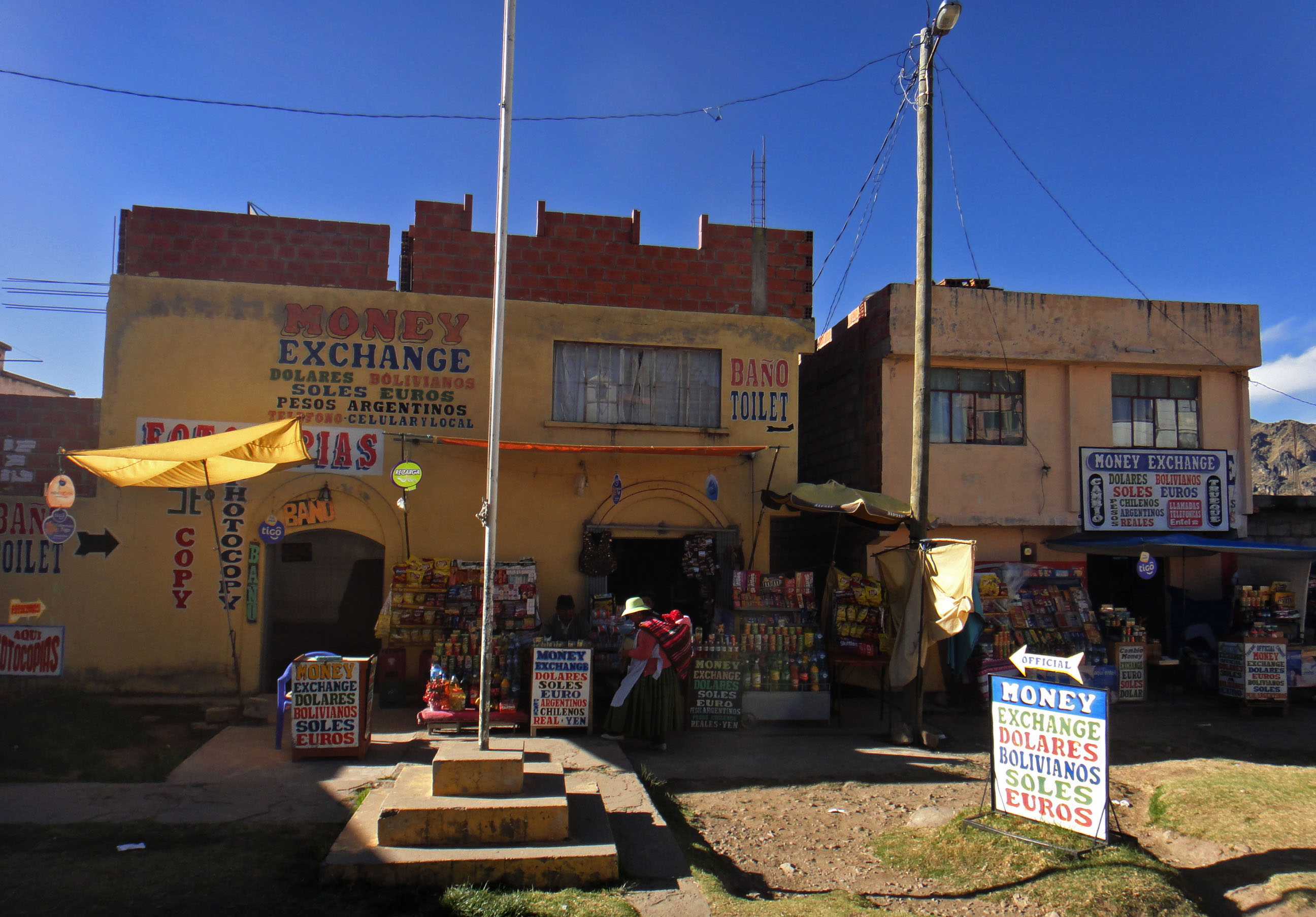
After this all we had to do was visit a money changer. These were next to Migracion and get a couple of photocopies of documents – the money changer could also do this (there is an ATM in the main plaza in Copacabana).
Once back in the car we had to open the gate ourselves to get into Bolivia but then we were done.
Camping Sites in Peru
3 Grillos Puntas Hospedaje, Zorritos (S3 41.784 W80 42.322 ,1m)
Eco Hostal on the beach. Parking at Palapas just back from the beach (only 2 available and they were taken by 2 other campers when we arrived). S20 per night. extra 5 for electricity and 5 for wifi. Lots of hammocks on beach.
Hua Lodge, Punta Sol (S3 58.881 W80 58.689 ,64m)
This is a beachside hostel with space at back for large vehicle and it takes overland trucks (Dragoman). However they told us we couldn’t camp. Others may have better luck.
Primax, Sullana (S4 55.469 W80 41.855 ,106m)
Petrol station camping. Relatively quiet overnight. Free. 24hr security. Decent toilets
PetroPeru, Bagua Grande (S5 44.065 W78 27.984 ,442m)
Petrol station with toilets. Quite hot, humid and lots of mosquitoes in this area.
Main Plaza, San Pablo (S6 02.535 W77 55.166, 1917m)
Free. Very Very quiet overnight in very friendly village.Public Toilets in one corner of square. From here it is a three hour hike to Gocta falls. Small municipal charge for hike to falls
Villa de Paris, Chachapoyas (S6 14.422 W77 52.240 ,2271m)
Nice hotel on outskirts of town which allowed us to camp in the car park. S35 per night. Water available. Power if you ask. Restaurant on site. WIFI -“villadeparis1”. Pool -but empty when were there. Short narrow dirt road to get there but plenty of room to turn around at end. Toilets but no showers. We found the centre of town difficult to drive through and there is nowhere to park a larger vehicle.
Kuelap Parking (S6 25.577 W77 55.601 ,2924m)
The parking area at Kuelap was being rebuilt while were there so we had to park on uneven dug up ground. There were no toilets. Once visitor centre and parking lot is finished this will be an excellent place to stay.
Tucume Parking area (S6 30.770 W79 50.868, 50 m)
Overnight here possible. Free. No Facilities.
Ecolodge Manita Helmita, Lambayeque (S6 42.119 W79 53.740 ,38m)
Ecolodge at the back end of town. Difficult to find but sand road leads to the site. The owner is a lovely older gentleman who said it was free for us to stay but when pushed said he would accept a tip (we paid 15 Soles). We were given key to toilet and shower. Free WIFI available from restaurant area. Swimming Pool. Very quiet overnight.
Leimebamba Museum (S6 43.271 W77 47.539 ,2933m)
This would be perfect to spend the night with toilets and wifi, however when we asked we were turned down. Others may have more luck. The museum is very good and is on the road to Celendin.
Negro River (S6 43.809 W77 49.870 ,2407m)
Possible to wild camp by river (must take left fork in road to get there – not the main road), but we did not stay here.
Hostel Garuda, Pimentel (S6 50.114 W79 56.269 ,3m)
Basic Hostal with small secure car park in rear. Power and water available – did not use. S.15 per night. Big iron gates lock off car park. Toilets and hot showers available inside the hostel (you don’t have to use the yukky ones in the car park!). Wouldn’t bother with Pimentel – not much to see.
Pull-out by Cabin on road to Balsa (S6 50.865 W77 57.792 ,1857m)
In this area there aren’t many places to stay as many of the pull-outs are subject to rockfall. There is a small cabin by the side of the road with room to camp. When we arrived there was no one around but in the morning we met the very friendly farmer and owner of the cabin who gave us some fresh avocados. No Facilities. It would be possible to camp in Balsa but very hot !
Hacienda San Antonio, Banos del Inca, Cajamarca (S7 08.943 W78 28.108 ,2696m)
Camping for S25 per person at posh Hacienda, 2km off the highway. Turn at S7 09.891 W78 28.492 off Banos del Inca to Cajamarca road. Toilets and showers available. WIFI available but slow. Very quiet overnight. Water available ! Power would be too if you asked.
Banos Del Inca – Municipal Parking off Plaza (S7 09.798 W78 27.908 ,2668m)
Parking in small car park outside baths. Quiet overnight on Friday night. Saturday night quite noisy from band playing till 1.30am. Free but we gave the car park attendant 5 Sols for keeping an eye on the truck.
Huanchaco Gardens RV Park (S08 04.407 W79 07.087 ,12m)
Lovely RV park in beach town. Parking on grassy area around the back by the swimming pool. A little expensive at 40 Sols per night but good WIFI, access to hot shower in unused hotel room and toilets and sink in the campsite. Water, electricity and laundry service available. Rooms only 50 Sols per night.
Rio Santa Campsite, Canon del Pato (S8 39.602 W78 05.297 ,756 m)
Large area by side of river, safe from rockfall. No Facilities. Very quiet night.
Laguna Paron, Caraz (S9 00.019 W77 41.091, 4188m)
Beautiful mountain lake. Camping by start of hiking trail. Also possible to park on lake shore down rough track by these co-ordinates. Wind is funnelled down here though so we decided to stay up top. No Facilities. Free.
By a river on road to Laguna Paron, Caraz (S9 01.954 W77 46.118 ,2754m)
Lovely riverside camping spot by small bridge. Free. No Facilities. We had lunch here but didn’t stay overnight.
Los Pinos Lodge, Caraz (S9 02.913 W77 48.842 ,2282m)
Expensive at S50 per night but very nice. Room in yard for 2 campers max. WIFI, electricity, water, hot showers and toilets. Hotel has really nice garden with sun loungers, nice lounge and very friendly dog.
Camping in Official Campsite by Lakes, Llanganuco Lake (S9 03.168 W77 37.085)
Very large camping area by one of the lakes. Costs S5 to enter for the day but if you want to stay over night it costs a staggering S65! We returned to Restaurant Campestre for the night.
Restaurant Campestre, Llanganuco (S9 06.348 W77 41.283 ,3378m)
Restaurant about 1km from entrance to Huascaran park. Allowed us to park overnight for Free – we did eat here. Restaurant closes by 6.30pm and after this very quiet. Toilets available. Free.
The Way Inn, Huaraz (S9 30.285 W77 27.963 ,3706m)
Beautiful lodge above tree line on plateau with access to great bouldering and hiking. Access is approx. 22kms up a narrow dirt road just big enough for us. S15 per night per person for camping. Toilet block and hot showers available. 3 course evening meal for S35 each. Is shut for guests when retreats are going on – check website for dates.
Real Huascaran Hotel, Huaraz (S9 30.798 W77 31.863 ,3019m)
Hotel with large outside car park – height restriction on entry – just over 3.5m, we just squeezed under. Camping S30 per night. Access to toilets in lobby, decent wifi and hot showers available in unused hotel room.
Miramar Hotel and Restaurant, Huarmey (S10 02.884 W78 09.495 ,48m)
Free. Hotel and Restuarant with nice courtyard for parking. Toilets and Showers available. We ate in the restaurant which was cheap and good. We asked if we could stay the night in car park and they said it was fine.
Reserva Natural de Lachay, 100kms north of Lima (S11 21.716 W77 22.251 ,439m)
National Park camping. S10 per person. 3 camping areas all with pit toilets. No other facilities. Often foggy and wet here but beautiful on a clear day. The Turning for Lanchay from the highway is at S11 24.403 W77 23.222
Hitchhiker’s Hostel, Lima (S12 07.345 W77 02.163)
Large hostel in Miraflores district of Lima. Power and water are available. Toilets, hot showers and a kitchen. There is only space for around 2 large campers 1 large and 2 small. Can be noisy at night as there are tables right next to parking area where people drink and smoke until late. Cost S30 per night.
Petro Peru Lurin, Lima (S12 15.228 W76 55.646 ,26m)
Large petrol station with shop, restaurant and toilets. Free. Relatively noisy but safe with 24hr security.
Cochera in central Ollantaytambo (S13 15.567 W72 15.665 ,2841m)
Very very quiet overnight. Decent Toilet on site. S.8 per night. Parking on grass. 24hr security.
Possible Camping above Urubamba (S13 19.050 W72 06.371 ,3085m)
We didn’t camp but large area above Urubamba would be good for staying overnight.
Car Park at Moray Inca Site (S13 19.482 W72 11.392, 3164m)
It’s possible to stay here overnight although we didn’t.
Plaza Vea shopping centre, Chincha (S13 24.976 W76 08.492 ,104m)
Manager let us stay after our window was smashed just outside their shopping centre, not recommended to stop here. Toilets in supermarket. Free
Quinta Lala, Cusco (S13 30.344 W71 59.114, 3625m)
Cost S10 per person + s10 for vehicle. Extra S5 for Wifi and S3 for power. Laundry S12 per load. Toilet and tepid shower on site. Water available but not great for drinking. Busy campsite likely to meet other travellers here but plenty of room. Parking in big grassy campsite, not quite level but there are boards around to help. Best way to get here is to drive to Plaza de Armas then take Plateros and follow Sapphi up to the campsite. Don’t trust GPS to route because it will try to take you down unsuitable roads (even for Landcruiser size vehicle).
Hotel Mochica, Ica (S14 03.692 W75 44.407 ,603m)
Hotel in Ica with secure parking lot. Made us pay for a room which was ok but we didn’t use because it was too cold. Had hot showers and toilet + tv in room. S50 per night.
Edge Of Road Spot on way to Cusco (S14 28.567 W73 14.447 ,3458m)
About 40m off the road behind some bushes. No Facilities. Free.
Maison Suisse, Nasca (S14 51.067 W74 57.496 ,582m)
Good sized secure car park around back with water and electricity. Restaurant on-site but we didn’t try. Room available with toilet and shower. 10 minute walk from airport. S40 per night.
Mirador Cruz Del Condor, Colca Canyon (S15 36.758 W71 54.273 ,3790m)
Large parking area next to Miradors. Toilets open 8am to 4pm. Free but S70 per person to enter the valley.
Truck Park by restaurant, Santa Lucia (S15 41.426 W70 36.156, 4056m)
Truck Park. S5 for guarded overnight parking. Yukky toilets available.
Sillustani Ruins, near Puno (S15 43.434 W70 09.082 ,3849m)
Car Park of Sillustani, behind barriers. To sleep you must buy a ticket for the next day. S10 per person. No facilities. Toilets available uphill near site for S1.
Hotel Las Mercedes, Arequipa (S16 24.024 W71 32.532 ,2313m)
Lovely Hotel with long thin grassed area for parking. Outside tap for water, electricity sockets outside. Dedicated overland bath rooms and showers. Can only stay when there are no overlanders so email ahead to check. Gorgeous lounge inside with quick internet. 3 minute walk to Plaza Vea supermarket and 10 minutes to town. Cost S22 per person per night. Staff are very friendly. Wait in small layby outside on busy road and get someone to open the gate. No need to turnaround inside as you can drive straight through to gate at the other end.
 FromAtoB